What a public adjuster actually does — and when you don’t need one
A public adjuster is the only insurance professional licensed to represent you — the policyholder — on a property damage claim. They read your policy, document the loss, build an independent line-item estimate and negotiate the settlement with your carrier. In Illinois they are licensed by the Department of Insurance and are normally paid a percentage of what you recover.
Almost everyone meets an insurance adjuster for the first time on the worst week of their year. Water is coming through the ceiling, somebody is coming out on Thursday to "take a look," and nobody explains the one thing that matters most: whose side that person is on. A public adjuster is the answer to that question. This guide covers what the job actually involves, who pays for it, and — just as importantly — the situations where hiring one is a waste of your money.
What does a public adjuster actually do?
They take over the claim. In practice that means four distinct pieces of work: reading the policy properly, documenting the damage in a form the carrier has to answer, valuing the repair independently, and then negotiating the difference between their number and yours.
The reading comes first and is the part people underestimate. A homeowners policy is not one number; it is a stack of coverages, endorsements, exclusions and conditions that decide whether a loss is paid at all. Whether your basement water is a covered sewer backup or an excluded flood, whether your roof is settled at replacement cost or depreciated value, whether you carry ordinance-and-law coverage for code upgrades — none of that is visible from the damage. It is visible from the policy.
Then the documentation. Carrier adjusters are professionals working a queue; an inspection is often measured in tens of minutes. A public adjuster inspects the way the carrier's own experts are trained to — slope by slope, elevation by elevation, room by room — with photographs, measurements, moisture readings and contents inventories. Damage that is not documented does not exist as far as a claim file is concerned.
Third, an independent estimate: a line-item scope priced at current local construction cost, including the parts that get quietly dropped — code-required upgrades, matching, debris removal, the labour to take things apart before rebuilding them.
Finally the negotiation, which is the part a policyholder genuinely cannot do alone, because it is a professional argument conducted line by line in the carrier's own estimating language.
Isn’t the adjuster the insurance company sends already doing that?
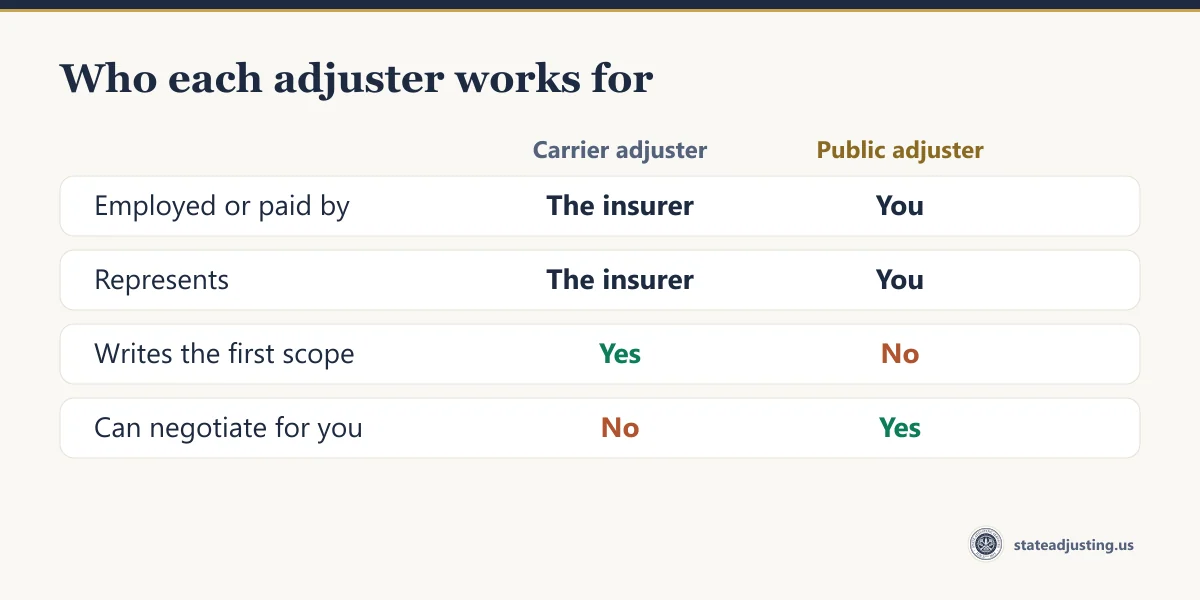
They are doing it for their employer. Staff adjusters are employed by the carrier, and "independent" adjusters are independent contractors hired and paid by the carrier — independent of its payroll, not of its interests. Both may be perfectly decent people. Both are working within settlement guidelines written by the company paying them.
That is not a conspiracy; it is simply how the arrangement is built. The imbalance it creates is that every professional in the room is working the claim except the one person whose money it is. A public adjuster is the licensed equivalent on your side of the table.
Who pays a public adjuster?
You do — out of the settlement, not out of pocket. Public adjusters in Illinois work on a contingency: an agreed percentage of what the claim actually recovers, set out in a written contract before any work starts, in a profession regulated by the Illinois Department of Insurance. If nothing is recovered, nothing is owed.
That structure is worth understanding, because it decides the incentives. A contingency fee means the adjuster earns only when you do, which aligns the two of you — but it also means a small, straightforward claim may not justify anyone's involvement. Which brings us to the honest part.
When is hiring a public adjuster not worth it?
Often enough that any firm which tells you otherwise is selling. Consider handling it yourself when:
| Situation | Why you probably don’t need help |
|---|---|
| The damage is clearly under, or barely over, your deductible | There may be no recovery to share, and filing can be the wrong move entirely |
| One simple, undisputed item — a single window, a fence panel | Scope is obvious; there is little to argue about |
| The carrier’s estimate already matches real local repair quotes | The claim is being paid correctly. Take it. |
| The loss is plainly excluded by your policy | No representation changes an exclusion. Check first, then decide. |
Representation earns its keep when a claim has scope to argue about: multiple building systems, hidden or disputed damage, matching questions, a denial you believe is wrong, a settlement that will not cover real quotes, or a fire or water loss where contents and living expenses run alongside the structure. Those claims are complicated enough that the difference between a documented and an undocumented file is measurable.
There is one frequently quoted number in this field worth citing carefully: a 2010 study by Florida's state watchdog, OPPAGA, found that hurricane claims settled with a public adjuster involved recovered substantially more than those without. It is one state, one catastrophe type, sixteen years ago — a signal, not a promise. Anyone quoting it as a guarantee for your claim is overselling it.
How do I check that an adjuster is legitimate?
Three checks, none of which takes long.
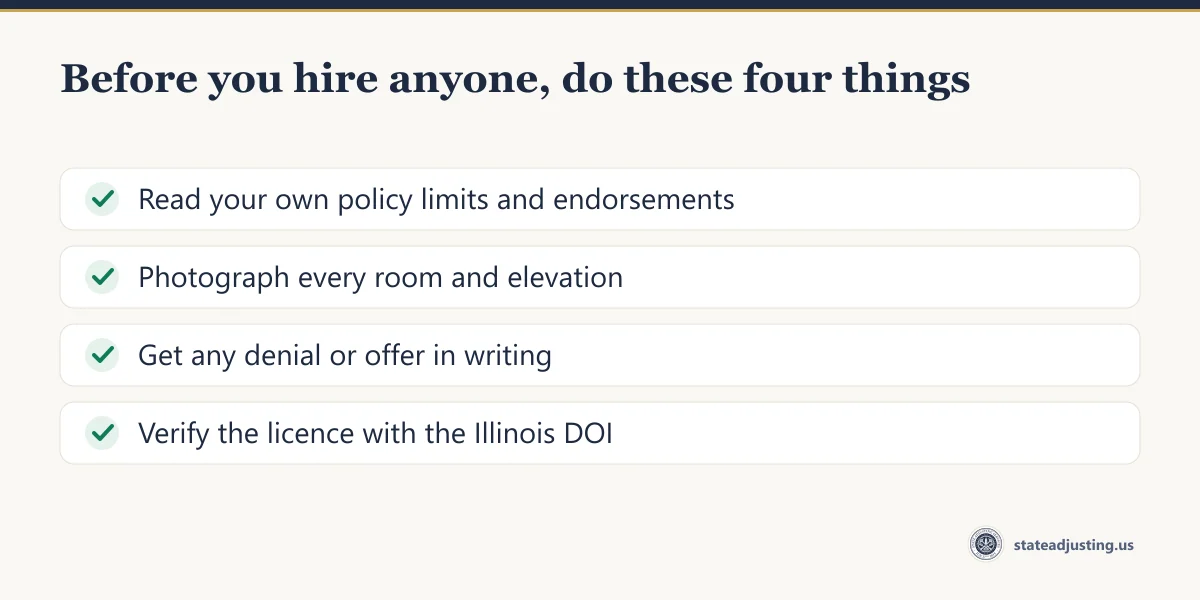
- Verify the licence. Public adjusters in Illinois must be licensed by the Illinois Department of Insurance, and you can confirm any licence directly with the Department. Ask for the number; a legitimate adjuster will give it without hesitating.
- Read the contract before signing. The fee, the scope of the engagement and how you can cancel should all be in writing, in plain language.
- Be careful with the contractor who offers to "handle the insurance." In Illinois, negotiating a claim on your behalf is reserved for licensed public adjusters and attorneys. A roofer offering to argue your claim is either overstepping that line or planning to build to whatever the carrier approves. That separation is exactly why we handle claims and our construction partner handles the building.
What to do next
If the damage has already happened: make the property safe, prevent further damage, photograph everything before anything is cleaned up, and keep every receipt. Then, before you give a recorded statement, get a straight read on what your policy owes you.
That read is what our free claim review is — we look at the policy and the damage and tell you where you stand, including when the answer is that you do not need us. If you want the detail first, our six-step process lays out exactly what happens on a claim we take on, the claim types pages cover what carriers typically miss on each kind of loss, and what clients say is published in full.
One thing worth repeating: nothing on this page is legal advice, and no honest adjuster can promise you an outcome. Claims turn on your policy, your damage and your carrier. What representation changes is whether anyone is arguing your side of it.
Questions we get about this
Is a public adjuster the same as the adjuster my insurance company sends?
No, and it is the most important distinction in a claim. The adjuster your insurer sends is employed or hired by the insurer and works within its settlement guidelines. A public adjuster is licensed to represent the policyholder only. Both are qualified professionals; they simply work for different people.
How much does a public adjuster cost in Illinois?
Public adjusters normally work on a contingency — an agreed percentage of what the claim recovers, written into a contract before any work begins, in a profession regulated by the Illinois Department of Insurance. There is no upfront cost, and if there is no recovery there is no fee. The exact percentage varies by claim and is always disclosed in writing first.
Can I hire a public adjuster after my claim has already been denied or paid?
Usually yes. A denial is not necessarily final and a closed claim can often be supplemented or reopened when new documentation, a re-inspection or an engineer's report supports it. Time limits in your policy and in Illinois law do apply, so the sooner it is reviewed the better.
Will hiring a public adjuster slow my claim down?
It should not. Complete documentation submitted once usually moves faster than a claim that is re-inspected repeatedly because information was missing. What does take time is a genuinely disputed claim — but that time is spent arguing over the amount rather than waiting on paperwork.