The Water Backup Endorsement: How the Limit Gets Chosen and Why It Runs Out
The water backup endorsement pays for water that comes up through a drain, sewer or sump, but only up to a limit you chose when you bought it. That limit is usually a single pot shared by the building repair, the cleanup and your belongings. On a finished basement, sewage cleanup and contents alone can use most of a small limit before anything is rebuilt.
The water backup endorsement is the coverage most Illinois basement claims depend on, and its limit is the number most homeowners learn about on the day it runs out. Nothing in the claim is denied. The carrier accepts the loss, applies the endorsement and pays the full limit, and the homeowner is still left with most of the bill. That outcome was decided at the time the limit was picked, often years earlier and often by default.
This guide explains how the limit works, what draws it down, how the deductible interacts with it, and how to size it before you need it. Our earlier guide on sewer backup vs flood covers the separate question of which coverage applies to which water. We are licensed Illinois public adjusters, not attorneys. Endorsement wording differs between carriers and editions, and your own policy governs.
What does the water backup endorsement actually cover?
It covers direct physical damage caused by water that backs up through sewers or drains, or overflows from a sump, sump pump or related equipment. A standard homeowners policy excludes that water entirely. The endorsement gives it back, up to its own limit, which is separate from and much lower than your dwelling limit.
Three things sit outside it. Flood, meaning surface water arriving over the ground, stays excluded and belongs to a flood policy. A pipe, hose or appliance that fails inside the house is ordinary water damage under the main policy at full limits, not backup at all. And the endorsement does not pay to fix whatever caused the backup: a clogged lateral, a tree root in the line or a worn-out sump pump is maintenance.
Read the endorsement itself for two wording points. First, whether sump overflow is named alongside sewer and drain backup, since some older or carrier-specific wordings treat it separately. Second, how it treats a sump that stopped because the power went out. Many homeowners policies exclude loss from a power failure that happens away from the premises, and endorsements handle that differently. A sump that fails during a storm-driven outage is one of the most common basement losses there is, so this is the sentence to find before the season starts.
How is the water backup limit chosen?
You or your agent pick it from a menu of fixed steps the carrier offers, often starting around $5,000 and rising in increments. Some carriers offer $25,000 or more; some cap lower. The step is printed on the declarations page or the endorsement schedule. If nobody asked you, the policy probably carries the lowest step.
The limit is not calculated from your house. Your dwelling limit is supposed to track the cost to rebuild; the backup limit tracks nothing unless someone sizes it. That is how a house with a fully finished basement, a second family room and a home office below grade ends up with the same backup limit as a house with a bare concrete floor and a furnace.
Carriers commonly limit when the endorsement can be added or raised: some will not change it once a storm is forecast or while a claim is open, and a new or higher limit applies only to losses after it takes effect. Raising it is a renewal-time decision in practice, and the premium difference between steps is a quote question for your agent, one step at a time.
Why does the limit run out so fast?
Because one limit usually covers several kinds of cost that arrive together. Sewage cleanup, removal of wet drywall and flooring, the rebuild, the mechanical equipment and the belongings stored below grade all draw from the same pot. On a finished basement, each of those can run into thousands of dollars on its own.
Backup water from a sewer is treated as contaminated. The restoration industry's water damage standard (IICRC S500) classes sewage as Category 3, and porous materials it touches, such as carpet, pad, drywall and insulation, are normally removed and discarded rather than dried. So the cleanup is not just fans and a dehumidifier. It is demolition, disposal, cleaning and antimicrobial treatment, and it is usually the first invoice, arriving within days, before a rebuild estimate even exists.
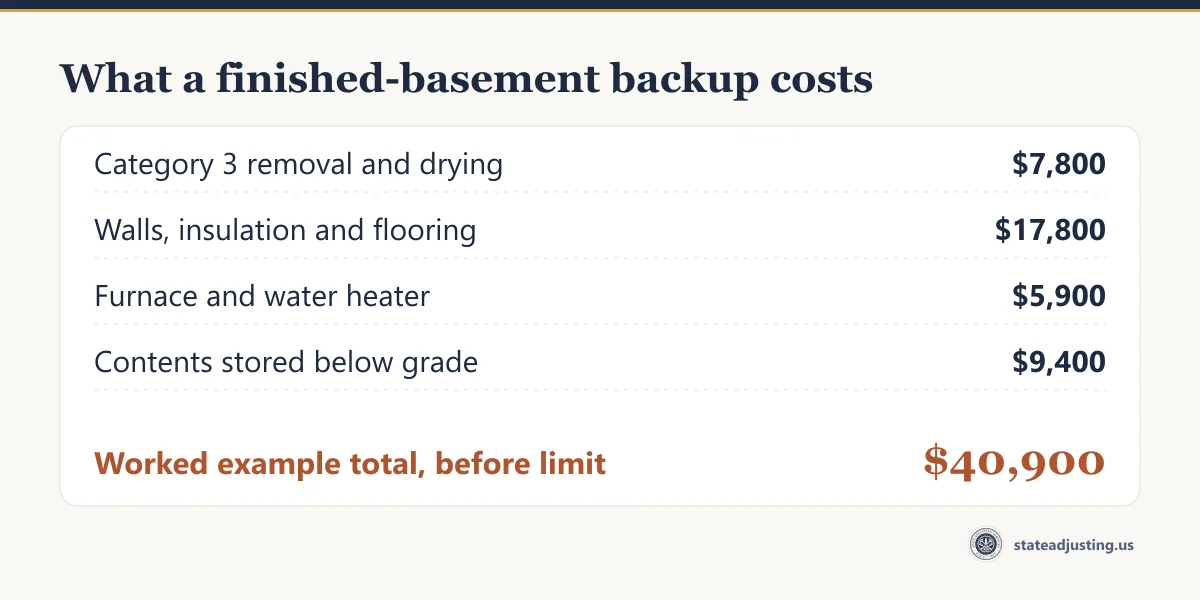
The figures below are an illustrative example, not a result from any client. A finished basement takes a sewer backup during a heavy rain. The endorsement has a $1,000 deductible.
| Part of the loss | Cost | What drives it |
|---|---|---|
| Category 3 removal and drying | $7,800 | Carpet, pad and lower drywall removed, cleaning, antimicrobial, equipment days |
| Walls, insulation and flooring | $17,800 | Rebuilding the finished space that was torn out |
| Furnace and water heater | $5,900 | Equipment that sat in contaminated water |
| Contents stored below grade | $9,400 | Furniture, electronics, tools and seasonal storage |
| Total | $40,900 |
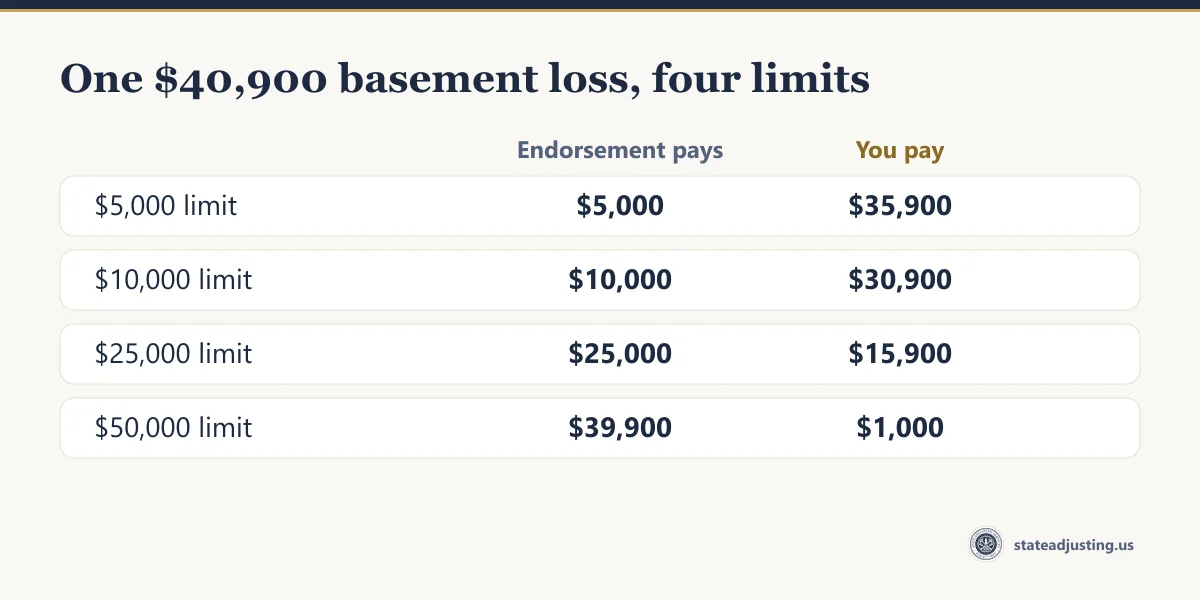
At a $5,000 limit the endorsement pays $5,000, and the cleanup invoice alone exceeds it. At $10,000 it pays $10,000 and leaves $30,900 with the homeowner. At $25,000 it leaves $15,900. At $50,000 it pays $39,900 and the homeowner carries only the deductible. The loss, the cause and the claim handling are identical in all four; only the number chosen at purchase changes.
How does the deductible interact with the limit?
It depends on the endorsement's wording, and on a large loss the difference is real money. Many wordings take the deductible off the loss first and then apply the limit. Others effectively take it out of the limit. Some endorsements also carry their own backup deductible, separate from and sometimes higher than the policy deductible.
| Scenario | Deductible taken from the loss | Deductible taken from the limit |
|---|---|---|
| $40,900 loss, $10,000 limit, $1,000 deductible | $10,000 paid | $9,000 paid |
| $6,000 loss, $10,000 limit, $1,000 deductible | $5,000 paid | $5,000 paid |
On a small loss the two readings produce the same cheque. On a loss well above the limit, the first reading means the deductible costs you nothing extra, because the limit is reached either way. If the payment you receive is the limit minus the deductible, ask the carrier in writing which sentence of the endorsement produced that calculation.
Depreciation works in a similar way. When the loss is far above the limit, even the actual cash value (what the damaged items are worth today, after depreciation) may exceed it. In our example, if $8,200 of the $40,900 were withheld as depreciation, the $32,700 actual cash value less the $1,000 deductible would still be over a $10,000 limit. Ask whether the full limit is payable now rather than split into a first payment and a later depreciation release that could never go above the limit anyway.
What should not be charged against the backup limit?
Anything caused by something other than the backup. When a basement takes water from more than one source, or a loss sits across more than one coverage, every dollar moved onto the backup endorsement is a dollar that would otherwise have been paid at your full policy limits. The allocation is where a capped claim is often improved.
- A separate supply-line or appliance failure. A washing machine hose or water heater that failed on its own is ordinary water damage under the main policy, even if it happened the same night as a backup.
- Damage from a wind-created opening. Rain that came through a storm-damaged roof or window belongs to the dwelling coverage, not the backup pot.
- Rooms the backup water never reached. Check that the scope charged to the endorsement matches where the water line actually was, from photographs taken before cleanup.
- Coverages the endorsement does not name. Read which coverages the limit applies to. Some wordings cap building and contents together; whether loss of use or debris removal also draws from the same pot depends on the text.
- Mould. Mould is commonly under its own separate sublimit; see our guide to mould after a water loss for how that allocation fight works.
If a municipal sewer main surcharged and caused the backup, whether the municipality is responsible is a legal question for an attorney, not something we can advise on. Be aware that under the Illinois Local Governmental and Governmental Employees Tort Immunity Act (745 ILCS 10/8-101), civil actions against a local public entity generally must be commenced within one year, so that conversation should not wait for the insurance claim to finish.
How much water backup coverage do you need?
Enough to cover what would be torn out, rebuilt and replaced below grade. Walk the basement and price it as a loss: finished walls and flooring, mechanical equipment, and everything stored there. Then choose the step that covers that total, and weigh the premium for each step against what you would pay yourself.
- Finished space: square footage of finished walls, ceilings and flooring, and any bathroom, kitchenette or built-ins.
- Mechanicals: furnace, water heater, water softener, laundry, electrical panel, anything sitting at floor level.
- Contents: furniture, electronics, tools, freezers, seasonal and archived storage. Basements hold the items nobody itemises.
- Cleanup: assume sewage cleanup and tear-out of lower walls and all soft flooring, not drying alone.
- History: a previous backup on the street, an older combined sewer system, a sump pump without battery backup, or no backwater valve all raise the odds.
- Renovations: finishing a basement is a reason to call the agent the same month, the same way you would report an addition.
A contractor's rough rebuild figure for the finished space is a better starting point than a guess. Prevention also matters: a backwater valve or a battery backup sump reduces how often you rely on the limit, though neither changes the limit itself, and some carriers ask about them when quoting.
What to do next
Before the next heavy rain, find the water backup line on your declarations page and write down three things: the limit, the deductible that applies to it, and whether sump overflow is named. Then compare the limit against what is actually in your basement. If the loss has already happened, photograph the water line and the failed sump or drain before anything is removed, and read the endorsement before discussing numbers.
If your backup claim has been paid at the limit, it is still worth checking that everything charged to it belongs there. Our pages on flood and sewer backup claims and water damage claims explain how we separate the sources, and our process shows how a claim runs with us involved. For a free claim review, contact us. We work on a percentage of the recovery, agreed in writing and regulated by Illinois law, with nothing paid upfront. Our office hours are Monday through Friday, 7:00 AM to 7:00 PM, and Saturday and Sunday, 9:00 AM to 5:00 PM.
Questions we get about this
What is the usual limit on a water backup endorsement?
There is no single standard amount. Carriers offer fixed steps, often starting around $5,000 and rising in increments, with some offering $25,000 or more. The limit you carry is printed on your declarations page or endorsement schedule. If nobody discussed it with you, the policy may carry the lowest step available.
Does the water backup limit cover both the house and my belongings?
Often, yes: many endorsements apply one limit to building damage, cleanup and contents from the same backup together. Some wordings differ on whether loss of use or debris removal also draws from that limit. Read which coverages your endorsement names, because your own policy governs.
Can I raise my sewer backup coverage after a storm?
A higher limit applies only to losses that happen after it takes effect, so it cannot help with damage that has already occurred. Carriers also commonly restrict changes when a storm is forecast or while a claim is open. Review the limit with your agent at renewal, before the wet season.
My backup claim was paid at the limit. Is there anything left to check?
Yes. Check that every cost charged against the backup limit was actually caused by the backup. Damage from a separate pipe or appliance failure, or from rain through a storm-damaged roof, belongs to the main policy at full limits. Also ask how the deductible was applied and whether the full limit is payable now.