Earth Movement, Settlement and Cracked Foundations: What the Policy Excludes

A cracked foundation is one of the most common reasons a homeowner calls a carrier and one of the most common reasons a claim comes back denied. The widely used homeowners form carries an earth movement exclusion and a separate settlement exclusion, and between them they remove most foundation damage from the policy. Most, not all. Several routes still pay for damage that shows up as a crack, and the denial letter does not always say which exclusion it relies on.
This guide sets out what each exclusion removes, the specific situations where foundation-related damage can still be paid, how the cause gets established, and what to do before anything is patched. We are licensed Illinois public adjusters, not attorneys. Forms differ between carriers and editions, and your own policy governs.
Why is foundation damage usually excluded?
Because the policy insures sudden, accidental physical loss, and the forces that crack most foundations are gradual or come from the ground itself. The form excludes earth movement in its general exclusions, and separately excludes settling, shrinking, bulging and expansion of foundations, footings, walls, floors and slabs. A third exclusion removes water below the surface of the ground.
The three exclusions are worded differently, and the differences matter later in the claim:
| Exclusion | What it names | What it gives back |
|---|---|---|
| Earth movement | Earthquake, landslide, mudflow, subsidence, sinkhole and any other earth sinking, rising or shifting. Recent editions add that it applies whether the movement was caused by nature or by people. | Direct loss by fire or explosion that follows the movement. Nothing else. |
| Settling, shrinking, bulging or expansion | Settlement of the building itself, including the cracking it causes in foundations, footings, walls, floors, roofs, ceilings, patios and pavements. | Ensuing loss not otherwise excluded, plus an exception for accidental discharge from a plumbing, heating or air conditioning system, including tear-out to reach it. |
| Water below the surface | Groundwater, including water that presses on, seeps through or flows through a foundation, slab, driveway or patio. | Fire, explosion or theft that follows. Nothing else. |
The earth movement and groundwater exclusions sit in the general exclusions, which the form introduces with language applying them regardless of any other cause contributing at the same time or in any sequence. The settlement exclusion sits in a different list, where ensuing loss is given back. A letter that says only "settlement" and a letter that says "earth movement" are describing two different results.
Which foundation-related damage can still be paid?
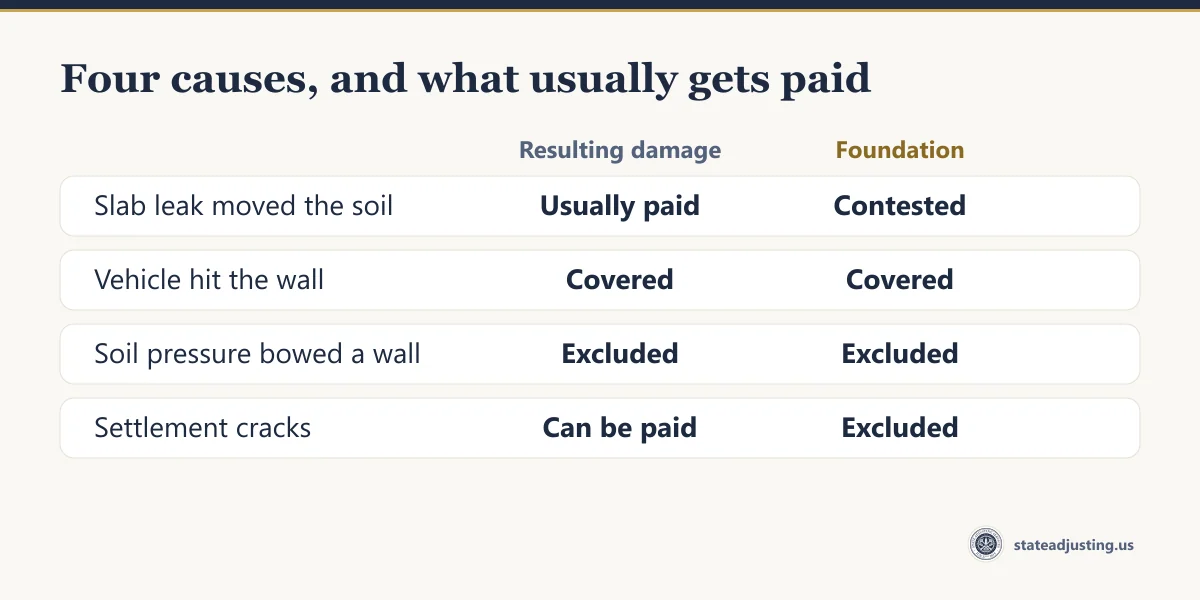
Damage caused by a covered peril, even when it shows up in or near a foundation. The common routes are an accidental discharge from plumbing, a collapse under the policy's additional coverage, fire or explosion following earth movement, and impact by a vehicle or a falling tree. Each has its own conditions, and the crack itself is rarely what gets paid.
An accidental discharge of water
A supply line or drain that fails under a slab or inside a wall is the route that comes up most. The policy's exception to the settlement exclusion gives back loss caused by accidental discharge from a plumbing, heating or air conditioning system, and it pays to tear out and replace part of the building where that is necessary to repair the system. The failed pipe itself is normally not covered, and water that ran for weeks can fall under the separate continuous-seepage exclusion. Our guide to sudden versus gradual water damage covers that second argument.
Collapse
The collapse additional coverage pays for an abrupt falling down or caving in of a building or part of one, caused by a short list of causes such as hidden decay, hidden insect damage or a covered peril. The same provision states that settling, cracking, shrinking, bulging or expansion is not collapse, and that a building merely in danger of falling down has not collapsed. A bowed basement wall still standing does not qualify.
Fire, explosion and impact
Fire or explosion that follows earth movement is covered. A car driven into the house or a tree falling on it is a covered peril, and the cracking it causes in the foundation wall is part of that loss rather than settlement. Photographs of the impact and the date it happened decide these claims.
Is earthquake or mine subsidence covered in Illinois?
Not by the standard homeowners form, which excludes both as earth movement. Earthquake can be added by endorsement. Mine subsidence is handled by a separate statutory program under Article XXXVIII of the Illinois Insurance Code, and in counties with a history of underground mining it is included in residential policies automatically.
Illinois sits near two active seismic zones: the New Madrid zone to the south and the Wabash Valley zone along the Indiana border. An earthquake endorsement adds the peril back, usually with a deductible written as a percentage of the limit rather than a flat amount, and some editions exclude exterior masonry veneer unless the declarations show it covered. The endorsement has to be in force before the shaking; it cannot be added afterwards.
Mine subsidence coverage pays for ground movement caused by the collapse of an underground mine, through the Illinois Mine Subsidence Insurance Fund. Elsewhere in the state it is optional. Look for a separate mine subsidence line on the declarations page; if a home in a former mining area shows none, ask the agent in writing whether it was declined or never offered.
How does a carrier decide what caused the crack?
Usually through an engineer it retains, who examines the crack pattern, the soil and drainage around the house, the plumbing and the age of the damage. The report is an opinion about cause, not a coverage decision, and it is only as strong as what the engineer actually looked at. Crack patterns point toward causes; they do not prove them.
| What you see | What it often indicates | Where it usually lands |
|---|---|---|
| Hairline vertical crack in a poured wall, unchanged for years | Concrete shrinkage during curing | Excluded as shrinkage; usually not structural |
| Stair-step crack along mortar joints in a block wall | Differential settlement of the footing | Settlement exclusion; ensuing loss may be payable |
| Horizontal crack with the wall bowing inward | Lateral soil or water pressure from outside | Groundwater and earth movement exclusions |
| New floor cracks, a warm spot or a jump in the water bill | A leak under the slab washing out soil | Contested: accidental discharge against earth movement |
| Fresh crack at a scraped or dented exterior wall | Impact by a vehicle or falling object | Covered peril, if the impact is documented |
The engineer's report has its own limits: which walls were examined, whether the slab was opened, whether a plumber's pressure test was reviewed. Our guide to reading the carrier's engineering report walks through how to check each one.
What happens when a leak under the slab moved the soil?
This is the hardest version of the claim, because two parts of the policy point in opposite directions. The accidental discharge exception gives back water damage and tear-out. The earth movement exclusion, applied regardless of cause, removes the ground movement the water produced. Most carriers pay the water side and exclude the foundation side.
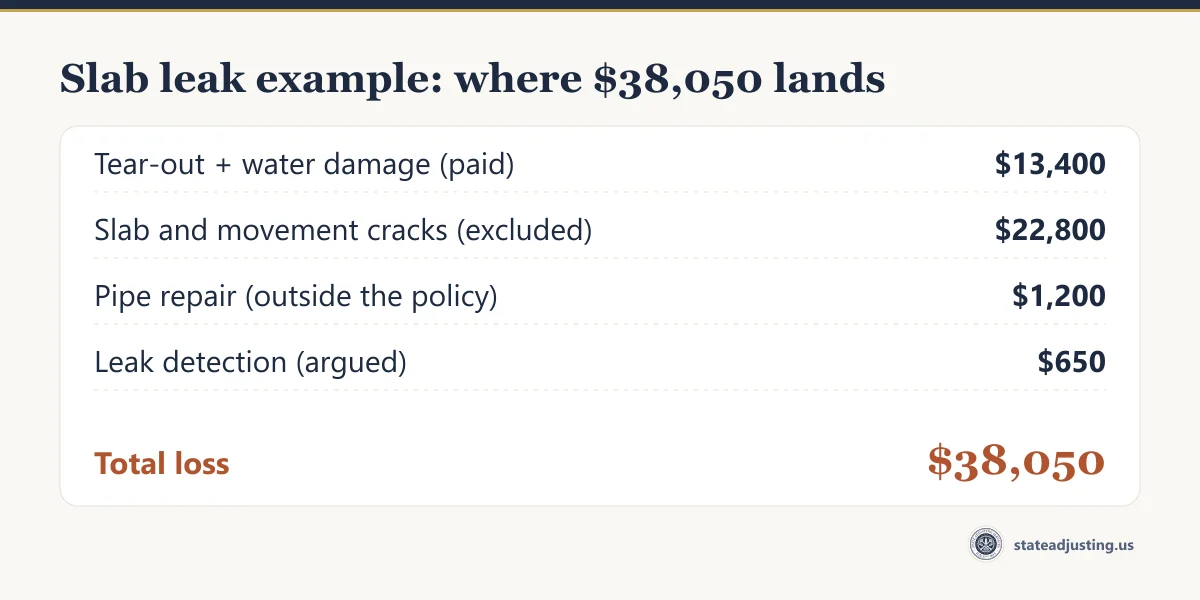
The figures below are an illustrative example, not a result from any client. A slab-on-grade ranch shows new floor cracks and a doubled water bill. A plumber finds a failed supply line under the slab. The policy has a $1,000 deductible; depreciation is left out to keep the arithmetic readable.
| Item | Cost | How it is usually treated |
|---|---|---|
| Leak detection | $650 | Argued: part of access, or a plumbing cost |
| Tear-out of the floor to reach the pipe | $3,800 | Paid under the accidental discharge exception |
| Pipe repair | $1,200 | Not paid: the failed system itself |
| Flooring, drywall and trim damaged by water | $9,600 | Paid, if the leak was not long-term seepage |
| Slab stabilization and leveling | $18,500 | Usually excluded as earth movement |
| Interior cracks from the movement | $4,300 | Usually excluded with the slab |
| Total | $38,050 |
Read the way most carriers read it, the claim pays $3,800 + $9,600 = $13,400, less the $1,000 deductible, for a $12,400 payment. The $1,200 pipe repair is outside the policy either way. The $22,800 of slab and movement damage is the disputed part, and whether water from a covered discharge can carry the foundation back into coverage depends on the exact wording and on how Illinois courts read it. That is a question for an attorney, not something we can advise on. What we can do is make sure the $13,400 side is complete and that the leak's duration is documented before the seepage argument starts.
What should you do before anything is patched?
Record the crack and its history before a contractor seals, injects or levels anything, because the repair erases the evidence of cause. Then find out whether water is involved, get the plumber's findings in writing, and read the denial letter for the exact exclusion named. Each step answers a different part of the carrier's analysis.
- Photograph and measure. Wide shots placing the crack on the wall, then close shots with a tape measure across its width. Note any doors or windows that started sticking.
- Date it. Older photographs, a home inspection report from purchase, or a dated crack gauge show whether the crack is new or has been there for years.
- Check the water. Pull twelve months of water bills. A sudden jump points to a supply leak; a gradual climb points to the seepage argument.
- Get the plumber's report in writing. What failed, where, the pressure-test result, and the photograph of the failed section. Keep the section itself.
- Report promptly. Notify the carrier once water or impact is suspected, not after the foundation contractor has finished.
- Read which exclusion is cited. Settlement, earth movement and groundwater lead to different results. Ask in writing for the provision relied on and for the complete engineering report.
- Use the right lever. Appraisal resolves disagreements about the amount, not about whether an exclusion applies. A coverage dispute over the foundation belongs with an attorney.
What to do next
If the crack came with water, the claim may have a payable side even when the foundation itself is excluded, and that side is often scoped short. Our page on water damage claims explains how we separate the sources, our process shows how a claim runs with us involved, and the FAQ answers the usual questions about fees and timing. For a free claim review, contact us. We work on a percentage of the recovery, agreed in writing and regulated by Illinois law, with nothing paid upfront. Our office hours are Monday through Friday, 7:00 AM to 7:00 PM, and Saturday and Sunday, 9:00 AM to 5:00 PM.
Questions we get about this
Does homeowners insurance cover a cracked foundation?
Usually not when the crack comes from settlement, shrinkage, soil pressure or other earth movement, which the widely used homeowners form excludes. Damage can still be paid when a covered peril caused it, such as a vehicle impact, an abrupt collapse under the collapse coverage, or water from a plumbing leak. Your own policy governs.
Is a slab leak that damaged my foundation covered?
The water side often is: the policy commonly pays for water damage from an accidental discharge and for tearing out the floor to reach the pipe, but not for the failed pipe. Foundation movement caused by the water is usually excluded as earth movement, and whether it can be covered is a legal question for an attorney.
Is earthquake damage covered in Illinois?
Not under the standard homeowners form, which excludes earthquake as earth movement. An earthquake endorsement can add it back, usually with a percentage deductible, and it must be in force before the earthquake. Mine subsidence is a separate statutory coverage in Illinois, automatic in some counties and optional in others.
Should I repair a foundation crack before the adjuster sees it?
Not before it is documented. Photograph and measure the crack, keep any failed pipe, and get the plumber's findings in writing first, because sealing or leveling removes the evidence of cause. Emergency steps to stop active water are a separate duty and should be done and photographed right away.