Contents Depreciation: How Used Household Goods Are Valued and What Moves the Number

On a contents claim, each item is usually valued at what a comparable new item costs today, then reduced for age and condition. Four inputs decide the result: the replacement price, the age, the useful life the carrier assigns, and the condition. Each one is a fact that records can support or correct, and none of them is fixed by law.
Contents depreciation is the line on a personal property claim that most homeowners see once, in a spreadsheet of several hundred rows, and never question. After a fire, a burst pipe or a break-in, the carrier prices every damaged item and then takes a percentage off for wear. The percentage looks technical. It is built from four ordinary facts, and a wrong fact in any one of them moves the check.
This guide explains how used household goods are valued, where the numbers come from, which of them you can correct and with what, and how the replacement cost endorsement changes what you are eventually paid. We are licensed Illinois public adjusters, not attorneys. Nothing here is legal advice, and your own policy governs your claim.
How does an insurance company depreciate household contents?
Most carriers use straight-line depreciation. They price a comparable new item, divide the item's age by the useful life they assign to its category, and deduct that share of the price. A sofa priced at $2,400, four years old, with a ten-year life, loses 40%, or $960, leaving an actual cash value of $1,440.
Actual cash value (ACV) is what the item is worth today, after depreciation. The widely used homeowners form does not define it; carriers commonly calculate it as replacement cost less depreciation, and that is the method you will see on most contents worksheets. The useful-life figures come from depreciation tables that carriers and estimating vendors maintain. They are a reference, not a statute: different tables give the same item different lives, and a table is only as good as the category it is applied to.
Condition is the fourth input and the least visible. A carrier may add depreciation for an item described as worn, or apply the table unadjusted. A well-kept item can be argued down the other way, but only with evidence of its condition before the loss: photographs, a walk-through video, a service record.
| Input | Where the carrier gets it | How it goes wrong | What corrects it |
|---|---|---|---|
| Replacement price | A pricing search for a comparable new item | A cheaper item of lower quality substituted as "comparable" | Brand, model, material and size from receipts, photos or labels, and a current listing for the matching item |
| Age | Your inventory, or an estimate when you gave none | A default age applied to every item with no date | Receipts, card statements, order history, delivery records, dated photos |
| Useful life | A depreciation table category | The item placed in a shorter-lived category than it belongs in | Asking which category and table were used, and showing what the item actually is |
| Condition | The adjuster's notes, or none | Extra wear taken without anything showing it | Pre-loss photos and video showing the item's actual state |
What does "like kind and quality" mean for the replacement price?
It means the replacement price should be for an item of the same type, quality and function as the one lost, bought new today. A solid-wood dining set is priced against solid wood, not veneer. A discontinued television is priced against the current model that does the same job, not a smaller or lower-grade one.
Price is the input people check least, because the worksheet shows only a description and a number. Read the description. Pricing tools match on keywords, and "sofa, three-seat" returns the cheapest three-seat sofa as readily as the one you owned. The fix is specific information: brand, model number, material, dimensions, the store it came from. A photo of the manufacturer's label or a screenshot of the original order does more than a paragraph of explanation.
Two smaller points belong here. Check whether sales tax is included in the replacement price on each line, because the replacement you buy will be taxed. And note that obsolete items are not priced at their original cost: an older laptop is replaced by a current laptop of comparable capability, which may cost less than you paid. That is ordinary like-kind pricing, not a reduction to dispute.
Why does the age of an item matter so much?
Because age is the numerator of the depreciation fraction. On a ten-year life, every extra year assigned to an item takes another 10% of its price. When the inventory gives no date, the carrier has to estimate one, and an estimate made across hundreds of undated lines tends to run older than the truth.
Most people do not have receipts for household goods, and the carrier does not require them for every line. You can still date items from records you already have: card and bank statements, online order histories, store loyalty accounts, delivery and warranty registrations, and the timestamps on family photos in which the item appears. An approximate date supported by one record is usually worth more than a precise date supported by memory. Our guide to building a contents inventory after a fire covers how to rebuild the list itself from those same records.
How is the useful life of an item chosen?
From the category the item is placed in on the carrier's depreciation table. Furniture, electronics, clothing, appliances and linens each carry different lives, and many tables split them further, by material or by grade. The same dining table can carry a ten-year life in one category and a twenty-year life in another.
You are entitled to understand how a number on your own claim was calculated. Ask in writing which table and which category were used for the items you question. When the category does not describe the item — solid hardwood furniture placed with general furniture, a commercial-grade appliance placed with the lightest-duty version — say what the item actually is and show it. Some carriers also apply a maximum percentage an item can be depreciated under their own guidelines; ask whether one applies, rather than assuming it does or does not.
A worked example: six items, two passes
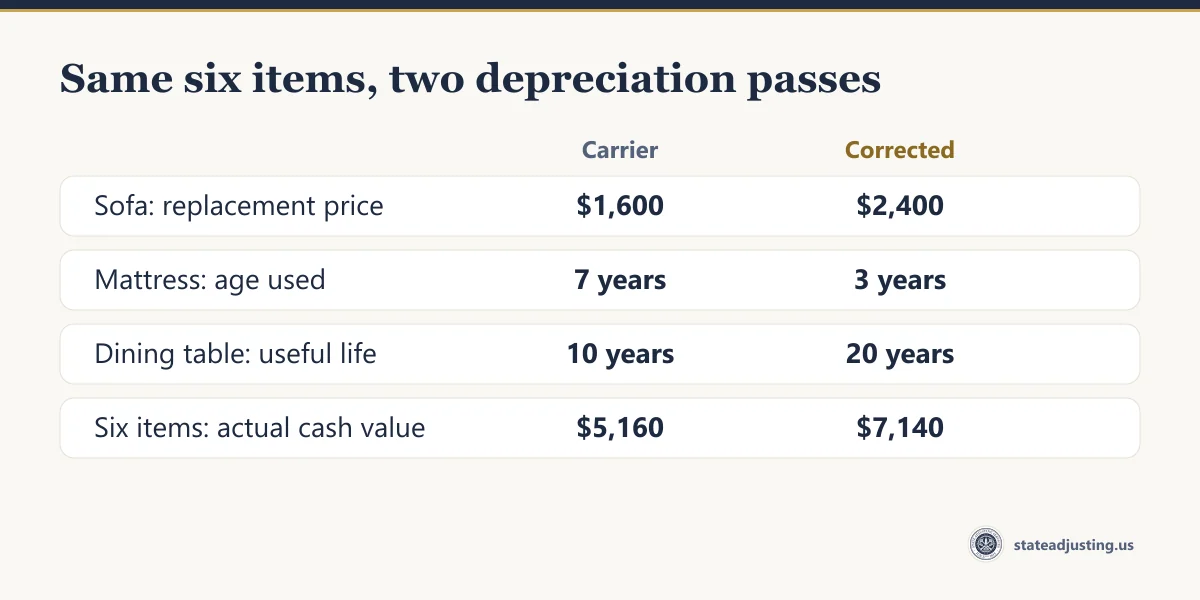
The figures below are an illustrative example, not a result from any client. Six items from one room, all damaged in the same loss. The carrier's first pass priced the sofa against a cheaper model, assumed an age of seven years for a mattress with no date on the inventory, and placed a solid hardwood dining table in a ten-year furniture category.
| Item | Carrier: price / age / life | Carrier ACV | Corrected: price / age / life | Corrected ACV |
|---|---|---|---|---|
| Sofa | $1,600 / 4 / 10 | $960 | $2,400 / 4 / 10 | $1,440 |
| Mattress and box spring | $1,500 / 7 / 10 | $450 | $1,500 / 3 / 10 | $1,050 |
| Television | $1,000 / 2 / 8 | $750 | $1,000 / 2 / 8 | $750 |
| Dining table and chairs | $3,000 / 6 / 10 | $1,200 | $3,000 / 6 / 20 | $2,100 |
| Winter coats | $1,200 / 2 / 5 | $720 | $1,200 / 2 / 5 | $720 |
| Refrigerator (freestanding) | $1,800 / 6 / 15 | $1,080 | $1,800 / 6 / 15 | $1,080 |
| Total | RCV $10,100, depreciation $4,940 | $5,160 | RCV $10,900, depreciation $3,760 | $7,140 |
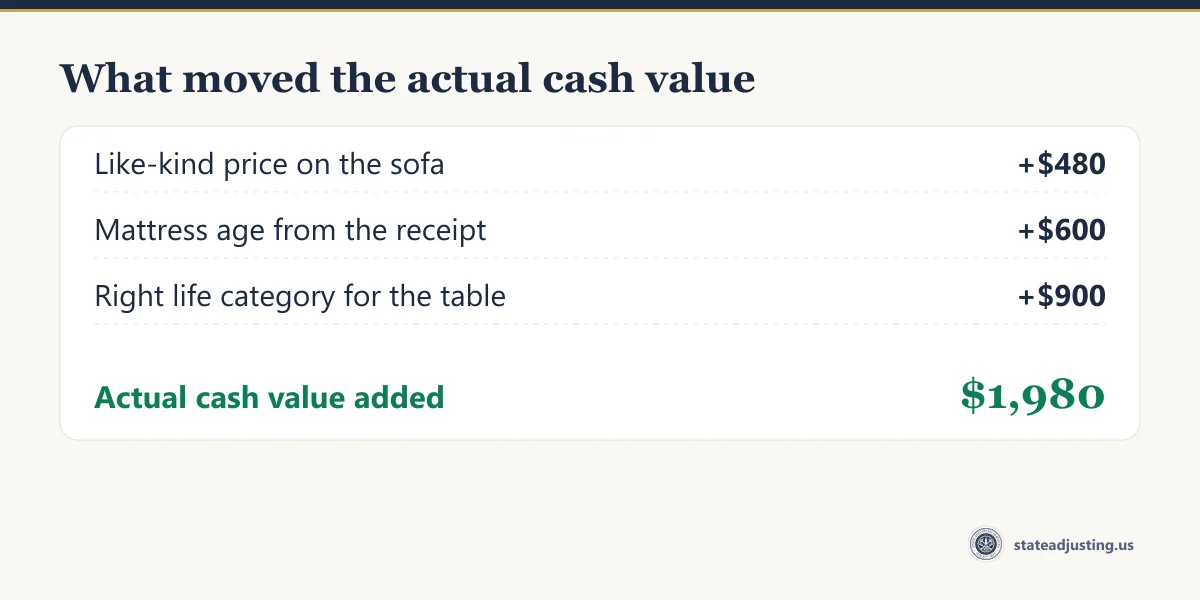
Three corrections, each supported by a record, added $1,980 of actual cash value: the like-kind price on the sofa added $480, the mattress receipt showing three years instead of seven added $600, and the right life category for the table added $900. Three of the six lines did not change at all, which is normal. Nothing was denied in either pass. The deductible is left out because in a real claim it is taken once across the whole occurrence, not item by item.
Do you get the depreciation back with replacement cost coverage?
Only if your policy covers personal property at replacement cost, and usually only after you replace the item. The widely used homeowners form values contents at actual cash value. Many policies add a personal property replacement cost endorsement, which pays the depreciation back once the item is actually repaired or replaced.
Check the declarations page or the endorsement list for it. In the widely used endorsement, when the replacement cost for the entire loss exceeds $500, the carrier pays actual cash value first and the rest after replacement is complete. The same endorsement lets you settle at actual cash value first, provided you notify the carrier within 180 days after the loss that you intend to claim the additional replacement cost. Wording varies between carriers and editions, so find the deadline in your own endorsement, and if you need more time, ask in writing before it passes. Our guide to collecting recoverable depreciation walks through that second payment.
The endorsement does not reach everything. It commonly excludes antiques, fine art and similar articles that cannot be replaced, memorabilia, souvenirs and collector's items, articles not maintained in good or workable condition, and outdated or obsolete articles that were stored and not in use. Those items are settled on a value basis instead. Special limits for categories such as jewelry and firearms still apply either way.
This is why the corrections in the example matter twice. On an actual cash value policy, the $1,980 is the whole difference. On a replacement cost policy, the corrected pass also raises replacement cost by $800 and lowers the withheld depreciation from $4,940 to $3,760 — so more is paid now and less depends on receipts later.
How do you challenge contents depreciation on your claim?
Line by line, in writing, with a record attached to each change. A general objection that the depreciation is too high rarely moves anything. A specific statement — this item is this model, bought on this date, and here is the order confirmation — gives the adjuster something they can approve.
- Get the full contents worksheet with price, age, life, depreciation percentage and source for every line, not just the totals.
- Sort by value. The ten or twenty most expensive lines usually carry most of the difference; start there.
- Check each description against what you owned: brand, model, material, size.
- Date the undated lines from statements, order histories and photos.
- Ask which table and category were used for any life that looks short.
- Send one organised response with the evidence attached per line, and keep a copy with the date sent.
- Keep damaged items until the carrier confirms it does not need them, and photograph anything before it is thrown away.
Illinois claim rules require a carrier to give a reasonable written explanation when it denies or reduces a claim, so ask for the basis of any line it will not change. If the disagreement is only about amount — prices, ages, lives — the appraisal clause may be an option; if it is about whether an item is covered at all, appraisal is the wrong tool.
What to do next
Before accepting a contents settlement, read the worksheet in the order above and correct what the records support. If the loss came from a fire, a burst pipe or a break-in, our pages on fire damage claims and vandalism and theft claims set out the rest of what those claims involve, and our process explains how we handle a contents schedule from start to finish.
If you would like a second set of eyes on a contents worksheet, contact us for a free claim review. We work on a percentage of the recovery set by written agreement and regulated by Illinois law, with nothing paid upfront. Our office hours are Monday through Friday, 7:00 AM to 7:00 PM, and Saturday and Sunday, 9:00 AM to 5:00 PM.
Questions we get about this
How much do insurance companies depreciate furniture and electronics?
There is no single percentage. Most carriers use straight-line depreciation: the item's age divided by the useful life assigned to its category on a depreciation table, applied to the price of a comparable new item. Electronics usually carry shorter lives than solid furniture, so they depreciate faster. The tables are carrier and vendor references, not law, and the category chosen can be questioned.
Can I dispute the depreciation on my contents claim?
Yes. Ask for the full contents worksheet showing price, age, useful life and depreciation for every line, then respond in writing line by line with a record attached to each correction: an order confirmation, a card statement, a photo of the label. Specific evidence on the highest-value lines moves the number far more than a general objection.
Do I get depreciation back on personal property?
Only if your policy includes replacement cost coverage for personal property, often added by endorsement. It then commonly pays actual cash value first and the withheld depreciation after the item is actually replaced. A policy that values contents at actual cash value does not pay depreciation back. Check your declarations page, because your own policy governs.
What if I do not have receipts for my belongings?
Most people do not, and receipts are not required for every line. Items can be dated and identified from bank and card statements, online order histories, loyalty accounts, warranty registrations and dated photos in which they appear. An approximate date backed by one record is usually more persuasive than a precise date from memory.