ACV vs. Replacement Cost: Why the First Check Is Smaller Than the Repair
Replacement cost value (RCV) pays what it actually costs to rebuild today. Actual cash value (ACV) pays RCV minus depreciation for the item's age and wear — a smaller number. Even on an RCV policy, the first check is usually paid on the ACV basis; the withheld difference, called recoverable depreciation, is only released after repairs are finished and documented.
A homeowner opens a settlement letter expecting a number close to the contractor's estimate, and finds a check for thousands less. That gap is not a mistake and it is not the carrier shorting the claim — it is actual cash value doing exactly what it is defined to do. Understanding replacement cost vs actual cash value before the first check arrives changes how you read every number that follows it.
What's the difference between ACV and replacement cost coverage?
Replacement cost value pays what it costs, at today's prices, to rebuild or replace the damaged item with similar materials — no deduction for age. Actual cash value pays that same replacement cost minus depreciation, a reduction tied to how old and worn the item already was. RCV is the larger number; ACV is RCV after subtracting years of use.
Most homeowners policies are written on an RCV basis for the dwelling, but that label describes the total you are entitled to, not the check you receive first. The settlement basis is set by the loss-settlement clause in your policy, and — as covered in our guide to reading your homeowners policy — it is worth confirming in writing rather than assuming from the word "replacement" in your policy's name.
Why is my first check smaller than what the repair actually costs?
Because on an RCV policy, the carrier typically pays in two steps. The first check is calculated on the ACV basis — replacement cost minus depreciation minus your deductible. The second check, the recoverable depreciation, is paid only after you complete the repair and show proof of the cost. The first check was never meant to cover the whole job by itself.
This two-step structure exists so the carrier is not paying full replacement cost on an item that never actually gets replaced. If a roof is damaged but the homeowner chooses to sell the house instead of repairing it, the depreciation holdback is not owed — the policy pays actual cash value for that decision, and full replacement cost only for the decision to rebuild. It is a reasonable mechanism. It is just rarely explained clearly in the settlement letter itself.
How does a carrier actually calculate depreciation on one item?
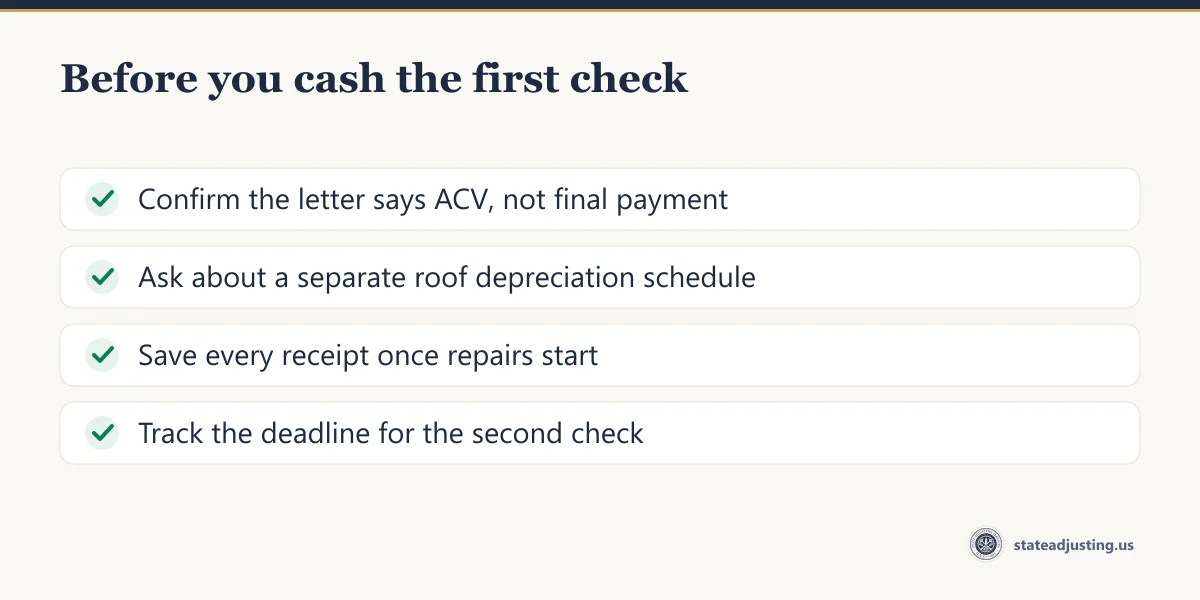
Depreciation is usually calculated from the item's age against an expected useful life, adjusted for its condition at the time of loss — a well-maintained 12-year-old roof and a neglected one do not depreciate identically, even at the same age. The formula is straightforward once you have the inputs; the disagreement is almost always over which inputs the carrier used.
Below is a worked example of the arithmetic on a single line item. The figures are illustrative only — an example of the math, not a quote, an offer, or a past settlement.
| Step | What it represents | Illustrative figure |
|---|---|---|
| Replacement cost (RCV) | What a new roof costs today, in similar materials | $14,000 |
| Depreciation | Age-and-condition reduction — a 12-year-old roof against, say, a 25-year expected life | −$5,600 |
| Deductible | Subtracted once, from the ACV figure | −$1,000 |
| First check (ACV) | What arrives before any repair happens | $7,400 |
The $6,600 gap between the first check and full replacement cost is not gone. On an RCV policy, it is recoverable — meaning it can be paid once the roof is actually replaced and the cost documented. The word "recoverable" is doing real work in that sentence; some depreciation, on some items or endorsements, is not recoverable at all, which is why the settlement letter's wording matters more than its total.
Is my roof covered on ACV or RCV — and why does hail change that?
Check the loss-settlement section for the roof specifically, separately from the rest of the dwelling. Because roofs are the most frequent and most expensive claim in a hail-prone state, some carriers write the roof on an ACV-only basis by endorsement — meaning there is no second check coming for the roof, even though the walls and interior may still be RCV.
This single endorsement can be the difference between a homeowner who is made whole after a hailstorm and one who is not, and it rarely gets read until after the loss. If your declarations page or endorsement schedule lists a "Roof ACV" or "Roof Surfacing" endorsement, that section of your home settles differently from the rest of the structure — full stop, regardless of what the dwelling's general settlement basis says.
| Replacement cost (RCV) | Actual cash value (ACV) | |
|---|---|---|
| What it pays | Full cost to rebuild with similar materials today | Replacement cost minus depreciation |
| When the full amount arrives | After repairs are completed and documented | All at once — there is no second check |
| Total received if fully repaired | Close to the full rebuild cost | Less than the rebuild cost, permanently |
| Common use | Dwelling on most standard policies | Personal property on many policies; roofs on some, by endorsement |
What is recoverable depreciation, and is it always available?
Recoverable depreciation is the withheld portion of an RCV settlement, released once you complete the repair and submit proof of the actual cost — typically a paid contractor invoice. It is only available on RCV policies to begin with, only for items actually repaired or replaced, and usually only within a window your policy sets, often one year from the date of loss.
Depreciation on personal property is frequently non-recoverable on cheaper policy forms, meaning the ACV check for a damaged couch or appliance is the only check coming, full stop. Whether depreciation on a given item is recoverable is stated in the policy, not decided case by case — read the settlement letter for the word "recoverable" against each line, not just the total.
What should I do if my ACV check feels too low?
Ask the carrier, in writing, for the depreciation worksheet behind the number — the age, useful life and condition figures it used for each item. A depreciation calculation built on the wrong age or an overstated wear factor is a documentation error, not an opinion, and it is fixable once you can see the inputs.
- Get the loss-settlement clause and any roof-specific endorsement in writing, not just a verbal summary
- Request the itemized depreciation worksheet, not just the total dollar figure
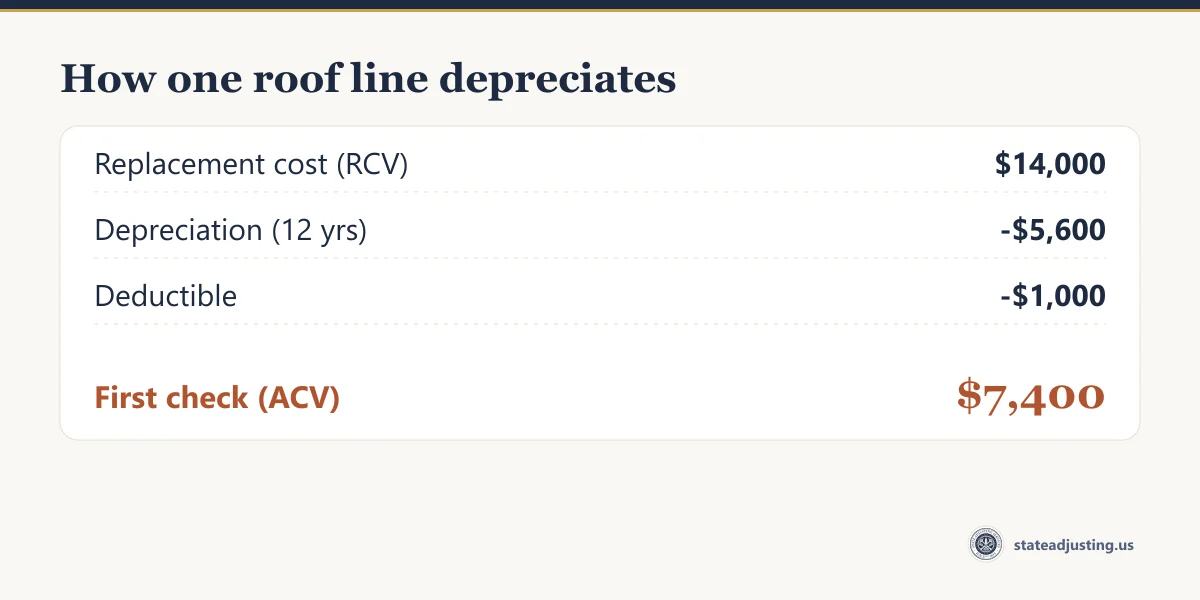
- Confirm, in writing, the exact deadline for submitting proof of completed repair
- Keep every contractor invoice and receipt — the second check is paid against documented cost, not an estimate
A settlement that does not match your policy's actual terms may depend on your specific policy and the extent of the damage — this is not legal advice, and if the disagreement is significant, a conversation with an attorney is worth having alongside any claim work.
What to do next
Pull your settlement letter and your policy's loss-settlement clause side by side. Confirm whether the check you received is labeled ACV or final, whether your roof carries its own depreciation schedule, and what deadline applies to recovering the rest. If a hail, storm or fire loss already has a settlement you're unsure about, our free claim review reads the numbers against your policy at no cost either way — our fee, when we're engaged, is a percentage of what we recover, agreed in writing, with $0 owed upfront. See our process for what that looks like, and our guide to hail damage claims for how ACV commonly plays out on a roof. If repair timing matters to your decision, our construction partner is covered in working with a contractor, always the homeowner's choice.
Questions we get about this
If my policy is replacement cost, why did I only get an ACV check?
Because most RCV policies pay in two steps. The first check is calculated on the ACV basis — replacement cost minus depreciation and your deductible. The second check, the withheld depreciation, is released only after you complete the repair and submit proof of the actual cost.
Is depreciation always recoverable?
No. Recoverable depreciation only applies on RCV policies, and only for items actually repaired or replaced within the deadline your policy sets, often around a year from the loss. On some policy forms, and on some ACV-endorsed items like certain roofs, depreciation is not recoverable at all — the first check is the only check.
How do I know if my roof is settled on ACV instead of RCV?
Check the loss-settlement section of your policy for the roof specifically, separate from the general dwelling clause, and check your endorsement schedule for a line like "Roof ACV" or "Roof Surfacing Schedule." Some carriers settle the roof on ACV even when the rest of the dwelling is RCV. If it isn't stated clearly, ask your carrier or agent to point to the exact clause in writing.
What documentation do I need to collect the recoverable depreciation?
Typically a paid contractor invoice or receipt showing the actual cost of the completed repair, submitted before your policy's deadline. Keep every receipt from the day repairs start, and confirm the submission deadline in writing rather than assuming a standard one-year window applies to your specific policy.