How to Read Your Homeowners Policy: The Six Lines That Decide Your Claim

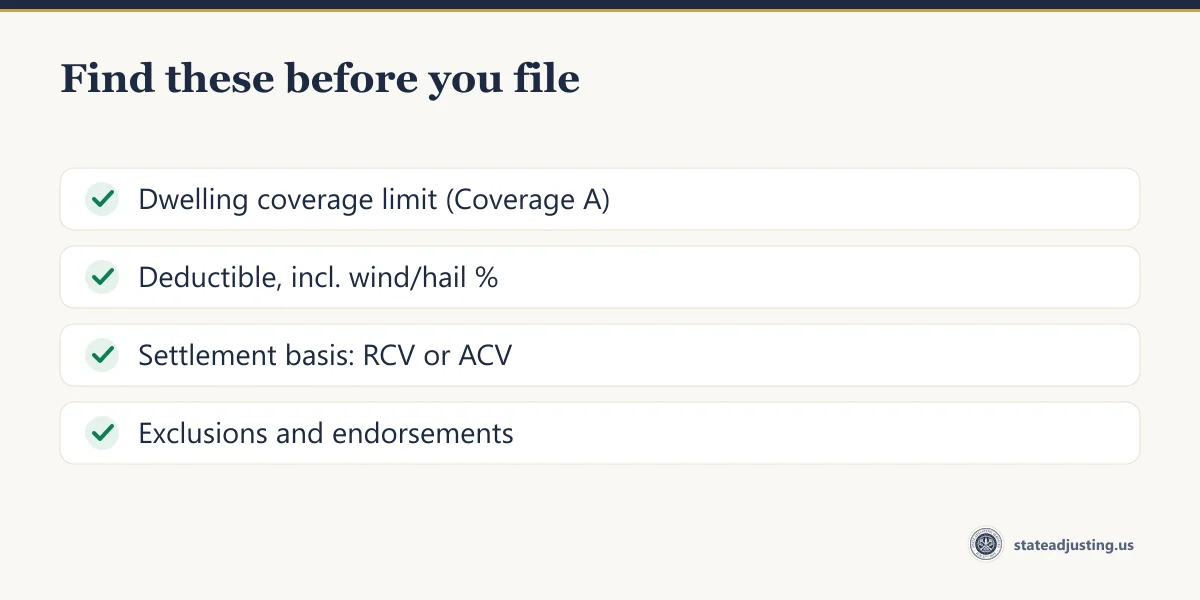
Six lines on your homeowners policy decide what a claim pays: the dwelling coverage limit, the deductible (including any separate wind or hail percentage), the settlement basis — replacement cost or actual cash value — the exclusions, the endorsements attached to your base form, and ordinance-or-law coverage. Read all six before you file, not after.
Most people open a homeowners policy for the first time after something is already leaking, burning or dented by hail. That is the worst time to be reading it. The declarations page, the exclusions and the endorsements attached to your policy decide, line by line, whether a loss is covered, how much you're paid, and whether that payment covers an actual rebuild. This guide walks through the six lines worth finding today, while nothing is on fire.
Where do I find my dwelling coverage limit, and does it matter after a loss?
Your dwelling limit — usually labeled Coverage A — sits on the declarations page, the one- or two-page summary your carrier mails at renewal. It caps the most a covered loss to the structure can pay, no matter how large the repair runs. If that number hasn't been reviewed in a few years, it may sit below today's rebuild cost.
Three more limits usually ride below it: Coverage B (other structures — a detached garage, a fence), Coverage C (personal property) and Coverage D (loss of use, meaning temporary housing). Carriers commonly set these as a percentage of Coverage A, though the exact percentages vary by policy — check your own declarations page rather than assuming a standard split. If a hailstorm takes the roof and the fence in the same afternoon, both draw from different limits, and a low Coverage B can leave the fence underfunded even when the roof is paid in full.
The dwelling limit is supposed to track the cost to rebuild your specific house, not its market value or the number on your tax bill — those track land and location, which have nothing to do with what a contractor charges to rebuild the structure. Carriers usually calculate it with a cost estimator at the time you bought the policy, then adjust it slightly at renewal. Materials and labor costs move faster than that adjustment often does, which is why it's worth comparing your limit against an actual local rebuild estimate every few years, not just accepting the renewal number.
What's my deductible — and is there a separate one for wind or hail?
Most homeowners policies carry one flat-dollar deductible that applies to every peril. In hail-prone states like Illinois, some carriers instead write a separate percentage deductible — commonly in the 1%–5% range of the dwelling limit — that applies only to wind and hail losses. That single line can change what you owe by thousands of dollars.
The percentage is calculated against your Coverage A limit, not against the repair estimate, so it grows every time your dwelling limit is increased at renewal. It's worth doing the arithmetic once, on paper, so a hailstorm doesn't come as a second surprise.
| Deductible type | How it's set | Example on a $300,000 dwelling limit |
|---|---|---|
| Flat-dollar (most perils) | Fixed amount, same for every covered loss | $1,000 |
| Percentage (wind/hail only) | % of the dwelling limit, applies to wind and hail losses | 2% = $6,000 |
Both the type and the percentage are set in your declarations, usually with their own line labeled "Wind/Hail Deductible" or similar. Your own policy governs — this table is an illustration of how the math works, not a quote for any specific policy.
The percentage deductible applies only to the peril it names. A hailstorm that also drives rain through a broken window creates two damage streams under two different deductibles: the roof and siding fall under the wind/hail percentage, while the interior water intrusion may fall under the standard flat deductible instead. Untangling which dollars sit under which deductible is exactly the kind of line-by-line reading a carrier's own estimator is trained to do — and worth doing yourself before you accept a number.
Does my policy pay replacement cost or actual cash value?
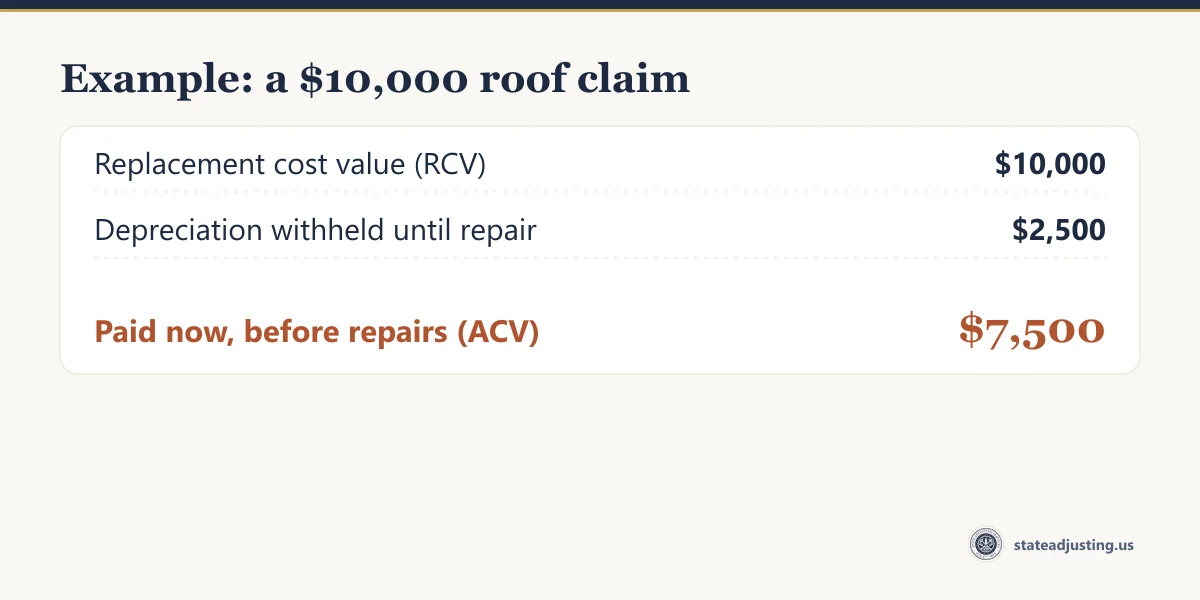
Check the "loss settlement" clause. Replacement cost value (RCV) pays what it actually costs to rebuild with similar materials today. Actual cash value (ACV) pays RCV minus depreciation for the item's age and wear — a smaller number, paid faster, on a smaller check.
Many policies pay the dwelling on an RCV basis but settle in two steps: an ACV check first, then the withheld depreciation — called recoverable depreciation — once repairs are complete and documented. Some carriers write the roof specifically on an ACV basis by endorsement, even when the rest of the dwelling is RCV, because roofs are the most frequent and most expensive hail claim. Read the loss-settlement section for the roof separately from the one for the rest of the structure; they are sometimes different clauses.
Here is how that two-step math looks on a simple example — figures below are illustrative only, not a quote or a past settlement:
What exclusions should I check before I file anything?
Every homeowners policy excludes some causes of loss outright. The common ones are flood, earth movement or settling, ordinary wear and tear or gradual deterioration, and mold beyond a small sublimit. Sewer or water backup is usually excluded from the base form and sold back as a separate endorsement.
An exclusion isn't a judgment call by the adjuster — it's a sentence already printed in your policy. Reading it before you file tells you which losses have no path to payment at all, versus which ones are simply going to take documentation and negotiation.
- Flood (a separate policy, not homeowners, covers this — see the National Flood Insurance Program)
- Earth movement, settling and foundation shifting
- Wear and tear, rot and gradual deterioration
- Mold, beyond whatever small sublimit your form allows
- Sewer or water backup, unless a specific endorsement adds it back
Which endorsements can add back coverage my base form leaves out?
Endorsements are the pages that modify the printed base form — they add coverage back, narrow it, or raise a sublimit. The ones worth locating: sewer/water backup, service line coverage, scheduled personal property (jewelry, art, tools above the base sublimit), a matching endorsement for uniform siding or roofing, and ordinance-or-law coverage.
They're usually listed together on a page titled "Schedule of Forms and Endorsements," a few pages behind the declarations. If a loss type isn't in your base coverage summary, check that page before assuming it isn't covered at all — it may simply live on an endorsement instead.
What is ordinance-or-law coverage, and why does it matter after a fire or a full roof loss?
It pays the added cost of rebuilding to today's building code, not yesterday's — code upgrades a standard policy often limits or excludes outright. It matters most on older homes and on losses big enough to trigger a code inspection, like a fire or a roof torn down to the decking.
A building permit pulled after a serious loss can require upgrades the original structure never had: updated electrical panels, egress windows, insulation standards. Without ordinance-or-law coverage, or with only a small standard sublimit, that gap is paid out of pocket. It's one line, and it's worth confirming before you need it rather than after.
Older homes carry more of this exposure simply because more time has passed since they were last brought up to current code. A house built decades ago, damaged badly enough to require a permit today, can trigger code items nobody planned for. Ask your agent directly what percentage of Coverage A your ordinance-or-law sublimit is — some policies include a modest amount automatically, others require adding it as its own endorsement, and the difference is easy to miss until a building inspector is standing in the driveway.
What to do next
Pull your full policy — not just the declarations page — and find the "Schedule of Forms and Endorsements." Check the six items in this guide against it: dwelling limit, deductible type, settlement basis, exclusions, endorsements and ordinance-or-law coverage. If a hail, storm, or fire loss has already happened, our free claim review reads the policy against the damage and tells you where you stand, at no cost either way.
For claim-specific detail, see our guides to hail damage claims and fire damage claims, and our six-step process for what happens once we're engaged. If you're deciding whether representation makes sense for your situation at all, start with what a public adjuster actually does.
Questions we get about this
What's the difference between Coverage A and my total policy limit?
Coverage A (dwelling) is only one of several limits on your policy. Coverage B covers other structures like a detached garage or fence, Coverage C covers personal property, and Coverage D covers additional living expenses. Each has its own limit, so a loss can be fully paid under one coverage and underfunded under another on the same claim.
Why did my insurer pay less than my contractor's repair estimate?
The most common reasons are a depreciation holdback under an actual cash value settlement, a deductible (including a separate wind/hail percentage deductible) subtracted before payment, or a scope disagreement over what the loss actually requires. Your settlement letter should state which of these applies; if it doesn't, ask your carrier to show the math.
Can I add an endorsement or change my deductible after damage has already happened?
No. Endorsements and deductible elections have to be in force before a loss occurs to apply to that loss. You can change them going forward for future losses, but not retroactively for a claim already in progress. This is exactly why reading the policy before anything happens matters.
Where on my policy do I actually find the endorsement schedule?
Look for a page titled "Schedule of Forms and Endorsements" or "Policy Forms," usually a few pages behind the declarations page in your full policy packet — not the shorter declarations summary alone. It lists every form number attached to your specific policy, including the ones that add coverage back.