Lightning and Power Surge Claims: Proving the Cause When Nothing Burned
Lightning is covered on essentially every standard homeowners policy, including damage to electronics and appliances, and nothing has to catch fire. A surge that came from the utility may not be: the widely used form insures artificially generated current but carves out electronic components. When nothing burned, the claim turns on cause, and cause is proved with records, marks and written diagnoses.
A lightning and power surge claim usually starts with a quiet house after a loud storm. The television will not turn on, the air conditioner hums without cooling, the garage door ignores the remote. Nothing is scorched and nobody saw a strike. The adjuster's first question is not what the equipment costs. It is what killed it — and on a standard policy, that answer decides whether most of the list is paid at all.
This guide covers how a policy separates lightning from a utility surge, what counts as evidence when there is no burn mark, the reasons these claims are most often reduced, and what to do before anything is repaired. We are licensed Illinois public adjusters, not attorneys. Nothing here is legal advice, and your own policy governs your claim.
Does homeowners insurance cover lightning damage when nothing caught fire?
Usually, yes. On the contents side of the widely used homeowners form, the first named peril reads "Fire or Lightning", and the dwelling is normally insured against every risk not excluded, with no lightning exclusion. A fire is not required. What is required is showing that lightning — not age, and not the utility — caused the failure.
The two halves of the policy work differently. The dwelling (Coverage A) includes everything built into the house: wiring, the service panel, the furnace and air-conditioning system, a hardwired garage door opener, interconnected smoke alarms. Those items are typically covered unless an exclusion applies. Personal property (Coverage C) — televisions, computers, a freestanding refrigerator — is covered only for the perils the policy names, and lightning is one of them.
A strike does not have to hit the house. Current from a strike nearby can arrive through overhead power lines, cable and phone lines, or the ground, which is why a house with no mark on the roof can lose equipment in several rooms at once. If a strike did hit the building, the urgent question is fire, not insurance: a start inside an attic or wall cavity can smoulder for hours, and fire departments commonly check with thermal imaging cameras. The wider damage a direct hit leaves — roof entry point, wiring, water through the opening — is set out on our lightning damage claims page.
What is the difference between a lightning surge and a utility power surge?
The source. Lightning is natural current from a strike, direct or nearby. A utility surge is current the grid produced: switching, a fault, a downed line, a failed transformer. The widely used form insures "artificially generated electrical current" as a separate contents peril, then excludes the electronic components and circuitry that are part of appliances, computers and entertainment equipment.
Read that carve-out against a modern house and it takes in almost everything that fails in a surge: televisions, computers, routers, and the control boards now inside refrigerators, washers and ranges. The same dead television can be fully payable as lightning damage and not payable at all as a utility surge — same policy, same date, same invoice.
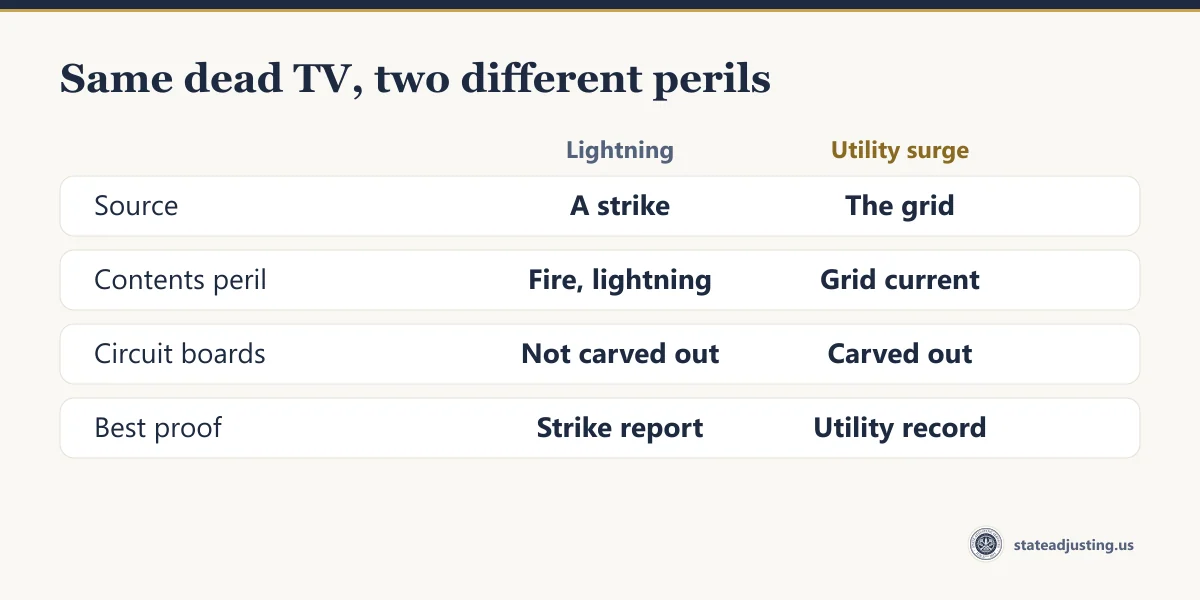
The dwelling side has no equivalent carve-out in the widely used form, but two exclusions do similar work. Mechanical breakdown, grouped with wear and tear, is what carriers apply to compressors and control boards. The power failure exclusion removes loss caused by a failure of utility service that happens away from the residence premises — the usual example is food that spoils during an outage. Wording varies between carriers and editions, and your own form governs.
Two other sources are worth knowing. Many carriers sell an equipment breakdown endorsement on homeowners policies, written for exactly this kind of failure, usually with its own limit and deductible; check the declarations page for it. And the utility has its own claims process. Whether a utility owes anything depends on its filed terms and is a legal question — ask the utility how to submit, and speak to an attorney if the amount justifies it.
How do you prove lightning caused the damage when nothing burned?
With three kinds of evidence that agree: a record that lightning struck near the address during the storm, physical marks where current entered or travelled, and written diagnoses from the people repairing each item stating how it failed. Any one of them alone gets argued. Together they usually settle the cause question.
| Evidence | What it proves | Where it goes wrong |
|---|---|---|
| Lightning strike report | Strikes recorded near the address, with time, estimated location and peak current | Run for the wrong date or a narrow time window; location estimates carry a margin of error |
| Electrician's written findings | Condition of the panel and branch circuits, damaged outlets, any entry point | "Looks like lightning" said on the doorstep is not evidence; ask for it in writing |
| Repair diagnosis for each item | Burned or failed components consistent with electrical overstress | "Unit failed, replaced" says nothing about cause |
| The damaged units and parts | The physical evidence a carrier or its engineer may want to examine | Thrown out with storm debris, or left with the installer |
| Photographs of marks | Scorched outlets, a blown surge protector, pitting on a pipe, a split tree, cracked chimney masonry | Taken after the repair, or not at all |
| The failure pattern | Several devices of different ages, on different circuits, failed in the same storm | Reported one item at a time over several weeks |
| Timeline | When each item was last working and when it failed | Rebuilt from memory months later |
The pattern is often the strongest single piece. Age failures arrive one at a time. A furnace board, a television, a router and a garage door opener of four different ages failing in the same storm is hard to explain as wear. Devices connected to two systems at once — power and a cable, phone or network line — often show damage at the data port, which is worth asking the repair technician to look for and note.
The honest limit: a strike report that finds no cloud-to-ground strikes within several miles over the whole storm period is real evidence against lightning. The question then becomes whether a utility event caused the failure — which changes the peril — or whether it was not a sudden event at all. Knowing that early is better than arguing a cause the data will not support.
Why do carriers deny or reduce lightning claims?
Five reasons come up again and again: no strike recorded near the address, age and wear, a utility surge rather than lightning, mechanical breakdown of equipment, and a total below the deductible. Each one is answered with a different document, and the denial letter should name the provision it relies on. Illinois claims rules require a written explanation of the basis for a denial.
| Reason given | What to check |
|---|---|
| No lightning recorded near the property | The date, time window and search radius the report used, whether you were given a copy, and the location accuracy the report itself states |
| Age, wear and tear | Whether repair diagnoses describe burned components, and whether items of different ages failed together |
| Utility surge, not lightning | Which peril the carrier applied, whether a strike report was ordered at all, and the utility's outage record for that date |
| Mechanical breakdown | Whether the failure had an outside cause rather than an internal wear process, in the technician's written words |
| Below the deductible | Whether every item across dwelling and contents was counted together; one occurrence normally means one deductible |
Ask for the strike report the carrier relied on, by name and date. Outside reports are commonly released on a specific written request; the method is in our guide to requesting your complete claim file. If an engineer was retained, the observations and limitations sections decide how far the opinion reaches — see how to read and answer an engineering report. Appraisal is generally the wrong lever here: it resolves the amount of a loss, not whether lightning caused it.
What is at stake: one storm, three readings
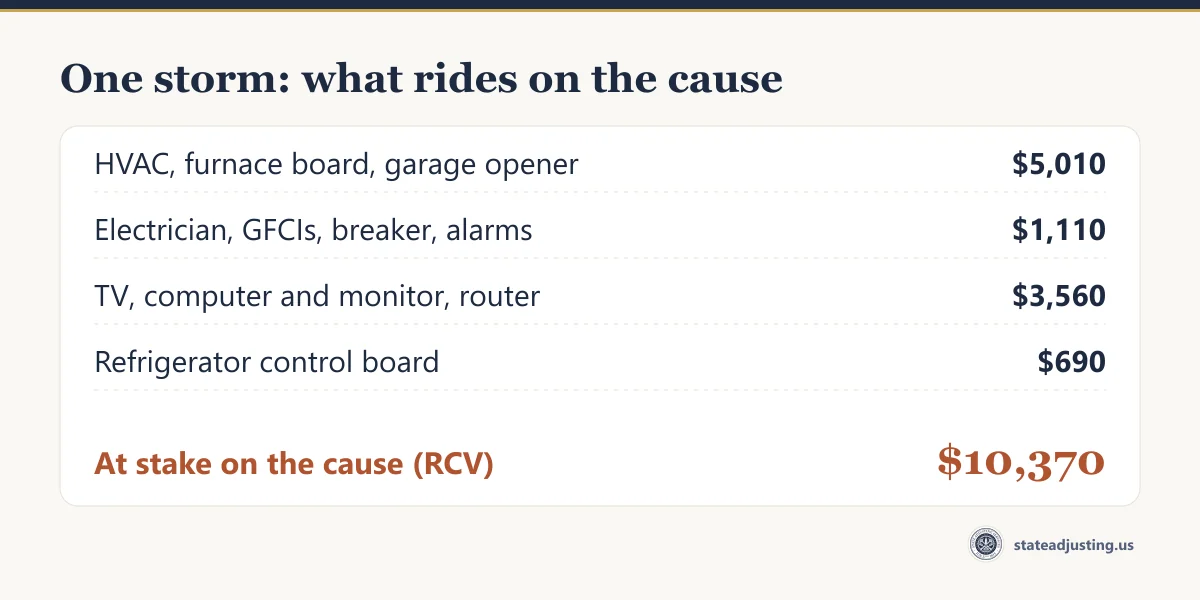
In an illustrative example, a July storm leaves nine items dead in one house, worth $10,370 at replacement cost. Read as lightning, the first payment is $6,840. Read as a utility surge under the widely used form, the $4,250 of electronics leaves the claim. Read as age and wear, nothing is paid. The invoices are identical in all three.
The figures below are an illustration, not a client result. The policy carries a $1,000 all-other-perils deductible; lightning is neither windstorm nor hail, so a separate percentage wind and hail deductible normally does not apply to it.
| Item | Coverage | Replacement cost |
|---|---|---|
| Air-conditioning control board and compressor | Dwelling | $3,850 |
| Furnace control board | Dwelling | $640 |
| Garage door opener | Dwelling | $520 |
| Electrician: diagnosis, four GFCI outlets, one breaker | Dwelling | $780 |
| Interconnected smoke alarms | Dwelling | $330 |
| 65-inch television | Contents | $1,400 |
| Desktop computer and monitor | Contents | $1,900 |
| Router (owned, not leased) | Contents | $260 |
| Freestanding refrigerator control board | Contents | $690 |
| Total | $10,370 |
- Read as lightning: $10,370 less $2,530 of depreciation ($1,150 on the dwelling items, $1,380 on the contents) is $7,840 actual cash value, less the $1,000 deductible: a first payment of $6,840. Where the policy settles at replacement cost, the $2,530 is normally recoverable once the items are replaced — the mechanics are in our guide to ACV and replacement cost.
- Read as a utility surge: the four contents items — $4,250 — are all electronic components or circuitry and fall outside the artificially generated current peril. The $6,120 of dwelling items stays in the claim, but it is where mechanical breakdown gets argued.
- Read as age and wear: nothing is paid.
Two practical notes from the same example. A modem leased from the internet provider does not belong on the list: equipment the provider owns is the provider's to replace. And check the box or registration of any surge protector that was in use — some manufacturers offer a connected-equipment warranty, which is a separate claim with its own terms.
What should you do in the first 72 hours after a suspected strike?
Make sure there is no fire, then preserve the evidence before anything is repaired or thrown away. The order matters, because most of what proves cause is destroyed by the repairs themselves: a replaced board goes back to the supplier, a new outlet hides the scorched one, a technician's verbal opinion is never written down.
- If you believe the house itself was hit, call the fire department first. If you smell gas, leave the house and call the gas utility from outside.
- Walk every room and write down everything that does not work, including items that restart but behave oddly, and note which outlet or circuit each was on.
- Photograph the panel and any tripped breakers, scorched outlets, blown surge protectors, and the exterior: roof, chimney, antenna or dish, nearby trees.
- Keep every failed item and replaced part. Ask each technician to return replaced boards and to write the cause of failure on the invoice.
- Have a licensed electrician inspect the panel and branch circuits, and ask for the findings in writing.
- Record the date and time of the storm and of any outage, and ask the utility for its outage or incident reference.
- Report the claim with the complete list rather than the first dead item. One occurrence is normally one deductible, and a list that looks small item by item often is not.
What to do next
If a lightning claim has been reduced to "age" or "surge", start with the strike report and the written reason, then line up the repair diagnoses against them item by item. We handle lightning damage claims and storm damage claims across Illinois, residential and commercial, and our claims process page shows how a loss is documented and negotiated.
We will review the declarations page, the list of damaged items and any letters from the carrier at no cost and no obligation. If we take the claim on, our fee is a percentage of the recovery, agreed in writing, capped by Illinois law and paid out of the settlement — nothing upfront, and no recovery, no fee. Reach us Monday to Friday, 8:00 AM to 5:00 PM, at (630) 297-8136 or through our contact page.
Questions we get about this
Is a power surge covered by homeowners insurance?
It depends on where the surge came from and what it damaged. A surge caused by lightning is generally covered for both the house and its contents. A surge from the utility is treated differently: the widely used form covers artificially generated electrical current as a contents peril but excludes electronic components and circuitry in appliances, computers and entertainment equipment, and on the dwelling side carriers often argue mechanical breakdown. Some policies add an equipment breakdown endorsement. Your own policy governs.
How does the insurance company know whether lightning struck my house?
Carriers commonly order a lightning strike report built from lightning detection network data, listing strikes recorded near the address with their time, estimated location and peak current. Ask for a copy in writing and check the date, time window and search radius it used. The report is read together with the physical inspection and the repair diagnoses, not on its own.
Do I need to keep the damaged electronics and parts?
Yes, until the claim is resolved. The failed units, replaced control boards and burned outlets are the physical evidence of cause, and the carrier or its engineer may ask to examine them. Discarding them turns a documented loss into a disputed one. If you need to dispose of something, photograph it first and ask the carrier in writing.
Does the deductible apply to each damaged item separately?
Normally no. Damage from one storm is usually one occurrence with one deductible across the dwelling and contents, which is why the complete list should be reported together. Lightning is not windstorm or hail, so a percentage wind and hail deductible normally does not apply to it. Check the deductibles on your declarations page, because your own policy governs.