Sudden vs Gradual Water Damage — and Why That Phrase Decides Your Claim

They are two different things, and your policy treats only one of them as a loss. A pipe that splits and dumps water in an afternoon is a sudden discharge, normally covered. Water that wept from the same pipe for months is "continuous or repeated seepage", which nearly every homeowners form excludes. The argument is almost never about the words. It is about how long the water ran, and that is an evidence question.
Sudden vs gradual water damage is the most common reason an Illinois water claim gets cut in half or closed altogether. One adjective in a field report — "long-term", "chronic", "maintenance" — moves a loss from the covered column to the excluded one, and it usually appears before anybody has established how long the water was actually running.
This guide covers what the two phrases mean inside a policy, why one word changes the outcome rather than the number, what physical evidence separates a sudden failure from weeks of seepage, what the difference costs on one bathroom leak, and what to do if a letter has already used the word "gradual". We are licensed Illinois public adjusters, not attorneys, so this is how these claims work in practice rather than legal advice about yours. Policy wording varies between carriers and between years — read your own form alongside this.
What does sudden versus gradual mean in your policy?
Most homeowners forms insure the building against direct physical loss unless something in the policy takes it back out. Water that escapes suddenly is not taken back out. Water that seeps or leaks repeatedly over a long period is: nearly every form excludes "constant or repeated seepage or leakage of water", along with wear, tear and deterioration.
The exclusion usually names a period, and this is the part worth finding in your own document. The older and still common wording is "over a period of weeks, months or years" — deliberately vague, and argued as such. A number of carrier forms now replace that phrase with a fixed count of days; fourteen is the number that appears most often. Those two versions behave completely differently in a dispute. Under the vague wording the carrier has to describe a duration that fits "weeks, months or years". Under a fourteen-day version there is a line, and a leak that ran nine days is on the covered side of it.
Two neighbouring exclusions do the same work from another direction. Wear, tear and deterioration covers the slow decline of the component itself — a supply line corroding since the house was built. Latent defect and mechanical breakdown covers parts that were failing from the start. Neither is about water, and both get quoted in water letters, because a pipe that finally lets go is almost always a pipe that had been getting worse.
That is the distinction which decides most of these files: the corrosion took eleven years, the split it caused took an afternoon. Forms generally decline to pay for repairing the corroded pipe and still respond to the water that escaped from it, subject to everything else in the form. Deciding the pipe was old is not the same as deciding the water ran for months, and the two get merged constantly.
Why does one word decide the whole claim rather than the amount?
Because seepage is an exclusion, not a deduction. It does not trim the estimate; it removes the loss. A file that would have paid drying, tear-out, flooring, cabinetry and mould remediation pays none of it once the cause is written down as long-term. There is no middle setting.
Three mechanics sit underneath that, and they are worth understanding before you argue with anybody.
- The failed part and the damage it caused are priced separately. Most forms will pay to tear out and replace the part of the building needed to reach the component that leaked, while the repair of the component itself stays your cost. A plumber's $210 invoice is not the claim. The wet floor is.
- Mould and rot are usually secondary, and usually capped. Where remediation follows a covered water loss it is commonly payable and commonly limited by a stated sublimit — figures in the $5,000 to $10,000 range are typical, and some forms remove the coverage unless an endorsement was purchased. The trap is arithmetic: rot and heavy growth take time, so the same evidence proving the loss is expensive is the evidence a carrier reads as duration.
- Some forms remove the loss if an excluded cause contributed at all. Where that wording appears, "there was some older staining as well" can be argued from a reduction into a full denial. This is exactly the kind of clause that decides claims quietly, and it is in the exclusions section of your own document, not in the letter you received.
One structural point, offered as how the form is built rather than as advice about your situation: on an all-risk form, seepage is a provision the carrier relies on to exclude. So it is reasonable — and usually productive — to ask, in writing, which exclusion is being applied and what the file says the duration was. If the answer turns out to be nobody's measurement but somebody's impression, that is worth knowing early. If it turns into a question of who must prove what, that is the point to speak with an attorney.
What evidence separates a sudden failure from weeks of seepage?
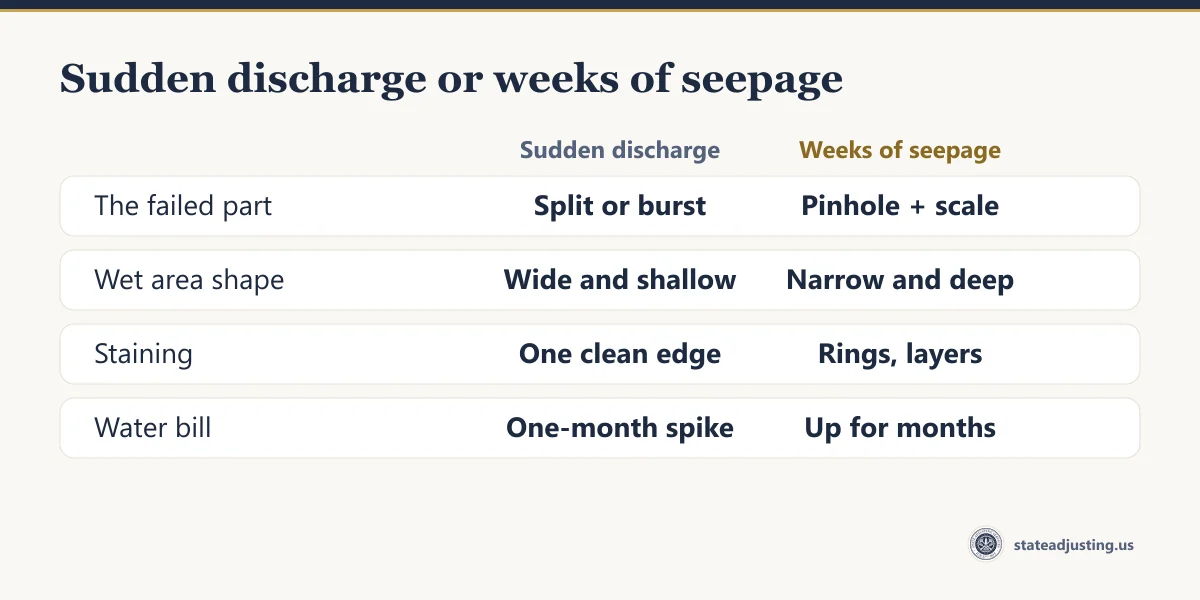
Physical evidence, nearly all of it destroyed by drying and demolition within about a week. A sudden discharge and a slow leak leave different marks: different failure surfaces on the part, different shapes of wet material, different staining, different wood, and a different pattern on your water bill. None of it is subtle once you know to look.
| What to look at | Sudden discharge usually shows | Weeks of seepage usually shows |
|---|---|---|
| The failed component | A split, a burst hose, a fitting blown off its crimp | A pinhole with mineral scale built up around it |
| Shape of the wet area | Wide and shallow — water spread across a floor and wicked up | Narrow and deep — saturated material with dry material beside it |
| Staining | One wet edge, uniform colour, no dried ring outside it | Concentric rings or tide lines from repeated wetting and drying |
| Wood and substrate | Saturated but structurally sound; swelling and cupping | Rot, softness, delaminated subfloor, crumbling particleboard |
| Mould growth | Little to none yet, or very early growth | Established colonies, layered growth, staining behind them |
| Water bill history | One billing period spikes, then returns to normal | A baseline creeping upward for months on a supply-side leak |
| Documents | A dated invoice naming the failure, a timestamped photo, a sensor alert | Nothing dated — so the carrier's estimate of duration goes unchallenged |
The water bill deserves its own sentence, because it is the dating evidence almost nobody pulls and every carrier will read. Twelve months of usage on a supply-side failure normally shows either a single spike or a slow climb, and those two shapes support opposite conclusions. Meter readings are recorded by a third party with no interest in the claim, which is what makes them useful.
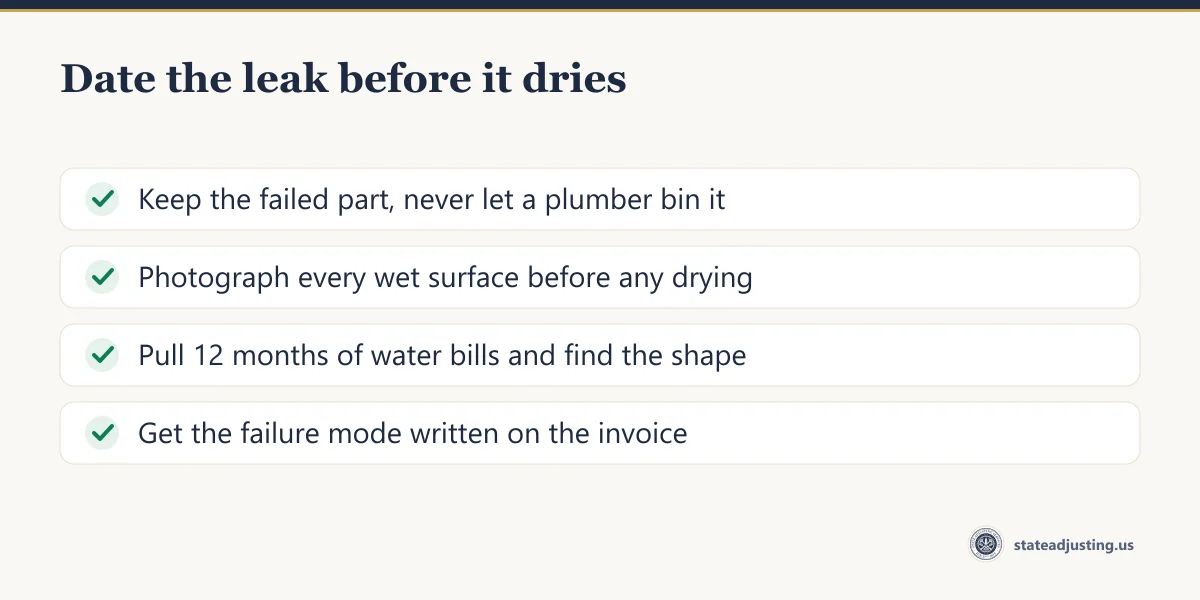
Two practical warnings. First, your policy requires you to protect the property from further damage, and most forms exclude damage caused by neglect to do so — so mitigate immediately, and do not delay drying to preserve evidence. Document first, dry second: photographs and video before anything moves, moisture readings written down with dates, the failed part bagged rather than left in the plumber's truck. Second, ask the plumber to describe the failure in words on the invoice. "Repaired leak" helps nobody. "Braided supply hose burst at the crimp" is a dated statement from an independent trade about the mechanism.
What does the difference cost on one leak?
Here is the same loss read both ways: an upstairs bathroom supply line that failed, on an illustrative Illinois house. These are worked example figures chosen to show the mechanics — not a price list, and not a result from any client file.
| Line | Amount | Why it sits there |
|---|---|---|
| Tear-out and access to reach the failed line | $780 | Access is normally payable even though the part itself is not |
| Drying, containment and moisture monitoring | $2,450 | Three days of equipment with daily readings recorded |
| Vanity, flooring and lower drywall replaced | $6,900 | Materials the water reached and ruined |
| Mould remediation in the wall cavity | $3,200 | Often payable after a covered loss, often capped by a sublimit |
| Claimed if the failure was sudden | $13,330 | Before the deductible and before any withheld depreciation |
| The plumber's repair to the failed fitting | $210 | The component itself — normally your cost either way |
| The same file read as seepage | $0 | An exclusion removes the loss; it does not reduce it |
Notice how little effort separates the two readings. Nobody has to prove a number, re-measure a room or argue unit prices. One sentence in a field report does the whole job — which is why it is worth contesting on the day it appears rather than after the repair. And $13,330 is what is claimed, not what arrives first: on a replacement-cost policy part of it is normally held back as depreciation until the work is done, which we cover in our guide to recoverable depreciation.
The letter already says gradual. What can you do?
A denial on duration is one of the more reversible kinds, because it rests on a factual claim about time that somebody made without measuring. Work in this order.
- Read what was actually relied on. Ask for the specific policy provision in writing, and for the basis of the duration finding. There is a real difference between "the moisture readings and the rot pattern indicate months" and "the plumber said the pipe was old".
- Assemble the dating evidence before it disappears. The failed part, dated photographs, moisture logs, the drying company's daily readings, twelve months of water bills, the inspection report from when you bought the house, service records for the appliance or fixture, and any smart-sensor or leak-detector history.
- Separate the two questions. Was the discharge sudden, and was the component worn out? Both can be true at once. A response that only establishes the pipe was old has not answered the first question.
- Reopen rather than start over. A closed water claim is usually reopened with new evidence rather than refiled — the mechanics are the same as any claim supplement. Watch the clock while you do it: several Illinois deadlines run from dates that have already passed, which we set out in deadlines that end claims in Illinois.
- Know which tools do not fit. The appraisal clause resolves disagreements about the amount of a loss, not about whether the loss is covered at all. A seepage denial is a coverage question, so appraisal is generally the wrong lever for it.
- Escalate to the right place. How a claim is being handled can be raised with the Illinois Department of Insurance. If the dispute has become a legal question rather than a claim question, that is an attorney's work, not ours.
If the water arrived from below rather than from a pipe — a floor drain, a sump pit, a window well — the argument is a different one entirely, about the path the water took rather than how long it ran. That one is set out in sewer backup vs flood.
What to do next
If water is running right now, the order that protects you is: stop it, mitigate, then document — and keep the part. Photograph and video every wet surface before a fan is placed, write down where moisture readings were taken and when, keep receipts for tarps, fans, hotel nights and emergency plumbing, and put the failed fitting in a bag with the date on it. Then report the loss to your carrier promptly, in your own name, with the date the discharge started rather than the date you noticed the stain.
We handle water damage and flood and sewer backup claims across Illinois, residential and commercial, and a large share of that work is dating a leak that somebody has already written off as long-term. Our process page sets out how a claim runs with us on it, and past clients describe the experience on our reviews page. If you have a letter using the word "gradual" and want somebody to read it against your policy, our free claim review costs nothing and carries no obligation — including when the answer is that you do not need us. When we are engaged, our fee is a percentage of what we recover, agreed in writing and regulated by Illinois law, with $0 owed upfront. We answer the phone Monday through Friday, 7:00 AM to 7:00 PM, and Saturday and Sunday, 9:00 AM to 5:00 PM, on (630) 297-8136.
Questions we get about this
Is a slow leak covered by homeowners insurance?
Usually not. Nearly every homeowners form excludes constant or repeated seepage or leakage of water over a long period, alongside wear, tear and deterioration. What matters is how long the water actually ran, not how old the pipe was. Some forms define the period as "weeks, months or years"; others use a fixed number of days, commonly fourteen. Your own form governs.
My insurer says my water damage was gradual. Can that be challenged?
Yes, and it often is, because a duration finding is a factual claim somebody made rather than a measurement. Ask in writing for the policy provision relied on and the basis for the duration. Then assemble dating evidence: the failed part, dated photographs, moisture logs, twelve months of water bills, service records and any leak-sensor history.
What is the best evidence that a pipe failure was sudden?
The failed component itself, kept rather than discarded. A split hose or a fitting blown off its crimp looks nothing like a pinhole surrounded by mineral scale. After that: timestamped photographs taken before drying began, the restoration company’s daily moisture readings, a plumber invoice that names the failure mechanism in words, and a water bill showing a single-period spike.
Should I dry the house before the adjuster sees it?
Yes. Your policy requires you to protect the property from further damage, and most forms exclude damage caused by neglecting to do so, so mitigate immediately. Document first and dry second: photograph and film every wet surface, write down moisture readings with dates, keep receipts for emergency work, and bag the failed part before anyone removes it from the property.