What Carriers Routinely Leave Out of a Hail Estimate

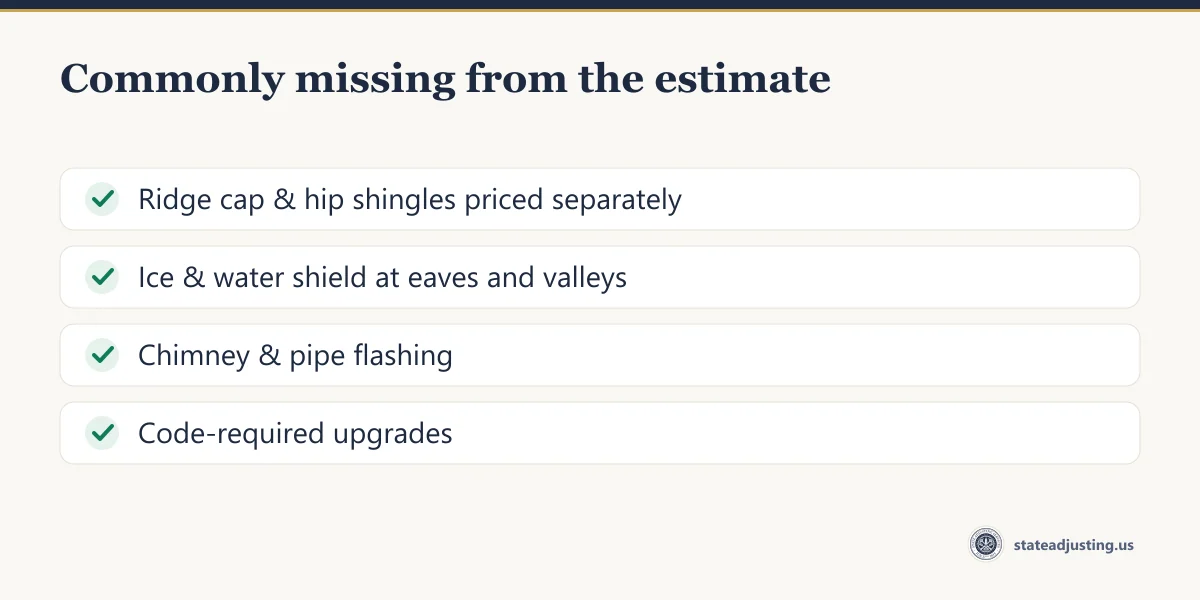
A hail damage estimate written from a single roof walk commonly misses ridge cap and hip shingles priced as their own line, ice and water shield along eaves and valleys, flashing at chimneys and pipes, and any code-required upgrade the estimating software doesn't already know about. None of that is necessarily bad faith — it's what a first look tends to miss. Reading the estimate line by line against what code and the manufacturer actually require is what catches it.
A hail damage estimate is supposed to describe everything it will take to put your roof back the way it was before the storm. In practice, the first number a carrier sends is usually written from one roof walk and priced against a standard estimating database — and several categories of work get left off that walk more often than any other. This guide covers what those categories are, why they're missed rather than denied, and how to check your own estimate against them before you sign off.
What actually goes missing from a hail estimate, and why?
Most missing items aren't a policy exclusion — they're work the field adjuster's inspection didn't capture. A roof walk measures slopes and counts hail hits from the surface; it doesn't always catch what's underneath the shingles, tucked into a valley, or required by a local building code the estimating software has no record of.
Field adjusters cover a large territory during storm season, and the software they price from (most carriers use one of two or three standard estimating platforms) builds a line-item list from measurements and a description of visible damage. If a category of work never gets described — because it wasn't visible from the ground or the ridge, or because nobody flagged it — the software has nothing to price. That's the mechanism behind most of what follows: not a decision to exclude the item, but a gap in what made it onto the estimate in the first place.
Which line items are the ones that repeatedly get left off?
Five categories account for most of what's missing: ridge cap and hip shingles priced as their own line rather than folded into the field, ice and water shield along eaves and valleys, drip edge and gutter apron, flashing at chimneys, pipes and sidewalls, and any local code upgrade the software wasn't told to include. Each one is a real, inspectable item — not a judgment call.
| Line item | Why it's commonly missing |
|---|---|
| Ridge cap and hip shingles | Sometimes bundled into a generic "field shingle" line at the wrong price, instead of priced as the heavier, differently-shaped product they are |
| Ice and water shield (eaves, valleys) | Not visible without lifting shingles, so a ground or ridge inspection has no way to confirm it's there or damaged |
| Drip edge and gutter apron | Thin metal trim, easy to overlook on a fast walk, especially where it's painted to match the fascia |
| Flashing at chimneys, pipes and sidewalls | Soft metal that dents under hail the same way gutters do, but sits low on the slope where hits are harder to photograph |
| Local code upgrades | Estimating software prices a like-for-like replacement by default; a municipality's current code requirement has to be added manually |
What about the roof deck and code-required upgrades specifically?
Roof deck replacement gets added when hail or the resulting leak has actually damaged the plywood or OSB underneath — that's confirmed once the old roofing is off, not before, so it's reasonable for it to be missing from a first estimate. Code upgrades are different: they're knowable in advance from your municipality's current building code, and many first estimates are written as if the code hasn't changed since the roof was last replaced.
- Ask whether the estimate assumes a tear-off to the deck, or just a shingle-over — the two require different code compliance
- Check whether your municipality currently requires ice and water shield at eaves and valleys regardless of the original roof's age
- Ask if a permit is required for this scope of work in your jurisdiction, and whether the estimate includes the permit fee
- Confirm the estimate accounts for current ventilation code, not just what was there before the storm
None of this requires legal expertise to raise — it requires comparing the estimate against your local code office's current requirements, which is public information you or your adjuster can request directly.
Timing matters here too. A code upgrade or deck damage that surfaces once a roofing crew has torn off the old shingles is usually handled as a supplement — an addition to the original estimate, backed by photos of what was actually found underneath — rather than a reason to reopen the whole claim. That's a normal step in a hail claim, not a sign that anything went wrong with the first estimate; it's simply the point where the roof can finally be inspected from underneath instead of from the ground.
How can you tell your estimate is short before you sign?
Compare the estimate's shingle count and linear footage against your roof's actual measurements, and check whether ridge cap, ice and water shield, drip edge, and every flashing point on the roof each have their own priced line. If a category is missing entirely rather than priced low, that's the more common pattern — and the easier one to catch.
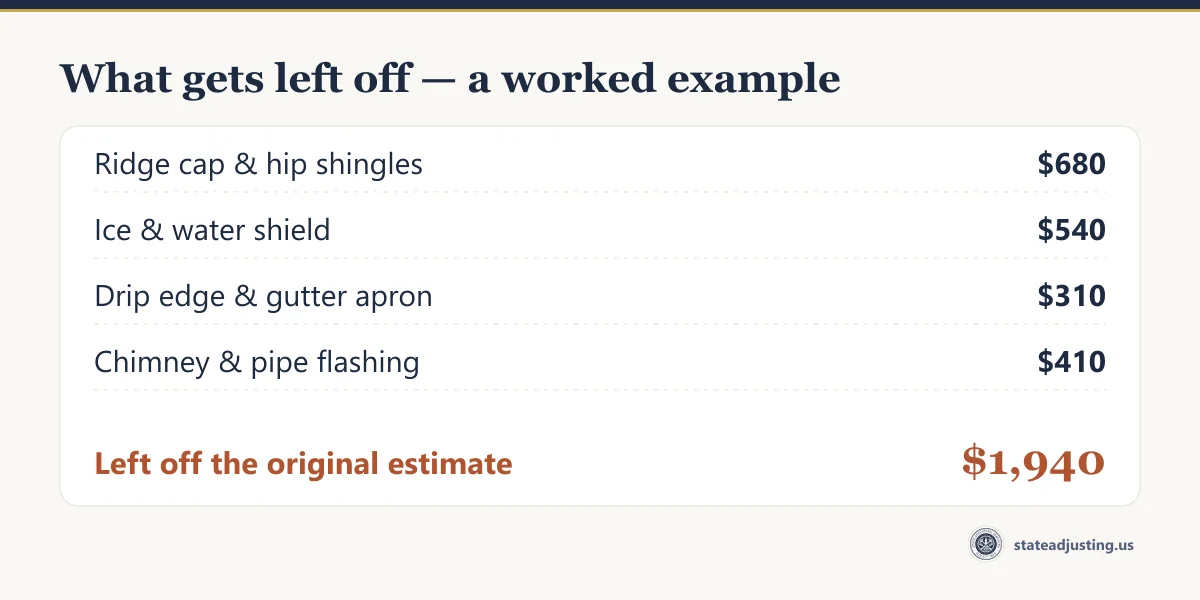
The figures below are a worked example only, meant to show how these gaps add up on a mid-size roof — not a quote, and not a past client's settlement.
| Line item | Illustrative figure |
|---|---|
| Ridge cap and hip shingles, priced separately | $680 |
| Ice and water shield, eaves and valleys | $540 |
| Drip edge and gutter apron | $310 |
| Chimney and pipe flashing | $410 |
| Left off the original estimate | $1,940 |
On a roof where the field shingle line alone runs several thousand dollars, $1,940 in missing trim and flashing is easy to lose inside a bigger number — which is exactly why it's worth checking each line against the roof itself rather than only the total at the bottom.
What should you do if you think line items are missing?
Walk the estimate line by line against a physical inspection of the roof — ideally with someone who reads estimates for a living, since the gaps described above are specific line items, not a general sense that "the number feels low." A missing category is usually correctable through a supplement request with photos and, where relevant, code documentation; it's rarely a dispute that needs to go further than that.
Photograph what you're pointing to before you raise it: the ridge line from the ground, the valley if it's visible, the flashing around each chimney and pipe, and the drip edge along the eaves. A supplement request that names a specific line item and shows the spot it applies to moves faster than a general statement that the estimate seems low — the carrier's reviewer is checking the same categories described above, and a photo answers the question before it has to be asked twice.
What to do next
Pull your written estimate and check it against the five categories above, one at a time, against the roof itself. If ridge cap, ice and water shield, drip edge, or flashing don't appear as their own priced lines, that's worth raising with the carrier in writing before you sign anything. Our guide to hail damage claims covers the broader claim process for storm damage, and our guide to reading your homeowners policy covers the coverage lines that decide what's owed in the first place. If you'd rather have someone read the estimate against your policy directly, our free claim review does exactly that at no cost — our fee, when we're engaged, is a percentage of what we recover, agreed in writing, with $0 owed upfront. See our process for what that involves and our client reviews for what past clients say. If the roof needs repair once the claim is settled, our construction partner is one option — always the homeowner's choice, never a condition of the claim.
Questions we get about this
What line items are most commonly missing from a hail estimate?
Ridge cap and hip shingles priced as their own line, ice and water shield along eaves and valleys, drip edge and gutter apron, and flashing at chimneys, pipes and sidewalls are the ones most often left off a first estimate — usually because a roof-walk inspection did not capture them, not because they were denied.
Does a missing line item mean the carrier is acting in bad faith?
Not usually. Most first estimates are written from one roof walk and priced by software that only lists what the inspection described. A missing category is most often a gap in what got documented, not a decision to exclude it — though it still needs to be raised and corrected.
How do I get a missing item added to my hail estimate?
Photograph the specific spot — the ridge, a valley, the flashing around a chimney or pipe — and submit a written supplement request that names the line item and shows the photo. A request tied to a specific item and location moves faster than a general statement that the total seems low.
Are code-required upgrades automatically included in a hail estimate?
No. Estimating software defaults to a like-for-like replacement unless someone adds the current code requirement manually. Checking your municipality’s current building code — ice and water shield requirements, permit fees, ventilation rules — is worth doing before you sign off on the estimate.