Statement of no loss: what you certify when a lapsed home policy is reinstated
A statement of no loss is a short form you sign when a homeowners policy that lapsed, usually over a missed payment, is being put back in force. On it you certify that nothing happened to the property during the gap that has led, or is likely to lead, to a claim. The carrier relies on that sentence when it decides whether to reinstate you, and it can come back to the same sentence when you file a claim months later. That second use is why the form deserves more than a quick signature at the agent's desk.
Your own policy and the carrier's own form govern everything below. We are licensed Illinois public adjusters, not attorneys, so this explains how these forms are used and read in property claims, not legal advice.
Where the statement sits on the calendar
The statement covers one stretch of dates: from the moment the policy stopped to the moment you sign. Drawn out, the sequence after a missed payment usually looks like this.
- Step 1Premium dueThe bill goes unpaid past the due date and any grace period the policy allows.
- Step 2Notice mailedFor nonpayment, an Illinois company must mail it at least 10 days before the cancellation date.
- Step 3Cancellation dateCoverage stops, often at 12:01 a.m. The gap starts here.
- Step 4The gapWhatever happens to the house now happens outside the policy.
- Step 5You pay and signThe statement covers the gap up to the date, sometimes the hour, of your signature.
- Step 6The carrier decidesReinstated with a gap, reinstated without lapse, or declined.
Something can also happen between step 5 and step 6. If it does, tell the agent in writing the same day, before the reinstatement is processed, rather than waiting to see whether the carrier says yes.
The words you are actually certifying
Most forms ask about three things, and only one of them is damage you can see. Wording differs between carriers, so read yours line by line. One published carrier form, for instance, has the policyholder affirm that “no losses, claims, or events likely to result in a loss or claim have occurred”, for the period “beginning with the expiration of my policy through the date I signed this statement.”
- Losses
- Physical damage to the house, a detached garage or fence, or your belongings: a leak, a cracked window, hail on the roof, a theft. It counts whether or not you ever meant to claim it, and whether or not you already paid for the repair.
- Claims
- A demand someone has made against you, such as a neighbour who wants you to pay for a tree that fell on their car, or a visitor's medical bills after a fall on your steps. A homeowners policy carries liability coverage, so these belong on the form too.
- Events likely to result in a loss or claim
- The widest of the three. A hailstorm you know passed over your street, a ceiling stain that showed up, a dog bite that has not produced a bill yet. Nothing needs to be repaired, estimated or reported for it to fall here.
The same form warns that “an incorrect statement or omission of fact” relating to the request “may prevent recovery under the policy.” Read plainly, a loss left off the form can cost you the claim for that loss. The agent guides we read while writing this go further and describe carriers denying claims and, in serious cases, voiding the policy back to its start. When you are unsure whether something counts, asking costs nothing and guessing can cost the claim.
What happened during the gap, and what to do before you sign
Most people's gap was a quiet ten or twenty days and the form is a formality. The rows further down the table are where it stops being one.
| During the gap | Does it belong on the form? | Before you sign |
|---|---|---|
| Nothing at all, and no storms in your area | Nothing to disclose | Sign, keep a copy and take the photos described further down |
| A hail or wind storm hit your town, and you saw no damage | Ask the agent, since many forms reach “events likely to” cause a loss | Have the roof and siding looked at first, or name the storm and its date in writing |
| A stain, drip or crack you noticed but never traced | Yes, as something you saw | Describe it in plain words with the date you first noticed it |
| Damage you know about, repaired or not | Yes | Expect that loss to stay with you, and ask whether reinstatement is still offered |
| A theft or break-in | Yes, with the police report number | Treat it like any other known loss |
| Someone was hurt on the property, or a neighbour blames you for damage | Yes, even before any bill arrives | Tell the agent, and talk to an attorney about the liability side |
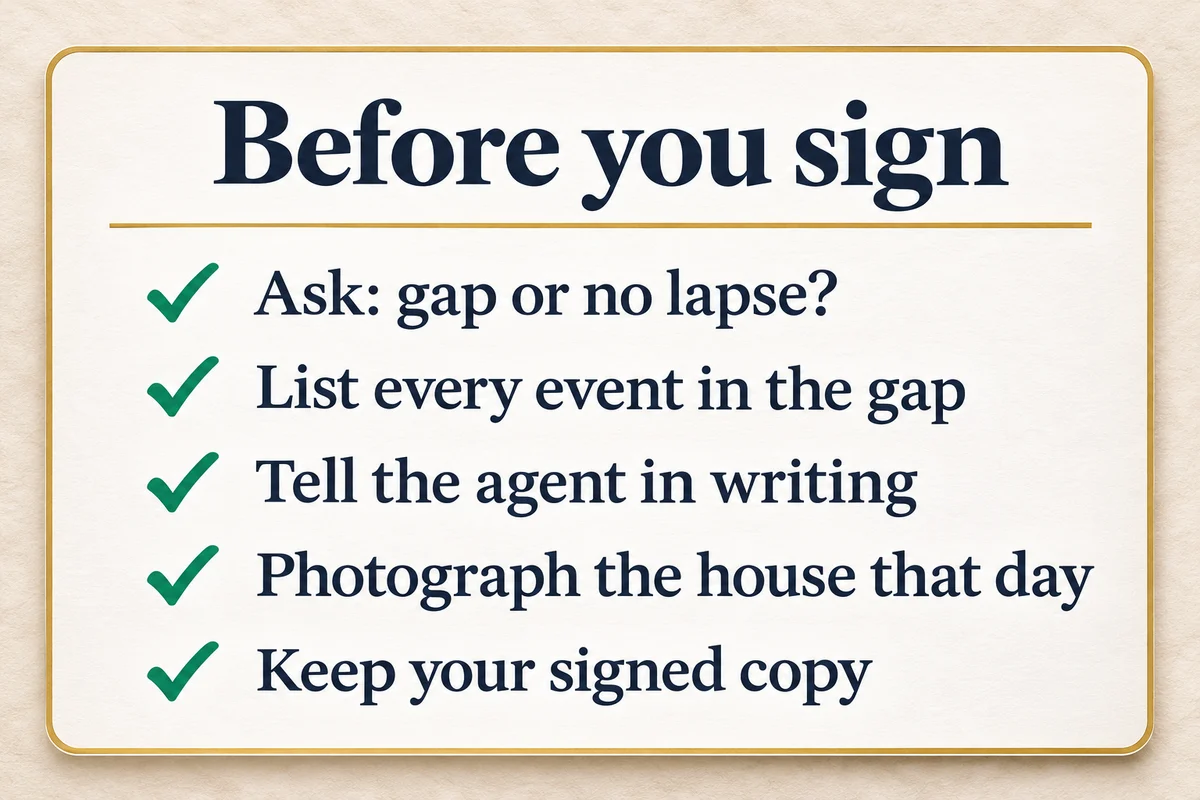
A short e-mail to the agent before you sign, listing what you saw and when, is a better record than a phone call. If the carrier reinstates you after reading it, you hold a dated document showing it knew.
Reinstated with a gap or without lapse
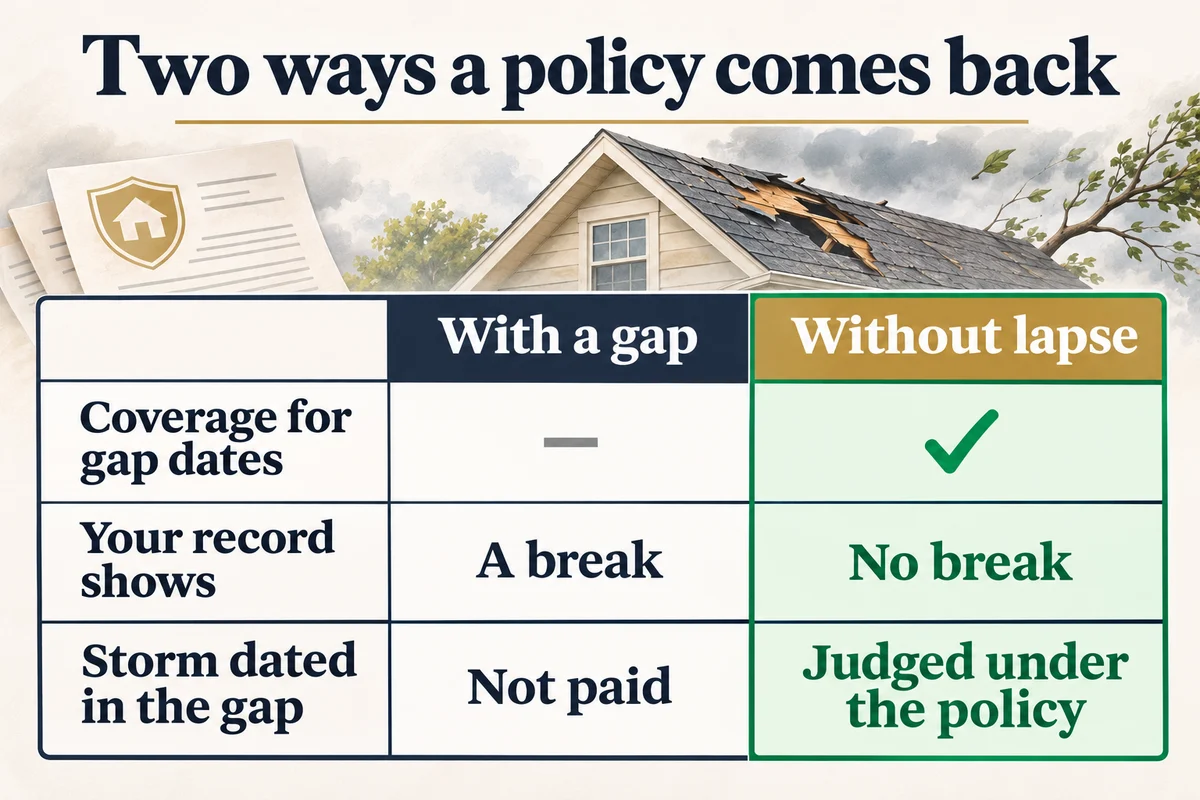
Signing the statement does not decide the outcome. The carrier decides under its own rules, and some carriers decline reinstatement entirely once a set number of days has passed. The notice you get afterwards says which of two things happened, and the difference shows up the first time something goes wrong.
With a gap
The policy restarts on a new effective date. Nothing between the cancellation and that date is covered.
A storm dated inside the gap stays your own cost, even if you only find the damage next spring.
Your insurance history shows a break in coverage, which carriers look at when they price a renewal or a new policy.
Without lapse
The policy is treated as if it never stopped, so there is no break on your record.
Your statement is what the carrier relied on to restore those days, which is why the gap dates are later read against what you certified.
Damage from the gap that nobody could have known about is decided by the policy wording and the facts. Damage you knew about and left off is the exact case the form was written for.
Look for those words on the reinstatement notice and keep it with your declarations page. If the notice says neither, ask the agent to answer in writing.
Photograph the house on the day you sign
Months later, nobody will remember what the roof looked like on reinstatement day, and hail and wind damage are often found long after the storm that caused them. A dated set of photos taken the day you sign is the simplest proof that damage found later was not there yet. It takes about an hour.
- Every slope of the roof from the ground, using the phone's zoom. Stay off the roof.
- Each wall of siding, the gutters and downspouts, and the window wraps and screens on the side the weather comes from.
- The top-floor ceilings, and the ceilings around chimneys and skylights, where a roof leak shows first.
- Basement walls and floor, the water heater and the area around the sump pump.
- The air-conditioning unit outside, plus any fence, shed or detached garage.
- One wide shot of the street with the house number, so the set is clearly this property on this day.
Leave the files exactly as the phone saved them, because the date and time stored inside each one are part of the proof. Our guide on what to photograph after property damage describes the same habit for the day something does go wrong.
What Illinois tells homeowners about cancellation
The company must mail a cancellation notice “at least 10 days before the cancellation date for nonpayment of premium” and “at least 30 days before the cancellation date for all other reasons.”
“During the first 60 days of a new policy, your company may cancel for almost any reason.”
A cancellation can be appealed to the Director of Insurance only if it was for a reason other than nonpayment, with a written request sent at least 20 days before the cancellation date. Homeowners who cannot find coverage elsewhere “may be eligible to buy insurance from the Illinois FAIR Plan Association.”
Source: Illinois Department of Insurance, If your homeowners insurance policy is canceled
That page does not deal with reinstatement, which each carrier handles under its own rules. Two practical points follow from it. Open any letter with the word cancellation in it on the day it arrives, because ten days goes quickly. And if a policy was cancelled for a reason other than nonpayment and you think the reason is wrong, the appeal has to be in before the cancellation date, not after. Our page on complaints to the Illinois Department of Insurance covers how the Department handles a dispute once a claim is involved.
When a claim comes in after reinstatement
The first thing a carrier fixes on any claim is the date of loss, and after a reinstatement it sets that date beside the gap. For a burst pipe, a fire or a theft the date is usually plain. Hail and wind are harder: carriers look up storm dates at your address in weather records, and an adjuster may conclude that the bruised shingles on your roof come from a storm inside the gap. Your signing-day photos, and any note you sent the agent before signing, are what you answer with.
The carrier may also ask you to sign a sworn proof of loss for the new claim. It is the opposite document. A statement of no loss says nothing happened, while a sworn proof of loss states what did happen and what it cost, and both are signed on the same expectation that every line is accurate.
If a hail damage claim or any other claim is refused because the carrier places the loss in a gap, ask for the refusal in writing, with the date it relies on and the record it took that date from. We review policies and denial letters free of charge, and when we take a claim our fee is a percentage of the recovery, regulated by Illinois law, with nothing paid upfront. Reach us through the contact page or at (630) 297-8136, Monday through Friday 7:00 AM to 7:00 PM and Saturday and Sunday 9:00 AM to 5:00 PM.
Questions we get about this
What is a statement of no loss?
It is a short signed form in which you certify that no losses, claims or events likely to lead to a claim happened to the insured property during a period without coverage, usually between a cancellation for nonpayment and reinstatement. The carrier relies on it when it decides whether to reinstate the policy.
Is a statement of no loss the same as a proof of loss?
No. A proof of loss is filed after a claim and states what was damaged and what it cost. A statement of no loss is signed before coverage is restored and states that nothing happened during the gap.
What if something happened while my policy was lapsed?
Put it on the form, or tell the agent in writing before you sign. A loss inside a gap is normally not covered, and leaving it off can cost you that claim and give the carrier grounds to question the policy. If someone was hurt or blames you for damage, talk to an attorney about the liability side.
Does signing a statement of no loss mean my policy is reinstated?
No. The carrier decides under its own rules. It may reinstate the policy without a lapse, reinstate it with a gap in coverage, or decline. The reinstatement notice says which, so keep it with your declarations page.