Water-damaged hardwood floor: when the claim pays past the wet boards

When water ruins part of a hardwood floor, a homeowners claim can pay for more than the wet boards. What decides it is where that floor physically stops, whether new boards can be made to look like the old ones, and whether the floor had dried before anyone wrote the scope. Many first estimates replace the wet boards and refinish a patch around them. If the same boards run without a break through the kitchen, hallway and living room, that patch often stays visible, and the real discussion is about sanding and refinishing the whole connected run.
Your own policy and its endorsements govern every point below. We are licensed Illinois public adjusters, not attorneys, so read this as how these claims are commonly handled, not as legal advice. It also assumes the water itself is covered, which depends on the source and on how long it went on; our guide to sudden versus gradual water damage covers that first question.
One floor through four rooms
A hardwood floor is one surface for as long as the boards keep going. Tongue-and-groove boards lock into each other and the finish goes on over the whole area in one pass, so the floor doesn't end where a wall line sits on a drawing. It ends at a doorway with a threshold, at a change of material, or where the boards change direction.
Example layout. Dashed lines: open, the boards continue. Solid dark line: a threshold, where the floor stops.
In this house the carrier might write the 60 square feet, the 180-square-foot kitchen, or the 520-square-foot run of kitchen, hallway and living room. The bedroom sits outside all three, because a threshold is a natural break where a slightly different sheen is ordinary. Photograph every break, and every place where there isn't one. A wide shot from the kitchen into the living room, with the boards running through, does more for the scope than a paragraph of description.
Why the floor has to dry before anyone sands it
Water makes boards cup: the edges rise because the bottom of each board is wetter than the top. If a cupped floor is sanded flat before the moisture evens out, the raised edges are cut away, and as the wood keeps drying the middle of every board ends up higher than its sides. The floor crowns. An article in the National Wood Flooring Association's magazine describes a floor reading about 6.5 to 7 percent at the surface and past 10 percent deeper in the same boards, with a gap you can't see or feel (Hardwood Floors Magazine, October 2025).
For the claim this matters twice. A scope written in the first week can be wrong in either direction: boards that looked ruined sometimes flatten as they dry, and boards that looked fine can be wet underneath. And if the floor is sanded too early and crowns months later, the carrier may treat the crowning as a workmanship problem rather than part of the water loss. Ask the drying company or the flooring contractor for readings at the surface and at depth, and keep a log like this one.
| When | Where to take readings | What the log should show |
|---|---|---|
| The day drying starts | Inside the wet patch, at its edge, and in a dry room as a baseline | Surface and deep readings for each spot, the meter used and its species setting |
| Every few days while equipment runs | The same spots, marked with tape so they don't drift | Readings falling toward the dry room's numbers |
| When the equipment is removed | The same spots plus the subfloor, if a board can be lifted | The gap between surface and depth, and any spot still well above the baseline |
| Before anyone sands | The same spots again | Surface and deep readings close to each other and to the dry room |
Three ways to scope the same floor
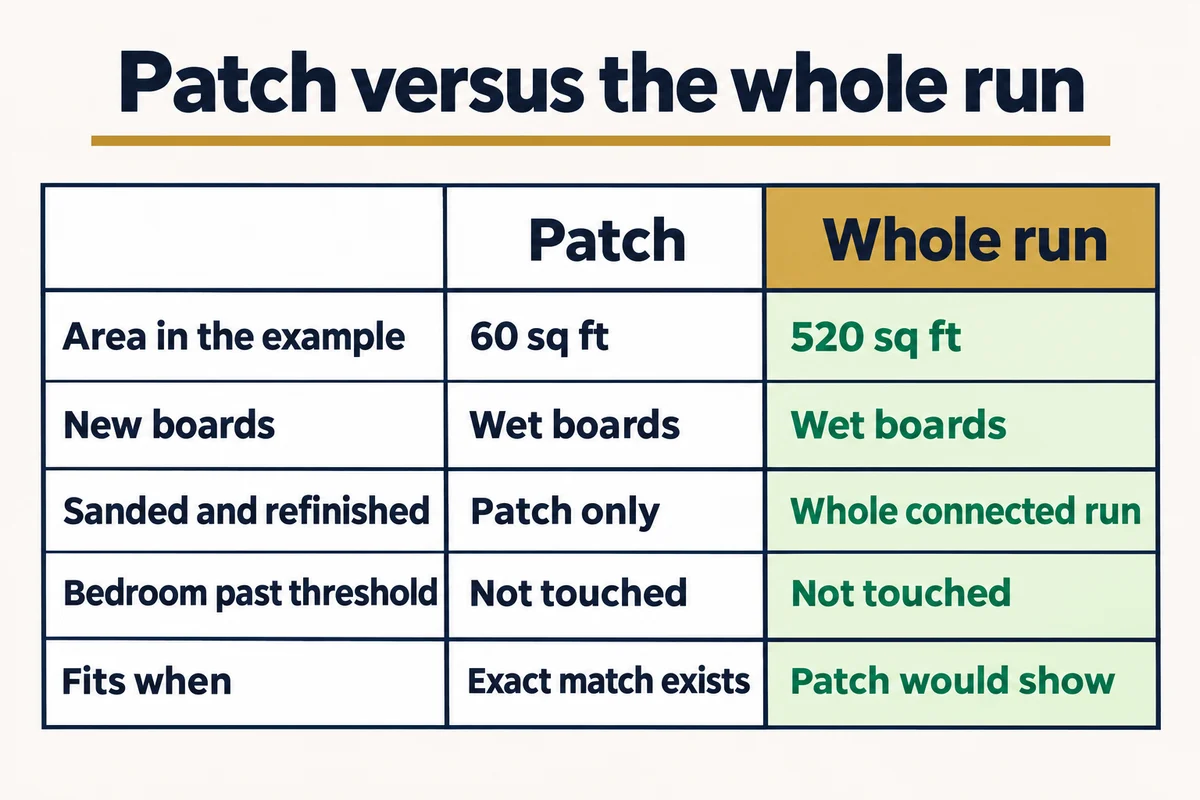
Most disputes over a wet hardwood floor come down to which of these three the estimate describes. Each one replaces the wet boards; the difference is how much of the surrounding floor gets sanded and refinished so the new boards disappear into it.
| Scope | Sanded and refinished | When it usually fits |
|---|---|---|
| Boards only | The patch, 60 sq ft in the example | The same boards and finish are still available and a flooring contractor confirms the patch will blend |
| Room to the nearest break | The whole kitchen, 180 sq ft | The room's floor stops at its own threshold, transition strip or change of material |
| Whole connected run | Kitchen, hallway and living room, 520 sq ft | The boards continue through open doorways, and a smaller refinish would leave a visible line |
Look closely at the middle option. If the kitchen has no threshold, refinishing only the kitchen moves the visible line from the dishwasher to the kitchen opening. It is still a patch, a bigger one. An adjuster offering the room should be able to point to where that room's floor stops.
What the policy and the Illinois rule say
Many homeowners policies are built on the standard industry form, whose replacement cost condition pays to repair or replace the damaged part of the building
with material of like kind and quality and for like use
Nothing in that phrase says patch. The open question is what restoring like kind and quality takes on a floor that was one surface before the water. Some policies add an endorsement limiting matching to the damaged area, or saying the carrier won't pay to replace undamaged property only so that it matches. Read the loss settlement section and every endorsement before arguing the scope, because a clause like that changes the argument.
Illinois also has a rule for how the carrier's estimate is handled, in 50 Ill. Adm. Code 919.80(d)(7)(C). It doesn't use the word match. It does say three things that help on a floor:
- The estimate the settlement is based on has to be reasonable and allow the repair to be done in a workmanlike manner, and on request the company must give you a copy of it.
- If your contractor's written estimate is higher, the company must review it and answer promptly in writing.
- In that answer it has to name a contractor who will do the work in a workmanlike manner, or else tell you in writing that reasonable costs above its estimate will be reimbursed.
The third point is the practical test of a floor patch. If the carrier's position is that 60 square feet can be replaced and blended, ask in writing which flooring contractor will do it at that price and stand behind how it looks. Our guide to closing the gap when your contractor's estimate is higher walks through that exchange.
A worked example in square feet
- New boards, in every scope
- 60sq ft
- Patch refinish
- 60sq ft
- Kitchen refinish
- 180sq ft
- Connected run refinish
- 520180 + 90 + 250
- Bedroom, outside every scope
- 140sq ft
These figures are an example, not a client's claim, and there is no price beside them because sanding and finishing rates vary with the species, the finish and the size of the job. What the example shows is the size of the choice: the run is almost nine times the patch. Agree on where the floor stops before arguing about a price per square foot, because the area moves the claim far more than the rate does.
The evidence that moves a floor scope
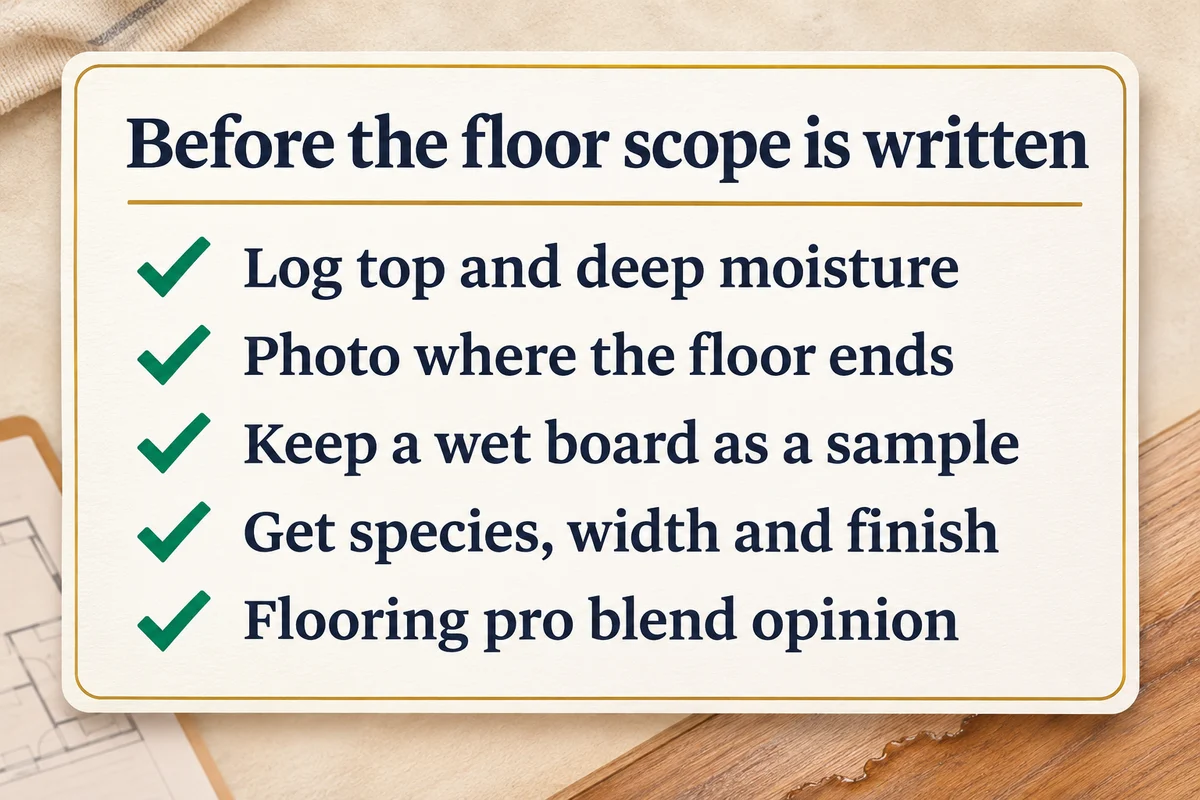
- Wide photos from one room into the next showing the boards running through with no threshold, and close photos of each threshold that does exist. Our list of what to photograph after property damage covers the rest of the house.
- The moisture log, surface and depth, up to the day the floor is ready to sand.
- One removed board kept as a sample, bagged and labelled with the date and the spot. Don't throw out the removed flooring until the carrier has seen it or agreed in writing that it can go.
- The species, board width, grade and finish. The original invoice or a leftover box helps; without them, a flooring contractor can usually identify the wood from the sample.
- A written opinion from a flooring contractor on whether new boards and a patch refinish will blend with the existing floor, and if not, why: a discontinued product, a finish aged by sunlight, a stain colour that new wood won't take the same way.
- Readings of the subfloor and underlayment, since wet plywood under dry-looking boards changes the scope again.
Other floors with the same question
The same where-does-it-stop question comes up with every floor that runs between rooms. What changes is why a patch is hard to hide.
| Floor | What makes a patch hard |
|---|---|
| Engineered wood | It can be sanded only as far as its top layer of real wood allows. A thin layer may not take a full refinish, which pushes the scope toward new boards. |
| Laminate | It can't be sanded at all, the boards click together across rooms, and a pattern bought years ago may no longer be sold. |
| Vinyl plank | The same click joints as laminate, and the same problem with patterns that have left the market. |
| Tile | Size and shade both have to match. The FC&S editors answered one case where an insurer wanted 18-inch tile cut down to fit a 16-inch floor: cutting it, they wrote, did not return the floor to its pre-loss condition (PropertyCasualty360). |
When the floor scope is already written
A floor is where a reasonable-looking estimate can leave a visible line through the middle of a house. If yours pays for the wet boards and the same floor keeps going past them, we review the estimate and the policy free of charge. Our fee is a percentage of the recovery set by Illinois law, agreed in writing, with nothing upfront. The water damage claims page explains how we work these losses, our guide to matching on Illinois roofs and siding covers the same argument outside the house, and you can call us at (630) 297-8136, seven days a week.
Questions we get about this
Will insurance replace my whole hardwood floor if only part of it got wet?
It depends on your policy and on the floor. New boards usually go in only where the wood is damaged, but if the same floor runs without a threshold into other rooms and a patch would stay visible, the claim may include sanding and refinishing the whole connected area. Some policies have an endorsement that limits matching, so read yours first.
Should I let anyone sand a cupped hardwood floor right after a leak?
Not until moisture readings at the surface and deeper in the boards are close to each other and to a dry room. A cupped floor sanded too early can crown later as it keeps drying, and the carrier may then treat the crowning as a workmanship problem rather than part of the water loss.
Where does a hardwood floor stop for an insurance claim?
Usually at a doorway with a threshold or transition strip, at a change of material, or where the boards change direction. Open doorways where the same boards continue do not stop the floor. Wide photos showing the boards running from room to room are the simplest proof.
What if the insurer says a patch will blend but my contractor says it won't?
Get your contractor's opinion and estimate in writing. Under the Illinois claims rule for property estimates, the company must answer a higher written estimate promptly in writing and either name a contractor who will do the work in a workmanlike manner or tell you that reasonable costs above its estimate will be reimbursed.