Space heater or appliance fire: protecting your insurance claim
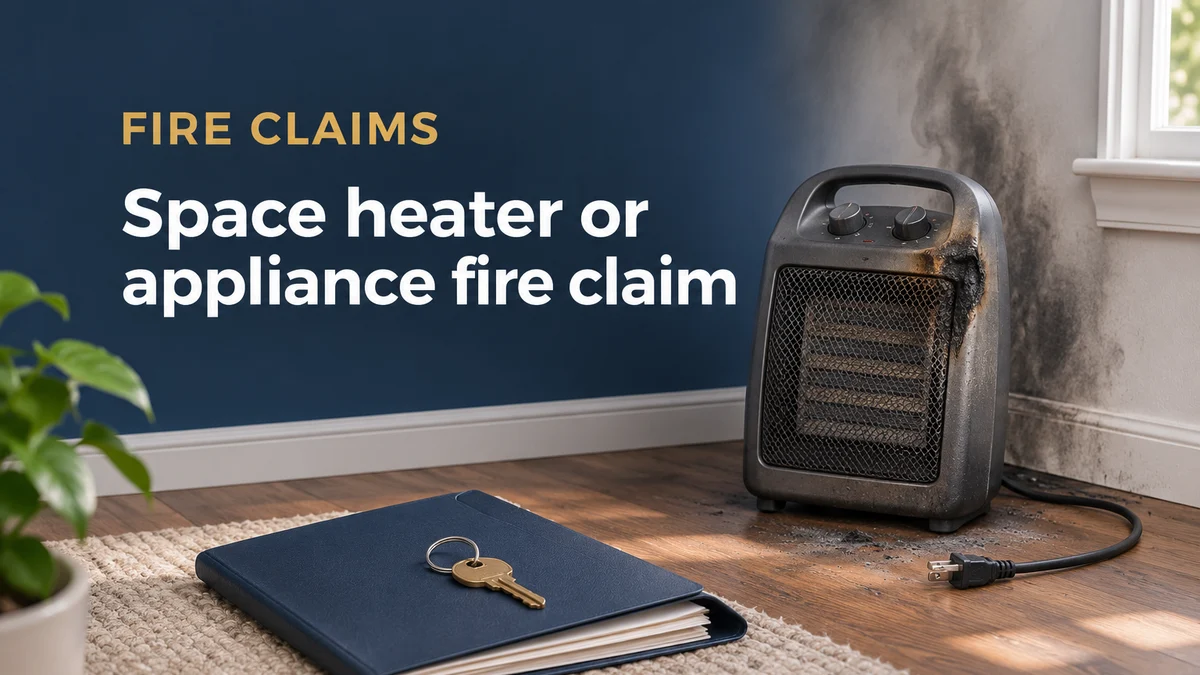
When a space heater, dryer, dehumidifier or any other appliance starts a house fire, your homeowners policy pays it the way it pays any covered fire: the repairs, your belongings and the cost of living somewhere else while the house is fixed. The product only changes what happens around that claim. Someone will want to examine the burned unit, your carrier may later try to recover what it paid from the manufacturer, and the money the policy never paid you, starting with the deductible, rides on that recovery. Most of it is decided by what you keep in the first days.
Your own policy and its endorsements govern everything below. We are licensed Illinois public adjusters, not attorneys, so this is how these claims commonly run, not legal advice.
Two separate tracks after an appliance fire
An appliance fire produces two different files. Yours is the claim under your policy. The second is the carrier's attempt to get its money back from whoever made or sold the product, called subrogation. They run at different speeds and the first should not wait for the second.
| Your claim | The carrier's recovery from the maker | |
|---|---|---|
| Who runs it | You, with your carrier's adjuster | Your carrier, often through a lawyer it hires |
| What it is about | What the fire damaged and what the policy owes | Whether the product failed and who is responsible |
| What it needs from you | Proof of loss, inventory, estimates, receipts | The unit, the scene as it was, your cooperation and signatures |
| How long it takes | Months, usually | Often years |
| What it can put in your pocket | Everything the policy covers | Part of what the policy did not cover, such as the deductible |
In Illinois the claims rule at 50 Ill. Adm. Code 919.50(a) asks a company to tender payment within 30 days for the portions of a claim that are not in dispute once it has affirmed liability, and to explain a lower offer in writing. Nothing there pauses your payment while the company decides whether to sue a manufacturer. If an adjuster says the claim is on hold until the investigation of the product finishes, ask in writing which part of your loss is in dispute and why.
Keep the unit, and write down where it was
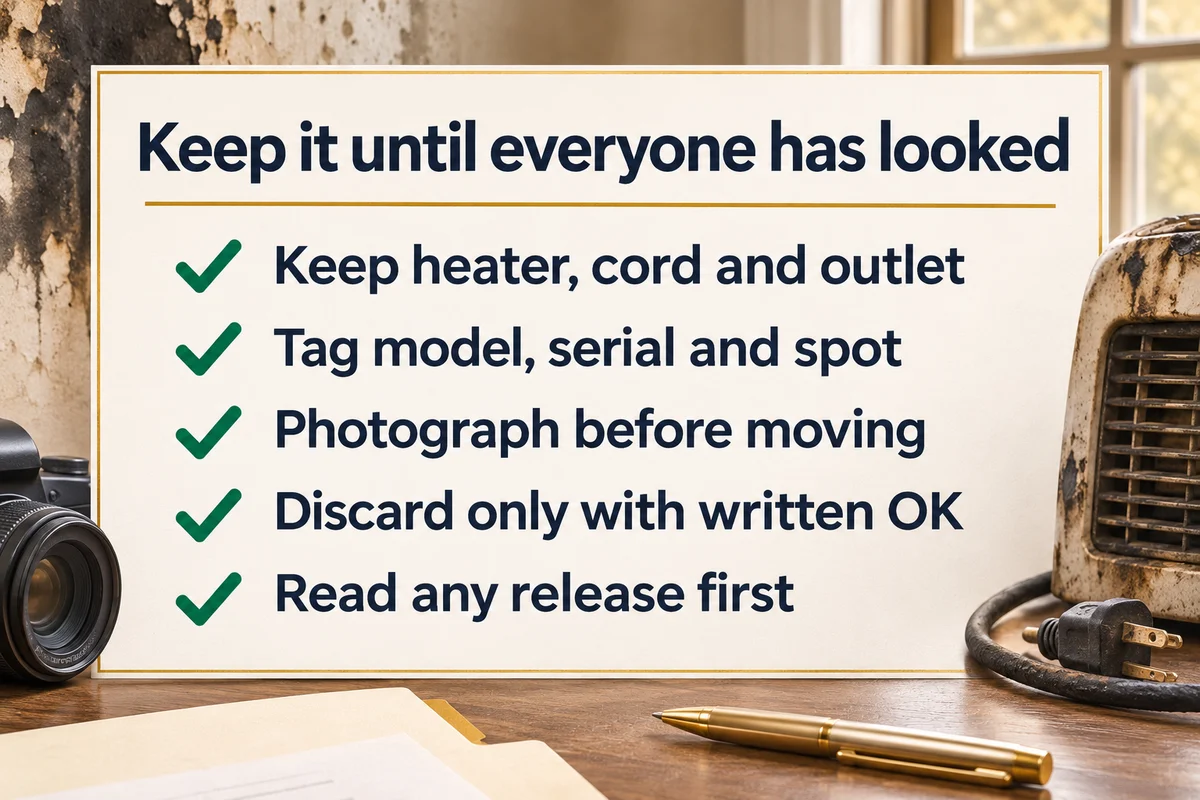
The burned appliance, its cord, the outlet or power strip it was plugged into and the debris directly around it are the evidence of what started the fire. A cleanup crew that bags everything for the dumpster can end a recovery in an afternoon. Leave the area where the fire started untouched until your carrier tells you in writing that its investigator is finished or doesn't need it. Board-up and water extraction elsewhere in the house can go ahead, and our guide to emergency mitigation and board-up bills covers how those are paid.
When the unit is moved, it should leave with a record like this one taped to the bag or box:
Evidence tag, fire of November 9
ItemPortable electric heater, cord and plug
Brand, model, serialFrom the label, or photo of what is left of it
Where it stoodBack bedroom, north wall, 14 inches from the curtain
Plugged intoWall outlet, lower socket; outlet cover kept
Photographed by and whenOwner, November 9, before anything moved
Now held byName, company and address of whoever took it
Example tag. The date, room and distances are invented; write your own.
- Photograph and film the unit where it sits, from across the room and close up, before anyone touches it. Include the outlet, the cord path and anything that burned near it.
- Find the brand and model from a label, the box, an order confirmation or a photo taken before the fire. A model number lets you search it for a recall and lets the investigator order an identical unit to compare.
- Ask your carrier in writing who will collect the unit, when, and where it will be stored. Keep their reply.
- If the carrier doesn't want it, ask for that in writing too, and keep the unit yourself in a dry place in a sealed bag until you have talked to an attorney about your own uninsured losses.
- Ask for a copy of the fire department's incident report, and note the name of any fire investigator who came to the house.
The joint scene exam: who comes, and what you do that day
When a product looks like the cause, the carrier's origin and cause investigator often waits so that the manufacturer and anyone else who may be blamed can send their own people to the same examination. Expect an electrical engineer, one or more investigators and sometimes a lawyer. The unit may be photographed, x-rayed or taken apart only when every side is present.
Your job that day is small and specific. Let them in, show them where things were, and answer questions about what you saw and when. You don't need to have a theory of the cause, and guessing ("it was probably the extension cord") doesn't help anyone. Ask for the names and companies of everyone who attends. If the house still needs repairs scoped, this is a good day to have your contractor or adjuster measure the rooms too, since the debris may be cleared soon after.
What the subrogation condition in your policy says
Most homeowners policies follow the standard industry form, which the FC&S editors quote in their basics of subrogation:
An "insured" may waive in writing before a loss all rights of recovery against any person or organization. If not waived, we may require an assignment of rights of recovery for a loss to the extent that payment is made by us. If an assignment is sought, an "insured" must sign and deliver all related papers and cooperate with us.
| The sentence | What it means after a fire |
|---|---|
| Waive in writing before a loss | Any waiver had to be signed before the fire. Signing one now, for example in a settlement with the store that sold the heater, can cost you coverage. |
| Assignment to the extent that payment is made by us | The carrier takes over the right to recover what it paid. The part it did not pay, such as your deductible, is not in those words. |
| Sign and deliver all related papers and cooperate | Refusing the paperwork can put your own claim at risk. Reading it first, and asking for changes where it reaches too far, is part of cooperating. |
Your policy may word this differently, and some carriers fold it into a section called Transfer of rights of recovery. Read yours in full.
Your deductible and the rest of what the policy left out
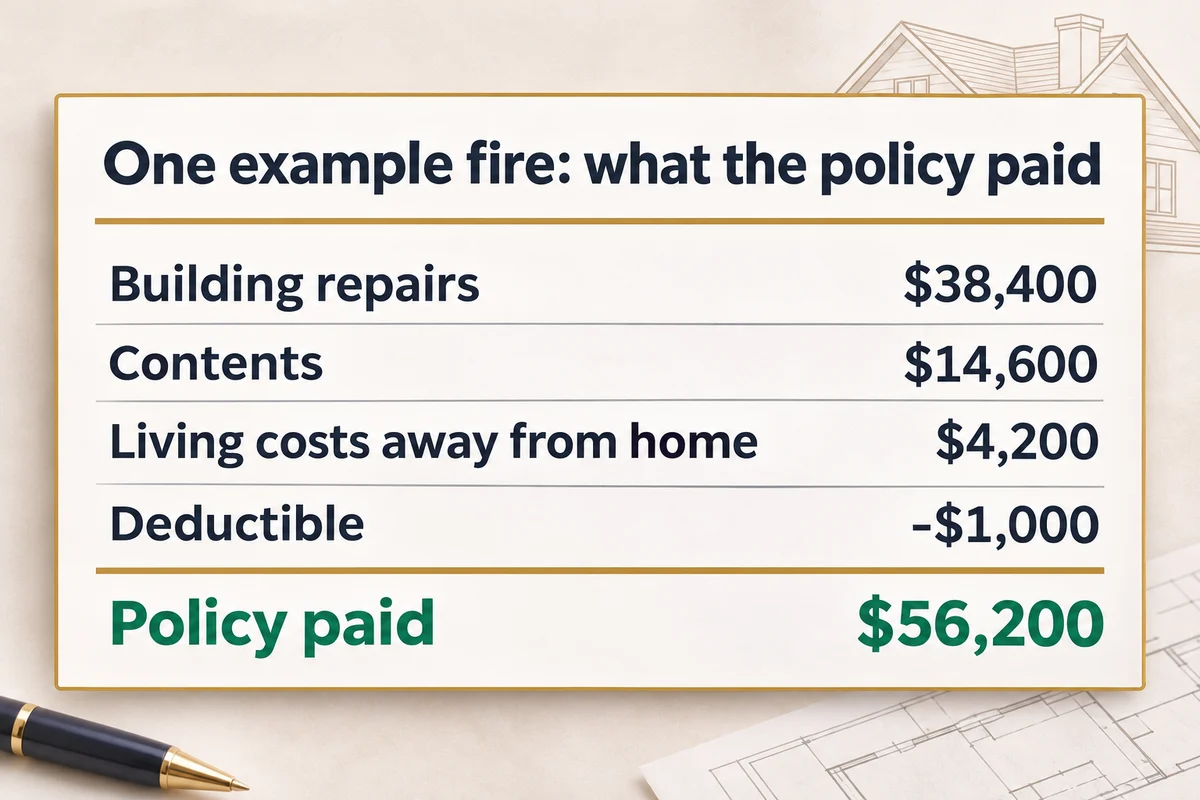
Here is one fire, invented for the example, with figures that add up. The heater burned a bedroom and smoke reached the rest of the house. The family spent seven weeks in a rental, and $900 in cash in a dresser burned. Many homeowners forms cap money at $200 in their special limits, so the policy paid $200 of it.
The $56,200 is the carrier's to recover. The $1,700 is the family's. When a carrier collects in full from the party at fault, the usual practice described in the FC&S article is that it includes the deductible in its demand and passes it back to the insured. When it settles for less than it paid, how much of the deductible comes back depends on the carrier and on what you agreed. Illinois has a statute requiring a share of the recovered deductible to go to the insured (215 ILCS 5/143b), but it is written for auto collision coverage, so on a house ask the question in writing early: will you include my deductible in your demand, and how will you share a partial recovery?
The $700 of cash, and anything else your policy excluded or capped, is not part of the carrier's recovery at all. If it is worth pursuing, it is your own claim against the maker, with its own deadlines, and that is a question for an attorney.
Before you sign a subrogation receipt or release
Months after the fire, a letter may arrive from a law firm working for your carrier with a subrogation receipt, an assignment or a release to sign. It is usually routine. Read it for these four things first:
- Whether it assigns only what the carrier paid, or every claim you have against the manufacturer, including the deductible and the losses the policy did not cover.
- Whether it says, or implies, that your claim under the policy is closed. Open items such as recoverable depreciation, a supplement for hidden damage or more living costs should still be open after you sign.
- Whether the amount it lists as paid matches your own records.
- Whether it says how a recovery will be shared with you.
If the paper reaches further than the payment it describes, ask the carrier to narrow it before you sign, and get the change in writing. If you have significant uninsured losses or an injury in the household, have an attorney read it.
When the carrier hints the fire was your fault
A heater too close to a curtain, a dryer vent full of lint, an appliance running on a light extension cord: carelessness is the most common cause of these fires, and it is not one of the exclusions in a standard homeowners form. Fire is a covered peril there whether or not someone was careless. The exclusion people confuse it with is intentional loss, which is about a fire somebody set on purpose. Your policy governs, so if a denial or a reduced offer cites carelessness, ask for the exact policy wording it relies on. Carelessness can still matter to the recovery, because a manufacturer will point to misuse, which is one more reason to describe what happened factually and not guess.
What we look at on an appliance fire
We don't investigate the cause; that belongs to the investigators. We document the whole loss: the smoke that travelled through the house, the contents list, the living costs and the repairs, so that your claim is paid in full on its own track whatever the recovery does. Our fire damage claims page explains how we work these losses, our guide to the contents inventory after a fire covers the list that usually decides the size of the settlement, and smoke damage in rooms the fire never reached explains how soot gets scoped. We review the estimate and the policy free of charge; our fee is a percentage of the recovery set by Illinois law, agreed in writing, with nothing upfront. Call (630) 297-8136, seven days a week.
Questions we get about this
Does homeowners insurance cover a fire started by a space heater?
A standard homeowners policy covers fire as a peril, and a space heater or other appliance starting it doesn't change that. The policy pays the covered repairs, contents and living costs, minus the deductible. Your own policy and its endorsements govern the details.
Should I throw away the appliance that caused the fire?
No. Keep the unit, its cord, the outlet and the debris around it where they are until your carrier confirms in writing that its investigator is finished or doesn't need them. The manufacturer may be responsible for the fire, and without the unit that can rarely be shown.
Will I get my deductible back if my insurer sues the manufacturer?
Often, if the insurer recovers in full, because it usually includes the deductible in its demand and passes it back. With a partial recovery it depends on the insurer and on what you agreed. Ask in writing early whether your deductible is in the demand and how a partial recovery will be shared.
Do I have to sign the subrogation papers my insurer sends?
Most policies require you to sign the papers needed to assign the insurer's rights of recovery and to cooperate. Read them first: they should cover what the insurer paid, not your uninsured losses, and they should not close your own claim. Ask for changes in writing, and have an attorney read them if your uninsured losses are significant.