Hail damage to siding: how to tell it, prove it and claim it

Hail damage to siding is usually covered by an Illinois homeowners policy as part of the windstorm or hail loss, under the same claim and the same deductible as the roof. The argument is rarely about whether siding is covered. It is about whether a given crack or dent was made by hail, by this storm, and how much of the wall has to come off because of it. That is a question of evidence, and much of the evidence sits on the outside of your house for only a few weeks.
We are licensed Illinois public adjusters, not attorneys. The wording we describe is from the widely used homeowners form. Your own policy and its endorsements govern.
What does hail leave on each kind of siding?
Hail does not mark every material the same way, and a carrier's inspector reads each one differently. Find the card for the material on your walls.
Vinyl
Hail cracks vinyl rather than denting it. Expect cracks across the face of a panel or along its bottom lip, pieces broken out, and sometimes a round hole. Older, sun-faded vinyl breaks more easily than new.
A single crack beside a stair, a grill or a downspout, a split running along the nail line, or chips only at lawn-mower height on one wall usually have another cause.
Aluminum and steel
Metal siding holds the dent. Hail leaves round dents scattered across the panel face at every height, often with the paint still on, and more of them on the side the storm came from.
Long scrapes, a row of dents at the height of a ladder or a bicycle handlebar, and dents in only one panel point to something that touched the wall, not something that fell on it.
Fiber cement
Fiber cement is hard but brittle. Hail can crush small spots in the face, knock paint off in round patches, break corners and edges, and start cracks that run out from an impact.
Hairline cracks along the fastener lines, swelling at the bottom edge where water sits, and cracks at the butt joints are installation or moisture problems a carrier will separate out.
Wood
On wood, look for dents in the softer grain and paint knocked off in spots with clean, bright wood showing underneath.
Grey checking along the grain, paint peeling in wide sheets, and soft or rotted lower courses are age. They do not stop the fresh marks from being paid, but they will be pointed out.
Is it hail, or something else?
A carrier's inspector asks three things about every mark: does it look like an impact from above, is it on a side the storm reached, and is it new. A mark that fails one of those gets written off as wear, installation or some other event. The table shows which other cause they usually have in mind and what answers it.
| Mark | Reads as hail when | Reads as something else when | What settles it |
|---|---|---|---|
| Cracked vinyl panels | Cracks repeat across one or two walls at random heights | There is one crack, next to a hose reel, a grill or the deck stairs | A wide photo of each wall with every crack marked, then close-ups |
| Dents in aluminum or steel | Round dents are scattered top to bottom | Dents line up at one height or sit on one panel | The same dents on the gutters and downspouts of that side |
| Chipped fiber cement or wood | Chips have clean, bright edges | Edges are dirty, weathered or painted over | Close photos with a tape measure in frame, taken soon after the storm |
| Torn screens, flattened AC fins | They face the same way as the damaged siding | Only one window or one face of the unit is affected | A storm report for your area on the date you give |
Why does the side of the house matter so much?
Hail is driven by the wind, so a storm from the west marks the west-facing walls and can leave the east side clean. A carrier expects that pattern. Damage spread evenly on all four sides, or found only on the sheltered side, reads as wear or a different cause. Before you look for damage, find out which way the storm moved. The NOAA Storm Events Database lists reported hail by county and date, and your local National Weather Service office publishes storm reports for recent events.
The wall facing the storm
Most of the siding damage, torn window screens, dented downspouts and the flattened face of the AC condenser if it sits on this side.
The two walls beside it
Fewer marks, often in a band toward the corner nearest the storm. Photograph them as carefully as the main wall: these are the walls a quick inspection skips.
The sheltered wall
Usually little or nothing. Photograph it anyway. It shows the siding's condition without the storm, and if replacement panels cannot match, it is the wall that question will be about.
The metal on every side
Gutters, downspouts, vent caps, the mailbox, a grill lid. Soft metal dents more readily than siding and backs up the direction your siding photos show.
Can the carrier call a dented wall cosmetic?
Yes, if your policy carries a cosmetic damage endorsement that reaches siding. These endorsements exclude hail marks that change how a surface looks without changing how it keeps water out. Some apply only to the roof covering, some only to metal roofing or siding, some to every exterior surface. Three things to read in the endorsement itself:
- the list of surfaces it applies to, and whether siding or 'exterior walls' is on it;
- how it defines a loss that affects function, such as a crack or a hole that lets water in;
- whether it gives back resulting damage, so that water entering through a hail opening is still paid.
On siding the split is fairly clean. A cracked or holed vinyl panel no longer sheds water the way it was made to, which is hard to call cosmetic. A shallow dent in aluminum that has not opened a seam is the case these endorsements were written for. We go through the endorsement in more detail in our article on roof age and cosmetic damage endorsements.
What a panel count leaves out
An estimate that says 'replace 14 panels' prices fourteen panels. Siding goes back on a wall as a system, and the parts around the panels are separate lines that have to be written in:
- the weather-resistive barrier behind the panels, where it is torn when the old courses come off;
- J-channel, starter strip, inside and outside corners and the trim around windows and doors that the new courses lock into;
- detaching and resetting what is fastened through the siding: light fixtures, the dryer vent hood, hose bib covers, the mailbox, satellite brackets;
- gutters, downspouts and window screens on the same side, which are separate items with their own photos;
- the whole elevation when the damaged panels are spread across it, rather than a count of the worst ones.
A worked example: one storm, two estimates
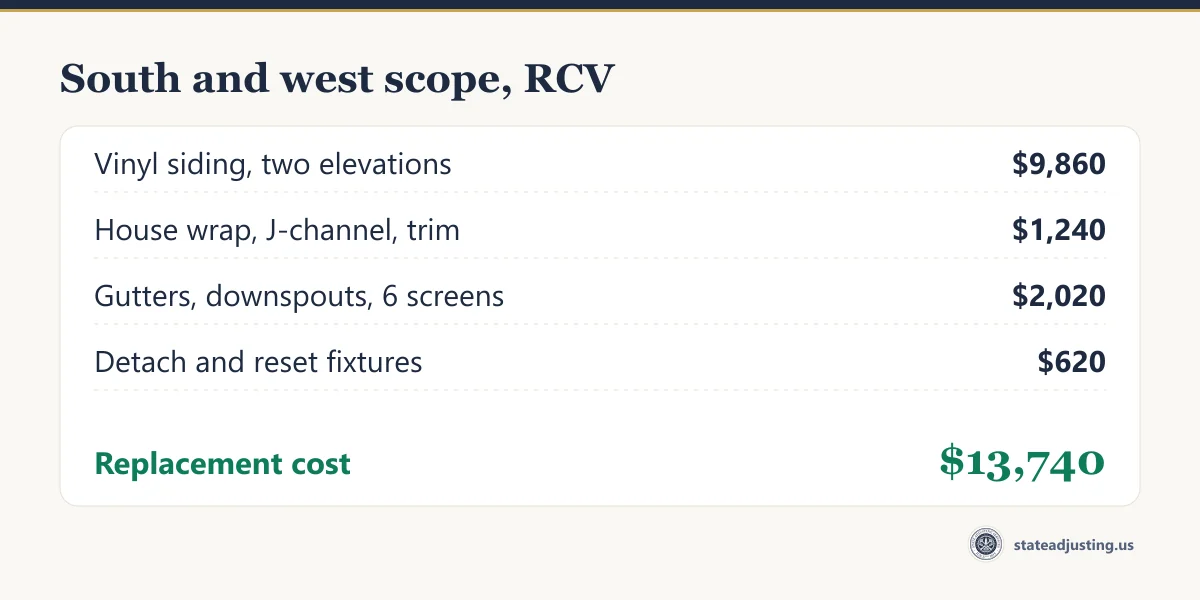
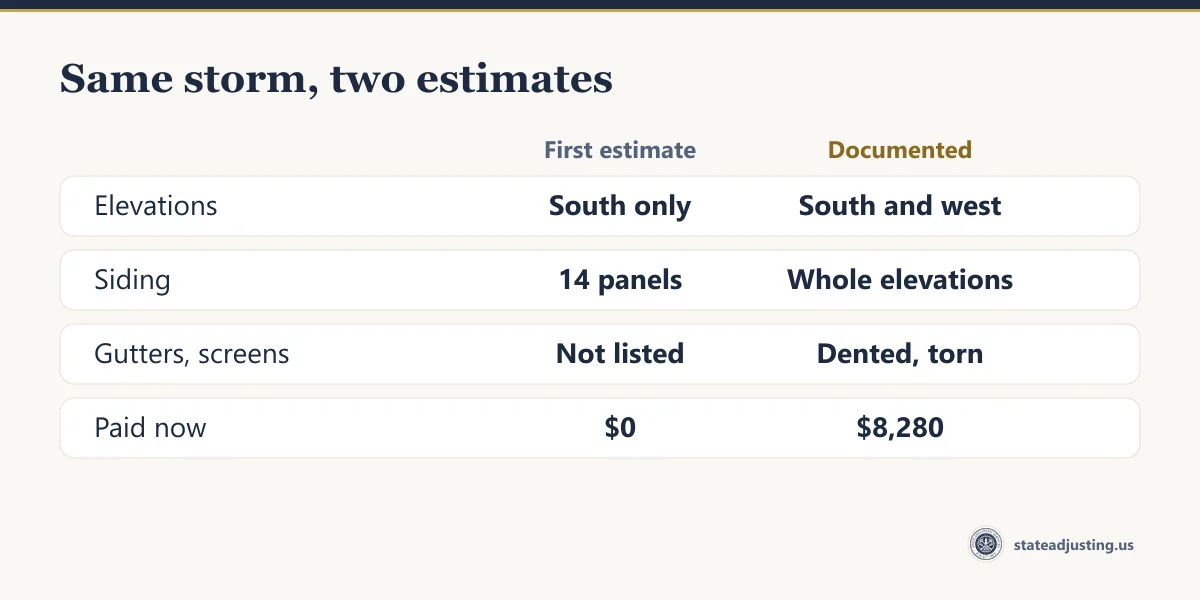
A house we made up for the arithmetic: vinyl siding, a 2,500 dollar deductible, a hailstorm out of the west. The first inspection walked the front of the house, which faces south, counted 14 cracked panels and priced them at 2,180 dollars. That is below the deductible, so the claim closed with nothing paid. The homeowner asked for a re-inspection and sent, before it, wide and close photos of the west wall with cracked panels at every height, the dented west gutters and downspouts, six torn screens on the west and south windows, and a storm report for the date.
| Line | First estimate | After re-inspection |
|---|---|---|
| Vinyl siding | 2,180 (14 panels, south) | 9,860 (south and west elevations) |
| House wrap, J-channel, trim | 0 | 1,240 |
| Gutters, downspouts, 6 screens | 0 | 2,020 |
| Detach and reset fixtures | 0 | 620 |
| Replacement cost | 2,180 | 13,740 |
| Less depreciation | not reached | 2,960 |
| Less deductible | 2,500 | 2,500 |
| Paid now | 0 | 8,280 |
Nothing in the first estimate was denied. It was a smaller scope, written from one wall. The 2,960 dollars of depreciation is paid later if the policy settles at replacement cost and the work is completed. The north and east walls are in neither column: replacing them would add about 8,900 dollars in this example, and whether that is owed is the matching question below.
What about the walls hail never touched?
When new panels on the damaged walls cannot reasonably match the rest of the house, whether the carrier pays for the undamaged walls depends on your policy's wording. Illinois has a case on almost exactly this. In Windridge of Naperville Condominium Association v. Philadelphia Indemnity Insurance Co., a 2014 hailstorm damaged aluminum siding on the south and west sides only, matching siding was no longer made, and the insurer paid for the damaged sides alone. The federal appeals court in Chicago, applying Illinois law, found the policy unclear about its unit of covered property and read it in favor of coverage for the buildings as a whole, as Business Insurance reported in 2019. That result turned on that policy's words. It is not a rule for every house.
Two things help long before that argument starts. Look in the garage or basement for leftover panels from the original job: a box with its label gives the maker, profile and colour, so the search for a match runs on facts. And ask the carrier in writing what it found when it looked for a match. Our article on matching roofs and siding in Illinois covers how to document a mismatch.
What to do in the first weeks after hail
- Find the date and direction of the storm from the NOAA database or a National Weather Service storm report, and write the date down. If two storms came through, the date you report decides which one the claim is for.
- Photograph every wall in even light, an overcast day or mid-morning, first from far enough back to show the whole wall, then each mark with a tape measure in the frame.
- Photograph the metal on each side: gutters, downspouts, the AC unit, vent caps, screens.
- Cover any vinyl or fiber cement that is broken open where water can get behind it, and keep the receipt for the materials.
- Report the siding in the same claim as the roof, wall by wall. The carrier inspects what it is told about.
- When the estimate arrives, check which elevations it names and whether wrap, trim, fixtures, gutters and screens appear. Ask in writing for a re-inspection of anything missing, with your photos attached.
- Look for leftover siding before anyone starts tearing off.
If your estimate looks like the first column above, we will review it free of charge. There is nothing to pay upfront, and no fee if nothing is recovered. You can see the kinds of hail damage claims we handle, read how a claim runs with us, or send us your estimate and photos.
Questions we get about this
Does homeowners insurance cover hail damage to vinyl siding in Illinois?
Usually yes. Hail is a covered windstorm or hail loss under the dwelling coverage of a typical Illinois homeowners policy, paid after the deductible. A cosmetic damage endorsement, a separate wind and hail deductible or the policy's own loss settlement terms can change what is paid, so your declarations page and endorsements govern.
Is a dent in aluminum siding enough for an insurance claim?
A dent is physical damage and many policies pay for it. If your policy has a cosmetic damage endorsement that lists siding or exterior walls, dents that do not affect how the siding keeps water out may be excluded. Read the list of surfaces in the endorsement itself.
How soon after a hailstorm should I report siding damage?
Policies ask for prompt notice, and some set a time limit for wind and hail claims, so read the duties after loss section of yours. Fresh impact marks are easiest to tell from old ones in the first weeks, which is when photographs do the most work.
Will the carrier replace siding on the walls that were not hit?
Only if your policy's wording supports it when the repair cannot reasonably match. In one Illinois siding case a federal appeals court read unclear policy wording in favor of replacing all of it, but the answer depends on your policy and on whether a match exists.