Snow load damage: what a homeowners policy pays when the roof sags, cracks or falls
A snow damage claim for weight, not meltwater, is usually payable on a standard Illinois homeowners policy, but the answer changes with what the snow actually did. A roof that fell in is handled by one sentence of the policy. A roof that only sagged is handled by another, and that sentence often pays nothing. Gutters torn off by sliding ice sit under a third. Knowing which one applies to your roof tells you what the carrier will argue and which record answers it.
We are licensed Illinois public adjusters, not attorneys. The wording below is from the widely used homeowners form. Your own policy and its endorsements govern.
Which sentence of the policy answers a snow loss?
The house itself is usually insured for any direct physical loss that is not excluded, so weight of snow does not need to be named for the dwelling. Collapse is the exception: the form excludes it and then gives it back through a separate additional coverage. Insurance Journal's forms columnist walks through the same sentences.
| What was damaged | The sentence that applies | What it means for you |
|---|---|---|
| Roof, framing or ceiling that fell in | Additional coverage for collapse, which lists the perils named for personal property, and weight of ice, snow or sleet is one of them | Paid inside the dwelling limit, no extra money. The fight is about cause, covered below. |
| Roof that sagged or cracked but is still standing | The same collapse wording, which says a building in danger of falling down is not in a state of collapse | Often refused as a collapse. Separate damage, such as a broken ceiling or a torn deck, is still argued on its own. |
| Gutters, vents, skylights, a satellite dish torn off by sliding snow or ice | The open-perils dwelling cover | Payable unless the carrier shows wear, deterioration or another exclusion caused it. |
| Footings, foundations, retaining walls, fences, patios, pavement | The exclusion for freezing, thawing, pressure or weight of water or ice to those items | Not paid for ice pressure or weight, by name. |
| Belongings in the house or garage | The contents peril: weight of ice, snow or sleet which causes damage to property contained in a building | Paid. Patio furniture and a grill left outside are not inside a building, so this peril does not reach them. |
Sag, crack or fall: where your roof sits changes the claim
The collapse wording defines collapse as an abrupt falling down or caving in of a building or part of one. A part of a building that is still standing is not in a state of collapse, even if it shows cracking. Robert Prahl sets out that definition and how it came about in Adjusting Today. In practice that gives three different claims.
It sagged, and you shored it in time
Nothing fell, so the collapse coverage usually does not respond, and the shoring itself is generally treated as protecting against a loss that has not happened yet. If drywall cracked, a ceiling tore or water got in, those are separate items and worth putting in front of the carrier with photographs. Ask for any refusal in writing.
Members broke, but the roof is still up
A cracked rafter or a split truss chord is a real loss, and this is where the wording gets argued. The carrier may say it is excluded collapse in waiting. The answer is to get a written structural finding on each broken member and claim it as direct physical damage, not as a collapse.
It came down
This is the case the collapse coverage was written for. The roof, the framing, the ceiling below, and whatever the falling structure hit inside are part of the loss. The carrier's question becomes whether snow caused it or something older did.
How much did the snow on your roof weigh?
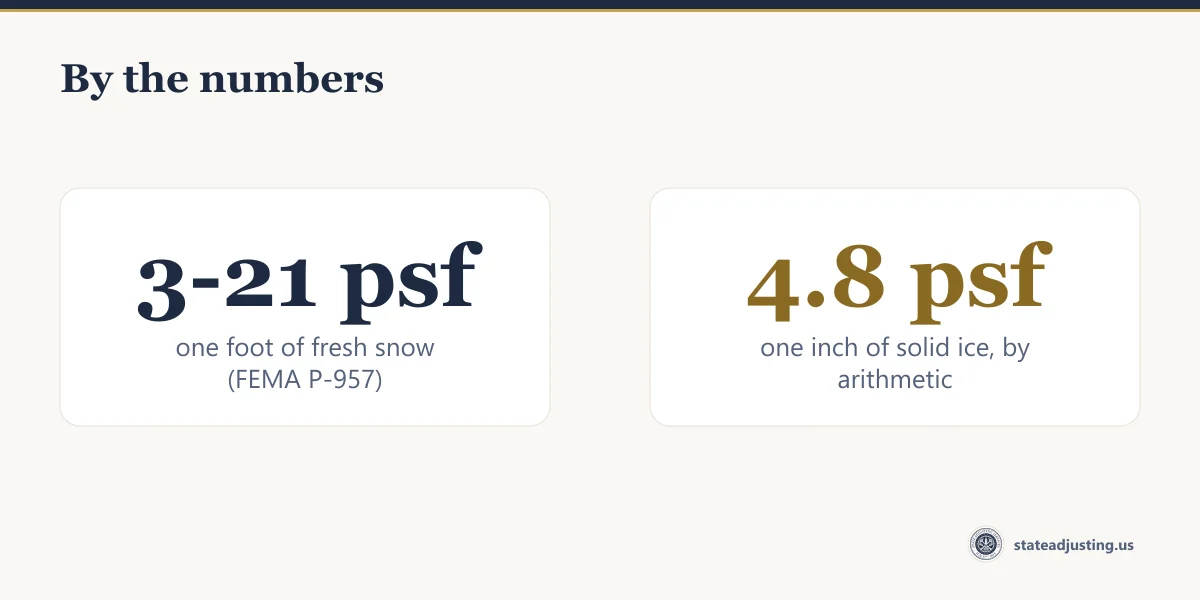
Enough to matter, and you will need to show the number. FEMA's Snow Load Safety Guide (FEMA P-957) puts one foot of fresh snow at 3 pounds per square foot when light and dry, and up to 21 pounds when wet and heavy. Ice is heavier still. Water weighs about 62.4 pounds per cubic foot and ice about nine tenths of that, so one inch of solid ice is close to 4.8 pounds on every square foot.
An attached garage roof, 24 by 24 feet, after a wet storm
- Roof area
- 576 sq ft
- Snow drifted off the house roof onto the lower garage roof: 2 feet, wet
- 2 x 21 = 42 psf
- Weight of the snow
- 42 x 576 = 24,192 lb
- A one-inch ice layer under it
- 4.8 x 576 = 2,765 lb
- Load on that roof
- about 26,957 lb
These figures are an illustration. The real number on your roof depends on depth, density and drifting, and lower roofs next to a taller wall collect drifts deeper than the snow on the lawn. A carrier will not accept a depth from memory. Photograph the snow with a tape measure in the frame from a window or the ground before anyone clears it, and download the daily snowfall and snow depth for the nearest station from NOAA's Climate Data Online.
The carrier says the framing was old. What answers that?
Most snow load disputes are about cause, not price. The denial letter will usually say the roof failed from deterioration, poor construction or a past repair, with the snow only the last straw. Each version is answered by a different record.
| What the carrier argues | The record that answers it |
|---|---|
| There was not enough snow to break a sound roof | Your tape-measure photographs, the NOAA station data for the days before the failure, photographs of the drift against the upper wall |
| The wood was rotted or the truss was already damaged | The broken members themselves, kept and photographed. A fresh break shows clean, bright fibres. Rot shows dark, soft, crumbling wood. |
| The roof was at the end of its life | The roof replacement invoice, the home inspection report from your purchase, any roofer's inspection |
| A previous owner cut or altered the framing | Permits on file with the municipality, and an engineer's finding on whether that alteration was what failed |
| It happened slowly over the winter | The date you first heard cracking or saw the sag, written down that day, against the dates of the storms |
If the carrier sends its own engineer, read the report for which members were actually examined. Our guide to reading a carrier's engineering report goes through that page by page.
The parts that are not a snow load claim at all
- Clearing snow off a roof that has not been damaged is upkeep, and the policy does not pay for it. Clearing a roof that has already failed, to stop more damage, is a different matter and should be invoiced separately.
- Water from ice backing up under the shingles is an ice dam claim, decided by different arguments. See ice dam damage and insurance.
- Snowmelt that runs across the yard into the basement is surface water, excluded from the homeowners policy. Our page on sewer backup versus flood explains the separate coverages.
- A car crushed in the garage is claimed on the auto policy's comprehensive coverage, with its own deductible.
- A detached garage or shed is paid from the other structures limit, usually 10% of the dwelling limit for all of them combined. More on that in what Coverage B pays for.
A worked example: the attached garage that gave way
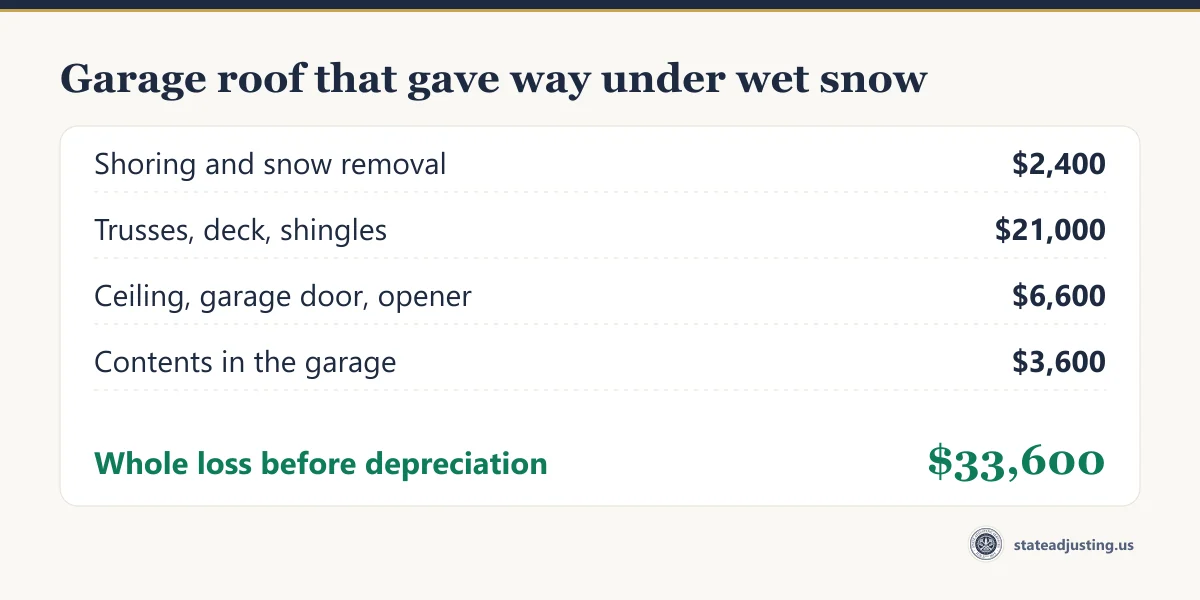
The figures are an illustration, not a client result. After two days of wet snow, the roof over a 1996 attached garage cracks in the night and three trusses come down onto the garage door and the shelving. The rest of the trusses are bowed. The house roof is undamaged.
| Line | Amount |
|---|---|
| Emergency shoring and clearing the failed roof | $2,400 |
| Trusses, roof deck, shingles and underlayment | $21,000 |
| Garage ceiling drywall and insulation, garage door and opener | $6,600 |
| Contents: snow blower, shelving, tools, stored boxes | $3,600 |
| Whole loss before depreciation | $33,600 |
Suppose the carrier takes $3,400 of depreciation, mostly on the 12-year-old shingles and the used contents, and the policy has a $1,000 all-perils deductible. A wind and hail deductible is a separate figure and normally does not apply, because snow is neither. That gives $33,600 minus $3,400 minus $1,000, a first payment of $29,200, with up to $3,400 more after the work is done if the policy pays replacement cost on the building and the contents.
Two lines in this file get argued most often. The bowed trusses that did not fall can be scoped as standing and therefore outside collapse, which would remove most of the $21,000 framing line. A written finding from the framer or an engineer that bowed trusses cannot be reused answers that. And if the carrier decides the trusses failed because of a past alteration, the whole $33,600 becomes a coverage question rather than a price question, and that is a point for an attorney.
The first 48 hours after a roof gives way
- Get everyone out of the rooms under the damaged area. Do not go up on the roof.
- Photograph the snow with a tape measure in the frame, from inside or from the ground, before it is cleared.
- Report the loss to your carrier the same day and write down the claim number.
- Hire a contractor to shore the structure and clear the failed roof. Keep the invoice apart from the repair estimate. Our guide to emergency mitigation bills covers what to read before signing.
- Keep the broken pieces of framing, or at least photograph every break up close before it goes in a dumpster.
- Download the NOAA daily snow data for the storm days and save it with the claim.
- If the carrier refuses or reduces the claim, Illinois rules require a reasonable written explanation (50 Ill. Adm. Code 919.50). Ask for the policy provision it relies on.
Where we come in
On a snow load file our work is the scope and the cause record: every member, every ceiling and every item in the garage written down, with the snow data and photographs set beside them. If the carrier turns the claim into a dispute over an exclusion, we say so and tell you it is a question for a lawyer. Our ice and snow damage claims page and our process show how a file runs with us. To have your estimate or denial read against the policy, contact us or call (630) 297-8136, Monday to Friday, 8:00 AM to 5:00 PM. The review is free. Our fee is a percentage of the recovery, agreed in writing and regulated by Illinois law, with nothing paid upfront.
Questions we get about this
Does homeowners insurance cover a roof that collapsed under snow?
On the widely used homeowners form, usually yes. Collapse is excluded and then given back through an additional coverage that includes the weight of ice, snow or sleet. The payment comes from the dwelling limit, less depreciation and your deductible. The usual dispute is whether snow caused the failure or older damage did, so photographs of the snow depth and the broken framing matter. Your own policy governs.
Is a sagging roof covered if it did not fall?
Often not as a collapse. The collapse wording says a building or part of a building in danger of falling down is not in a state of collapse, and a standing part is not in collapse even if it shows cracking. Separate damage such as torn drywall, a cracked ceiling or broken framing can still be claimed on its own, ideally with a written structural finding.
Does insurance pay for removing snow from my roof?
Not as routine upkeep. Clearing snow from a roof that has not been damaged is maintenance. Once a covered loss has happened, the reasonable cost of protecting the property from further damage, such as shoring and clearing a failed roof, is normally part of the claim. Keep that invoice separate from the repair estimate.
How do I prove how much snow was on my roof?
Photograph the snow with a tape measure in the frame from a window or from the ground before anyone clears it, photograph any drift against a taller wall, and download the daily snowfall and snow depth for the nearest weather station from NOAA's Climate Data Online. Write down the date you first saw the sag or heard cracking.