Commercial smoke damage claims: stock, equipment and lost income when the fire was next door
A commercial smoke damage claim does not need a fire at your own address. If the restaurant two doors down burned and your shop now smells of it, the claim is made on your own commercial property policy, with your own deductible. It is also larger than a cleaning bill. One smoke loss in a business has five separate parts, and the first estimate from the carrier usually prices one or two of them.
We are licensed Illinois public adjusters, not attorneys. Commercial policies differ far more than homeowners policies do, so the form and endorsements in your own policy govern everything below.
Does a commercial policy cover smoke from somebody else's fire?
On the widely used forms, usually yes. Many commercial policies are written on a special causes of loss form, which covers direct physical loss unless the form excludes or limits it. Smoke is not on the excluded list, apart from one narrow sentence:
"Smoke, vapor or gas from agricultural smudging or industrial operations."
Causes of Loss, Special Form CP 10 30 09 17, exclusion 2.c (sample copy published by the New York State Office of General Services)
A kitchen fire in the next unit is neither of those. The same form lists smoke among its "specified causes of loss", next to fire, lightning and explosion. That list matters in a second place. The form excludes the release of pollutants, and soot is the kind of residue a carrier may call a pollutant. The exclusion does not apply when the release was itself caused by one of the specified causes of loss, and fire and smoke are both on that list.
Policies written on a basic or broad form name their covered perils one by one instead. Smoke is normally one of the names, so the answer tends to be the same, but check which form your declarations page lists before the first call. Haze from a distant wildfire that leaves no residue is a different and contested question, and one for an attorney.
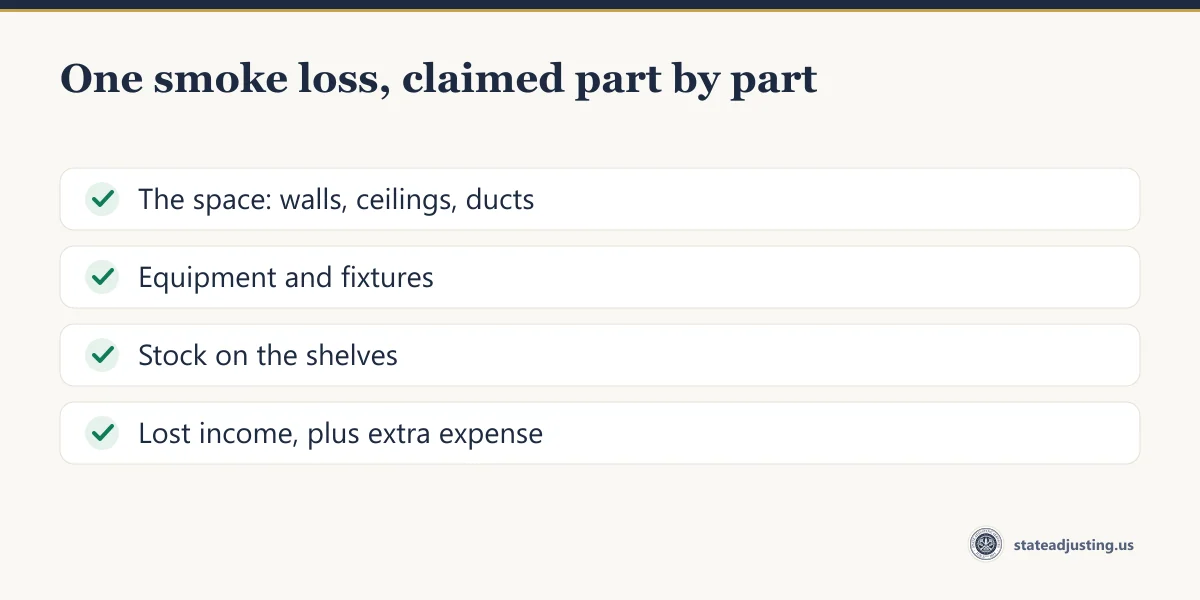
The five parts of one smoke loss
Each part is paid under a different line of the policy and proved with a different record. A claim that arrives as a single figure gets answered as a single figure, usually the cleaning one.
1. The space itself
Walls, ceilings, flooring, the ductwork and air handler, insulation above a drop ceiling. Oily soot has to be sealed with a primer before repainting, and ducts left dirty bring the smell back when the heat runs.
Proved by photographs taken before cleaning and a room-by-room scope.
2. Equipment and fixtures
Tills, computers, display cases, refrigeration, machines. Soot residue is chemically reactive on electrical contacts, so electronics are evaluated one by one, not wiped and passed.
Proved by an asset list with serial numbers and a technician's written finding per item.
3. Stock
Goods for sale, raw materials, packaging. Stock that did not burn can still be unsellable. The next section covers how that gets shown.
Proved by a count on the day, purchase invoices and your point-of-sale records.
4. Lost income
Net income plus the expenses that keep running while you are closed or slowed down. On standard wording a slowdown counts, and payment starts 72 hours after the physical loss.
Proved by monthly profit and loss statements and sales records for the same weeks last year.
5. Extra expense
Money spent to keep trading or to reopen sooner: a temporary unit, air scrubber rental, overtime for the cleaning crew, rush freight on replacement stock. It runs from the first day, with no 72-hour wait on standard wording.
Proved by invoices kept apart from the repair invoices, each with a note of what it saved.
Parts four and five only exist if your policy includes business income coverage. Our guide to business interruption claims explains how that figure is built and which declarations entries cap it.
What happens to stock that did not burn?
It ends up in one of three groups, and the carrier's first estimate tends to put all of it in the first. Sorting it yourself, item by item, before anything leaves the building is the most valuable day of work in the whole claim.
| Outcome | Typical goods | What you need on paper |
|---|---|---|
| Cleaned and sold as new | Sealed tins and glass, hard goods in closed cartons | The cleaning invoice, and a note that the odor was gone afterwards |
| Cleaned but only sellable at a markdown | Clothing after laundering, furniture, books | The price before and the price actually obtained, per item or per lot |
| Cannot be sold | Open food, cosmetics, medicines, porous goods that hold odor, anything a supplier or inspector says to discard | The written instruction to discard, photographs, the count, and purchase invoices |
Three cautions. Do not throw stock out before the carrier has had the chance to see it, unless an authority orders it, and then keep the order. If you sell food, ask your local health department in writing what it requires before you reopen and what has to go. That letter is evidence. And count the damaged stock physically. The special form does not pay for property that is simply missing where the only evidence is a shortage found on taking inventory, so a book figure with no count behind it invites exactly that argument.
How the policy prices stock, at your cost or some other way, is set by its valuation condition. Ask the adjuster in writing which paragraph is being applied.
A worked example: a clothing shop beside a restaurant fire
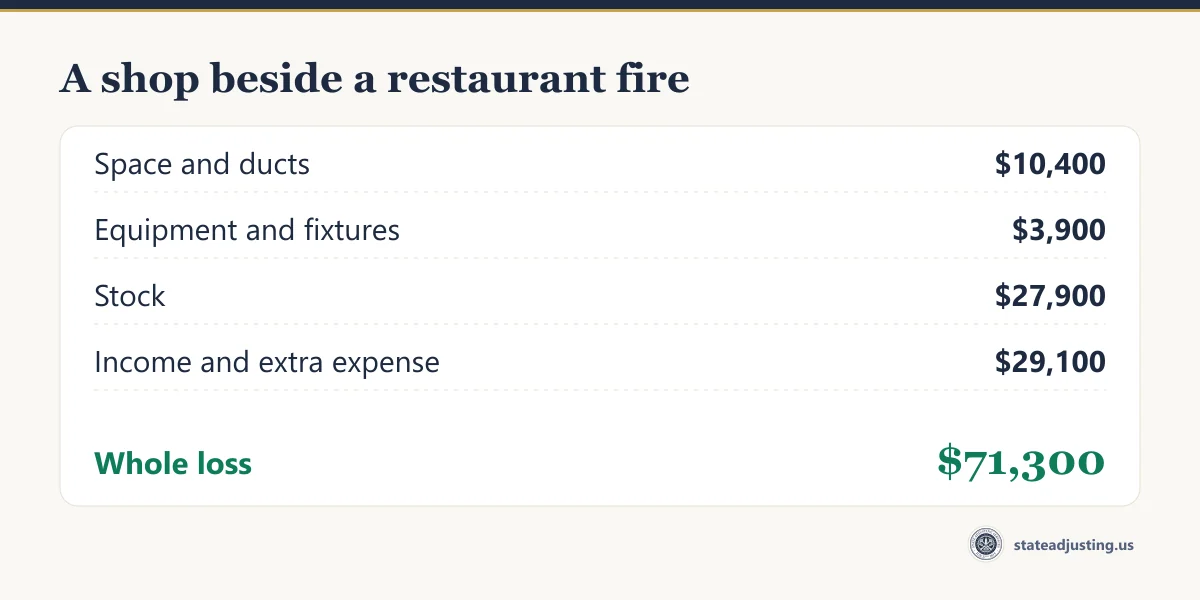
The figures are an illustration to show where the money sits. They are not a client result. A kitchen fire in the adjoining unit is put out in an hour. No flame reaches the shop. Smoke comes through the shared ceiling void and the rooftop unit pulls it across the sales floor. The shop is closed for three weeks.
| Part | Line | Amount |
|---|---|---|
| Space | Clean, seal and repaint walls and ceiling | $7,600 |
| Space | Duct cleaning, filters, air handler | $2,800 |
| Equipment | Tills, display fixtures, back-office computers | $3,900 |
| Stock | Laundering of washable garments | $6,400 |
| Stock | Garments and leather goods that kept the odor | $21,500 |
| Income | $54,000 expected, less $6,000 earned online, less $22,000 of expenses that stopped | $26,000 |
| Extra expense | Air scrubbers, storage unit, rush freight | $3,100 |
| Whole loss | $71,300 |
$10,400 + $3,900 + $27,900 = $42,200 of property. $26,000 + $3,100 = $29,100 on the income side. The deductible and the 72-hour wait are left out to keep the sum readable. Now suppose the first estimate is $9,800: a wipe-down of the sales floor, repainting one wall, and a per-garment cleaning allowance. Nothing has been denied. $61,500 is simply not written down yet, and each missing line needs its own record from the list above.
You rent the unit. Who claims the walls?
The lease decides that before either insurance policy does. The landlord's policy and yours can both touch the same ceiling, and work that neither adjuster scopes is the usual result. Read the insurance and repair clauses of the lease and answer these in writing with the landlord in the first week:
- Who repairs the interior finishes: the walls, ceiling tiles and flooring inside your unit?
- Who owns the improvements you paid for when you fitted the unit out, and who is required to insure them?
- Who maintains the rooftop unit and the ductwork that serves only your space?
- Does rent stop or reduce while the unit cannot be used? Rent that continues is a continuing expense in your income claim.
Report to your own carrier the same day in any case. The business that had the fire may be liable to you, and your carrier may pursue it later, but its insurer owes you no prompt answer.
The first ten working days, in order
- Day 1: report the loss to your carrier and write down the claim number. Switch off the air handler so it stops spreading soot.
- Day 1: photograph every room before anyone cleans. Include stock on the shelves, inside closed cabinets and above ceiling tiles.
- Days 1 to 2: count the stock and tag it into the three groups. Keep the count sheets.
- Days 1 to 3: start a separate ledger for extra expense. Our guide to emergency mitigation bills covers what to check before signing a cleaning company's work authorization.
- Days 2 to 5: get written findings on electronics and refrigeration, one line per item.
- Days 3 to 5: put the lease questions to the landlord by email.
- Days 5 to 10: pull monthly profit and loss statements for three years, and sales for the same weeks last year.
- By day 10: read the carrier's estimate against the five parts and list what is absent. If an offer is reduced or a part is refused, Illinois rules require a reasonable written explanation (50 Ill. Adm. Code 919.50).
Where we come in
We handle commercial as well as residential claims across Illinois. On a smoke loss our work is the scope: every room, every asset, the stock count and the income figures, set out part by part so nothing waits to be noticed. If the carrier refuses a part by quoting an exclusion, that is a coverage dispute, and our guide to choosing between a public adjuster and an attorney explains why it goes to a lawyer. Soot in a house is scoped the same way, covered in smoke damage without a fire. Our fire and smoke damage claims page and our process show how a file runs with us. To have the estimate read against your loss, contact us or call (630) 297-8136, Monday to Friday, 8:00 AM to 5:00 PM. The review is free. Our fee is a percentage of the recovery, agreed in writing and regulated by Illinois law, with nothing paid upfront.
Questions we get about this
Does commercial property insurance cover smoke damage if my business did not burn?
Usually yes on the widely used forms. The special causes of loss form covers direct physical loss unless excluded, and its smoke exclusion is limited to smoke from agricultural smudging or industrial operations. Basic and broad forms normally name smoke as a covered peril. Your own form and endorsements govern.
Can I claim inventory that looks fine but smells of smoke?
Stock that holds odor or cannot lawfully or safely be sold is part of the loss, but it has to be documented: a physical count, photographs, purchase invoices and any written instruction to discard. Goods that can be cleaned are claimed at the cleaning cost, and goods sold at a markdown need the before and after prices.
Can a business claim lost income after smoke damage?
If the policy includes business income coverage and the smoke caused direct physical loss at your premises, yes. On standard wording the coverage pays net income plus continuing expenses, a slowdown counts as well as a full closure, and payment begins 72 hours after the loss. Extra expense is paid from the first day.
I rent my unit. Do I claim on my policy or the landlord's?
Often both policies are involved. Your policy covers your business property, stock and income. Who repairs and insures the interior finishes and the improvements you paid for is set by the lease, so read its insurance and repair clauses and confirm the answer with the landlord in writing.