Matching: When Illinois Policies Owe You a Uniform Roof, Not a Patch
A repair to one roof slope, one exterior wall, or one section of flooring often can't match the surrounding material exactly — dye lots and weathering differ over time. Many Illinois policies, and Illinois matching case practice, support extending the repair to the full slope, elevation or room instead of leaving a visible patch. Your own policy governs.
Matching is one of the more overlooked line items in an Illinois property claim. A carrier agrees to repair the damaged section only, and the surrounding material — a roof slope, a run of siding, a section of hardwood floor — ends up visibly different from what was never touched. This guide covers what matching means, when Illinois policies and matching case practice support a full, uniform repair instead of a patch, and how to document the request so it holds up.
What does "matching" mean in a property claim?
Matching means the repaired material has to reasonably resemble what's left undamaged — similar color, texture and quality, to the extent that's actually available. When a carrier repairs only the damaged section and the patch reads as visibly different from the surrounding material, that's a matching problem — a separate issue from whether the underlying damage was covered at all.
Most claims start as two questions: is the damage covered, and what does it cost to fix. Matching is a third question that only comes up once the first two are settled — whether the finished repair actually reads as part of the same roof, wall or floor, or as a patch a neighbor or a buyer's inspector can point to.
It shows up most often on roofs, where one damaged slope gets new shingles while the rest of the roof carries years of sun fade and granule loss the new shingles don't have. It shows up on siding, where a discontinued color or profile leaves the replacement panel a visibly different shade. It shows up on hardwood floors, where a water-damaged section gets new boards that won't take a matching stain, and on fencing, where a section replaced years after the rest simply looks newer.
When do Illinois policies require a full, uniform repair instead of a patch?
Many Illinois homeowners policies, along with Illinois matching case practice, support replacing the full slope, elevation, room or fenced run — not just the damaged section — when a reasonable match isn't available. Whether that applies to your claim depends on your specific policy wording and how different the patch would actually look next to the original material.
There's no single number that decides it — no fixed percentage of discoloration or years of age that automatically triggers a full replacement. What decides it is whether the replacement material, installed next to the original, is a reasonable match. A discontinued shingle line, a changed siding profile, or a stain a new floorboard can't reproduce is evidence the patch won't match — and that evidence is what a matching claim is built on, not a general sense that the repair looks worse.
Some adjusters and contractors talk informally about a "line of sight" test — whether the mismatch is visible from a normal viewing distance, like the street for a roof or the doorway for a room. That's a useful way to describe what you're documenting, not a rule written into every policy. Read your own policy's replacement cost or loss settlement section, and if it doesn't address matching directly, ask your adjuster in writing whether it applies to your claim.
| Surface | Why an exact patch is hard |
|---|---|
| Asphalt roof shingles | Sun fade and granule loss on existing slopes; new shingles come from a different production lot |
| Vinyl or fiber cement siding | Colors and profiles get discontinued or updated by manufacturers within a few years |
| Hardwood flooring | Stain and finish age unevenly; a new board rarely takes a matching finish on the first try |
| Fencing | Weathered wood or vinyl next to new material reads as two different ages, even in the same style |
How do you document a matching problem so the carrier can't wave it off?
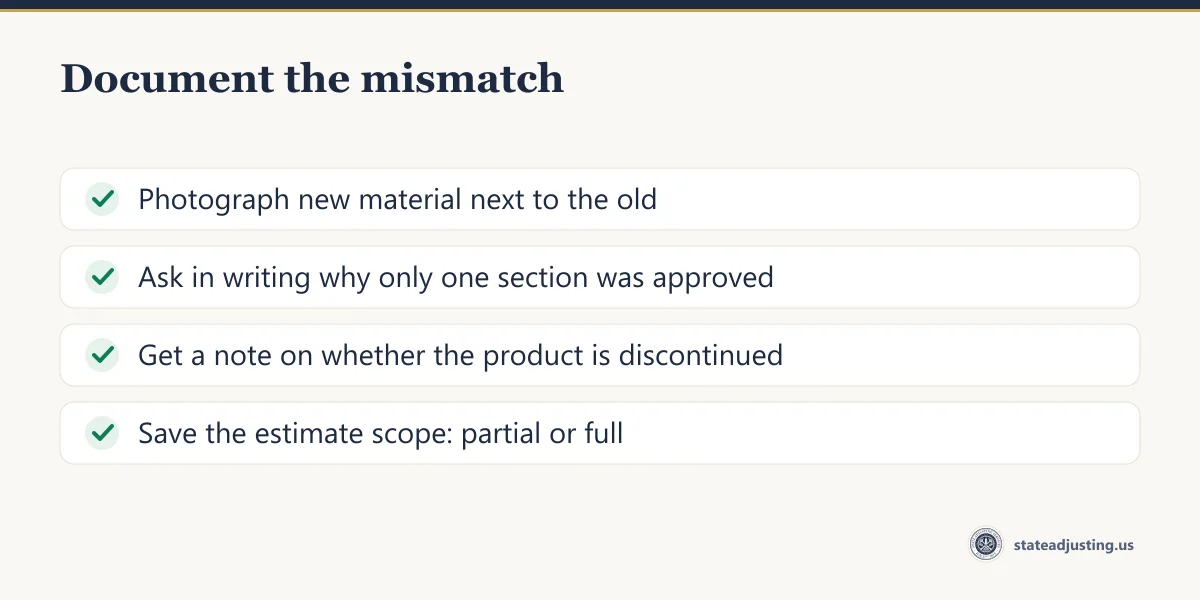
Photograph the repaired section next to the untouched material in the same shot and the same light, and ask your contractor or roofer for a written note on whether the product is discontinued or the color has shifted. A documented, specific mismatch moves faster than a general statement that the repair "looks off."
Keep the photos dated and keep them side by side — a single wide shot showing old and new material in the same frame is more useful than two separate close-ups taken days apart. If your contractor can get written confirmation from the manufacturer or supplier that the product line is discontinued, or a sample chip showing the color difference, that documentation is what turns "this looks different to me" into a claim the carrier's reviewer can act on.
What does the cost difference actually look like?
There's no fixed formula — the gap between a single-section patch and a full, matched repair depends on the material, the size of the area and the extra work of tying the new section into the old. Below is a worked, illustrative example only, not a quote or a past client's settlement, showing how those costs can stack up on a mid-size roof slope.
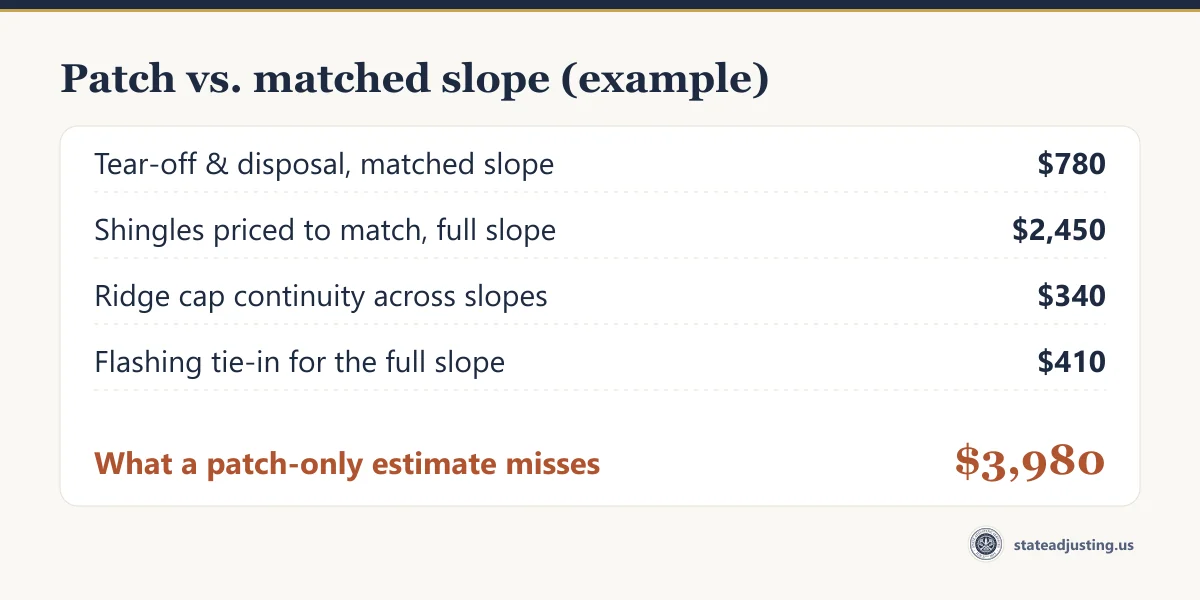
The example above isolates what a full-slope, matched repair adds beyond a single-section patch — tear-off and disposal across the whole slope, shingles priced to match rather than approximate, ridge cap continuity, and the flashing work needed to tie the new section into the old cleanly. On an actual roof the figures will depend on the slope's size and the shingle line involved; the point is that the gap is usually made up of several smaller line items, not one large one, which is exactly why it's easy for a patch-only estimate to leave it out entirely rather than underprice it.
What can you do if the carrier still says the patch is close enough?
- Ask for the "patch is sufficient" position in writing, not just verbally from the field adjuster
- Attach your side-by-side photos and any manufacturer discontinuation note directly to that written request
- Point to the specific policy language you're relying on, if your policy addresses matching or uniform replacement
- If the claim stalls, most Illinois property policies include an appraisal clause as a way to resolve a value dispute — a topic worth raising with whoever is handling your claim
None of this requires legal advice to raise. It requires photographs, a written product-match note, and a request that names the specific slope, wall or room rather than describing the repair in general terms.
What to do next
If a repair on your property left one section visibly different from the rest, start with the photos: old material and new material in the same frame, in the same light. Our guide to hail damage claims covers how matching issues typically surface after a hail-damaged slope is repaired, and our guide to what carriers routinely leave out of a hail estimate covers the line items that go missing alongside it. If you'd rather have someone read your policy and the carrier's position directly, our free claim review does exactly that at no cost — our fee, when we're engaged, is a percentage of what we recover, agreed in writing, with $0 owed upfront. See our process for what that involves and our client reviews for what past clients say. If the repair itself needs a contractor once the claim is settled, our construction partner is one option — always the homeowner's choice, never a condition of the claim.
Questions we get about this
What does "matching" mean in a homeowners insurance claim?
It means the material used to repair a damaged section has to reasonably resemble what's left undamaged — similar color, texture and quality. When a repair is limited to only the damaged spot and looks visibly different from the surrounding roof, siding or flooring, that's a matching problem, separate from whether the damage itself was covered.
Does my Illinois policy guarantee a full roof replacement instead of a patch?
Not automatically. Many Illinois policies, along with Illinois matching case practice, support a full slope or full exposure replacement when a reasonable match isn't available — but it depends on your specific policy wording and how different the patch would look. Read your policy's replacement cost section, or ask your adjuster in writing whether it addresses matching.
What if my carrier says a single-slope or single-wall patch is close enough?
Ask for that position in writing, then respond with side-by-side photos of the old and new material and, if available, a written note from your contractor on whether the product is discontinued or the color has shifted. A documented, specific mismatch is easier for a carrier's reviewer to act on than a general statement that the repair looks off.
Does matching apply to anything besides roofing?
Yes. It comes up most often on siding, where colors and profiles get discontinued, and on hardwood flooring, where a new section rarely takes a matching stain. Fencing and painted surfaces can raise the same issue when only part of a run is replaced.