Insurance paid part of your claim: the undisputed amount and the rest

When an insurance company accepts some of your property claim and argues about the rest, Illinois expects it to pay the part nobody disputes now, not hold all of it until the argument ends. That partial payment is the undisputed amount. Depositing it does not end your claim for the remainder unless the check or its letter says the payment is final, and Illinois only allows that wording in narrow cases. What matters next is reading what the payment covers, writing down that you took it as partial, and putting the disputed part on its own track.
Your own policy and the company's letters govern your claim. We are licensed Illinois public adjusters, not attorneys, so this explains how these rules work in property claims, not legal advice.
The 30-day rule for the part nobody disputes
The Illinois rules on claim handling set the clock. Once a company affirms that it owes something on a claim, it has 30 days to offer payment, and it may not sit on the agreed portion while a different portion is still argued over.
“For those portions of the claim which are not in dispute and for which the payee is known, the company shall tender payment within said 30 days.”
50 Ill. Adm. Code 919.50(a), required practices for all insurance companies
Two conditions sit inside that sentence. The portion must be agreed, and the payee must be known. On a home with a mortgage, the payee for dwelling money includes the lender, so the check may carry the servicer's name next to yours. That is the payee question answered, not a reason to wait. Our guide to the loss draft process when the mortgage company is on the check covers how that money gets released.
The same section adds a second duty. When the company settles a first-party claim for less than you asked, it must send a reasonable written explanation of the lower amount within 30 days after it finishes its investigation, naming the policy definition, limitation, exclusion or condition it relies on. A notice that the Illinois Department of Insurance is available to you must come with that explanation. A partial check with no reason for the missing part is a payment with half its paperwork missing.
Reading the letter that comes with a partial check
The check itself says little. The letter or payment summary that arrives with it tells you what was paid, what was held back and why. The sample below numbers the five lines worth stopping on. The wording and the numbers are an illustration, not a real claim.
Payment summary, homeowners claim, wind and hail loss
1Coverage A, Dwelling. Payment enclosed: $22,300.00.
2This payment represents the undisputed amount of the dwelling portion of your claim.
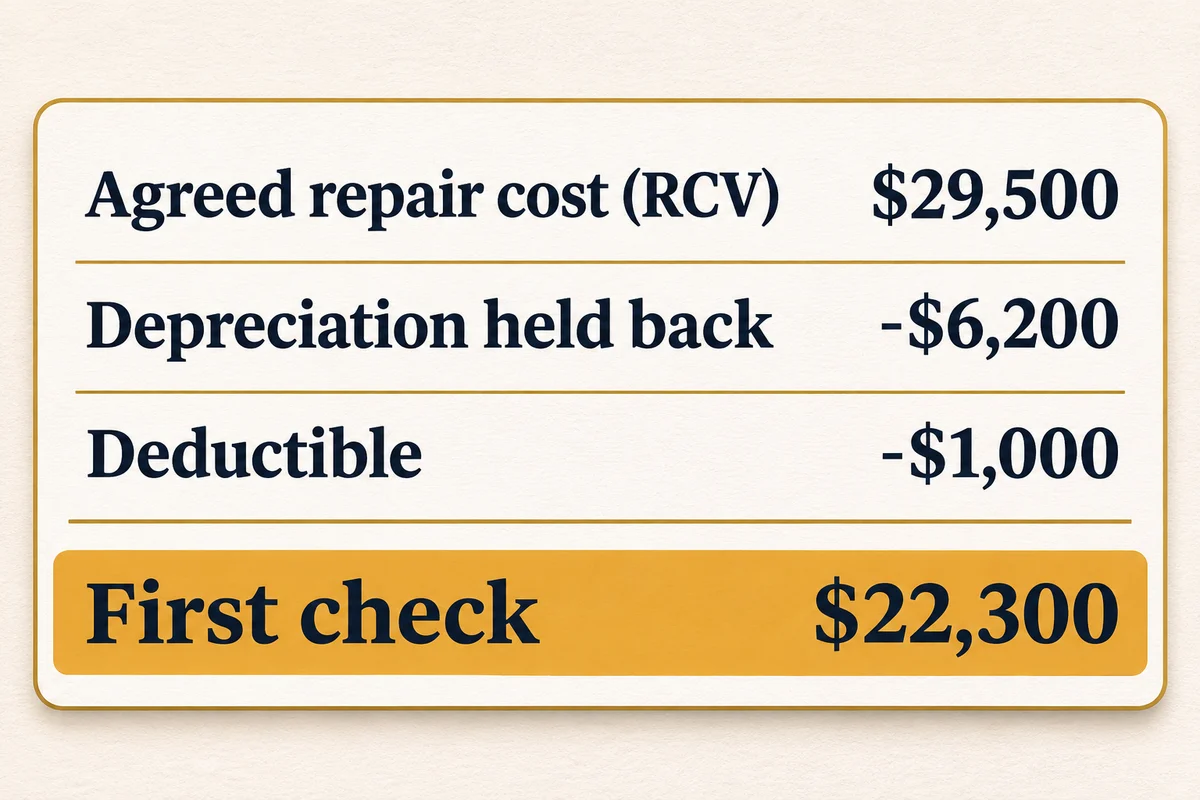
3Replacement cost of agreed repairs $29,500.00, less recoverable depreciation $6,200.00, less deductible $1,000.00. Depreciation may be recovered when repairs are completed.
4We are unable to include replacement of the siding on the north and west elevations ($11,500.00). Please see the enclosed explanation and the policy language cited.
5Notice of availability of the Illinois Department of Insurance is enclosed.
- Find the coverage named on each payment. Illinois law treats a payment that omits the coverage it is made under as an improper claims practice (215 ILCS 5/154.6(l)). Dwelling, other structures, contents and living expenses each have their own limit, so you need to know which pot this money came out of.
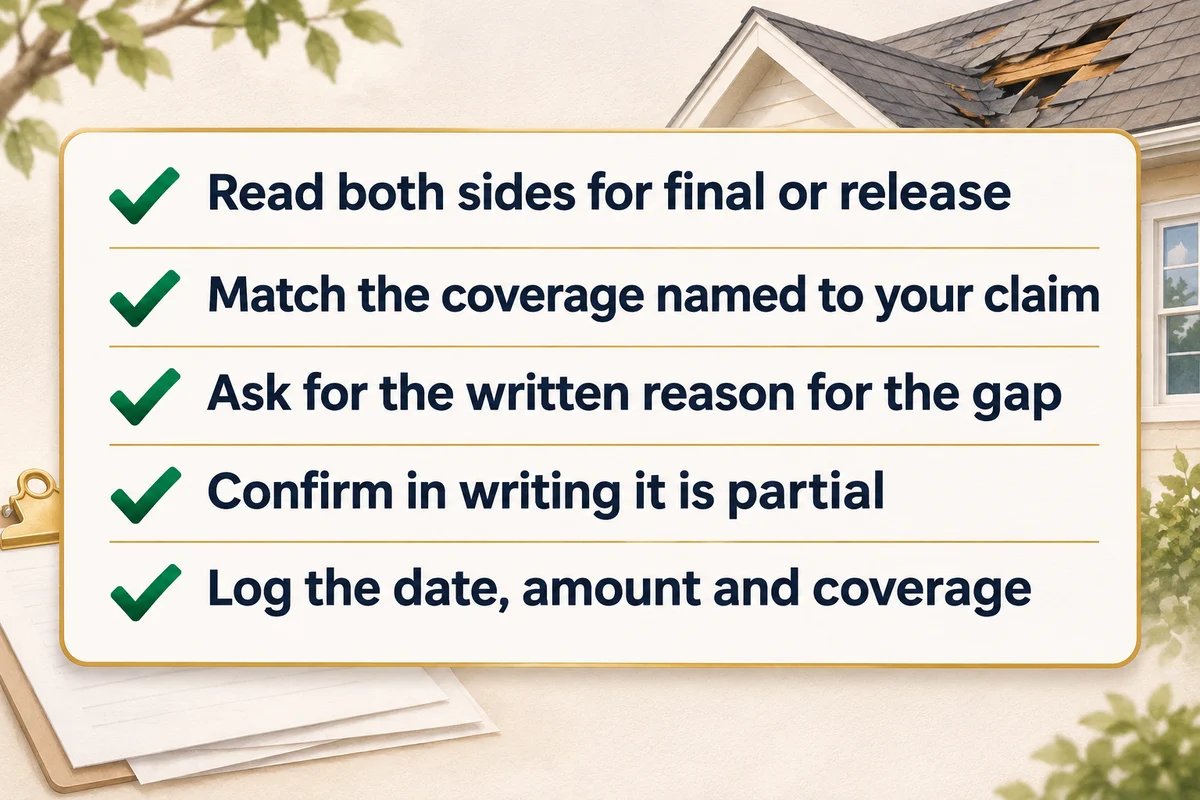
- Look for the word the letter uses for the payment. “Undisputed”, “partial” and “advance” tell you more is expected. “Final”, “full and final” or “release” are the words to stop on before you endorse anything.
- Check the arithmetic against the company's estimate. Depreciation held back is not disputed money; it is money already agreed and waiting for the work, which is why it travels a different road from item 4.
- This is the genuinely disputed part. It should come with the reason in writing and the policy wording behind it. If the letter only says “not included” or “not covered” without the clause, ask for it.
- The Department of Insurance notice is required with a lower offer. Its absence does not make the payment wrong, but it tells you the explanation package is incomplete.
Does cashing a partial check close the claim?
Usually not, and Illinois limits the cases where it can. A company may not mark a check, draft or cover letter as “final” or as “a release” of a claim unless it has paid the policy limit or there is a bona fide dispute over coverage or over the amount payable (50 Ill. Adm. Code 919.60(a)). An undisputed payment, by its own description, is not the end of anything.
No final or release wording on the check or letter
Deposit it. The money is yours under the part of the claim both sides agree on, and holding the check does nothing for the disputed part except delay repairs. Before or on the day you deposit, send a short email or letter to the adjuster saying you are accepting the payment as partial payment of the claim and that the items in dispute remain open. Keep a copy. That one paragraph settles any later question about what you meant.
The check or letter says final, full settlement or release
Do not endorse it yet. Write back and ask the company to reissue the payment without that wording, or to state in writing that the payment does not close the disputed items. If the company says there is a real dispute and the wording stays, you are being asked to choose between this amount and the rest of your claim. That is the point to bring in a professional, and if the choice involves giving up rights, an attorney. A separate release form sent for signature with a partial payment deserves the same pause.
One claim split into four amounts
A partial payment is easier to deal with once you see that the money missing from the check is not one number. Take the illustration above: a contractor's bid of $41,000 for roof, gutters and siding after a storm damage claim. The company agrees to $29,500 of it at replacement cost and disputes the siding.
The thin grey band is the $1,000 deductible. Example figures, not a client's claim.
- Paid now $22,300
- Agreed replacement cost, minus depreciation and the deductible. Under 919.50(a) this is the part that should reach you within 30 days of the company affirming it.
- Depreciation held back $6,200
- Agreed, but released only once the repair is done and documented, under the replacement cost terms of most homeowners policies. You do not argue for it; you finish the work and claim it. Our guide to collecting recoverable depreciation lists what the company usually asks to see.
- Deductible $1,000
- Yours on this loss whatever happens to the rest. If the disputed part is later paid, the deductible is not taken a second time on the same claim.
- Disputed $11,500
- The only part actually in disagreement. It needs evidence, not patience: photos, measurements, the policy wording, the reason in the company's letter, and a written answer to that reason.
Laid out like this, the homeowner in the example has $28,500 of agreed money and an $11,500 question, which is a very different conversation from “they paid about half”.
Asking for the undisputed part when it has not arrived
Sometimes the opposite happens: the company agrees with most of the estimate but says nothing will be paid until everything is settled. A short written request usually moves it. What it should contain:
- The claim number, the date of loss and the coverages involved.
- The items or amounts the company has already accepted, quoted from its own estimate or emails, so there is no doubt they are agreed.
- The date it affirmed those items, if you know it, and a reference to the 30-day tender of undisputed portions in 50 Ill. Adm. Code 919.50(a).
- A statement that you will accept that payment as partial and that the remaining items stay open.
- A request for the written explanation of any item it is not paying, with the policy provision it relies on.
- Who the payees should be, including the mortgage servicer on dwelling money, so the payee question cannot become a reason for delay.
Send it by email and keep the sent copy with the date. Illinois also requires a company to acknowledge pertinent communications on a claim with reasonable promptness, so a request like this should get an answer, not silence.
Keeping the disputed part moving
Once the agreed money is in hand, the disputed amount has a handful of routes, and which one fits depends on what the disagreement is about.
- New or missed damage, or a scope that left items out: a supplement with photos and measurements. See how a claim supplement reopens the scope.
- Agreement that the loss is covered but not on the price or the extent of the repair: the appraisal clause in most property policies, explained in our guide to the appraisal clause.
- A refusal to give a written reason, or months without an answer: a complaint to the Illinois Department of Insurance, which the notice in your letter points to.
- A disagreement over whether the policy covers the item at all, such as an exclusion or a matching question: the policy wording decides, and a coverage dispute may be a matter for an attorney.
Watch the calendar while this runs. A partial payment does not pause the time limits in your policy, and our guide to the deadlines that end claims in Illinois shows how they are counted.
If you are holding a partial check and are not sure what the missing part is made of, send us the letter and the company's estimate. We read them line by line, separate what is agreed from what is disputed, and tell you what we see before you sign anything with us. How a claim runs once we take it on is set out on our claim process page; the first review costs nothing, and our fee is only ever a percentage of what is recovered.
Questions we get about this
What is an undisputed amount on an insurance claim?
It is the part of a property claim that the insurance company agrees it owes, paid while another part is still being argued over. In Illinois, 50 Ill. Adm. Code 919.50(a) says the company shall tender payment for portions of the claim that are not in dispute, and for which the payee is known, within 30 days of affirming liability.
Does cashing a partial insurance check end my claim?
Not usually. Illinois rule 919.60(a) bars a company from marking a check or letter as final or a release unless it paid the policy limit or there is a bona fide dispute. If no such wording appears, you can deposit the check and tell the company in writing that you accept it as partial payment and the disputed items remain open.
What should I do if the check says final or full settlement?
Do not endorse it straight away. Ask the company in writing to reissue it without that wording or to confirm that the payment does not close the disputed items. If it refuses, you are being asked to give up the rest of the claim, which is the point to get professional advice before signing.
Why is recoverable depreciation not part of the dispute?
Depreciation held back on a replacement cost policy is money the company has already agreed to. It is paid once the repair is completed and documented. The disputed amount is different: it needs evidence and a written answer to the company's reason, through a supplement, appraisal or a complaint, depending on what the disagreement is about.