Who pays for power surge damage in Illinois: your policy, the utility or both
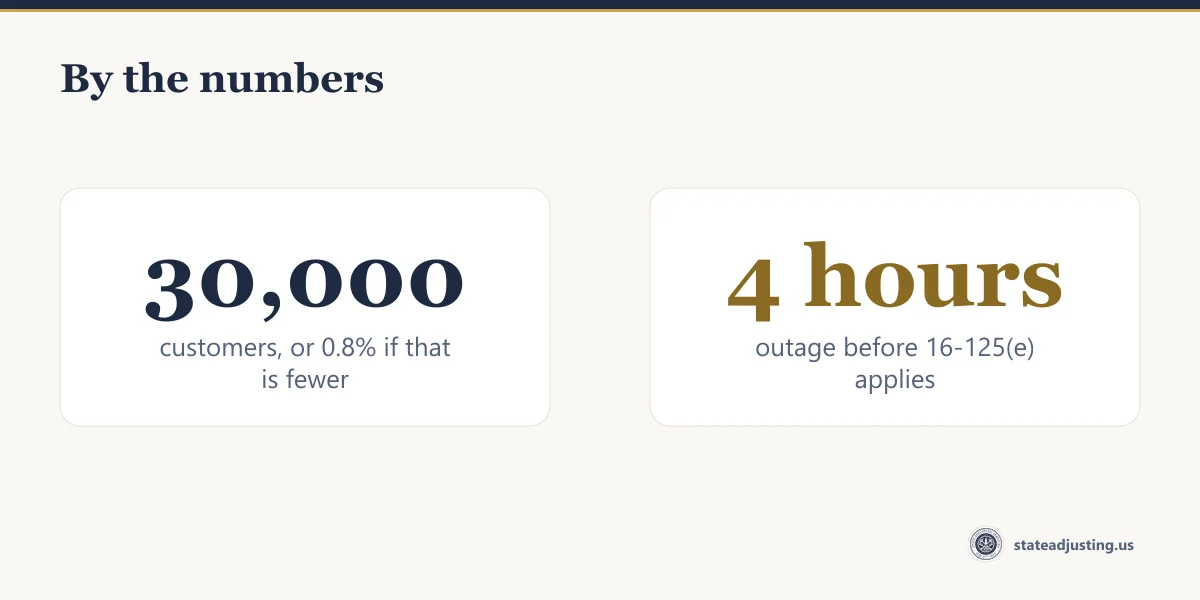
Who pays for power surge damage in Illinois depends on two things: where the surge came from and how many other customers it hit. For most households the first payer is their own homeowners policy, and how much it pays depends on which part of the policy each damaged item sits in. A large electric utility owes money under Illinois law only when one surge damages goods across more than 30,000 of its customers (or 0.8% of them, if that is fewer) and the cause was not weather or another listed exception, and that claim is decided by the Illinois Commerce Commission. When a third party caused it, such as a crew that hit a line, your carrier may pay first and recover from them later.
The order to ask: your policy, the utility, then whoever caused it
Start with the insurance claim, keep the utility route open beside it, and leave recovery from a third party to the carrier that pays you. The three are not alternatives you pick between. They run on different clocks and reach different items.
- Your homeowners policyApplies to a surge of any size from any source, lightning and the grid included.Built-in equipment is claimed under the dwelling coverage and belongings under contents, each by the policy's own wording, normally with one deductible for the event.
- The electric utility, under 220 ILCS 5/16-125Applies only to utilities with 100,000 or more customers, and only above a size threshold set in the statute.Pays the replacement value of goods damaged by a qualifying surge, or actual damages after a long outage. Decided through the Illinois Commerce Commission.
- The person or company that caused itA contractor who struck a buried line, a driver who took down a pole, faulty electrical work next door.Usually reached through subrogation: your carrier pays your claim, takes over the right to recover, and pursues them.
The order matters because the insurance claim has conditions of its own. Prompt notice and a proof of loss are duties in the policy, and they do not pause while a utility looks into the event. The statute itself says its remedies do not diminish or replace other remedies a customer has, so filing with your carrier does not give anything up on the utility side.
How many customers does a surge have to reach before the utility pays?
More than 30,000 customers or more than 0.8% of the utility's total customers, whichever number is smaller. The rule binds only electric utilities with 100,000 or more customers. Customers for whom the Commission grants a waiver are taken out of the count, which can drop an event back under the line.
Because the smaller of the two numbers counts, the threshold depends on the size of the utility. The arithmetic for a few sizes:
| Customers the utility serves | 0.8% of them | Number the surge must pass |
|---|---|---|
| 4,000,000 | 32,000 | 30,000 |
| 1,200,000 | 9,600 | 9,600 |
| 500,000 | 4,000 | 4,000 |
| 100,000 | 800 | 800 |
| Fewer than 100,000 | Not used | The section does not apply |
A transformer that fails on one street and takes out the furnace boards of a few dozen houses is nowhere near any of those numbers. That is why most surge losses are paid, or argued about, under the homeowner's own policy. The statute route is real, but it is built for events that reach a whole region.
Outage or surge: the statute treats them as two events
Subsection (e) covers a long interruption and subsection (f) covers a surge. Spoiled food after a five-hour blackout and a dead control board after the power snapped back are different claims under the statute, with different measures of payment, even when they happen on the same evening.
| Outage, 16-125(e) | Surge, 16-125(f) | |
|---|---|---|
| What starts it | A continuous interruption of 4 hours or more, with power below 50% of standard voltage or lost entirely | A power surge or other fluctuation that causes damage |
| How many customers | More than 30,000 or 0.8%, whichever is less, out for 4 hours or more | More than 30,000 or 0.8%, whichever is less |
| What the utility owes | All actual damages, not including consequential damages; also the local government's emergency costs | The replacement value of all goods damaged |
| How the utility avoids it | A waiver from the Commission for one of the four listed causes | Showing one of the same four causes |
| Where it is decided | The Illinois Commerce Commission | The Illinois Commerce Commission |
The four causes are written into the statute word for word:
(1) Unpreventable damage due to weather events or conditions.
(2) Customer tampering.
(3) Unpreventable damage due to civil or international unrest or animals.
(4) Damage to utility equipment or other actions by a party other than the utility, its employees, agents, or contractors.
220 ILCS 5/16-125(e) and (f), Illinois General Assembly
In Illinois the outages big enough to pass the threshold usually come with storms, and weather is the first cause on that list. A failure of the utility's own equipment on a calm day is not one of the four. Two procedural lines also shape the route. A utility's request for a waiver is on time if it is filed within 30 days after a claim reaches the Commission, and the statute says no utility is liable while that request is pending. Damage awards cannot be paid out of rate funds.
Whether a given event qualifies is a question for the Commission, and a claim there is yours to file or an attorney's. We do not file it. What we can do is make sure the insurance claim does not sit and wait for it.
What your homeowners policy pays for a surge
It depends on the item. Equipment built into the house is claimed under the dwelling coverage, where the widely used form insures direct physical loss unless an exclusion applies. Belongings are paid only for the perils the policy names, and that is where a surge from the grid is read most narrowly. Your own policy wording governs.
On the dwelling side sit the furnace and air-conditioning boards, wiring, outlets, breakers, the panel and a hardwired garage door opener. Carriers there usually argue mechanical breakdown or wear, so the technician's written finding that a unit failed from a voltage event carries the claim.
On the contents side, lightning is a named peril and grid current is a separate one: sudden and accidental damage from artificially generated electrical current. The widely used form then leaves out loss to electronic components of appliances, computers and televisions under that peril. A dead television can be payable as lightning and not as a utility surge. The power failure exclusion removes loss caused by a utility failure away from the premises, which is how spoiled food usually ends up outside the policy. Our article on proving lightning when nothing burned covers the cause evidence in detail.
Two more places to look. An equipment breakdown endorsement, where the policy carries one, is written for failures like these and has its own limit and deductible. Some carriers also sell a food spoilage endorsement. Both show on the declarations page.
Subrogation is the link back to the utility or the contractor. The widely used form lets the carrier require an assignment of your rights of recovery to the extent it pays, and asks you to sign and cooperate. Carriers often include your deductible when they recover, though nothing obliges them to pursue it. Ask your carrier before you sign a release offered by the utility or by whoever caused the surge, because a release can end the recovery the carrier was counting on.
One house, one surge: how the list splits
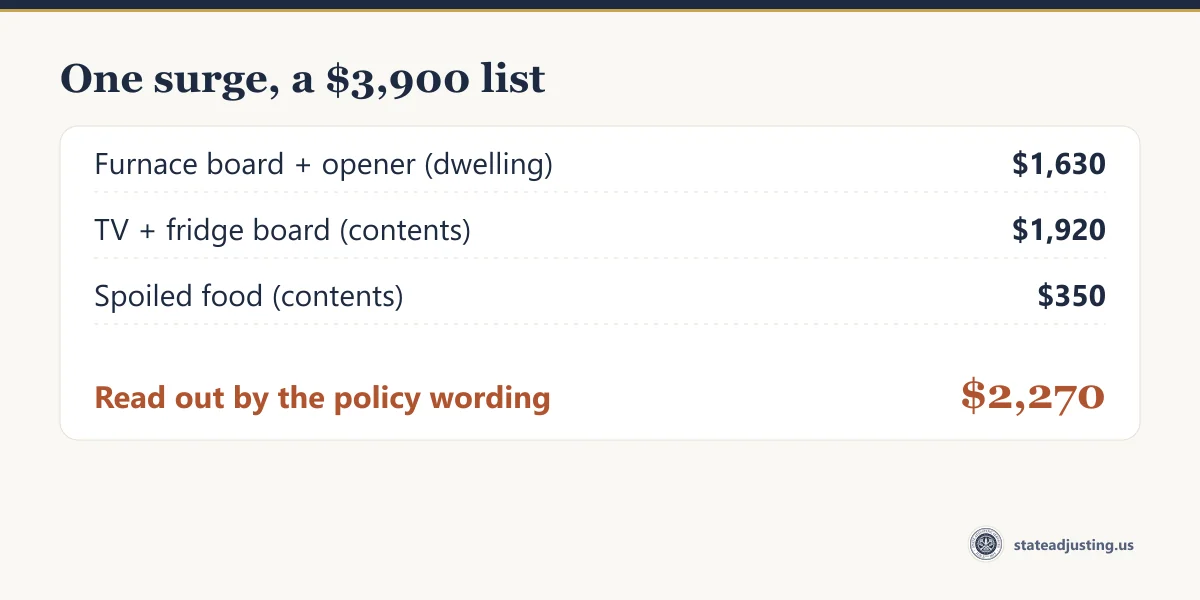
An example with round numbers, not a real claim. A transformer fails on the street on a calm summer evening. The lights flicker, go out for five hours and come back with a surge. The household has a $1,000 deductible and no equipment breakdown endorsement.
| Item | Part of the policy | How the widely used wording reads it | Cost |
|---|---|---|---|
| Furnace control board | Dwelling | Covered unless the carrier shows breakdown or wear | $1,150 |
| Hardwired garage door opener | Dwelling | Same as the furnace board | $480 |
| Television | Contents | Grid current peril, electronic components left out | $1,300 |
| Refrigerator control board | Contents | Same as the television | $620 |
| Spoiled food | Contents | Power failure away from the premises, excluded | $350 |
| Whole list | $3,900 |
If the carrier accepts the voltage finding, the dwelling items pay $1,150 + $480 = $1,630, less the $1,000 deductible, so $630. The other $2,270 ($1,300 + $620 + $350) is the part the policy wording points away from. Those are exactly the items the statute reaches: replacement value for the surge damage, and actual damages for losses from an outage of 4 hours or more, if the event passed the threshold and none of the four causes applied. A failed transformer on a calm day is not on the list. If the same failure reached 400 houses, the statute does not apply and the policy is what is left, along with the utility's own claims process.
Nobody is paid twice for one item. Where the carrier pays, its subrogation takes that part of any recovery.
What to keep so both routes stay open
The same evidence serves the insurance claim, the Commission and any subrogation. Most of it disappears within a week if nobody asks for it.
- Every failed board and part, tagged with the unit it came out of, until your carrier and anyone pursuing the utility say they are finished with it.
- A written finding from each technician that names the unit, its age and that it failed from a voltage event.
- The times the lights flickered, went out and came back, and the outage or ticket number the utility gave you.
- Photos of the panel, the outlets and any scorch marks, taken before an electrician opens anything.
- A request for the utility's service record of the event. Subsection (j) requires one for every fluctuation reaching 10 or more customers, with the date, duration, number of customers, cause and equipment involved, and copies are open to public inspection.
- Claim numbers, dates and names for every call to the carrier and to the utility.
What to do this week
We handle the insurance side: the dwelling and contents claim, the full list, the proof of cause and the negotiation with your carrier. The Commission route belongs to you or an attorney, and our article on which part a public adjuster or an attorney handles explains that split.
- Report the loss to your carrier as one event with every failed item on it, and ask whether the policy carries an equipment breakdown or food spoilage endorsement.
- Ask the utility in writing for the event number and its claims procedure, and keep the reply.
- Hold on to the parts and findings listed above.
- Send us the declarations page and the list. Our page on power surge damage claims shows how we build the list, and our process shows each step after that.
The review is free, there is nothing to pay upfront, and our fee comes out of the recovery only. We answer at (630) 297-8136 Monday through Friday from 7:00 AM to 7:00 PM and Saturday and Sunday from 9:00 AM to 5:00 PM, or you can send the details here.
Questions we get about this
Does the electric company have to pay for power surge damage in Illinois?
Only in a narrow case. Under 220 ILCS 5/16-125(f), an electric utility with 100,000 or more customers pays the replacement value of goods damaged by a surge that reaches more than 30,000 of its customers or 0.8% of them, whichever is less, unless it shows unpreventable weather damage, customer tampering, unrest or animals, or a party other than the utility as the cause. Those claims are decided through the Illinois Commerce Commission.
Should I file with my insurance or the utility first?
With your insurance. The policy's notice and proof-of-loss conditions run whatever the utility does, and the statute says its remedies do not replace others. If your carrier pays, it can pursue the utility or another responsible party through subrogation, and carriers often include the deductible when they recover.
Does homeowners insurance cover a power surge from the utility?
Partly, depending on the item and the policy. Built-in equipment such as furnace boards and wiring is claimed under the dwelling coverage. Belongings depend on the named perils, and the widely used form's artificially generated current peril leaves out electronic components of appliances, computers and televisions. An equipment breakdown endorsement, if the policy has one, is written for this. Your own policy wording governs.
Is food that spoiled in a power outage covered?
Often not under the homeowners policy, because the power failure exclusion removes loss caused by a utility failure away from the premises. Some carriers sell a food spoilage endorsement. Under the statute, an outage of 4 hours or more that reaches the size threshold makes a large utility responsible for actual damages unless the Commission grants a waiver for one of the four listed causes.