Public adjuster or attorney: who handles which part of an Illinois property claim

Which one you need on a property claim in Illinois, a public adjuster or an attorney, depends on what the carrier is disputing. If the argument is about how much the damage costs to repair, that is adjuster work. If the argument is about whether the policy covers the loss at all, or the next step is a lawsuit, that is attorney work. Many files contain both, and the two halves need different people.
We are licensed Illinois public adjusters, so we will say the limit of our own license first. Illinois law bars us from giving legal advice, and nothing below is legal advice. What follows is a way to sort your own claim, using the letters you already have.
What does Illinois law let each of them do?
A public adjuster is licensed by the Illinois Department of Insurance to prepare and negotiate a first-party property claim for the policyholder. An attorney is licensed to give legal advice and to represent you in court. The statute draws the line between them in one sentence:
"A public adjuster shall not provide legal advice or representation to the insured or engage in the unauthorized practice of law."
215 ILCS 5/1590(l)
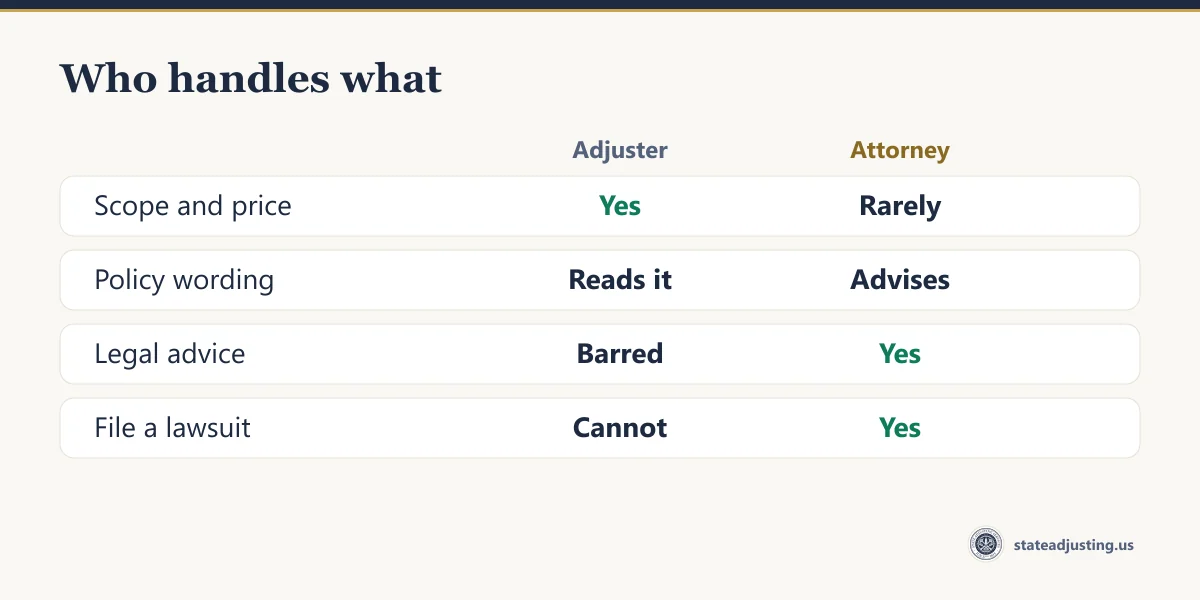
| Question | Public adjuster | Attorney |
|---|---|---|
| Measure the damage and price the repair | Yes. This is the core of the job. | Usually through an estimator or adjuster the attorney brings in |
| Negotiate the amount with the carrier | Yes | Yes |
| Tell you what an exclusion legally means for you | No. That is legal advice. | Yes |
| File a lawsuit or answer one | No | Yes |
| Agree a settlement without asking you | No. Section 1590(k) requires your knowledge and consent. | Ask how your fee agreement handles settlement authority |
| Fee | Capped by statute on a personal residence at 10% of what the insurer pays | Whatever the written fee agreement says |
The fee cap is in 215 ILCS 5/1570(e). It is a ceiling, and the rate you pay is the one in your signed contract. Our guide to the Illinois public adjuster contract goes through what that document has to contain.
Which kind of dispute do you have?
Read the carrier's last letter and its estimate, then find the sentence that explains why the number is what it is. Sentences about quantity, price or missing items put you in the left column. Sentences that quote a policy provision as the reason for paying nothing put you in the right one.
The amount is disputed
- The estimate covers one slope or one room and the damage is on several.
- Line items are missing: tear-off, drip edge, gutters, painting to a natural break.
- Your contractor's bid is thousands above the carrier's replacement cost total.
- Depreciation looks too heavy, or was never released after the work was done.
- The carrier agrees the storm caused the loss and disagrees on repair against replacement.
Coverage or the law is disputed
- The letter denies the claim and quotes an exclusion or a policy condition.
- The carrier alleges misrepresentation, concealment or fraud.
- You have been asked to sit for an examination under oath.
- A release or "full and final" wording has been put in front of you.
- The deadline to sue in the policy is a few months away.
- Somebody has served court papers on you, or you want to serve them.
The left column is what we do every working day. The right column is where we stop and say the file needs an attorney, because any useful answer there is a legal opinion.
What if one claim has both problems?
Then it gets split, and each half goes to the person allowed to argue it. This is common. A carrier can accept the roof, measure it short, and deny the interior under a separate provision in the same letter.
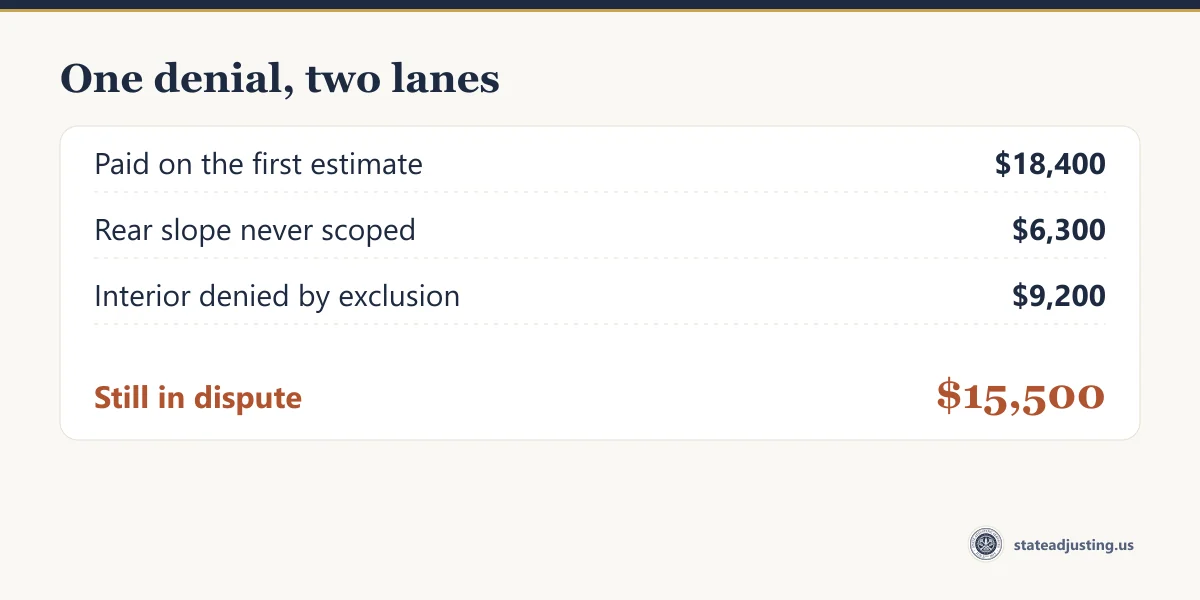
The figures below are an illustration, not a client result. Depreciation and the deductible are left out so the arithmetic stays readable. A hailstorm with wind damages a roof and rain stains two upstairs ceilings. The carrier pays $18,400 on an estimate written from the front slope. The rear slope, worth $6,300 at the same unit prices, is not on the estimate. The interior, $9,200, is denied with a sentence saying no opening was created by wind.
| Part of the loss | Amount | Dispute and who argues it |
|---|---|---|
| Front slope, paid | $18,400 | No dispute |
| Rear slope, never measured | $6,300 | Amount. Public adjuster, by re-inspection. |
| Interior, denied under a provision | $9,200 | Coverage. Our evidence, an attorney's legal position. |
| Still in dispute | $15,500 |
$6,300 + $9,200 = $15,500. The first figure is a question of fact: was the rear slope damaged, and how many squares is it. The second has a factual half and a legal half. Photographs of torn shingles above the stain are evidence, and collecting them is our work. Whether the wording applies once that evidence is in, and what to do if the carrier still says no, is not. Our guide to the opening created by wind test covers the evidence side.
What can only a lawsuit reach?
Two things in the Illinois Insurance Code matter here, and both sit on the attorney's side of the line.
The first is 215 ILCS 5/155. In a court action against an insurer, where the court finds the company's conduct or delay "vexatious and unreasonable", the section says the court may allow reasonable attorney fees and other costs, plus an added amount. That added amount may not exceed any one of three figures: 60% of what the court or jury finds you are entitled to recover, $60,000, or the difference between that finding and what the company offered before the suit. The section applies inside a lawsuit. A public adjuster cannot file one, so cannot ask for any of it. Whether your facts come anywhere near that standard is for an attorney to judge.
The second is the clock. Most property policies limit the time you have to sue the carrier. Under 215 ILCS 5/143.1, that period stops running from the date proof of loss is filed until the date the claim is denied in whole or in part. Negotiation with us does not pause it. If the date in your policy is getting close, an attorney should see the file before anything else happens. Our guide to claim deadlines in Illinois lists the clocks and what starts each one.
Appraisal belongs in this picture too. It is a process written into most policies for settling a disagreement about the amount of loss, without a court. It does not decide coverage. A file in the left column may suit appraisal. A file in the right column does not.
Do the two fees stack?
They can, so ask before you sign the second agreement. If an adjuster is already under contract and an attorney then takes the file, both agreements may apply to the same dollars. Put two questions in writing to each: which payments is the fee calculated on, and does money the carrier paid before you were hired count. An adjuster's answer has to fit under the statutory cap. Get the attorney's answer in the fee agreement itself.
Money already paid before anyone was hired is the place people forget to ask about. In the example above, $18,400 arrived with no help from anybody.
What should you bring to either one?
The same file. An adjuster and an attorney both start by reading it, and a complete one saves a week.
- The full policy with the declarations page and every endorsement.
- Every letter and email from the carrier, in date order, including the denial or the reservation of rights.
- Each version of the carrier's estimate, and your contractor's bid.
- Your photographs from before any cleanup, and the receipts for emergency work.
- The proof of loss if you filed one, with the date it was sent.
- Any engineering report, and any recorded statement transcript you were given.
- A one-page timeline: date of loss, date reported, inspections, payments.
If parts are missing, you can ask the carrier for them in writing. Our guide to requesting your claim file has a paragraph you can copy.
Where to start if you still can't tell
Send us the denial letter and the estimate. A free review ends one of three ways: the carrier paid correctly and you need nobody, the gap is an amount dispute we can take on, or the letter turns on coverage and you should speak to an attorney licensed in Illinois. We say which. Pages on storm damage claims and water damage claims show what we look for on those losses, and our process shows how a claim runs once we are involved. To start, contact us. Our fee is a percentage of the recovery, agreed in writing and regulated by Illinois law, with nothing paid upfront. Office hours are Monday to Friday, 8:00 AM to 5:00 PM.
Questions we get about this
Do I need a lawyer or a public adjuster for a storm damage claim in Illinois?
It depends on what the carrier disputes. If the disagreement is about the amount, such as missing line items, an unmeasured slope or a low estimate, a public adjuster can document and negotiate it. If the carrier denies coverage under a policy provision, alleges fraud, or a lawsuit is the next step, that needs an attorney. Your own policy governs.
Can a public adjuster give legal advice in Illinois?
No. Section 1590 of the Illinois Insurance Code says a public adjuster shall not provide legal advice or representation to the insured or engage in the unauthorized practice of law. A public adjuster can read the policy, document the loss, price the repair and negotiate the amount with the carrier.
Can I hire both a public adjuster and an attorney on the same claim?
Yes, and claims with both an amount dispute and a coverage dispute often need both. Ask each in writing which payments their fee is calculated on and whether money the carrier paid before they were hired is included, because both fee agreements can apply to the same dollars.
Can a public adjuster sue my insurance company?
No. Only an attorney can file a lawsuit for you. Remedies that exist only in court, such as the attorney fees and added amount a court may allow under 215 ILCS 5/155 where an insurer's conduct is vexatious and unreasonable, are outside what a public adjuster can pursue.