You hit your own garage with your car: which insurance pays for what
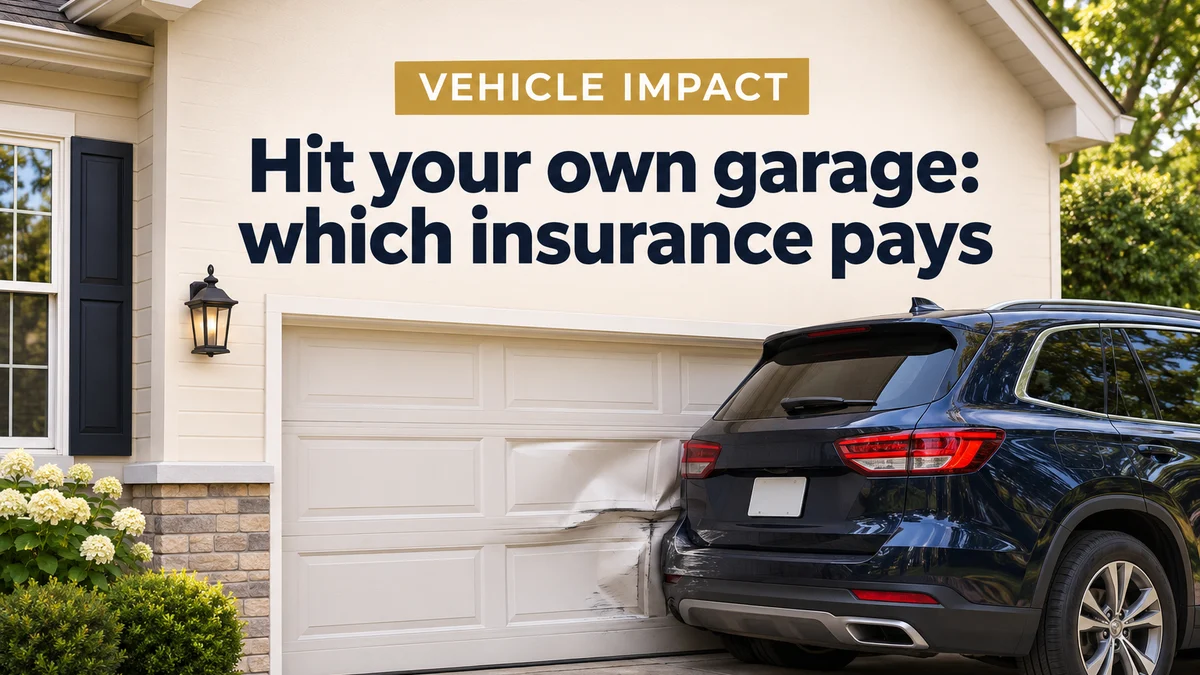
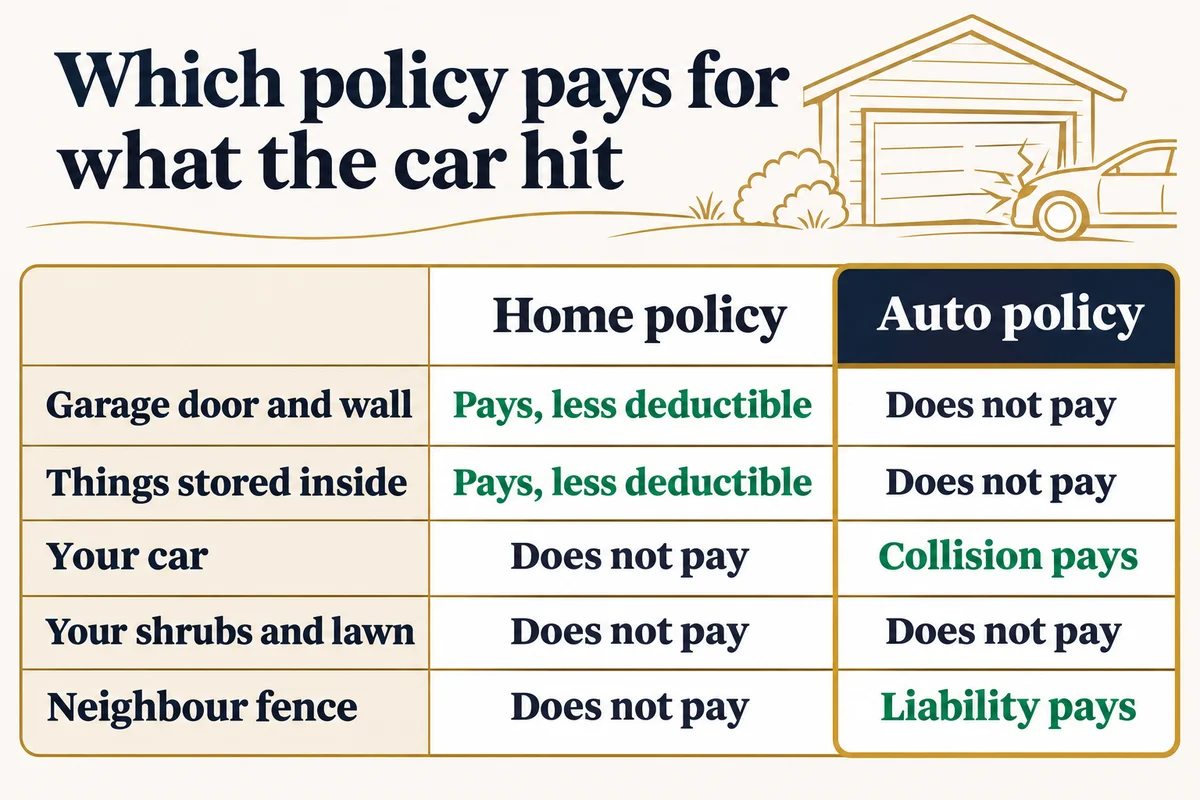
When you hit your own garage with your car, two of your policies split the bill and a few things fall between them. Your homeowners policy pays for the garage door, the wall and the things stored in the garage, less your home deductible. Your auto policy pays for the car only if you carry collision coverage, less the collision deductible. Your auto liability does not pay for your own house, and under the standard homeowners form your shrubs and lawn are not covered when the car is yours. We are licensed Illinois public adjusters; below is each item the car can reach, the policy line behind it, and a worked winter example. Your own policy wording governs.
Each thing the car hit, and the policy that answers for it
Sort the damage by object before you call anyone. Each card names the policy and the part of it that usually responds when the driver is you or someone who lives with you.
- Attached garage door and wallPart of the house. Door, tracks, opener, jamb, framing and drywall.Home, Coverage A
- Detached garageA building standing apart from the house, with its own limit, often 10% of Coverage A.Home, Coverage B
- Things stored insideFreezer, bikes, tools, shelving and boxes the car pushed over.Home, Coverage C
- Riding mower or snow blowerCovered as property when it is not registered for the road and is used to look after the home.Home, Coverage C
- The car itselfBumper, grille, lights, hood. The home policy lists motor vehicles as property it does not cover.Auto, collision
- A neighbour's fence or carSomeone else's property, so the driver's auto liability is the payer.Auto, liability
- Your shrubs, trees and lawnThe standard form pays for these only when the vehicle is not owned or driven by someone who lives there.Usually nobody
Gold tags: your homeowners claim. Dark tags: an auto claim. Dashed card: a gap in the standard form.
If the car stopped in a detached garage, read our guide to Coverage B for detached garages, fences and sheds before you report it: the clear-space test decides which limit the garage sits under, and a breezeway can move it back to Coverage A.
The five policy lines that decide it
Insurers file their own versions of the homeowners form, but most follow the standard one. The lines below are quoted from form HO 00 03 04 91, in the copy filed with the Nevada Division of Insurance. Look for the same words in your own policy; the numbering may differ.
- "We cover other structures on the 'residence premises' set apart from the dwelling by clear space."
- A detached garage is Coverage B. An attached one is part of the dwelling, Coverage A. The house and the garage are covered for risk of physical loss, and the list of exclusions that follows has no line for vehicles, so a car striking either is a covered cause under this form.
- "6. Vehicles."
- This is one of the named perils for your belongings, Coverage C. The freezer the bumper crushed and the bikes on the wall are paid under it. This form adds no carve-out for a car you drive yourself.
- "Property Not Covered. We do not cover: ... 3. Motor vehicles or all other motorized land conveyances."
- Your car is never part of the homeowners claim. The same section puts back vehicles not subject to motor vehicle registration that are "used to service an 'insured's' residence", which is why a riding mower or snow blower in the garage is covered.
- "Vehicles not owned or operated by a resident of the 'residence premises'"
- This sits in the additional coverage for trees, shrubs, plants and lawns, which is capped at 5% of the dwelling limit and $500 for any one tree, shrub or plant. A car you own or drive leaves the hedge it flattened outside the claim.
- "We will not pay for 'property damage': ... c. To property owned by an 'insured'"
- The liability part of the homeowners policy cannot pay for your own garage either. Your own property is claimed under Section I, the property part, or not at all.
Some insurers write the Vehicles peril with a narrower carve-out that leaves out a fence, driveway or walk struck by a vehicle a resident owns or drives. If your form has that sentence, the cracked driveway apron is outside the claim even though the garage door is inside it.
Who was behind the wheel changes two rows
The house is your homeowners claim whoever drove. What moves with the driver is the shrub coverage and whose auto liability is open. The Illinois Department of Insurance describes property damage liability as paying for "damage to another person's car or property such as fences, buildings", and notes it may also pay when the driver was a family member living with you or someone using your car with your permission (Illinois auto insurance shopping guide).
| Who drove which car | Garage and house | Your shrubs and lawn | The neighbour's fence |
|---|---|---|---|
| You, or someone you live with, in your car | Your homeowners claim | Not covered under the standard form | Your auto liability |
| A visitor driving your car with your permission | Your homeowners claim | Still not covered: the car is owned by a resident | Your auto liability, which follows the car |
| A visitor who does not live with you, in their own car | Your homeowners claim, or a claim against the visitor's auto liability | Covered up to the 5% and $500 limits, less your deductible | The visitor's auto liability |
The third row is where an aunt backing out of your driveway after a holiday dinner becomes a two-insurer claim. Her auto liability owes you for your garage as someone else's property, and your own insurer can pay you first and recover from hers. We walked through that route, release and all, in the guide on claiming against the driver's insurer after a car hits your house.
A January morning on an icy driveway, worked through
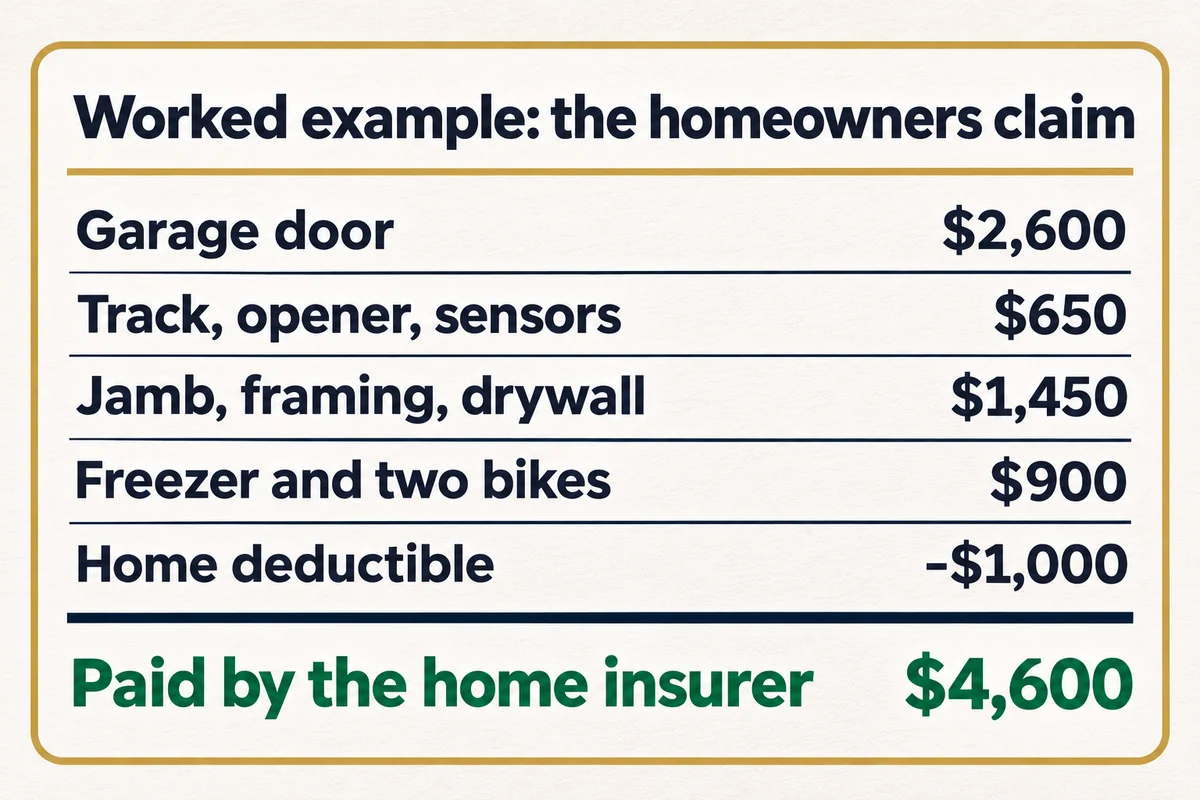
The figures below are an illustration, not a client's file and not a quote. A car slides down a sloped, icy driveway and stops in the closed door of an attached two-car garage. The door is buckled, a track is bent, the jamb on one side has moved, and a chest freezer and two bikes inside are crushed. The home deductible is $1,000. The collision deductible is $500.
Homeowners claim
- New 16 ft insulated door
- $2,600
- Track, rollers, opener rail, sensors
- $650
- Jamb, wall framing, drywall, paint
- $1,450
- Chest freezer and two bikes
- $900
- Home deductible
- -$1,000
- Paid by the home insurer
- $4,600
Auto claim
- Bumper cover and grille
- $1,500
- Headlamp and bracket
- $800
- Collision deductible
- -$500
- Paid by the auto insurer
- $1,800
Two policies means two claim numbers and two deductibles, $1,500 out of pocket in this example, even when one company writes both. The belongings line may first be paid at a depreciated value, with the rest released once they are replaced, depending on how your policy settles personal property.
Now change one fact: the car only creases the bottom panel, and a door company replaces that panel for $450. The house side is under the $1,000 deductible, so the homeowners claim would pay nothing. The bumper may still be worth a collision claim on its own. The two decisions are separate, and the policy that pays nothing should not be the one you report by habit.
What sits behind a dented garage door
A door that took a car's weight passes the force into the parts it hangs on. A quick estimate often prices the door and stops. Before you accept a number, have the opening itself looked at:
- the vertical and horizontal tracks, the rollers and the brackets that hold them to the jamb;
- the opener rail and the trolley, which can bend even when the motor still runs;
- the two safety sensors near the floor, which have to line up again before the door will close;
- the side jambs and the wall framing behind them, checked for plumb with a level;
- the header over the opening, and any crack in the drywall running up from its corners;
- the edge of the garage slab where the bottom of the door sits, if the car rode up on it.
When the car went through the door and into the wall of the house, the claim is a larger structural one, the kind our page on vehicle impact damage claims takes apart layer by layer.
Claim it, or pay for it yourself?
Start with arithmetic: a written repair price for the house side, set against your home deductible. If the gap is small, many owners pay the door company directly and keep the claim history clean. If the jamb, framing or header are involved, the number climbs quickly, and that is usually the point where the claim earns its keep. Our guide to whether to file a claim or pay out of pocket sets out the questions to ask your insurer before you decide.
The auto side is its own decision. Illinois law does not require collision coverage, though a lender may for a financed car, and the Department of Insurance notes collision deductibles from $0 to $1,000. If you carry only liability, nothing pays for your own car in this accident.
The first day, in order
- Leave a door that has jumped its track or has a loose spring to a garage door technician, and unplug the opener. The springs are under heavy tension.
- Before you move the car, photograph it against the door from outside, then the door, the jamb and the stored items from inside. Our list of what to photograph after property damage covers the angles.
- Close the opening if the door will not shut, with plywood or a tarp, and keep the receipt. The policy expects you to protect the property from further damage.
- Get one written price for the door and one look at the framing before you report anything, so you know whether you are above the deductible.
- Report the house to your home insurer and the car to your auto insurer as two separate losses, and write down both claim numbers.
- Keep the bent tracks, the crushed freezer and the broken bikes until the adjuster has seen them or told you in writing they can go.
When the hit went past the door
A bent panel is a job for a door company. We take on the files where the car pushed the framing, the header or the house wall out of line, where the estimate priced the door and nothing behind it, or where the carrier says the damage was already there. That is the work we do on vehicle impact claims across Illinois, following the same claim process we use on every file. We are licensed public adjusters, not lawyers, and no one can promise how an insurer will decide.
Send us the door company's price, the photos from inside the garage and your declarations page, and we will tell you whether the framing side changes the picture; that look is free. Our clients give us 4.9 from 33 Google reviews. There is nothing to pay upfront: our fee comes out of the settlement as an Illinois-regulated percentage agreed in writing, and without a recovery there is no fee. Call (630) 297-8136 or use the contact page, Monday through Friday 7:00 AM to 7:00 PM and Saturday and Sunday 9:00 AM to 5:00 PM.
Questions we get about this
Does car insurance pay for damage to my own garage?
No. Auto property damage liability pays for another person's car or property, such as fences and buildings, so it does not pay for your own house. Your garage is claimed on your homeowners policy, and collision coverage, if you carry it, pays for the car.
Does homeowners insurance cover hitting my own garage door with my car?
Under the standard HO-3 form, yes, less your home deductible: an attached garage is part of the dwelling (Coverage A) and a detached one is an other structure (Coverage B), and the form has no vehicle exclusion for either. Some insurers word the Vehicles peril more narrowly, so read your own policy.
Are the things stored in my garage covered if I drive into them?
Usually, yes. Belongings are covered for the named peril Vehicles under Coverage C, so a crushed freezer, bikes or tools go on the homeowners claim. The car itself is not covered by the homeowners policy, and a riding mower or snow blower used for the home is covered as property.
Is it worth filing a claim for a damaged garage door?
Compare a written repair price for the house side with your home deductible. A single panel often costs less than the deductible and is paid directly. When the tracks, jamb, framing or header are damaged too, the cost often clears the deductible and a claim is worth opening.