A contractor damaged your house: whose insurance pays
When a contractor damages your house while working on it, the first policy that should answer is usually the contractor's own liability insurance, because the damage came from their work and that is what the policy is for. Your homeowners policy can still pay for much of the resulting damage, such as the ceiling a loose fitting soaked or the rooms a torch fire smoked, and your insurer may then recover its money from the contractor. What neither policy usually pays for is redoing the bad work itself. That part is a matter between you and the contractor.
We are licensed Illinois public adjusters, not attorneys, so this explains how claims of this kind usually run, not legal advice about suing anyone. Your own policy governs your claim, and the contractor's policy has its own wording that you will not see until their insurer quotes it.
One accident, three different bills
Most of the confusion comes from treating a contractor accident as one bill. It is almost always three, and each one has its own likely payer. A plumber who replaces a shutoff valve under the kitchen sink and leaves a compression nut loose is a good example: by the time someone notices, water has run for hours.
| The bill | In the sink example | Who usually pays |
|---|---|---|
| The faulty work itself | Redoing the valve connection the plumber installed badly. | The contractor, under the contract or a warranty. Liability policies and homeowners policies generally leave this out. |
| The damage the work caused | The swollen sink base cabinet, the wet subfloor, the stained ceiling of the room below, drying equipment. | The contractor's liability insurer, or your homeowners policy as resulting damage, which may then go after the contractor. |
| Your costs around it | Hotel nights while the floor dries, meals out, a ruined rug and the food in a fridge that had to be unplugged. | Either route can reach these. On your own policy they fall under personal property and additional living expense coverage. |
Keeping the three apart matters when you talk to anyone about the loss. If the contractor's insurer says it does not cover faulty workmanship, it may be right about the first row and still owe the second. If your own insurer cites its workmanship exclusion, the same split applies, as the section on your own policy explains.
Which insurer to call first
Start with the contractor's insurer when the contractor admits the mistake and hands over the policy details. Start with your own when the contractor goes quiet, has no insurance, or the house needs drying and repairs faster than a third party will move. These four questions settle it for most homeowners.
Is water still spreading, or is the house unsafe to live in?
Yes: stop the source, call for drying and report it to your own insurer today. Mitigation cannot wait for a stranger's insurer to assign an adjuster.
No: you have a few days to gather paperwork before choosing a route.
Did the contractor give you a certificate of insurance and agree to report it?
Yes: ask for the claim number in writing and let their carrier inspect.
No: your own policy is the faster road, and your insurer can pursue the contractor later.
Is the damage worth more than your deductible?
Yes: both routes stay open; a claim on your policy may get repairs moving sooner.
No: the contractor's insurer, or the contractor directly, is the only way to be paid at all.
Has the contractor's insurer refused or stopped answering for two weeks?
Yes: open a claim on your own policy now and tell your insurer who did the work.
No: keep a dated log of every contact and keep waiting, within your own policy's notice rules.
You can report to your own insurer and still pursue the contractor's carrier. What you cannot do is collect twice for the same damage, so tell each side about the other.
What Illinois makes a home repair contractor carry
Illinois sets a floor. Under the Home Repair and Remodeling Act, section 25, anyone in the business of home repair and remodeling has to keep liability insurance of $100,000 per person and $300,000 per occurrence for bodily injury, and $50,000 per occurrence for property damage. The one exception is a business with a net worth of at least $1,000,000 on a financial statement prepared within the last 13 months.
That $50,000 is a minimum, not a typical figure. Many contractors carry far more, and some carry exactly what the law asks. The only way to know is the certificate of insurance, which lists the insurer, the policy number, the dates and the limits. The state's own consumer rights pamphlet, which contractors must give customers, tells homeowners to check whether the contractor has the proper insurance before the job starts.
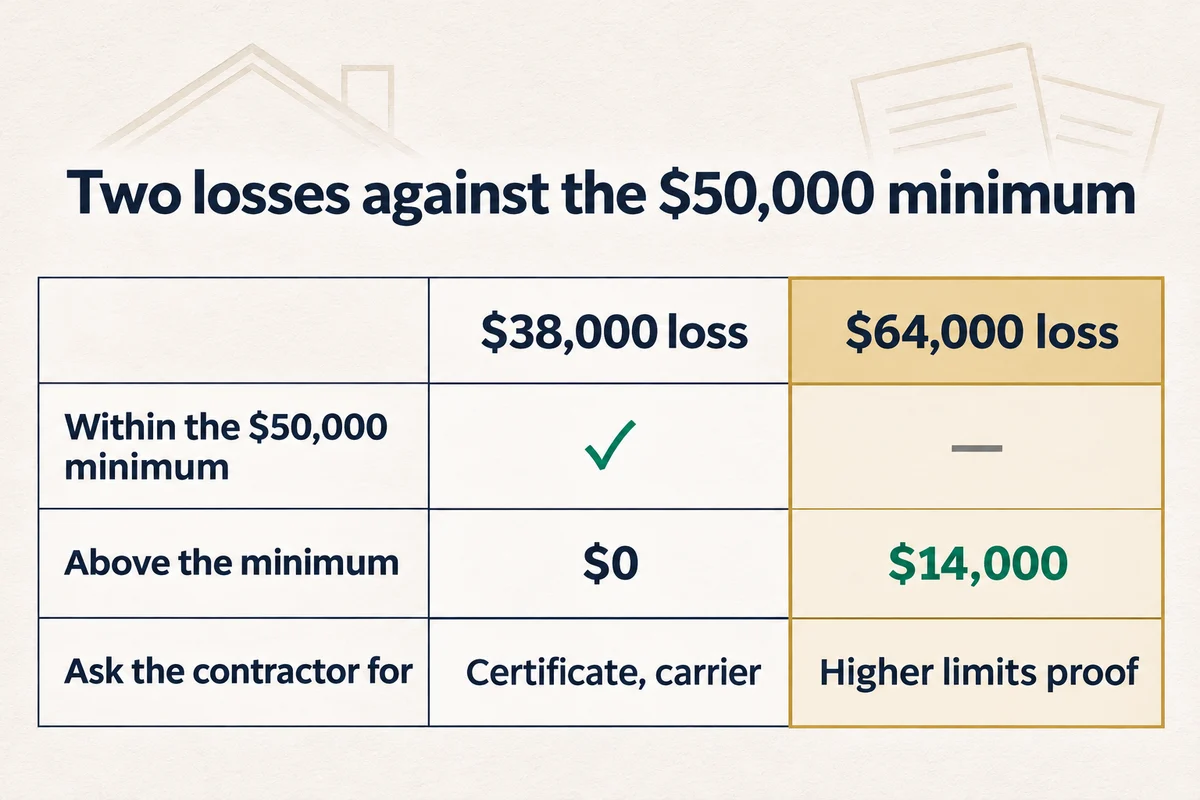
The table runs two made-up losses past a contractor who carries only the minimum. The numbers are an example, not a result.
| Kitchen leak | Roof left open before rain | |
|---|---|---|
| Property damage | $38,000 | $64,000 |
| Contractor's limit at the legal minimum | $50,000 | $50,000 |
| Above that limit | $0 | $14,000 |
| Where the rest can come from | Nothing left over, if the insurer accepts the claim. | The contractor personally, or your own policy for the covered part of the damage. |
In the second case the contractor's insurer cannot pay more than its limit, even when fault is clear. A claim on your own policy, with your insurer pursuing the contractor afterwards, is often how the whole house gets repaired at once.
When your own policy pays first
Your homeowners policy does not ask who caused a burst fitting or a fire before it decides whether the damage is covered. It asks what the cause was and whether that cause is excluded. Water released suddenly from a plumbing system and fire are covered causes on the standard form, whether the plumber or the dishwasher started them. Our guide to sudden versus gradual water damage explains why a leak that seeped for months is treated differently.
The standard Homeowners 3 form, edition HO 00 03 04 91 (copy published by the Nevada Division of Insurance), excludes loss caused by faulty, inadequate or defective workmanship, repair, construction, renovation or remodeling. The same paragraph then says that ensuing loss not otherwise excluded is covered. In plain words: the bad connection is not paid for, the water damage that followed it can be.
- Your deductible applies, just as on any other claim.
- Your insurer may then use subrogation, its right to step into your shoes and recover what it paid from the contractor or the contractor's insurer. If that recovery succeeds, insurers often return some or all of the deductible to the policyholder.
- Do not sign anything that releases the contractor before your insurer agrees. A release can wipe out the insurer's right to recover, and many policies make that your problem.
- Hotel nights and meals while the house is unusable go under additional living expense, which our guide to living expenses during a claim covers line by line.
Your policy may use different words, and some companies add their own endorsements for renovation work. Read the exclusion your insurer actually cites, not the summary in a letter.
Paperwork to get from the contractor this week
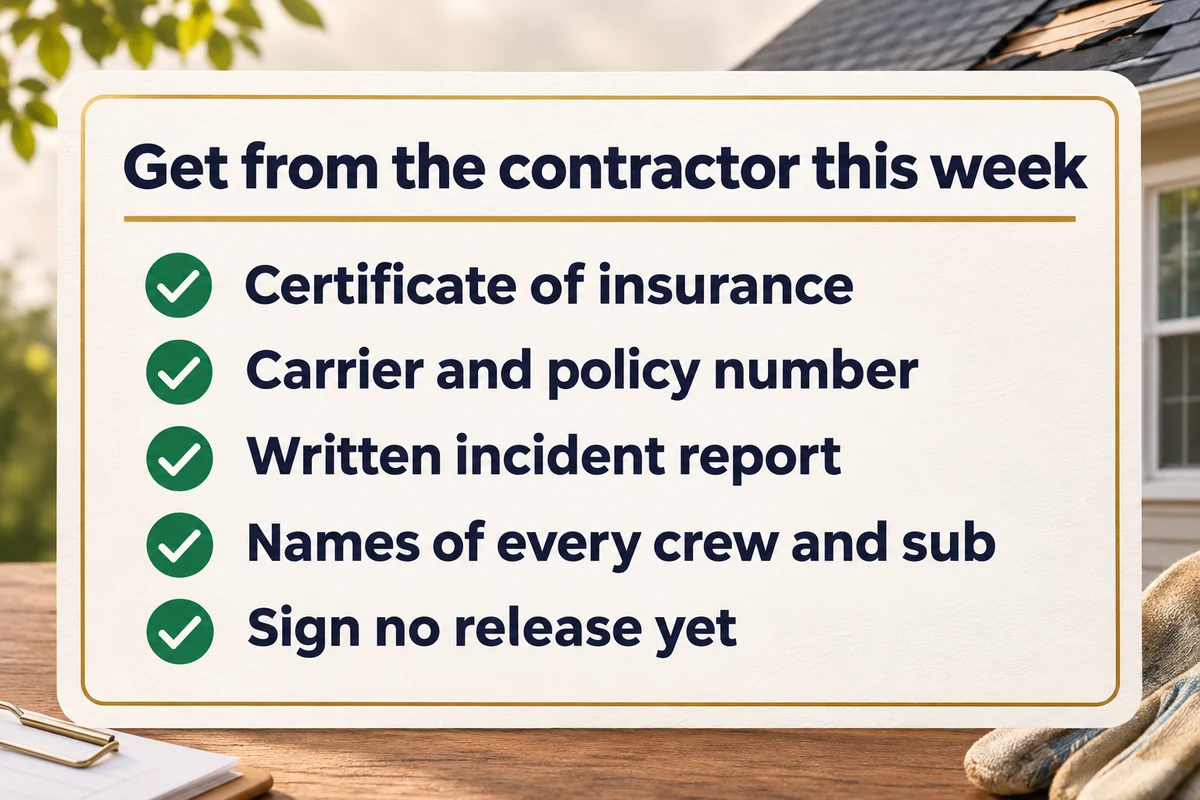
The contractor's cooperation is never better than in the first days, while the crew still wants to finish the job and be paid. Ask for these in writing, by email or text, so each request carries a date.
- A current certificate of insurance showing general liability, the insurer's name, the policy number and the policy dates. A certificate that expired before the day of the damage does not help you.
- A short written account from the contractor of what happened and when: which fitting, which tarp, which tool.
- The names of every crew member and subcontractor on site that day. A subcontractor may carry its own policy, and it may be the one that pays.
- The permit number, if the work needed one, and the contract or estimate you signed.
- Photos of the damaged part before anyone removes it. Keep the failed fitting, valve or connector in a bag. Insurers on both sides may want an engineer to look at it.
- A note of any cash offer to settle. Write it down, do not accept it yet, and sign no release until you know the full repair cost.
Roofing work is its own case in Illinois, because roofers hold a state licence. Our post on telling a contractor from a claim scheme covers how to check a roofer before work starts.
When the contractor's insurer says no
A liability insurer owes its duty to the contractor, not to you, and it pays only when its customer is legally responsible. A refusal is common and usually comes with one of three reasons. Each has a next step that keeps the house moving.
| What the letter says | What it usually means | Next step |
|---|---|---|
| The damage is the insured's own work product. | The insurer is excluding the faulty work itself, the first of the three bills. | Ask in writing whether the resulting damage is also refused, and why. If it is, take the resulting damage to your own policy. |
| Our insured was not negligent. | The insurer disputes fault, often blaming an old pipe or the weather. | Your own policy covers sudden water or fire damage regardless of fault, so open the claim there and let the insurers argue about fault later. |
| The policy was not in force, or this work is not covered. | Lapsed coverage, or a policy written for another trade. | Your own policy is now the main route. Recovering from an uninsured contractor is a matter for an attorney. |
Where a public adjuster helps and where an attorney does
A licensed public adjuster works for you on the claim under your own policy. On a contractor accident that means measuring the resulting damage room by room, making sure the drying, the cabinets, the flooring and the ceiling below are all in the estimate, keeping the faulty-work exclusion confined to the faulty work, and claiming the living expenses and damaged belongings. You can see how we handle a claim from first call to final payment, and the kinds of water damage claims we take on.
A demand against the contractor personally, or a lawsuit for the part above their limit, belongs to an attorney. Our article on which parts of a claim a public adjuster or an attorney handles draws that line in more detail. If a contractor's mistake has left part of your house wet, burned or open to the weather, call us for a free review of what your own policy should pay before you sign anything.
Questions we get about this
Does homeowners insurance cover damage caused by a contractor?
Often it covers the resulting damage, such as water or fire damage from a mistake during the work, because the policy looks at the cause of loss, not at who caused it. The standard form excludes the faulty workmanship itself. Your deductible applies, and your insurer may later recover from the contractor. Your own policy governs.
Should I file with the contractor's insurance or my own?
If the contractor admits the mistake and gives you a certificate of insurance, their liability insurer is usually the first stop and you pay no deductible there. If the contractor is uninsured, disputes fault or the house needs urgent repairs, a claim on your own policy is often faster, and your insurer can pursue the contractor afterwards.
How much insurance must a contractor carry in Illinois?
Under section 25 of the Illinois Home Repair and Remodeling Act, a home repair and remodeling business must carry at least $50,000 per occurrence for property damage and $100,000 per person and $300,000 per occurrence for bodily injury, unless it has a net worth of at least $1,000,000. Many contractors carry more; the certificate of insurance shows the real limits.
Should I accept cash from the contractor to settle the damage?
Not before you know the full repair cost. Water damage often spreads into subfloors and walls that are not visible at first, and a signed release can end your right to more money and your insurer's right to recover. Write down any offer, get an independent estimate, and sign nothing that releases the contractor until you understand the whole loss.