Detached Garages, Fences and Sheds: What Coverage B Actually Pays For
Coverage B — Other Structures — pays for the buildings on your lot that are not attached to the house: a detached garage, a shed, fences, usually the driveway. On most homeowners policies the limit is 10% of your dwelling limit, and it is a separate limit that does not reduce Coverage A.
Coverage B is the part of a homeowners policy most people meet after a storm, and usually in the wrong direction. The roof gets inspected, the estimate arrives, and the detached garage at the back of the lot, the sixty feet of fence the wind laid flat and the shed with a hole in its roof are not on it. Nothing was denied. Those structures were simply never looked at, because the adjuster who came out was there for the house.
This guide sets out what Other Structures coverage includes, how the limit is calculated, the four exclusions that quietly remove a structure from it, and why fence and shed settlements land low so often. We are licensed Illinois public adjusters, not attorneys. Policy wording varies between carriers, and what follows describes the widely used industry homeowners form that most policies are built on. Your own policy governs.
What does Coverage B actually cover?
Structures on your residence premises that are separated from the dwelling by clear space, or connected to it only by a fence, a utility line or a similar connection. In practice that means the detached garage, a shed on a foundation, fences, driveways and walkways, retaining walls, gazebos, in-ground pools, light poles and a detached deck.
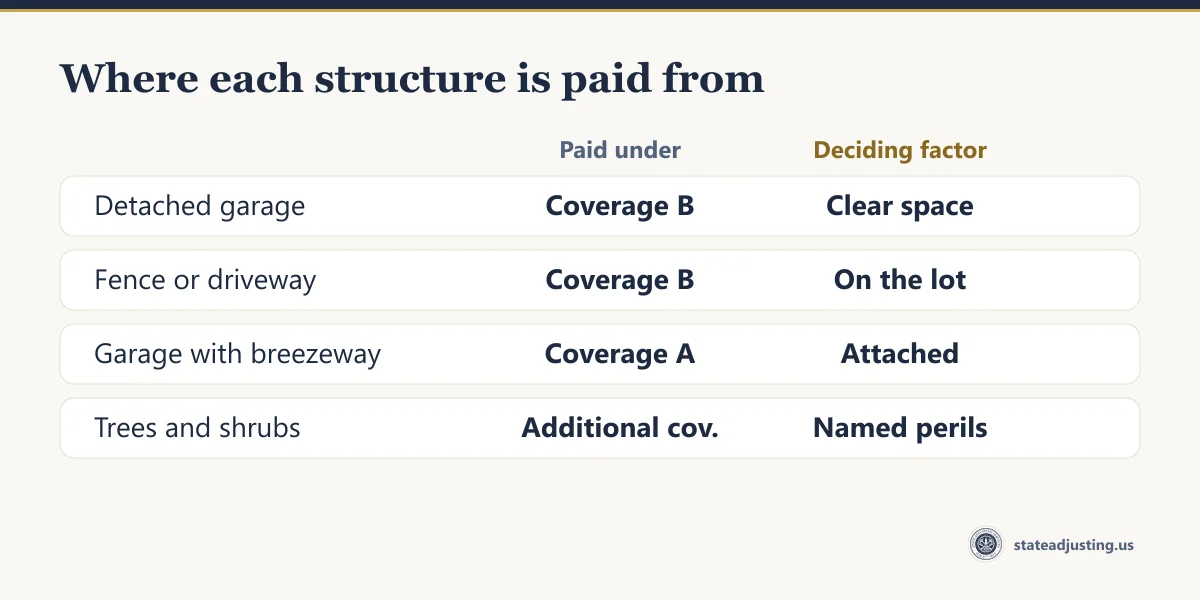
The phrase that decides most arguments is clear space. A garage standing on its own is Coverage B. A garage joined to the house by an enclosed, roofed breezeway is generally treated as part of the dwelling and paid under Coverage A instead — which matters enormously, because Coverage A is usually ten times the size. If your garage sits under the same roofline as the house, or shares a wall with it, do not assume the small limit applies. Ask which coverage the carrier used, and ask early.
The same test cuts the other way for things people assume are covered by the house. A fence is not part of the dwelling no matter how close it runs to it. Neither is the driveway, the retaining wall holding up the side yard, or the pergola off the patio if it is free-standing. All of that competes for one limit, and that limit is smaller than most homeowners realise.
How much Coverage B do I have?
On most homeowners forms, 10% of your Coverage A dwelling limit. It is a separate limit rather than a slice of Coverage A — using it does not reduce what is available for the house. Some carriers write 2% or 5% instead, and the amount can usually be increased by endorsement for a modest premium.
| Coverage A (dwelling limit) | Coverage B at 10% | Coverage B at 5% |
|---|---|---|
| $200,000 | $20,000 | $10,000 |
| $340,000 | $34,000 | $17,000 |
| $500,000 | $50,000 | $25,000 |
| $750,000 | $75,000 | $37,500 |
Read that table as a ceiling, not as a budget. On a $340,000 dwelling limit, a 10% Coverage B gives you $34,000 for every detached structure on the property combined. A two-car detached garage destroyed outright can cost more than that to rebuild — call it $46,000 with a new slab, framing, siding, roof, an overhead door and current code requirements. The policy pays $34,000 and stops. The $340,000 sitting in Coverage A is not available for it, because the dwelling was not damaged.
That gap is worth knowing before a loss rather than during one. If your property carries a substantial detached garage, a coach house, a barn or a long run of fencing, the default 10% is often the wrong number, and raising it is one of the cheaper adjustments on a homeowners policy.
What does a Coverage B claim look like on paper?
Like a smaller version of the dwelling claim, with the same arithmetic: replacement cost, less depreciation, less the deductible. The difference is that the items are easy to overlook and easy to under-measure, so the total depends heavily on whether somebody actually walked the lot.
Take a straight-line wind event on that $340,000 house. The detached garage loses most of a shingle roof and some decking, priced at $9,400. One hundred and twenty feet of cedar privacy fence goes down, priced at $7,800. The shed takes a limb through the roof and the service door, $2,150. Debris removal and haul-off adds $600. The Coverage B loss is $19,950 at replacement cost — comfortably inside the $34,000 limit, but nowhere near what a roof-only inspection would have produced.
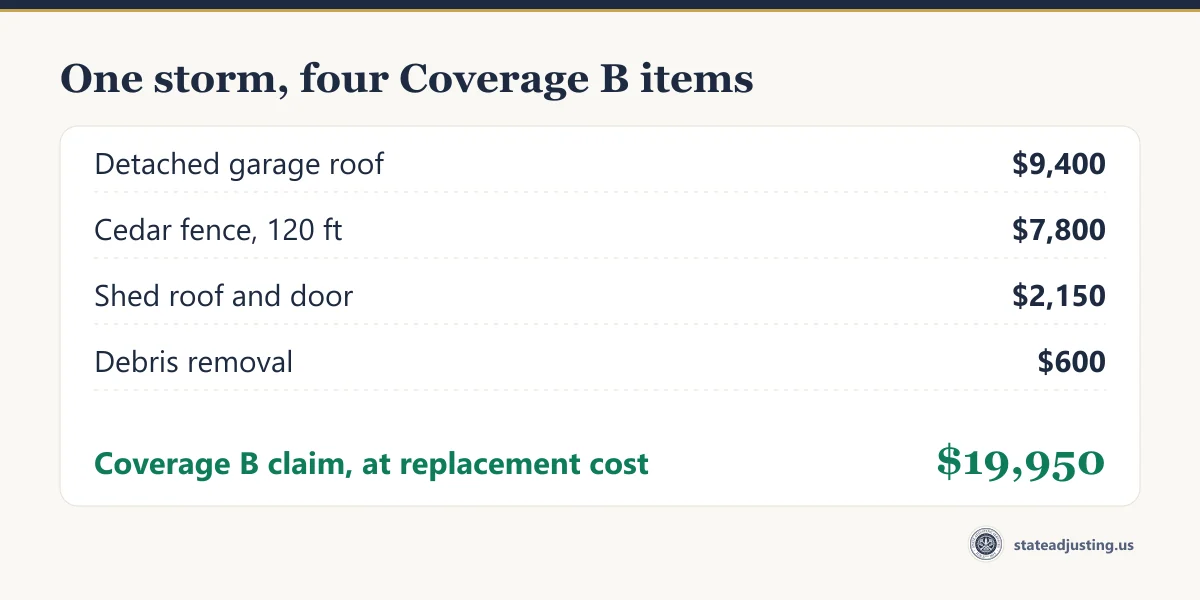
Now the deductions. The fence is twelve years old and the garage roof fourteen, so depreciation is real and it is heavy: $7,850 across the four items. Actual cash value is $12,100. Subtract a $2,500 deductible and the first cheque is $9,600. If the policy covers other structures at replacement cost, most of that $7,850 comes back once the work is done and documented — which is the same second-cheque mechanic we describe in recoverable depreciation. If the policy covers them at actual cash value only, $9,600 is the end of it.
One deductible normally applies to the whole occurrence, not one per structure. The fence, the shed and the garage in the same storm are one loss. That is worth checking on your own declarations page, because a percentage wind and hail deductible changes the arithmetic considerably — we cover that in percentage wind and hail deductibles.
What does Coverage B not pay for?
Four exclusions sit in the coverage itself, and they are about use rather than damage. A structure can be perfectly ordinary and still fall outside Coverage B because of what is kept in it or who is using it. These are the ones we see applied.
| Excluded | What it looks like in real life |
|---|---|
| Land, including the land under the structure | The shed is covered; the graded and compacted ground it sits on is not. Relevant after washouts and slope failures. |
| Structures rented to someone who is not a tenant of the dwelling | The back garage rented out for storage to a neighbour. A private garage rented to a tenant of the home is generally still covered. |
| Structures from which a business is conducted | A workshop where a trade operates, a detached office where clients are seen. Not the same as hobby use. |
| Structures used to store business property | The garage holding a contractor's stock or materials. Forms usually make an exception for property owned by an insured, and usually exclude stored fuel. |
None of this is exotic. A homeowner who parks a work van and a pallet of flooring in the detached garage has changed the coverage picture without changing anything else, and will find that out at the claim rather than at the renewal. If a structure on your lot earns money in any form, that belongs in a conversation with your agent now, not in an adjuster's report later.
Why do fences and sheds settle so low?
Three reasons, and only one of them is arguable. Fences and outbuildings depreciate faster than a house, some policies now cover them at actual cash value by endorsement, and carriers frequently price the damaged panels rather than the run. The first is arithmetic, the second is in your paperwork, and the third is a genuine dispute worth having.
- Depreciation is steep. A wood fence has a shorter expected life than a roof, so a twelve-year-old cedar fence can lose half its value on paper before anyone argues about anything. Replacement cost coverage is what brings that money back; actual cash value coverage does not.
- Check for an outbuilding endorsement. Some policies now settle detached structures, or roof surfaces on them, at actual cash value while the dwelling stays at replacement cost. Others exclude wind and hail on outbuildings altogether. This will be a named form in the endorsement schedule on your declarations page.
- Panels versus the run. If twelve panels of a hundred-and-twenty-foot fence are down and the remaining panels are the same age and finish, the question is whether a partial replacement produces a reasonably uniform result. That is the same matching argument that comes up on roofs and siding, and it is set out in matching in Illinois policies.
- Measurement. Fences are priced by the linear foot and sheds by the square foot. Measure them yourself and compare the figures to the estimate. A fence written as 80 feet when it is 120 is a $2,600 error nobody will find for you.
Are trees and landscaping covered?
Rarely, and almost never for wind. Trees, shrubs and plants sit in a separate additional coverage on the standard form, usually capped at 5% of the dwelling limit with no more than $500 for any one plant, and it responds only to a short list of named perils: fire or lightning, explosion, riot, aircraft, a vehicle not owned by a resident, vandalism and theft.
Windstorm is not on that list. A mature tree brought down by an eighty-mile-an-hour gust is, in most policies, your loss and your expense. What the policy does address is what the tree hits and what it blocks. On the standard form, if a tree felled by wind, hail or the weight of ice or snow damages a covered structure or blocks the driveway, removal is covered up to $1,000 in total and $500 for any one tree. If it falls in the middle of the yard and hits nothing, removal is generally not covered at all.
Debris removal for the structures themselves works differently and better. It is included within the limit that applies to the damaged property, and if the repair plus the debris removal exceeds that limit, most forms make an additional 5% of the limit available for the removal. On a $34,000 Coverage B that is another $1,700 when a structure is a total loss — small, but it is real money that has to be asked for.
What gets missed, and how to stop it
The single most common Coverage B failure is not a coverage dispute at all. Nobody walked the back of the lot. The inspection focused on the roof, the estimate reflected the inspection, and the homeowner accepted it without knowing that a whole coverage had gone unexamined. That is fixable, and it is fixable by you, on the day.
- Photograph every structure before you clear anything. Wide shot first to place it on the lot, then the damage close up with a tape measure in frame. Our guide to what to photograph after property damage applies to outbuildings exactly as it does to the house.
- Measure the fence, the shed and the garage. Linear feet of fence, square feet of shed and garage footprint, plus the height and the material. Write it down before the adjuster arrives.
- Walk the adjuster to the back of the lot. Do not assume the inspection includes it. Point at each structure and ask for it to be included.
- Find your Coverage B limit in dollars. It is on the declarations page, usually printed as both a percentage and an amount. Know the ceiling before you know the loss.
- Ask which coverage each item was paid from. The summary page of the carrier's estimate separates them, and a garage paid from the wrong coverage is worth challenging. We break that document down in how to read the carrier's estimate.
What to do next
If a storm has already happened, compare the carrier's estimate against a list of every structure on your property, not against the roof. Anything on the lot that is missing from the estimate is not a denial and does not need an appeal — it needs to be reported and inspected, which is a phone call. Anything that is on the estimate at a length or a square footage you can disprove with a tape measure needs a correction, and corrections at that level are usually straightforward.
If nothing has happened yet, pull the declarations page and look at two numbers: the Coverage B limit in dollars, and whether other structures are settled at replacement cost or actual cash value. Those two lines decide most of what this article describes, and both are easier to change now than to argue about later.
State Adjusting Services is a licensed Illinois public adjuster. We read the policy, measure and price the whole loss, and negotiate it with the carrier on wind, hail and storm claims across Illinois, detached structures included. Our fee is a percentage of the recovery, agreed in writing and paid out of the settlement: $0 upfront, and no recovery means no fee. If you want a free review of your policy and your claim, get in touch, or read how the process works first. Our office is open Monday through Friday, 7:00 AM to 7:00 PM, and Saturday and Sunday, 9:00 AM to 5:00 PM.
Questions we get about this
Is my detached garage covered by my homeowners insurance?
Usually yes, under Coverage B — Other Structures — rather than under the dwelling coverage. It applies to structures separated from the house by clear space. The limit is commonly 10% of your dwelling limit and covers every detached structure on the lot combined.
Does homeowners insurance pay for a fence blown down by wind?
Commonly yes, as an other-structures loss, subject to your deductible and to depreciation. Fences depreciate quickly, so the first payment can be well below the replacement price. Whether the rest comes back depends on whether the policy covers other structures at replacement cost.
Can I use my dwelling coverage if the garage costs more than my Coverage B limit?
No. Coverage A applies to the dwelling. If a detached structure exceeds the Coverage B limit, the excess is the homeowner's. That is why raising the other-structures limit by endorsement is worth considering when a property has a large detached garage or barn.
Is a tree that fell in a storm covered?
The tree itself usually is not. Trees and shrubs sit under a separate additional coverage that responds only to named perils such as fire, explosion and vandalism, and windstorm is generally not among them. Removal is typically covered only if the tree damaged a covered structure or blocked the driveway, up to modest limits.