Claiming against the driver's insurer after a car hits your house

When a car hits your house, the at-fault driver's insurance owes you for the property damage its driver caused, up to the driver's property damage liability limit, measured the way a liability claim is measured, and usually in exchange for a release that ends your claim against that driver. It does not owe you the terms of your homeowners policy. In Illinois the smallest limit a driver may carry is $20,000 per accident for property damage, and that one figure has to cover everything the car struck, not only your wall.
We are licensed Illinois public adjusters, not attorneys. Injuries from the crash, and any lawsuit against the driver, are matters for a lawyer. This guide covers the property side: how the claim against the driver's insurer works, how it fits next to your own policy, and the rules the Illinois Department of Insurance publishes for it. Your own policy governs your homeowners claim.
What does the driver's insurer owe you, and what doesn't it?
The driver's insurer is answering a liability claim. Its customer damaged your property, and it pays for that damage on the customer's behalf. You have no contract with it, and that one fact explains most of what catches homeowners off guard in the first week.
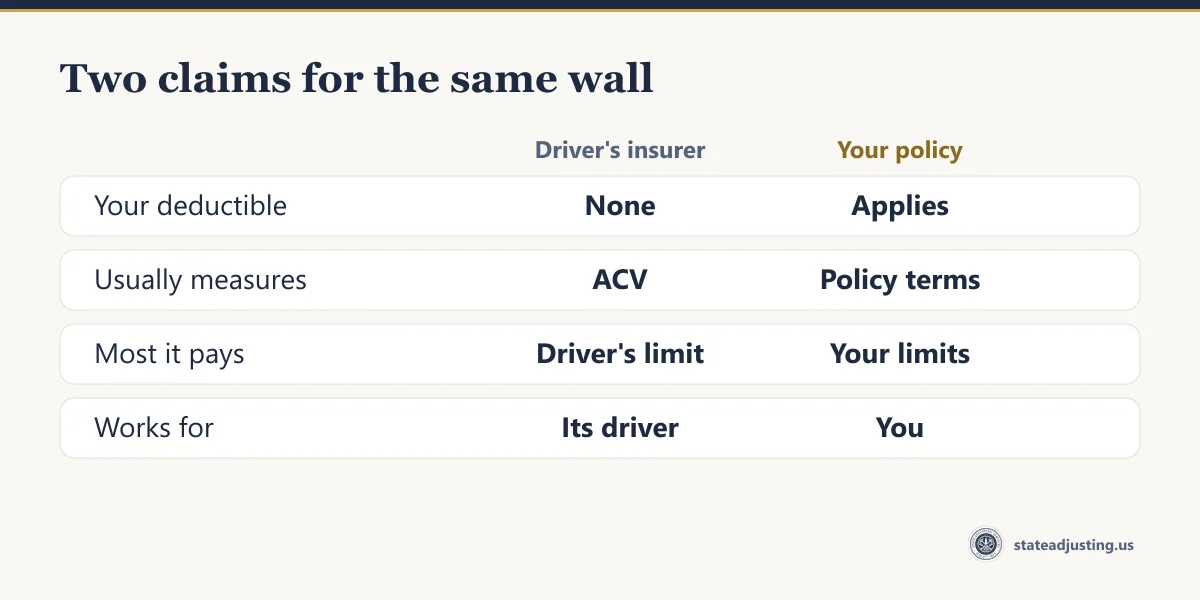
- You pay no deductible on this claim, since it is not your policy. The state's page on filing a claim with another driver's insurance company says so in plain terms.
- Its job is to restore what your property was worth just before the crash. Liability claims are often settled at actual cash value (ACV: what the damaged part was worth that day, after age and wear), and how far that reaches is set by Illinois law, not by your homeowners form. Our guide to ACV versus replacement cost shows how wide that gap gets on an older window, porch or run of siding.
- It can cut what it pays by any share of fault it assigns to you. Under Illinois comparative negligence, the same state page says a claimant generally recovers when 50% or less at fault, reduced by that percentage. An owner whose house was hit by a car that left the road is usually not at fault at all, but read every offer letter for a percentage.
- It pays nothing above its driver's limit. What is left over is the driver's personal debt, and collecting it is work for an attorney.
Your homeowners insurer differs on each point. You carry the deductible, it works for you under the contract you paid for, and it pays on your policy's terms, often replacement cost released in stages, up to your own limits.
How one $20,000 limit gets divided between everyone the car hit
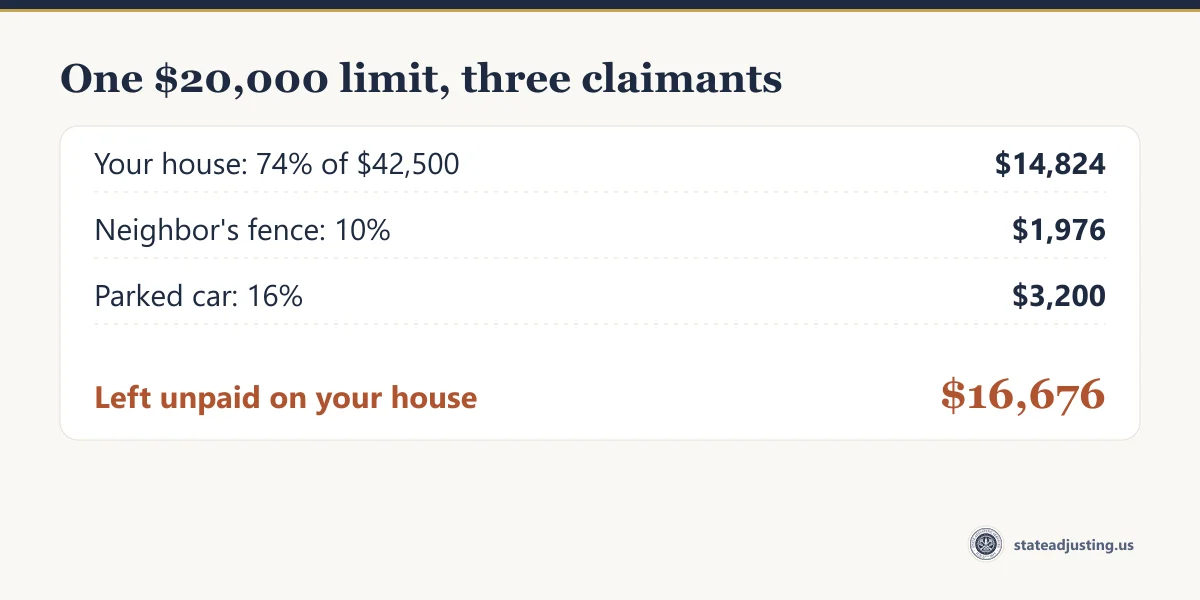
A per-accident limit is one pot for every claimant. The fence the car went through, the car it clipped at the curb and your house all draw on it. How an insurer splits a limit that is too small for the claims against it depends on its policy and on the law. One common method is in proportion to each claimant's damage, and the table below runs that method on made-up figures. It is an illustration, not a claim we handled.
| Claimant | Damage | Share | Paid from $20,000 |
|---|---|---|---|
| Your house: wall, window, porch, room behind | $31,500 | 74.1% | $14,824 |
| Neighbor's fence | $4,200 | 9.9% | $1,976 |
| Parked car at the curb | $6,800 | 16.0% | $3,200 |
| All three | $42,500 | 100% | $20,000 |
In that example, $31,500 less $14,824 leaves $16,676 of the house unpaid if the auto claim is the only claim you make. A driver who bought a higher limit changes the arithmetic, so ask the driver's insurer in writing for the property damage limit and how many claims are open against it. Some insurers will not disclose a limit before settlement. Your homeowners claim can go ahead either way.
The release is the step you can't take back
The Illinois Department of Insurance warns that another driver's insurer will usually not settle until you sign a release for damages, and that the offer is then the only amount you will receive. Do not sign it, or cash a check described as final, until the full cost of the repair is known.
Three costs are often still unknown in the first weeks after an impact: whether the studs and header behind the face of the wall moved, whether the foundation cracked where the bumper struck, and what it costs to match brick or siding that is no longer made. Each tends to appear only once the wall is opened.
Tell your own insurer before you sign anything the driver's insurer sends. Most homeowners policies carry a subrogation condition, which gives your insurer the right to recover from the person responsible whatever it pays you, and a release you sign can affect that right. Ask your insurer in writing how it wants the two claims coordinated, and keep the reply. Whether a particular release is safe to sign is a legal question, and an attorney should read it.
Running both claims side by side, week by week
You can claim against both insurers, provided each dollar of damage is paid once. For most homeowners the order that protects the repair is to open both claims at once, let your own insurer pay under your policy, and let it pursue the driver's insurer afterwards. This is how the weeks usually run, with the time limits the state publishes for the claim against the driver.
Report the loss in writing and ask for the claim number and the adjuster's name. Keep every board-up and shoring invoice; our note on emergency mitigation bills covers what gets questioned.
Give it the police report number and your address. A phone call from it is not yet a claim: ask for its claim forms.
Inspection of the wall inside and out, then a first estimate.
It must send claim forms within 15 working days of your request.
A first payment, often at ACV, with depreciation held back until the work is done.
Its own inspection and an offer, usually with a release attached.
Supplements as the wall comes open and hidden damage is priced.
If your claim is still unresolved, it owes you a reasonable written explanation of the delay.
It may pursue the driver's insurer and may hand back your deductible from what it recovers, in full or in part.
Deals with your insurer instead of you, up to what remains of the limit.
Your policy's own suit-limitation clause applies, and it is usually far shorter. Read it on your form.
Accept a final offer or file suit within 5 years of the accident.
What to send to which insurer
Most of the file goes to both insurers. The differences are in what you owe each one, and that follows from which of them you have a contract with.
| Item | Driver's insurer | Your homeowners insurer |
|---|---|---|
| Police report number, then the report | Send it: fault is decided from it | Send it |
| Pictures of the vehicle where it stopped, and of both faces of the wall | Send them | Send them |
| Contractor's itemised estimate | Send it, and ask for theirs line by line | Send it, with supplements as the wall opens |
| Board-up and shoring invoices | Send them | Send them |
| A recorded statement | You are not its policyholder; ask what it is for, and read our note on the recorded statement first | Your policy usually requires your cooperation |
| Medical records | Part of an injury claim, which is an attorney's matter | Not part of a property claim |
| A signed release | Only once the full repair cost is known and your insurer has been told | Not used |
If the driver's insurer offers too little or goes quiet
A claim against another driver's insurer has no appraisal step; the state's page says there is no appraisal requirement, and appraisal lives in your own policy instead. When the driver's insurer will not move, these are the routes open to you:
- Claim the shortfall under your own homeowners policy. For the house, this is usually the faster route.
- Ask the driver's insurer in writing for its estimate item by item, and answer each item with your contractor's figure for the same work.
- If it misses the 15-working-day or 60-day rules, file a complaint with the Illinois Department of Insurance. Our guide to a complaint to the Illinois Department of Insurance explains what the department does with one.
- Talk to an attorney about a claim against the driver personally, including small claims court where the amount is within the county's limit.
The minimum limit itself is in 625 ILCS 5/7-203, as the state's auto insurance shopping guide sets out: $20,000 per accident for property damage. Your own policy has its own remedies, written into its conditions, including appraisal where you and your insurer agree on the cause of the damage but not the amount.
Where we come in
We handle your homeowners claim. We document the impact from the brick through to the room behind it, price the repair including matching and code items, and keep the coordination with the driver's insurer in writing so that no release cuts the claim short. Our page on vehicle impact claims shows how we work these losses. The first review is free; our fee is a percentage of the recovery, agreed in writing and regulated by Illinois law, so nothing is paid upfront. Call (630) 297-8136 or send us the details. We are open Monday through Friday 7:00 AM to 7:00 PM and Saturday and Sunday 9:00 AM to 5:00 PM.
Questions we get about this
Do I pay a deductible when I claim against the driver's insurance?
No. A claim against another driver's insurer carries no deductible for you, as the Illinois Department of Insurance states. If you claim under your own homeowners policy, your deductible applies, and your insurer may return some or all of it from what it later recovers from the driver's insurer.
What property damage coverage must an Illinois driver carry?
At least $20,000 per accident under 625 ILCS 5/7-203. That limit is shared by all the property the vehicle damaged, so a house, a fence and a parked car hit in the same crash all draw on the same $20,000 unless the driver bought more.
Should I sign the release the driver's insurer sent me?
Not until the full repair cost is known and you have told your own insurer in writing. A release usually ends your claim against the driver, and it can affect your insurer's right to recover what it pays you. Whether a specific release is safe to sign is a question for an attorney.
How long can I wait to settle with the other driver's insurer?
For property damage, the state's insurance department allows five years from the crash to accept a final offer or sue. Your homeowners policy has separate and usually much shorter time limits, so open that claim right away.