File a home insurance claim or pay out of pocket? How to work it out

Whether to file a home insurance claim or pay out of pocket comes down to one sum: add your deductible to what the claim would cost you in higher premiums, then compare that total with the real cost of the repair. Above the total, filing usually leaves you ahead. Below it, paying yourself usually does. The word to watch is real, since a quote for the damage you can see may not be the whole repair, and some losses should be reported whatever the first number says.
We are licensed Illinois public adjusters, not attorneys. The Illinois rules below come from the Insurance Code and the Department of Insurance, and your own policy governs your claim. Every dollar figure on this page is an example to show the sum. None is a quote or a result.
What is the smallest repair worth claiming?
The smallest repair worth claiming is your deductible plus the premium cost of having the claim on your record. A claim for less than that pays you less than it costs you. Two numbers go in, and you can get both before you report anything.
Premium cost is the one figure nobody can give you in general, us included, since it differs by company and by the file. The next section shows how to ask for it. The table runs the sum for four deductibles at two made-up premium costs, so you can see how much the deductible moves the answer.
| Your deductible | Premium cost $720 | Premium cost $1,500 |
|---|---|---|
| $1,000 flat | $1,720 | $2,500 |
| $2,500 flat | $3,220 | $4,000 |
| 1% of $350,000 ($3,500) | $4,220 | $5,000 |
| 2% of $350,000 ($7,000) | $7,720 | $8,500 |
The last two rows catch people out. Wind and hail can carry a separate deductible written as a share of the dwelling limit, here a limit of $350,000, so a homeowner who remembers paying $1,000 last time may be looking at $7,000 for a storm. Our guide to percentage wind and hail deductibles shows where that line sits in the policy.
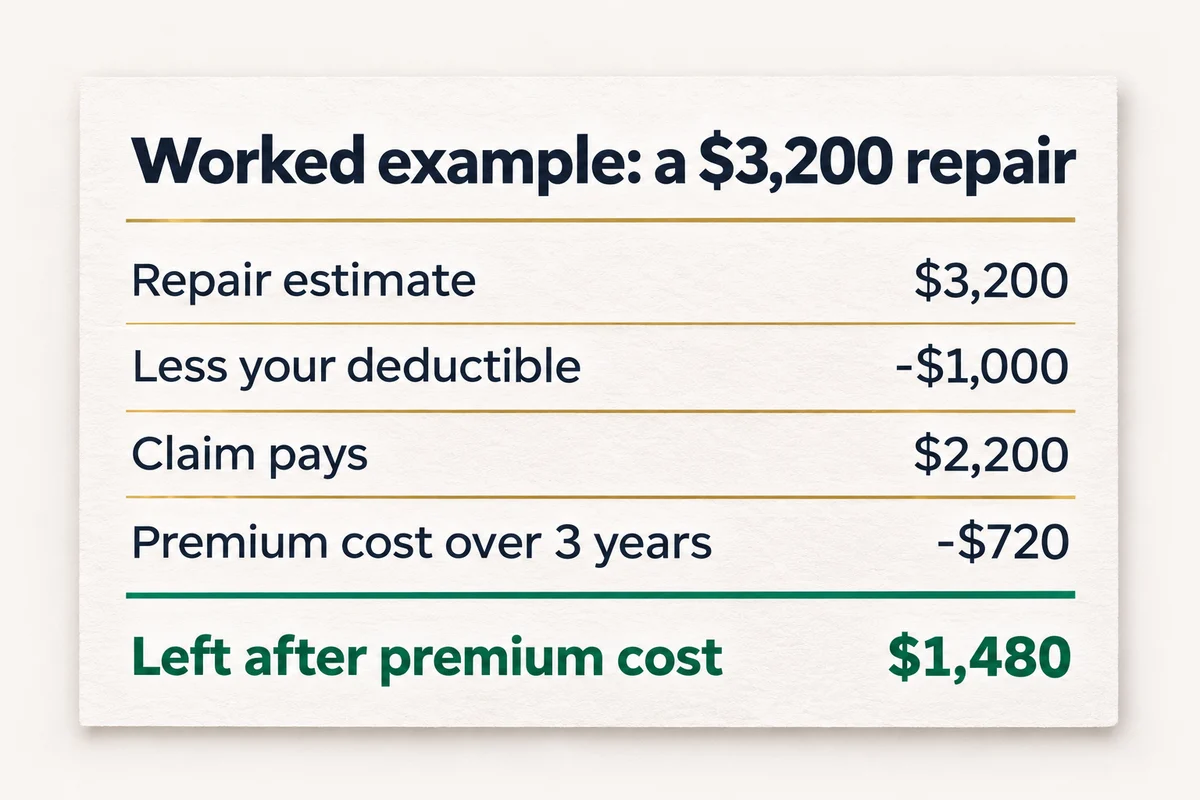
Here is the first row at work, with a premium increase of $240 a year for three years. On a $3,200 repair the claim pays $2,200, and after $720 in premium you are $1,480 ahead of paying it all yourself. On a $1,400 repair the claim pays $400 and still costs $720, which leaves you $320 worse off.
The deductible stays your cost in every version of this sum. A contractor who offers to absorb it is not making the claim cheaper, and our post on storm chasers at the door explains what that offer does to the numbers on the contract.
When is the visible quote the wrong number to compare?
The sum is only as good as the repair figure. A handyman's price for a stained ceiling covers the ceiling. It can't price what is behind it. For these six kinds of loss we would not settle the question on a first quote, and for some of them the sum isn't the deciding factor at all.
| What happened | What the first quote may leave out | Do this before deciding |
|---|---|---|
| Water in a ceiling, wall or floor | Wet insulation, framing and subfloor stay out of sight until something is opened. The cause also decides coverage, as our guide to sudden versus gradual water damage explains. | Stop the water, photograph it, and get moisture readings before anything is patched. |
| Hail or wind on a roof | A patch price covers the shingles someone pointed at. It may miss flashing, vents, gutters and other slopes, the same items we see in what gets left out of a hail estimate. | Have every slope inspected and photographed, and keep the photos. |
| Smoke or soot | Residue moves through ductwork into rooms the flame never reached. We cover this in smoke damage without a fire. | Look inside closets, vents and filters before any cleaning starts. |
| Someone hurt, or a neighbor's property damaged | The bill isn't yours to estimate, and it may arrive long after the event. | Read the notice duty in your liability section and report it. Take any legal papers to an attorney straight away. |
| A house you can't live in | Hotel and meal costs sit on top of the repair. They may fall under additional living expense coverage. | Keep every receipt from the first night. |
| Damage somebody else caused | The money may come from that person's insurer. Our post on a driver hitting your house walks through it. | Get the police report and the other insurer's details before you spend anything. |
How do you ask your agent without opening a claim?
Say plainly that you are asking a coverage question and not reporting a loss, and put it in writing if you can. A question about possible coverage and a reported loss are treated differently, so the words you use matter. Almost every article on this subject says to call your agent, and few mention this.
The Connecticut Insurance Department and the Utah Insurance Department both tell consumers to be specific about which one they are doing. Both say the C.L.U.E. claims database instructs insurers not to report inquiries about possible coverage. Utah adds that telling an agent about a loss can count as a claim even if nothing is paid, and Connecticut notes that a claim closed without payment can still be recorded. Those are other states' regulators describing a database insurers use across the country. No wording can promise how a particular company logs a call, which is why an email with a date on it is the better record.
This is a coverage question only. I am not reporting a loss and I am not asking you to open a claim.
- What deductible applies to [wind and hail, water, fire] on my policy?
- If a claim of about $[amount] were paid, what would my renewal premium be, in dollars?
- How many years would that change last, and would I lose a claim-free discount?
- Does a claim closed without payment count when my policy is rated or renewed?
Asking first does not put off your duties under the policy. If the answer points to filing, report the loss promptly. Your policy's notice wording and the other time limits are in our post on deadlines that end claims in Illinois.
What can an Illinois insurer do after you claim?
Once a home policy has been in force past its first 60 days, an Illinois insurer cannot cancel it mid-term solely because it paid a claim. It keeps more room at the renewal date, where nonrenewal is allowed for most reasons with written notice. So the rule protects the current term, and the renewal is where a claim can still count.
| Stage of the policy | What the company may do | Written notice |
|---|---|---|
| First 60 days of a new policy | Cancel for almost any reason. | 30 days, or 10 for nonpayment |
| Mid-term after 60 days, or on a renewal policy | Cancel only for nonpayment, misrepresentation or fraud in obtaining the policy, or an increase in the risk originally accepted. A paid claim cannot be the sole basis. | 30 days, or 10 for nonpayment |
| Renewal date, in force under 5 years | Decline to renew for most reasons. Barred reasons include the property's age or location and the occupants' personal characteristics, and credit information can't be the only reason. | 30 days, with specific reasons |
| Renewal date, in force 5 years or more | Decline to renew for nearly any reason on the longer notice. The shorter notice is limited to misleading information on the policy or a significant change in the risk. | 60 days, or 30 for those two reasons |
The table draws on the Department's pages on cancellation and nonrenewal. The paid claim rule is 215 ILCS 5/143.21b, which covers residential policies up to a four family dwelling. Illinois defines cancellation as ending a policy before its expiration date, so that section speaks to the mid-term case. For nonrenewal, the one claims limit on the Department's page concerns hate crime losses backed by a police report.
You do have a route if a notice arrives. It must give specific reasons, explain your right to appeal and mention the Illinois FAIR Plan. You can ask the Director of Insurance for a hearing at least 20 days before the date it takes effect, and the policy continues through the hearing as long as premium is paid. If the reason given is the condition of the property, the company must allow up to 90 days for repairs.
What do other insurers see when you shop for a policy?
They can see your claims history in a C.L.U.E. report, which insurers may pull when you apply or ask for a quote. It lists the date of loss, type of loss, amount paid and the property address. That means a claim follows the house and you when you change companies, so it belongs in your decision if you plan to shop around at renewal.
The Washington insurance commissioner's office and Connecticut's department both describe up to seven years of property claims, while Utah's page says up to five. Federal law entitles you to a free copy from LexisNexis, online or at 866-312-8076, and we would read yours before you email your agent. It may show a past claim you had forgotten, which changes the answer to question 2. To correct a mistake, contact LexisNexis. It checks with the insurer that reported the item and gives you the result within 30 days, and you can add your own statement to future reports.
If you pay for it yourself, what should you keep?
Keep enough paper to prove the damage was fixed, by whom and when. If you have a claim on the same part of the house later, an adjuster may ask whether some of the damage is old. A folder answers that in one email. We would keep:
- Dated photographs from before, during and after, taken the way our guide on what to photograph sets out.
- The written contract, the final invoice and proof of payment. Illinois home repair contracts over $1,000 have to be in writing.
- Any permit and the final inspection for it.
- A short note of what happened, the date, and what the contractor found once things were opened up.
- The warranty and the product labels for what went in.
Tell the contractor to stop and call you if the job turns out bigger than quoted. That is the moment to run the sum again, before the wet drywall goes in a dumpster and the evidence goes with it. Once the repair is finished, your insurer has nothing left to inspect.
If the sum says file, or you still can't tell
Report the loss, protect the property from further damage and photograph everything first. Keep your receipts for the emergency work. From there the job is to document the full loss, whether that is a water damage claim, a hail claim or something else, and a public adjuster can do that for you under a written contract.
If you are undecided, send us your photos and your declarations page through the contact page or call (630) 297-8136. We are open Monday through Friday, 7:00 AM to 7:00 PM, and Saturday and Sunday, 9:00 AM to 5:00 PM. The review is free, and if a claim isn't worth pursuing, we say so at that review. If we do take it on, our process page shows what happens next. There is nothing to pay upfront: the fee is a percentage of the recovery, agreed in writing, and with no recovery there is no fee.
Questions we get about this
Is it worth filing a claim if the repair is just over my deductible?
Usually not, if the repair figure is reliable. A claim only leaves you ahead when the repair costs more than your deductible plus the premium cost of the claim. Ask your agent for that premium cost in dollars, and make sure the quote covers hidden damage, before you decide.
Will my insurance go up if I file a claim and get paid nothing?
It depends on the company, so ask yours in writing. The Connecticut Insurance Department says a claim closed without payment can still be recorded in the C.L.U.E. database, where other insurers can see it. Whether it changes your premium is an underwriting decision for each insurer.
Can an Illinois insurer drop me for filing a claim?
Not mid-term on the sole basis that it paid a claim: 215 ILCS 5/143.21b bars that for residential policies. At the renewal date the rules are wider, and a company may decline to renew for most reasons with written notice of 30 or 60 days, depending on how long the policy has been in force.
Does asking my agent a question count as a claim?
An inquiry about possible coverage should not be reported, according to the Connecticut and Utah insurance regulators, who say C.L.U.E. instructs insurers not to report inquiries. Telling an agent about an actual loss can count as a claim, though. State that you are asking a coverage question only, and do it by email so your words are dated.