Your Claim Was Denied: The Five Things to Do in the First Week

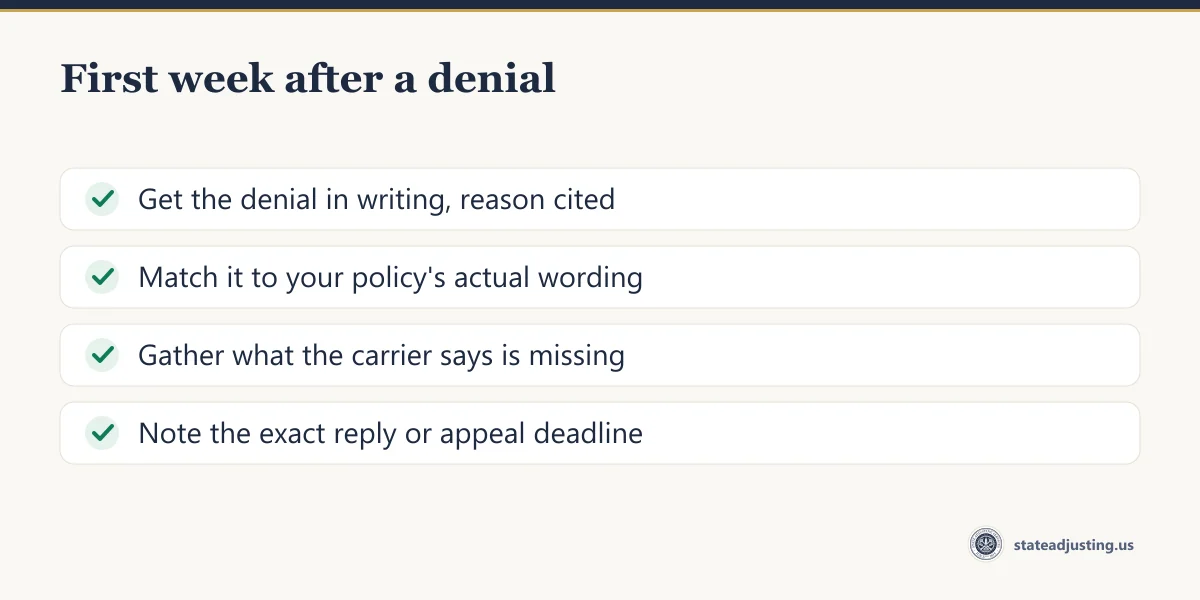
A denial letter states one carrier's conclusion, tied to one policy provision — it is not automatically final. In the first week: get the denial in writing, match its stated reason to your policy's actual wording, gather whatever documentation the carrier flagged, note the reply deadline, and decide whether the dispute is about facts or a legal reading of the policy.
When your claim was denied, the letter you received states a conclusion — a specific policy provision, applied to the facts the carrier had at the time. It is not automatically the final word. What you do in the first week often decides whether that denial holds, gets reversed on reconsideration, or ends up in front of an appraiser or an attorney, because most policies attach a real deadline to challenging it.
What are the five things to do in the first week after a denial?
Get the denial in writing, match its stated reason to your policy's actual wording, gather whatever documentation the carrier flagged, note the reply deadline, and decide whether the dispute is about facts and paperwork or a legal reading of the policy. Each step narrows down what actually happens next.
- Get the denial in writing, with the exact policy provision cited
- Match that provision to your own policy's actual wording, not the letter's summary of it
- Gather whatever documentation the carrier says is missing or insufficient
- Note the exact appeal, reconsideration, or reply deadline stated in the letter
- Decide whether the dispute is about facts and documentation, or a legal reading of the policy
Carriers deny claims verbally more often than policyholders expect, and a verbal denial is hard to challenge because there is nothing to point back to. Ask, in writing, for the denial itself, referencing the specific section it relies on — an exclusion, an endorsement, or a condition in the body of the policy. If you have not read your own policy line by line yet, our guide to reading your homeowners policy covers the sections that decide most disputes.
Compare the letter's cited provision against your actual policy — not the carrier's paraphrase of it. Denials are sometimes built on the wrong provision: an exclusion written for one cause of loss applied to a loss that was actually caused by something else, or a condition the carrier believes wasn't met when it was. That mismatch is not a matter of opinion; the provision either says what the letter claims it says, or it doesn't.
How do I read a denial letter without a law degree?
Most denials fall into a handful of categories: an excluded peril, a condition the carrier says wasn't satisfied (like late notice), insufficient documentation, or a policy limit already reached. Which category applies changes what happens next — a documentation gap is usually fixable; a genuine exclusion usually isn't, though a misapplied one can be challenged.
| Phrase on the letter | What it usually means |
|---|---|
| "Excluded peril" | The policy states this specific cause of loss isn't covered — check the exact exclusion's wording against your loss |
| "Wear and tear" / "pre-existing" | The carrier believes the damage existed, or developed gradually, before the date of loss rather than during it |
| "Late notice" / "untimely reporting" | The carrier says you didn't report within the policy's notice requirement — check what that requirement actually says |
| "Insufficient documentation" | The carrier is asking for something specific. Find out exactly what, in writing, rather than resubmitting everything |
| "Policy limit reached" | A sub-limit — contents, additional living expenses, a specific peril — may cap the payout even when the loss is covered |
A denial for insufficient documentation is the easiest to answer — it is asking for something specific, and providing it (photos, receipts, a contractor's scope) can resolve the claim without any real dispute. A denial citing an exclusion is the hardest, because no amount of paperwork changes what a policy does not cover. The only real question is whether the exclusion was applied correctly to your specific loss, and that question is worth checking rather than assuming.
What are my options if the denial stands?
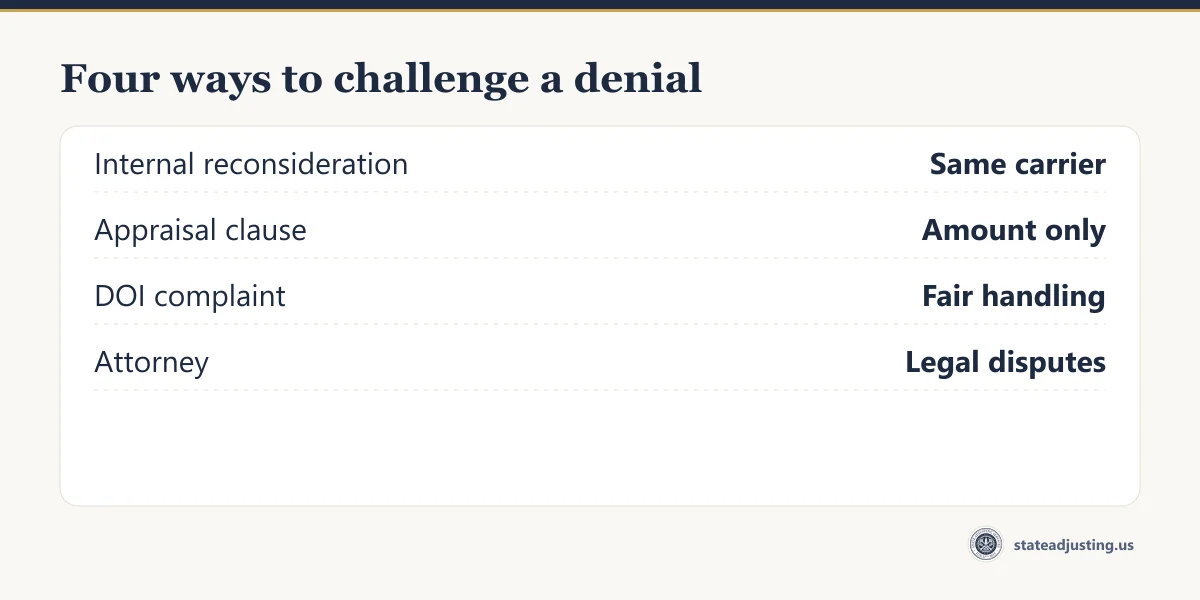
Four paths exist, and they are not interchangeable: ask the carrier to reconsider internally, invoke your policy's appraisal clause if the dispute is over the amount of a loss the carrier already agrees is covered, file a complaint with the Illinois Department of Insurance, or consult an attorney. Which one fits depends on exactly what is being disputed.
| Option | What it actually does | Who handles it |
|---|---|---|
| Internal reconsideration request | Asks the same carrier to review the same claim with new information or documentation | You, or a public adjuster on your behalf |
| Appraisal clause | Settles a dispute over the amount of a covered loss — not whether coverage exists in the first place | Two appraisers, one per side, plus an umpire if they disagree |
| Illinois Department of Insurance complaint | Reviews whether the carrier followed Illinois claims-handling rules | The Department, a state regulator — not a substitute for the claim itself |
| Attorney consultation | Evaluates legal options when a coverage dispute doesn't resolve any other way | A licensed attorney — this is not something we do |
Appraisal is the option homeowners most often misapply: it resolves disagreement over how much a covered loss is worth, not whether the loss is covered at all. Invoking appraisal on a straight coverage denial doesn't work, because there is no agreed-covered amount to appraise yet. We'll cover the appraisal clause in more depth in a future guide — for now, this distinction is enough to keep you from spending a week on the wrong process.
When does a public adjuster help with a denied claim?
When the dispute turns on documentation, valuation, or how a provision applies to your specific facts, a public adjuster can rebuild the file, compare the denial against your policy line by line, and negotiate with the carrier. When the dispute is purely legal — how a court would interpret ambiguous policy language — that is an attorney's work, not ours.
We are not lawyers, and we don't take every denied claim. Some denials are correctly applied exclusions, and no amount of representation changes what a policy does not cover. What we can do, usually within a short review, is confirm which kind of denial you're looking at before you spend more time or money chasing the wrong fix — the documentation that helps most is the same as any claim: photographs, a contractor's scope, and the policy itself. See our guide to what a public adjuster actually does for where that work does and doesn't help.
What to do next
Pull the denial letter and your policy side by side. Confirm the exact provision cited, check whether documentation is genuinely missing, and note the reply deadline before it passes. If you're unsure whether a denial was correctly applied to your policy, our free claim review reads both together at no cost, and our fee — when we're engaged — is a percentage of what we recover, agreed in writing, with $0 owed upfront. See our process for what a full review involves, our client reviews for what past clients say, and our hail damage claim guide for how denials commonly play out on that loss type.
Questions we get about this
How long do I have to challenge a denied insurance claim in Illinois?
It depends on your specific policy. Most set a suit-limitation clause measured in months to a few years from the date of loss, and any internal appeal deadline is usually stated in the denial letter itself. Read your own policy language rather than assuming a standard window applies, and do not wait to find out.
Does the appraisal clause apply to a denied claim?
Only if coverage is not the dispute. Appraisal resolves disagreement over the dollar amount of a loss the carrier already agrees is covered. It does not apply when the carrier is denying coverage altogether. Confirm which kind of dispute you actually have before invoking it.
Can I resubmit a claim after it has been denied?
Often, yes, especially when the denial cited missing documentation or when new evidence, such as an engineer's report, additional photos, or a contractor's findings, addresses the carrier's stated reason. A genuine policy exclusion is harder to overcome by resubmitting, so check what the denial actually cites first.
Should I get a public adjuster or an attorney after a denial?
It depends on what is disputed. A public adjuster can rebuild documentation, re-check the policy language and negotiate with the carrier, which is useful when the dispute is about facts or valuation. A denial that turns on how a court would read ambiguous policy language calls for an attorney, and the two are not mutually exclusive.