Water leaking from the condo unit above: who pays in Illinois

When water comes through your ceiling from the condo unit above, an Illinois building usually has three payers for one leak. The association's master policy pays for the bare ceiling, walls and floors of the units. Your own HO-6 condo policy pays for your paint, your upgrades and your belongings. The owner upstairs can be made to answer for damage that started in their unit. Who carries the master policy deductible is a choice state law gives the board, and on a small leak that choice moves more money than the claim itself. Your declaration and each policy's own wording govern, so below is how the layers usually split and which sentences to find.
One wet ceiling, three payers
A leak from above runs down through the same layers in almost every building. The map below shows the usual payer for each one under the Illinois Condominium Property Act, for a leak that started in a pipe or appliance serving only the unit above. A declaration or a board rule can move a row, so read it as the list of questions to ask, not as the answer for your building.
Where the water started decides whose file it is
Find the source before anyone discusses money. The place the water came from decides which policy opens first and who can be billed later.
- A line, drain or appliance that serves only the unit above
- A dishwasher hose, a toilet supply, a shower valve, a branch line inside their kitchen wall. Many declarations treat these as part of that unit. The master policy still covers the bare surfaces it insures in both units; what changes is who can be asked to carry the deductible and your finishes.
- A riser, stack or main that serves several units
- Many declarations make these common elements that the association maintains. The break may sit inside the wall of the unit above while its owner did nothing and owns nothing that failed. That is a fact worth putting in writing before the board decides who pays the deductible.
- The roof, an outside wall or a window
- Water from outside that passed through the unit above is a building envelope loss, and the roof and walls belong to the association. Report it to the association first. The owner above is a second victim here, not the source.
For a fixture inside the walls, the statute has a sentence of its own: "Common elements include fixtures located within the unfinished interior surfaces of the perimeter walls, floors, and ceilings of the individual units initially installed by the developer." A pipe the developer ran inside the walls sits in a different place in the law from a hose an owner connected last spring. Ask the plumber to write down what failed, where it sat and which units it served, and keep the failed part.
The Illinois sentences that move the money
Every quote below comes from Section 12 of the Illinois Condominium Property Act or from Section 9.1, as published by the General Assembly. We quote them so you can find them in a letter from the board. How a court would apply them to your building, or whether the owner above is liable to you, is a question for an Illinois attorney; we are public adjusters and do not give legal advice.
Section 12(a)(1): what the master policy must insure
The association's property insurance must reach "the common elements and the units", which takes in "the bare walls, floors, and ceilings of the unit" unless the board decides otherwise. The statute's words for that are "except as otherwise determined by the board of managers".
The drywall in your ceiling is normally a master policy item, even when a private unit leaked into it. Ask whether your board has "otherwise determined".
Section 12(c): three ways to handle the deductible
"(i) pay the deductible amount as a common expense, (ii) after notice and an opportunity for a hearing, assess the deductible amount against the owners who caused the damage or from whose units the damage or cause of loss originated, or (iii) require the unit owners of the units affected to pay the deductible amount."
Route (iii) can put the bill on you for water that was not yours. Route (ii) needs notice and a hearing first.
Sections 12(e)(2) and 12(f): who can chase whom
"The insurer waives its right to subrogation under the policy against any unit owner of the condominium" and "the association's policy is primary insurance."
The association's carrier cannot sue the owner above for what it paid. Where your HO-6 and the master policy cover the same item, the master policy pays first. The waiver binds the association's insurer only, not yours.
Section 9.1(a): the owner's own liability
"A unit owner shall be liable for any claim, damage or judgment entered as a result of the use or operation of his unit, or caused by his own conduct."
This sentence stands apart from any insurance. It is the general rule behind a claim against the owner above.
Section 12(h): mandatory unit owner coverage
"...compensatory (but not consequential) damages to another unit caused by the negligence of the owner or his or her guests, residents, or invitees, or regardless of any negligence originating from the unit. The personal liability of a unit owner or association member must include the deductible of the owner whose unit was damaged, any damage not covered by insurance required by this subsection, as well as the decorating, painting, wall and floor coverings, trim, appliances, equipment, and other furnishings."
A board may require every owner to carry this coverage, by its declaration, bylaws or a rule. Get the rule itself and look for the words "regardless of any negligence". Where they appear, the owner above answers for your finishes and your own deductible even when nobody was careless, and their policy is the one that pays.
One more line matters for timing. Section 12(g) says a loss under the master policy "must be adjusted by and with the association", and the money is paid to the association, which spends it first on the bare walls, ceilings and floors. You cannot settle your ceiling directly with the master carrier, so the board's report of the loss is what starts that part of the claim.
A worked example: one dishwasher hose, three possible bills
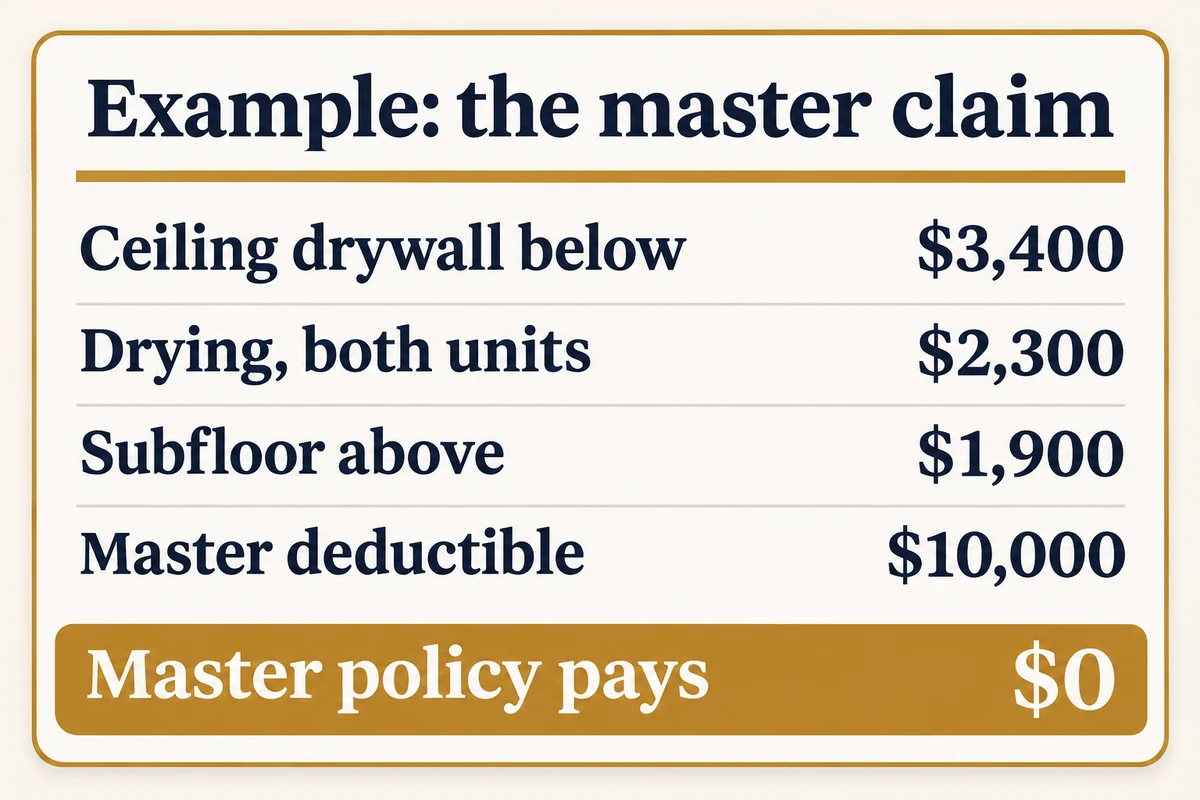
The numbers here are illustrative, chosen to show the arithmetic. They are not a client file, and your own prices and deductibles will differ. A dishwasher supply hose fails overnight in a third floor kitchen. Water runs through the subfloor into the kitchen and dining room ceilings of the unit below. The master policy carries a $10,000 deductible, and the owner below has an HO-6 with a $1,000 deductible. The upstairs owner's own cabinets are left out to keep the sums short.
| Item | Unit | Whose layer | Amount |
|---|---|---|---|
| Ceiling drywall, kitchen and dining room | Below | Association, bare ceiling | $3,400 |
| Drying equipment, both units | Both | Association | $2,300 |
| Subfloor under the dishwasher | Above | Association, bare floor | $1,900 |
| Paint, ceiling texture and crown trim | Below | Owner below | $1,450 |
| Hardwood floor the owner installed | Below | Owner below | $5,800 |
| Rug and dining chairs | Below | Owner below | $2,250 |
The association's layer adds up to $7,600 ($3,400 + $2,300 + $1,900). That is less than the $10,000 deductible, so the master carrier pays nothing, and somebody pays $7,600 out of pocket. Which somebody depends on the route the board takes under Section 12(c):
Route (i): common expense
- Association budget
- $7,600
- Owner above
- $0
- Owner below
- $0
Route (ii): unit where it started
- Association budget
- $0
- Owner above
- $7,600
- Owner below
- $0
Route (iii): units affected
- Association budget
- $0
- Owner above
- $3,050
- Owner below
- $4,550
Route (iii) here splits the bill by where each repair happened, with the drying cost halved: $3,400 + $1,150 below, $1,900 + $1,150 above. A board can divide it another way; its rule or resolution says how.
The owner below also has their own layer: $1,450 + $5,800 + $2,250 = $9,500. The HO-6 pays $8,500 of it after the $1,000 deductible. Under route (iii), the $4,550 assessment can go to the loss assessment line of that HO-6 if the policy has one; the limit on that line is a separate number on the declarations page, and it is worth reading before the assessment letter arrives. If the board has a 12(h) rule with the "regardless of any negligence" wording, the owner below can ask the upstairs owner's insurer for the $1,000 deductible, and the HO-6 carrier that paid $8,500 may try to recover it from the same place.
If the leak came from your unit
Half the calls about a leak between floors come from the owner upstairs. Your position has its own steps.
- Report it to your own HO-6 carrier the same day, even if your floor looks dry. The liability part of your policy is usually what answers the claim from below, and prompt notice is one of the policy's conditions.
- Ask the board in writing which route under Section 12(c) it plans to use. Route (ii) cannot be applied to you without notice and an opportunity for a hearing, and you can bring the plumber's written finding to it.
- Get the board's unit owner insurance rule, if it has one, and check which wording it uses: negligence only, or "regardless of any negligence". The second reaches further.
- Keep the failed hose, valve or fitting. If a part was defective, your carrier may pursue its maker, and it cannot do that with a part that went out with the trash.
- Claim your own bare floor through the association and your own finishes through your HO-6, like the owner below does.
The first three days below a leak
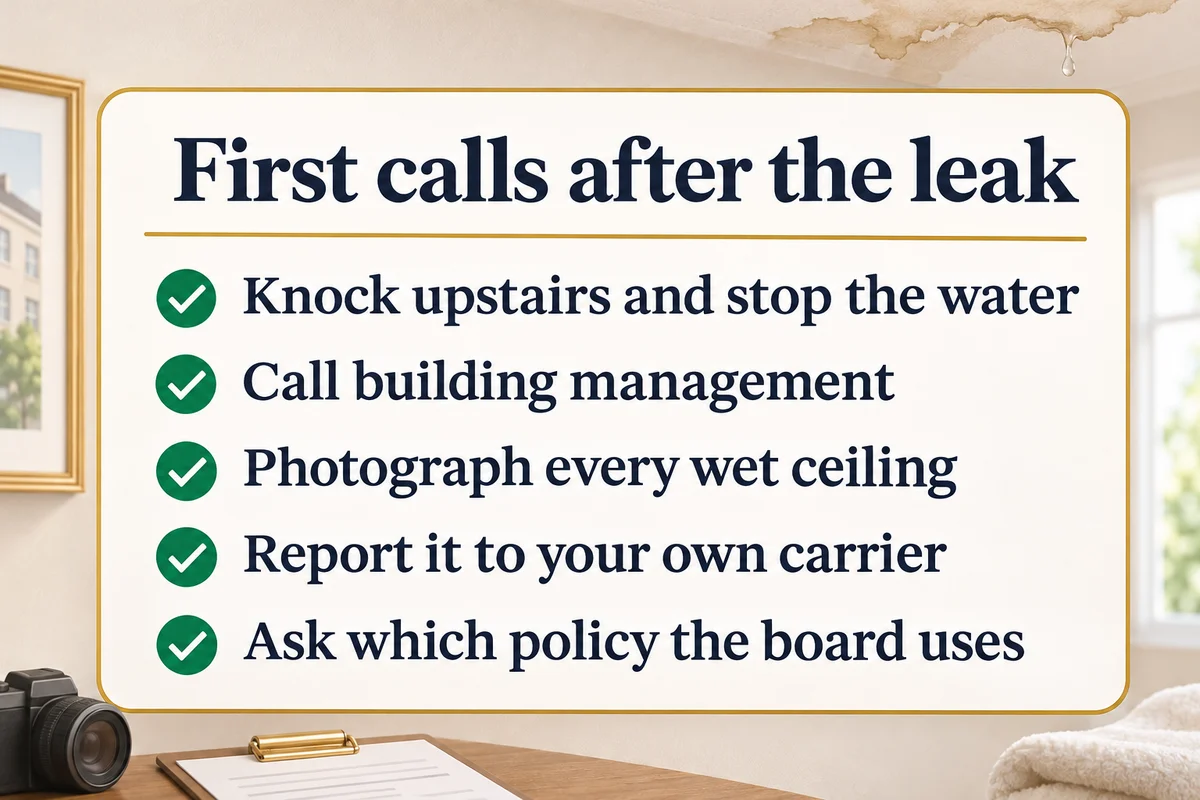
- Stop the water. Knock upstairs, and if nobody answers, call building management or the engineer to close the unit valve or the riser. Write down the time.
- Photograph the stains, sagging drywall, wet floor and belongings before anything is moved. Our list of what to photograph after property damage covers the shots carriers ask for months later.
- Tell the association in writing that day: your unit, the unit above, the time you found the water. The ceiling cannot be adjusted until the association reports its part.
- Open your own claim with your HO-6 carrier for finishes, belongings and any nights away from home.
- Ask the board for three papers: the declaration's definition of the unit boundary, the master policy's declarations page showing the deductible, and any unit owner insurance rule.
- Get the plumber's note on what failed, where, and which units the line serves. If the pipe froze, the heat questions in our frozen and burst pipe guide apply to the unit where it froze.
- Let the drying crew start. Drywall that stays wet behind a closed ceiling for days hands the carrier a mould argument.
When a second look pays off
Call us when the association and your carrier each say a layer belongs to the other, when the board wants to assess a deductible on you for water from someone else's unit, or when the leak went through several floors. Our pages on condo and association claims and water damage claims describe that work, and the general line between the master policy and your HO-6 is set out in our condo and HOA losses guide.
We read both policies, the declaration's boundary language and the board's deductible decision before you sign anything, and that first review costs you nothing. If you hire us, the fee is a share of what is recovered, set by Illinois law and written into the contract, and it comes out of the settlement; no recovery means no fee. You can reach the office seven days a week through our contact page.
Questions we get about this
Who pays when water leaks from the condo above in Illinois?
Usually three parties share it. The association master policy covers the bare walls, floors and ceilings of the units above its deductible, your HO-6 covers your finishes, upgrades and belongings, and the owner upstairs can be billed for damage that started in their unit. The declaration and each policy govern the details.
Can my condo association make me pay the deductible for a leak from another unit?
It can. Section 12(c) of the Illinois Condominium Property Act lets the board pay the master deductible as a common expense, assess it against the owner where the damage started after notice and a hearing, or require the owners of the affected units to pay it. Ask the board which route it uses.
Can the association's insurance company sue the upstairs owner?
No. Section 12(e)(2) of the Act requires the association policy to waive subrogation against unit owners. That waiver binds the association insurer only. Your own HO-6 carrier, after paying you, may still try to recover from the owner above or their insurer.
Does my HO-6 cover damage from my neighbor's leak?
In most policies it covers your paint, flooring, cabinets and other upgrades, your belongings, and living costs while the unit cannot be lived in, after your own deductible. The bare ceiling usually goes to the association master policy first. Your own policy wording governs.