Condo and HOA Losses: Where the Master Policy Stops and Yours Starts

In an Illinois condominium two policies cover one loss. The association's master policy insures the building and, under state law, the unit as it was originally built. Your own HO-6 policy insures the upgrades, your belongings, your living expenses and usually the master policy's deductible. The declaration decides exactly where the line falls.
A condo or HOA loss is the only property claim where two policies, two adjusters and two sets of paperwork end up pointed at the same wet ceiling. Most of the money that disappears in these files is not denied by anyone. It goes missing in the gap between the policies — in the drywall each side assumed the other was paying for, and in a master policy deductible nobody read until the assessment letter arrived.
We are licensed Illinois public adjusters, not attorneys. Declarations, bylaws and assessment disputes have legal dimensions we do not advise on, and policy wording varies between carriers and forms — your own documents govern.
Who insures what — the association or you?
Three arrangements exist, and your declaration names which applies. Bare walls: the association insures the structure only. Single entity, or original specifications: the association insures the unit as the developer built it, you insure what was added since. All-in: the association insures the unit including upgrades.
| Arrangement | The association insures | You insure |
|---|---|---|
| Bare walls | Roof, exterior, structure and common elements — nothing inside the unit | Drywall surfaces, flooring, cabinets, fixtures, contents, living expenses |
| Single entity (original specifications) | The above, plus the unit as originally built | Improvements and betterments, contents, living expenses |
| All-in / all-inclusive | The above, plus improvements and betterments | Contents, living expenses, deductibles and assessments |
The practical difference is a whole room. On a bare walls reading, a flooded kitchen leaves the association responsible for the framing and the owner responsible for every visible surface in it. On single entity, the association's scope reaches the cabinets and flooring the developer installed, and the owner's policy picks up only what replaced them later.
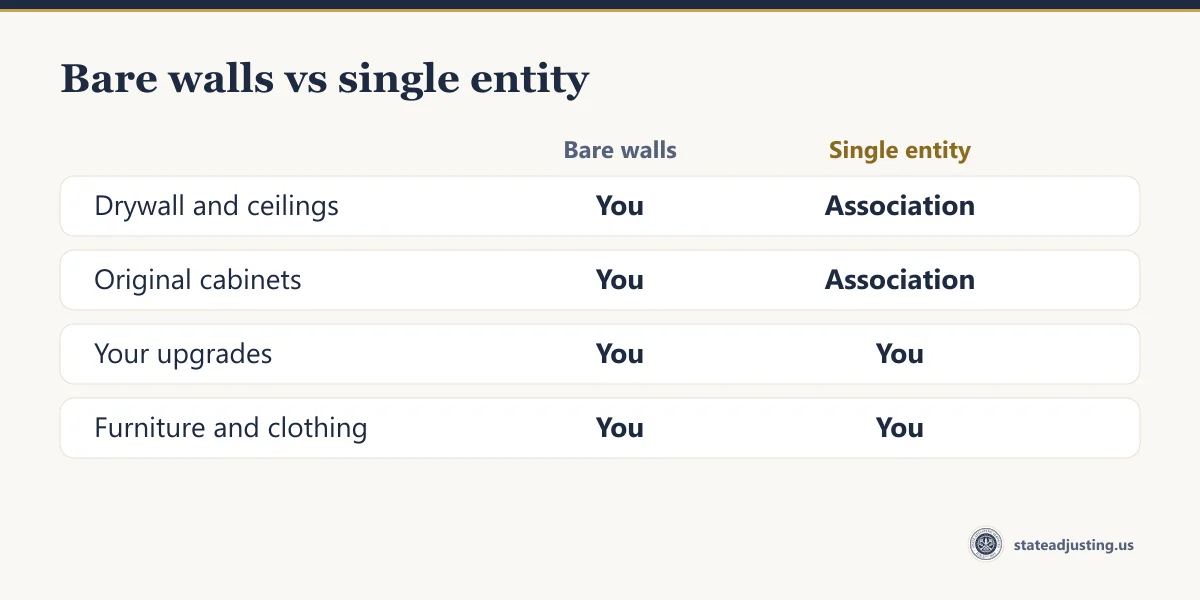
What does Illinois law require the association to insure?
Under the Illinois Condominium Property Act at 765 ILCS 605/12, the board must obtain property insurance covering the common elements and the units, excluding improvements and betterments installed by unit owners other than the developer, in an amount equal to full insurable replacement cost. In plain terms, the statutory floor for an Illinois condominium is single entity, not bare walls.
That matters because a great many declarations were drafted decades before the current wording and still read as bare walls. When a claim lands, the two carriers write their scopes from different documents, and the owner is caught between two adjusters who each believe the wall belongs to the other file. The fix is unglamorous and it works: ask the board or property manager, in writing, which document the association is adjusting under and what unit boundary it is applying — before scopes are written, not after both estimates are final. Whether a particular declaration can sit below the statute is a legal question for counsel, not one an adjuster resolves.
One important limit. If you live in a townhome or detached home governed by an association under the Common Interest Community Association Act rather than the Condominium Property Act, none of the above applies. There the declaration alone sets the split, and it is common for the association to insure only genuinely shared property — the clubhouse, the private drives, the pool — leaving your whole structure to your own policy. Read the declaration before assuming a master policy stands over your roof.
What is your HO-6 policy actually for?
An HO-6 is not a small homeowners policy. It sits on top of a master policy and fills four holes: what you added to the unit, what you own inside it, what it costs to live elsewhere, and what the association charges back to you. Each is a separate limit, and one of them is almost always wrong.
| Coverage | What it does in a condo | Where it goes wrong |
|---|---|---|
| A — Dwelling | Improvements and betterments, plus building property the declaration makes yours | Often still at the form's $5,000 minimum, years after a renovation |
| C — Personal property | Everything you would take with you if you moved out | Special limits on jewellery, cash and business property |
| D — Loss of use | Hotel, rent and food costs above normal while the unit is uninhabitable | Assumed to be the association's problem — it is not |
| E — Liability | Claims made against you when water leaves your unit | Confused with the deductible assessment — a different mechanism |
| Loss assessment | Assessments the association charges you after a covered loss | Base limit commonly $1,000; the deductible portion capped separately |
Coverage A is the expensive default. The widely used unit-owners form carries a $5,000 minimum, and nobody ever sends a letter about it, so that is the number a great many policies still show. To size it properly, price what it would cost to put back everything from the studs inward that the association's policy would not replace — flooring, cabinets, counters, tile, lighting, built-ins — and set the limit there. Upgrades installed by a previous owner generally count as your improvements too, not as the developer's original specification — which surprises people who bought a renovated unit.
Where does one loss actually land?
An example makes the split concrete. A washing machine supply hose fails in unit 4B on a Saturday, and water runs through the floor assembly into 3B below before anyone notices. Both units are opened up to dry. The declaration is single entity, and the damage sorts into four piles.
| What was damaged | Whose policy | Amount |
|---|---|---|
| Floor assembly, ceiling below, original-specification finishes in both units | Association master policy | $18,400 |
| 4B's added hardwood and custom cabinetry | 4B's HO-6, Coverage A | $9,200 |
| 3B's furniture, rugs and electronics | 3B's HO-6, Coverage C | $6,800 |
| Five weeks in a hotel for 3B's household | 3B's HO-6, Coverage D | $4,250 |
| Total damage from one hose | $38,650 |
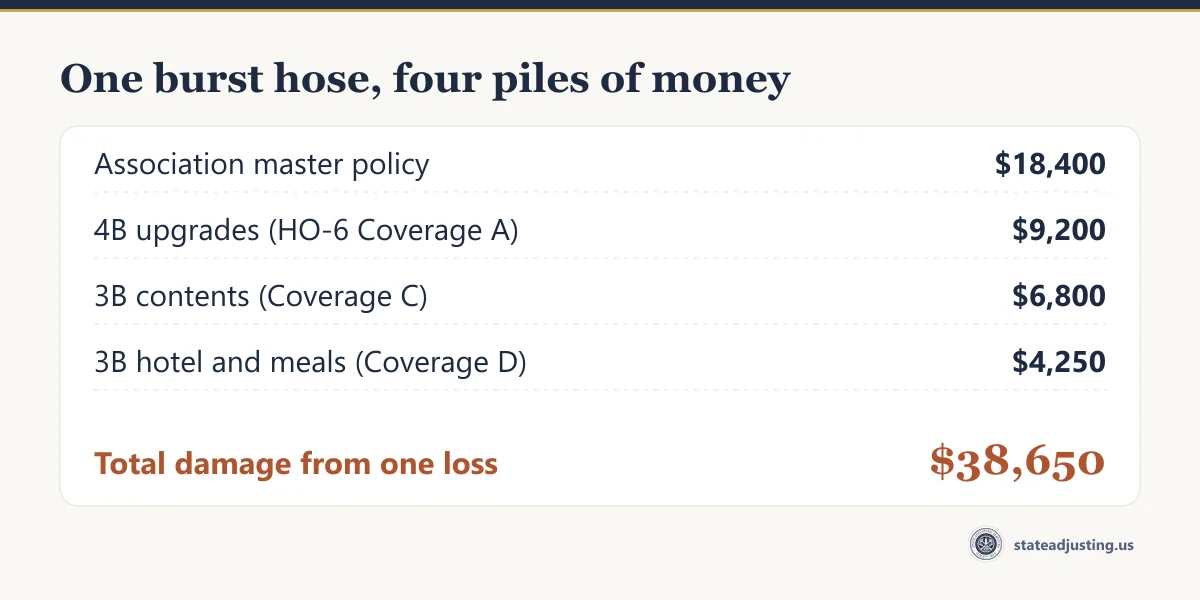
Then the deductibles land, and the picture changes twice. The association's master deductible is $25,000; the building repairs are $18,400. The master policy pays nothing at all — the loss is real, covered in principle, and sits entirely inside the deductible. Separately, 4B's Coverage A was never moved off the $5,000 minimum, so of the $9,200 in upgrades, $4,200 has no policy behind it. Contents and living expenses pay in the ordinary way, less each owner's deductible. This is an illustrative worked example, not an outcome we are promising; every file turns on its own declaration, policies and evidence.
Notice what did the damage. Nothing was denied. A deductible entirely normal for a building, and a limit nobody had looked at since closing, moved roughly $22,600 of a $38,650 loss toward two households.
Who pays the master policy deductible?
Whoever the board decides, within the routes the statute allows. 765 ILCS 605/12 sets out three: the board may pay the deductible as a common expense, may assess it — after notice and an opportunity to be heard — against the owner who caused the damage or from whose unit the cause of loss originated, or may require the affected unit owners to pay it.
That is why the $18,400 above is the sharpest number in the example. If the board assesses it to 4B, the question becomes what 4B's loss assessment coverage absorbs — and two limits apply, of which people know only the first. The overall loss assessment limit in the base unit-owners form is commonly $1,000, responding to assessments that arise from a loss to property owned collectively by all members, caused by a peril your own policy covers. On top of that, the widely used endorsement carries a separate cap — also commonly $1,000 — on the portion of an assessment that comes from the master policy's deductible, however high you raised the overall limit. That second sublimit is the one that surprises owners.
Raising loss assessment coverage is one of the cheapest changes on a condo policy, and it is worth doing before you need it. Four things to check across the two declarations pages:
- Which arrangement the declaration names — bare walls, single entity or all-in. Ambiguous wording is itself worth resolving in writing now.
- The master policy deductible. A five-figure deductible is ordinary on an association, and it decides whether a mid-sized loss reaches the master policy at all.
- Whether the master policy settles the building at replacement cost or actual cash value, and whether it carries ordinance or law coverage. An older building repaired to current code without it leaves a gap somebody pays for.
- Your Coverage A, your loss assessment limit, and the deductible sublimit inside it. Three numbers, one page, five minutes.
What to do in the first week of a condo loss
The mechanics differ from a single-family claim in one way: you are not the only person reporting, and you do not control the scope written for the building. Move early, in writing, on both tracks.
- Report to both the same day. Notify the property manager or board and open your own claim with your HO-6 carrier. Waiting for the association to "handle it" costs you the prompt-notice argument on your policy.
- Stop the water, then photograph before anyone mitigates. Mitigation is your duty and it destroys the scene, so the record has to be made first. Our guide to what to photograph before you touch anything applies directly, plus one addition: shoot the ceiling and walls of every neighbouring unit involved.
- Ask the manager in writing for three documents: the insurance article of the declaration and bylaws, the master policy declarations page, and the association's claim number. All three are ordinary requests, and all three are needed before anyone can say whose scope covers which surface.
- Keep the failed part. The hose, the valve, the connector. Whether the water was a sudden discharge or a slow leak decides coverage under both policies — see sudden vs gradual water damage — and the part is the proof.
- Do not let one estimate serve both policies. A scope written for the association's carrier will not itemise your improvements, and the line items you need will simply be absent — how to read the carrier's estimate covers the mechanics.
- Track your own spending from day one. Hotel folios, receipts, mileage, the gap between your normal grocery bill and eating out. Coverage D pays the increase, against records.
- Watch the drying timeline. Two units, two schedules and a shared floor assembly is how material stays wet long enough to become a second argument — mould after a water loss explains why the cause of the water decides that coverage.
What to do next
If you are in the middle of a condo or HOA loss, the highest-value hour you can spend is reading three pages side by side: the insurance article of your declaration, the master policy declarations page, and your own HO-6 declarations page. Nearly every dispute we see in these files was visible there before the loss happened.
We review condominium and association losses at no cost — a unit owner's claim or an association's claim on the building — and we say plainly when there is nothing worth pursuing. If there is, our fee is a percentage of what is recovered, set by written contract and capped by Illinois law: nothing upfront, no fee if there is no recovery. Read how we work a file, see what past claims have involved, or start from the damage — water, fire and smoke and hail each have a page.
Call (630) 297-8136 Monday to Friday, 8:00 AM to 5:00 PM, or send us the declaration and both declarations pages and we will tell you where the line falls. If the repair itself still needs doing, our construction partner is one option among many and never a condition of us working your claim.
Questions we get about this
Does my condo association's insurance cover the inside of my unit?
In an Illinois condominium, partly yes. Under 765 ILCS 605/12 the association's property insurance must cover the common elements and the units, excluding improvements and betterments installed by unit owners other than the developer. So the unit as originally built is generally on the master policy, and what has been added since is on your HO-6. Your declaration sets the exact boundary, and a townhome association governed by the Common Interest Community Association Act instead is a different question entirely — there the declaration alone decides.
Who pays the condo master policy deductible in Illinois?
The board decides, within the routes 765 ILCS 605/12 allows: pay it as a common expense, assess it against the owner who caused the damage or from whose unit the cause of loss originated after notice and an opportunity to be heard, or require the affected unit owners to pay it. If it is assessed to you, your HO-6 loss assessment coverage may respond — but the base limit is commonly $1,000, and the widely used endorsement caps the deductible portion separately. Read that endorsement before you need it.
How much Coverage A should a condo owner carry on an HO-6 policy?
Enough to replace everything from the studs inward that the association's policy would not put back: flooring, cabinets, counters, tile, lighting, built-ins and interior doors. The widely used unit-owners form carries a $5,000 minimum, and many policies still sit there years after a renovation. Upgrades installed by a previous owner usually count as your improvements as well, not as the developer's original specification, so a unit bought already renovated needs a real number rather than the default.
Does the association's policy pay for my hotel while my condo is repaired?
Generally no. Additional living expenses for a unit owner come from Coverage D on your own HO-6 policy, not from the master policy, which insures the building rather than your household. Coverage D pays the increase in living costs above what you normally spend while the unit is uninhabitable, against receipts, and it is subject to its own limit and time conditions. Start the folder on day one, because it is settled on records rather than estimates.