Toilet overflow insurance claim: when the backup exclusion applies
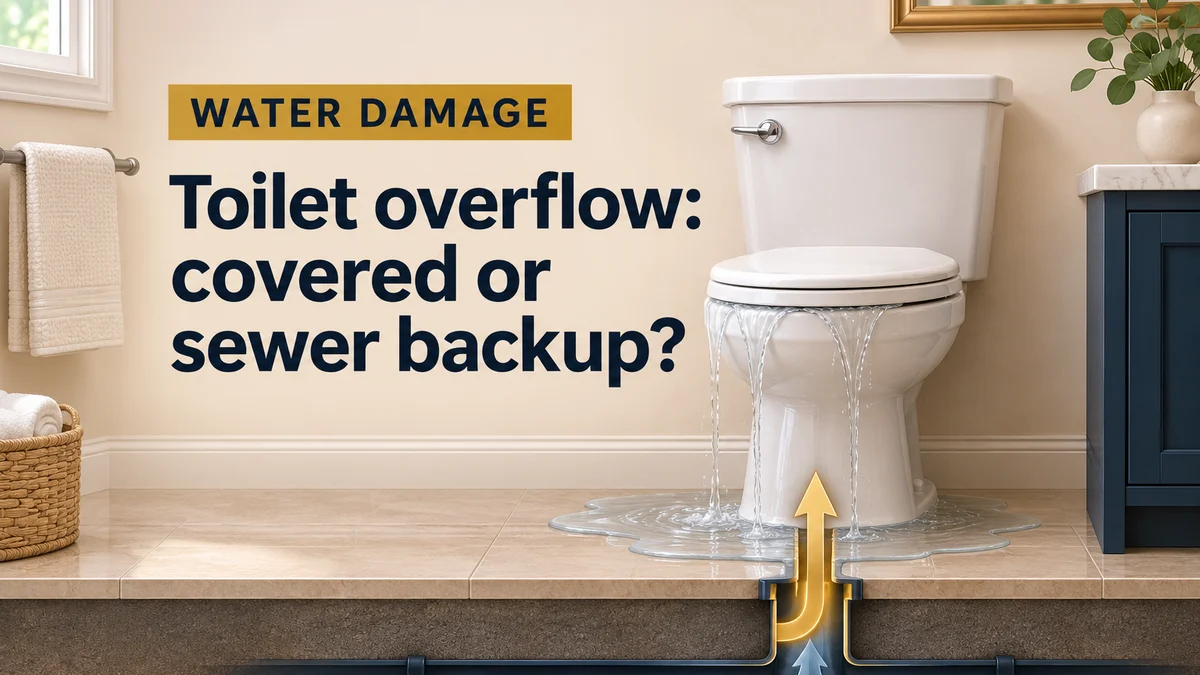
A toilet overflow insurance claim is usually paid by a standard homeowners policy when the clog sat in the toilet itself, so the water had nowhere to go but over the rim. It is usually refused under the sewer backup exclusion when the blockage sat further down the line and waste was pushed back up into the house. In that case only a water backup endorsement pays, and only up to its own limit. So the claim turns on one plain fact: where the plumber found the clog.
We are licensed Illinois public adjusters, and what follows is how these claims are usually read in practice. Every policy has its own water exclusion, and the wording in yours decides your claim. If a lawsuit ever comes into it, that part belongs with an attorney.
Overflow and backup are two directions of flow
An overflow is water that comes in through the supply line, fills the bowl and spills over because the way out is blocked close by. Most of it is clean water from the tank. A backup moves the other way: waste that was already in the drain line gets pushed back up and out of the lowest openings in the house, because the line further down is blocked or overloaded.
The widely used homeowners form excludes water that backs up through sewers or drains. In that form, the word overflow in the same exclusion is tied to a sump, a sump pump or related equipment, not to a toilet. That is why water spilling from a clogged bowl is normally treated as an accidental discharge from the plumbing system, which the policy covers, while sewage coming up from the line is not. Many carriers write their own forms, and some commercial policies also exclude water that overflows from a drain, so read the water exclusion in your own policy word by word.
Where the clog sat, from the bowl to the street
Follow the water from the toilet toward the city sewer. The further down the line the blockage was, the more likely the adjuster is to call it a backup.
In the bowl or the trap
Too much paper, a wipe, a small toy. Only this toilet runs over, nearly always while someone is flushing it, and a plunger or a closet auger usually clears it.
Usual reading: an overflow. The water damage is paid under the base policy, minus the deductible.
In the branch line under the floor
The pipe that joins this bathroom to the main stack. The toilet may run over while the tub or sink in the same room drains slowly or gurgles.
Usual reading: argued both ways, because the adjuster may call that pipe a drain. What the plumber wrote about the spot and the object matters most here.
In the building drain or the line to the street
Roots, grease or a sagging pipe. Water shows up first at the basement floor drain or a basement toilet or shower, often when a washer or dishwasher empties upstairs.
Usual reading: a backup. The base policy excludes it, and a backup endorsement pays up to its limit. Our sewer backup claims page covers that route.
In the public sewer
Heavy rain overloads the city or village main and pushes water back into houses along the street. Neighbours often have water in their basements the same night.
Usual reading: a backup, paid only by the endorsement.
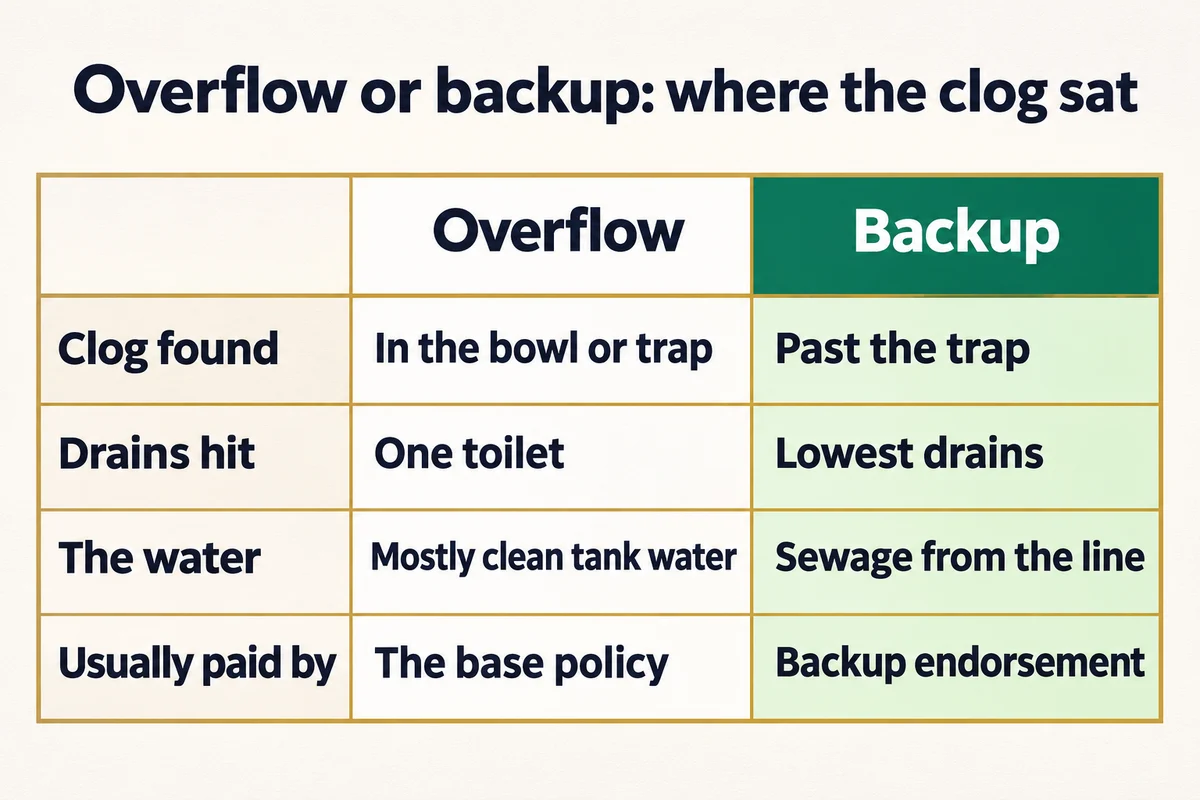
Signs that tell you which one happened
Write down what you saw before anyone else describes it for you. A plumber and an adjuster look at the same signs.
| Sign | Points to an overflow | Points to a backup |
|---|---|---|
| Where water came out | Only the toilet that was flushed | The basement floor drain, a basement toilet or shower, several openings at once |
| When it started | Right after a flush | When other fixtures drained, or during heavy rain |
| What the water looked like | Mostly clear, from the tank | Dark, with waste and a sewer smell |
| What cleared it | A plunger or a closet auger | A cable run from a cleanout, or nothing until the rain stopped |
| Next door | Nobody else had a problem | Neighbours had water the same day |
The plumber's invoice carries the most weight
The invoice is often the only written record of where the blockage was, and adjusters read it closely. A vague line can turn an overflow into a backup on paper. Ask the plumber to write what they found and where they found it. Never ask anyone to write something that did not happen.
- 1Toilet overflowed, 2nd floor hall bath. Pulled toilet, removed wipes lodged in trap. Reset on new wax ring.
- Names the fixture, the spot (the trap) and the object. This reads as an overflow from the toilet itself.
- 2Cleared drain.
- Says nothing about where. An adjuster may read drain as the drain in the exclusion. Ask the plumber to add the location and what came out.
- 3Main line blocked approx. 40 ft from cleanout, tree roots. Cabled to street.
- This is a blockage in the building sewer, so expect the backup exclusion. Check the declarations page for a water backup endorsement and its limit.
Keep what came out of the pipe in a sealed bag, or at least photograph it next to something that shows its size. If the plumber ran a camera down the line, ask for the video and the footage time where the problem shows.
What the claim pays when the overflow is covered
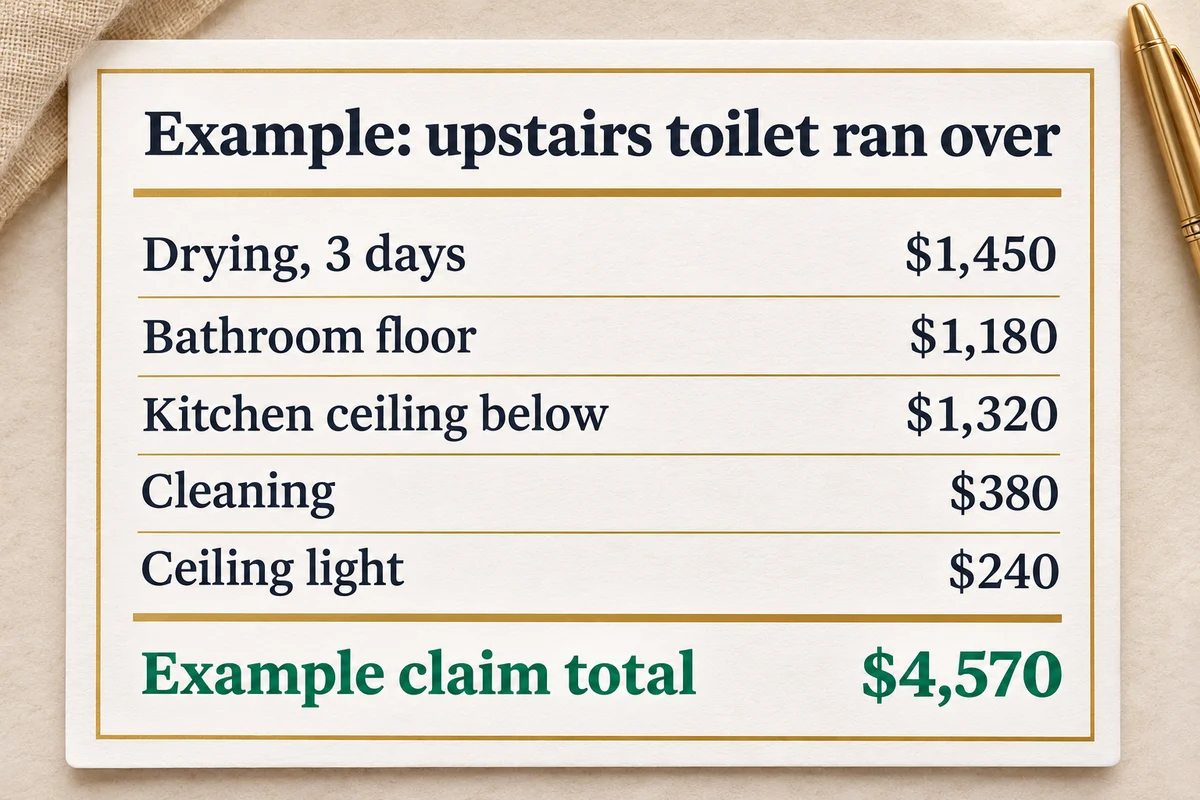
Here is an illustration with round numbers, not a result from any claim. A guest flushes a second-floor toilet late in the evening, the bowl runs over for twenty minutes before anyone notices, and the water goes through the floor into the kitchen ceiling below.
| Water extraction and drying, 3 days | $1,450 |
| Bathroom floor: vinyl planks and underlayment | $1,180 |
| Kitchen ceiling below: drywall, tape and paint | $1,320 |
| Cleaning and disinfecting both rooms | $380 |
| Kitchen ceiling light replaced | $240 |
| Total damage in the example | $4,570 |
| Less a $1,000 deductible | −$1,000 |
| Paid if every line is accepted | $3,570 |
Two things usually stay off that list. The toilet itself is not paid unless the water event damaged it, because the policy does not pay for the system the water escaped from. The plumber's charge to clear the clog is treated as fixing the plumbing, not as damage. If a wall or floor had to be opened to reach a pipe, the cost of tearing out and putting back that part of the house is commonly paid. Depending on your policy, part of the money may be held back as depreciation until the work is finished.
Put the clog in the line to the street instead, and the same rooms fall under the backup endorsement. That endorsement is commonly sold in amounts such as $5,000 or $10,000, with its own deductible, and a finished basement full of sewage can use it up quickly. Our article on how the water backup limit gets chosen and why it runs out explains what to check before the next storm.
The slow leak at the base of the toilet
The second common refusal on toilet claims has nothing to do with a clog. A worn wax ring or a loose closet bolt lets a little water out with every flush for weeks, and nobody sees it until the floor feels soft or a brown ring appears on the ceiling below. The adjuster then points to the exclusion for continuous or repeated seepage or leakage. Some policies put a number of days on it, often 14, and others say weeks, months or years.
What helps is evidence of whether anyone could have seen the leak. Water trapped under vinyl and plywood is a different situation from a puddle someone stepped around every morning. Photograph the subfloor when it is opened, and write down the date you first noticed the stain. Our article on sudden versus gradual water damage goes through how that wording is read, and a cracked tank or a burst supply hose is handled like the other fixture losses on our appliance and fixture leak claims page.
When the toilet is in a condo above someone else
In a condo or townhouse, water from your bathroom often reaches the unit below or the shared walls. Which policy pays which part depends on the association's declaration and on two policies, the master policy and your unit-owners policy, and the board may charge the master deductible to the unit where the water started. Our guide to condo and HOA losses walks through that split. Tell the management company the same day, in writing, and ask the downstairs owner to photograph their ceiling before anyone cuts it open.
The first hour after the bowl runs over
- Turn off the valve behind the toilet, clockwise. If it is stuck, shut the main water valve for the house.
- Do not flush again, and ask everyone not to run sinks, showers, the dishwasher or the washer until you know where the clog is.
- Check the basement floor drain and any basement toilet or shower. Water there means the problem is further down the line, so photograph it.
- Photograph the bowl, the floor, the ceiling below and everything wet before you clean up.
- Pull up standing water, lift wet rugs and move furniture out. Keep receipts for towels, fans and rentals. Wet subfloors grow mould, and the policy expects you to protect the house.
- When the plumber comes, ask where the blockage was and ask for that on the invoice. Keep what came out.
- Report the claim to your insurer and write down the claim number, the date and the name of the person you spoke to.
- Ask for a written reason if the adjuster calls it a backup, with the policy wording they rely on.
If the adjuster calls it a backup and you believe the clog was in the toilet, or the endorsement limit is far below the damage, send us the plumber's invoice and the letter. We read them with you at no cost and tell you plainly whether there is something to argue. If you hire us, our fee is a percentage of the recovery set in writing and limited by Illinois law, with nothing paid upfront.
Questions we get about this
Does homeowners insurance cover a toilet overflow?
Usually yes for the water damage, when the clog was in the toilet itself and the water spilled over suddenly. Sewage pushed back up from a blocked or overloaded sewer line is excluded by most base policies and is paid only by a water backup endorsement, up to its limit. Your own policy wording governs.
Is a toilet overflow the same as a sewer backup?
No. An overflow is mostly tank water spilling over because the toilet's own outlet is blocked. A backup is waste pushed back up from a blocked or overloaded drain line further down, and it usually shows first at the lowest drains in the house, such as a basement floor drain.
Will insurance pay for a new toilet after it overflows?
Usually not. The policy pays for the damage the water caused to floors, ceilings and belongings, not for the plumbing fixture the water came from or the plumber's work to clear the clog, unless the fixture itself was damaged by a covered event.
What if the toilet leaked slowly at the base for weeks?
A leak at the wax ring that went on for weeks is often refused under the continuous or repeated seepage or leakage exclusion. Whether it applies depends on your policy wording and on whether the leak could have been seen, so keep photos of the subfloor and the date you first noticed the stain.