Frozen and Burst Pipes: The Heat Condition That Decides the Claim
A burst pipe claim rarely turns on whether water damage is covered — under the widely used homeowners form it usually is. It turns on the freezing exclusion, which is given back if you used reasonable care to maintain heat in the building, or to shut off the water supply and drain the system. The resulting damage and the tear-out to reach the pipe are payable. The failed pipe itself is not.
A frozen pipe claim is usually decided by two facts that have nothing to do with the water: what the heat was doing, and whether anyone can still show it. The damage side is ordinarily straightforward — a burst supply line in January is exactly the sudden, accidental discharge the policy was written for. What removes the claim is one sentence about heat, and the evidence for that sentence disappears the moment the house is dried out, the furnace is repaired and the pipe leaves in the plumber's truck.
We are licensed Illinois public adjusters, not attorneys. Nothing here is legal advice, and the wording on your own form and declarations page governs your claim. What follows is how the freezing provision reads in the editions of the homeowners form most Illinois households are on, and where burst pipe claims are actually won and lost.
Does homeowners insurance cover a burst pipe?
Usually, yes. The dwelling is insured against direct physical loss on an open-perils basis, and the form specifically covers loss resulting from an accidental discharge or overflow of water from a plumbing, heating, air conditioning or fire sprinkler system or a household appliance — including the cost of tearing out the building to reach the failed part.
Sitting beside that is the freezing provision. The form excludes freezing of a plumbing, heating, air conditioning or automatic fire protective sprinkler system or of a household appliance, and any discharge, leakage or overflow from within that system caused by freezing. Then it hands the coverage back in the next sentence: the exclusion does not apply if you used reasonable care to either maintain heat in the building, or shut off the water supply and drain the systems and appliances of water.
Two details on that provision are worth checking on your own form before you answer any question about your thermostat. First, editions differ: some older versions attach the care requirement only while the dwelling is vacant, unoccupied or under construction, while the more recent editions read it as a standing condition whether or not anyone was home. Second, if the building is protected by an automatic fire protective sprinkler system, the requirement flips — you must use reasonable care to continue the water supply and maintain heat, because a drained sprinkler system protects nothing.
Why is the pipe itself not covered when the damage is?
Because the form insures the loss the water caused, not the component that failed. The give-back is explicit on both sides: it covers the resulting damage and the tear-out needed to reach the system, and it excludes loss to the system or appliance the water escaped from. The plumber's repair is yours. The wall he opened to get to it is not.
| Item | Where it usually lands | Why |
|---|---|---|
| The failed section of pipe and the plumber's repair | Not covered | The form excludes loss to the system the water escaped from |
| Tear-out and replacement of wall, ceiling or floor to reach it | Covered | Named in the same paragraph as part of the give-back |
| Water damage to ceilings, drywall, insulation, cabinets, flooring | Covered | Resulting loss from an accidental discharge |
| Personal property soaked by the water | Coverage C | Contents follow the covered loss, subject to their own limits |
| Hotel, meals and extra costs while the house is unliveable | Coverage D | Loss of use follows the covered loss, paid as incurred |
| A sump, sump pump or related equipment that failed | Not in this give-back | The provision's own wording excludes sumps, sump pumps, roof drains, gutters and downspouts |
| Thawing a pipe that froze but never burst | Not a claim | Nothing has been physically damaged yet — this is a plumbing bill |
| Mould that develops afterwards | Usually its own sublimit | Commonly $5,000 or $10,000 on the fungi endorsement — see our guide to mould after a water loss |
What does "reasonable care to maintain heat" actually mean?
The form does not define it, and no thermostat number appears anywhere in the policy. In practice it is a question of fact with two acceptable answers: heat was on and being maintained, or the water was off and the system drained. Half of each — heat turned down and the water shut off but never drained — is where claims are lost.
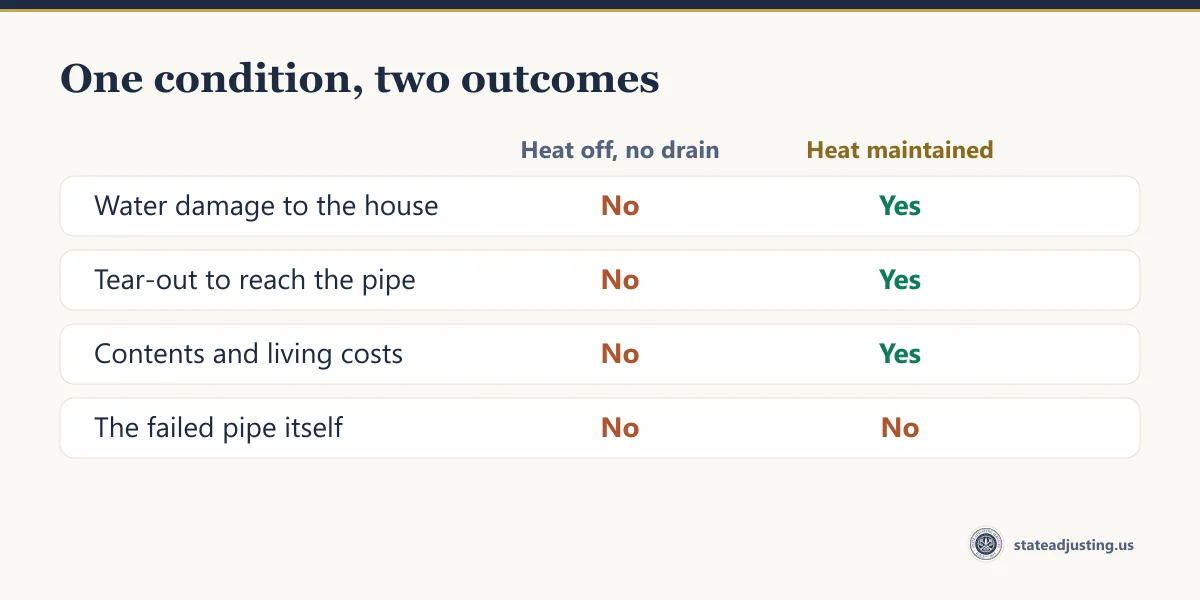
Neither route requires perfection. "Reasonable care" describes what you did, not what happened. A furnace that failed while the heat was set and running is a genuinely different picture from a house left cold to save gas, and the difference is visible in records that exist for a few weeks and then do not.
| What the carrier looks at | What it shows | Where to get it |
|---|---|---|
| Thermostat setting on the day | The setting itself, rather than the intention | Photograph it before anyone touches it or the power is cut |
| Smart thermostat history | Set point and actual indoor temperature, hour by hour | Export it from the app early — histories are short and accounts get reset |
| Gas or electricity consumption for the period | Whether the furnace was actually running, not just set | The usage graph in your utility account |
| Furnace or boiler service record | Whether the heating system failed, and roughly when | The HVAC company's invoice and service notes |
| Who was in the building and when | Whether there was an unoccupied stretch at all | Travel bookings, calendar, a neighbour or property manager |
| Main shut-off valve and drained fixtures | Whether the second route was taken instead of heat | Photographs at the valve; the plumber who winterised the house |
| The failed section of pipe | Whether it reads as ice pressure or long-term corrosion | Keep it — do not let it leave with the plumber |
The strongest single record is the combination of a set thermostat and utility usage that stops on the night the system failed. Put next to a service invoice for a failed ignitor or a tripped limit switch, that is not an argument about care — it is a heating breakdown, and the freezing provision's own condition is satisfied on the face of the documents.
What does a burst pipe claim add up to?
Here is the arithmetic on an illustrative Illinois loss — a worked example, not a client file. A supply line in an exterior wall of an upstairs bathroom lets go during a January cold snap and runs into the kitchen below. Replacement cost policy, $2,500 deductible.
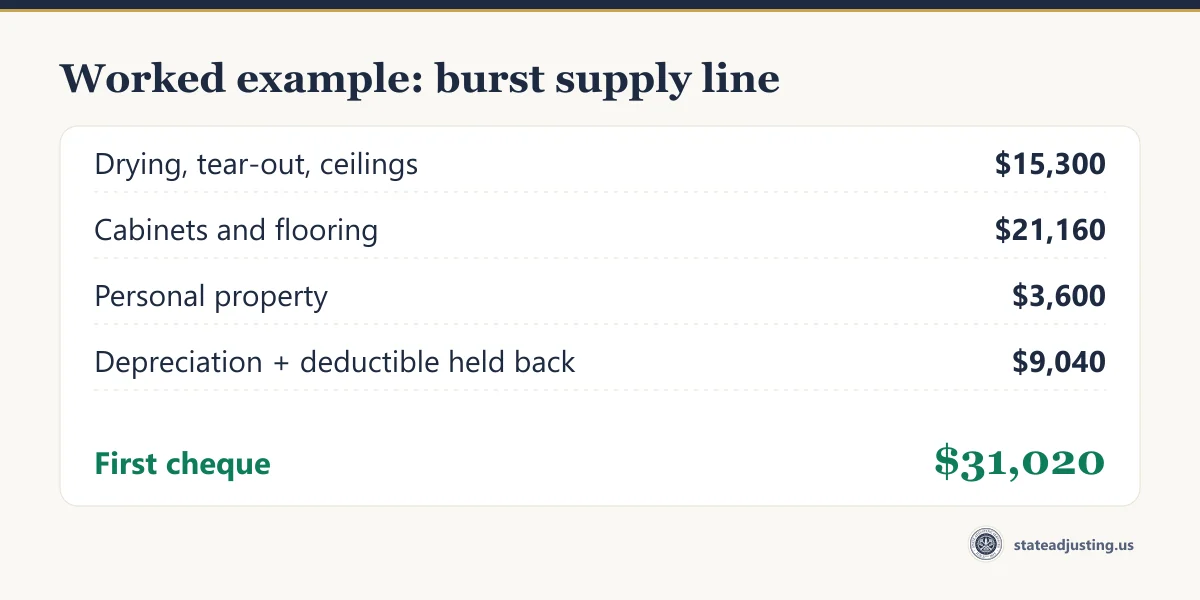
| Line | Detail | Amount |
|---|---|---|
| Emergency extraction and five days of drying | Mitigation invoice | $4,850 |
| Tear-out to reach the failed supply line | Covered even though the pipe is not | $1,150 |
| Ceilings, drywall, insulation and paint | Kitchen and hall, painted to a natural break | $9,300 |
| Kitchen cabinetry and countertop | Base cabinets saturated from below | $12,400 |
| Hardwood flooring | Kitchen into the adjoining dining room | $8,760 |
| Personal property | Coverage C, inventoried | $3,600 |
| Replacement cost value | $40,060 | |
| Less depreciation withheld | Recoverable once the work is done | −$6,540 |
| Less deductible | One occurrence, one deductible | −$2,500 |
| First cheque | $31,020 |
Two numbers in that table decide more than they look like they should. The $1,150 of tear-out is payable while the $340 the plumber charged to cut out and replace the burst section is not — the same wall, two sides of one sentence. And the $6,540 of withheld depreciation only comes back if it is claimed after the work is finished, which is the second cheque most households never go back for; we wrote about that in our guide to recoverable depreciation.
Read the other way, the same table is what the freezing exclusion costs. If the carrier concludes the heat was off and the system was not drained, the whole $40,060 goes with it — not reduced, removed — and the plumber's $340 is still yours. One condition, the entire claim.
Where frozen pipe claims go wrong
- The seasonal or empty house. A house between owners, tenants or seasons is where the freezing provision does its real work, and where the older "vacant or unoccupied" wording bites hardest. Our guide to vacant and unoccupied property covers the other exclusions that arrive at the same time.
- The unheated space. Pipes run through garages, crawl spaces, unheated additions and attics. Heat maintained in the living area is not always heat maintained where the pipe is, and that is exactly what a carrier will point at.
- "We turned the water off." Shutting the main is only half of the second route. Water left standing in the lines and traps still freezes and still splits pipe. The form asks for shut off and drained.
- The house that is listed for sale. Showings with the heat turned down, a lockbox, and nobody sleeping there is the most common version of this claim we see, and the listing itself is a dated record the carrier can read.
- The sprinkler-protected building. Commercial and some residential buildings with fire sprinklers reverse the requirement. Draining the system to protect it is the thing that voids the give-back.
- The late discovery. A pipe that let go days before anyone walked in turns into a different argument — how long the water ran — and that is a separate provision. See sudden versus gradual water damage.
The letter says "freezing" — what now?
A denial letter usually blends three findings into one paragraph, and they need different answers. That the loss was caused by freezing at all. That heat was not maintained. That reasonable care was not used. The first is often uncontested; the other two are evidence questions about what you actually did.
- Ask for the decision in writing with the provision named — the exact exclusion and the exact sentence relied on, not a summary.
- Request the complete claim file, including the field notes, photographs and any report the carrier commissioned.
- Answer the heat question with documents, in the order in the table above, rather than with a recollection.
- Separate the pipe from the damage. "The pipe was old" is a finding about the pipe, which was never covered. It is not a finding about the resulting water damage.
- Check the edition of your form for the vacant-or-unoccupied qualifier before accepting that the condition applied at all.
- Know which lever fits. Appraisal resolves the amount of a loss, not whether it is covered — on a freezing denial it is the wrong tool, and a coverage dispute that will not move is an attorney question.
What to do in the first 72 hours
- Shut the water off at the main, then photograph everything before mitigation starts. The wet room disappears within a day.
- Photograph the thermostat and export the smart thermostat history the same day, before the furnace is repaired or the power is restored.
- Keep the failed section of pipe. Ask the plumber for it in the moment; it will not be recoverable later.
- Report the loss and get the claim number, and note the date and time you first discovered the water.
- Get the water out quickly. The duty to prevent further damage is real, and delayed drying is the fastest route to a mould dispute inside a small sublimit.
- Keep the drying log and moisture readings from the mitigation company, and the invoices for emergency work.
- Save the utility usage screenshot for the billing period covering the loss, before it rolls off your online account.
If you have already received an estimate that covers the ceiling but not the cabinets, or a letter that says "freezing" without saying which sentence it relied on, that is the point to get another set of eyes on the file. We handle water damage claims and ice and snow damage claims across Illinois, and our claims process page shows how a file is documented and negotiated.
We will review a burst pipe file at no cost and no obligation: send the declarations page, the carrier's estimate or letter, and your photographs, and we will tell you plainly whether the scope matches the damage. If we take the claim on, our fee is a percentage of the recovery, agreed in writing, capped by Illinois law and paid out of the settlement — nothing upfront, and no recovery, no fee. Reach us Monday through Friday, 7:00 AM to 7:00 PM, and Saturday and Sunday, 9:00 AM to 5:00 PM, at (630) 297-8136 or through our contact page.
Questions we get about this
Does homeowners insurance cover a burst pipe in Illinois?
Generally yes. The widely used homeowners form covers loss resulting from an accidental discharge of water from a plumbing system, including the cost of tearing out the building to reach the failed part. It does not cover the pipe or appliance the water escaped from. The freezing exclusion can remove the whole loss unless reasonable care was used to maintain heat or to shut off and drain the system. Your own policy governs.
What temperature do I have to keep the house at?
The policy does not name a temperature. It asks for reasonable care to maintain heat in the building, or alternatively to shut off the water supply and drain all systems and appliances. What matters in a claim is the record: the thermostat setting, the smart thermostat history, utility usage showing the furnace running, and any service invoice showing the heating system failed.
My claim was denied because of freezing. Is that the end of it?
Not necessarily. A freezing denial usually contains three separate findings — that freezing caused the loss, that heat was not maintained, and that reasonable care was not used. The last two are evidence questions. Ask for the decision in writing with the provision named, request the complete claim file, and answer with dated records rather than recollection.
Is the plumber’s repair part of the claim?
Usually not. The form excludes loss to the system or appliance the water escaped from, so replacing the burst section is normally your cost. The tear-out and replacement of the wall, ceiling or floor needed to reach it is named in the policy as covered, along with the water damage that followed. Keep the removed piece of pipe either way.