Roof Age, Wear and Cosmetic Damage Endorsements on Illinois Policies
Roof age is not an exclusion. It hands the carrier three separate arguments that live in three places: the wear-and-tear exclusion decides whether the damage is storm or deterioration, a roof surfacing settlement endorsement can pay the roof at actual cash value and keep the depreciation, and a cosmetic damage endorsement can exclude dents that do not stop the roof working.
Roof age comes up in almost every hail and wind file we open in Illinois, and it is where most homeowners stop pushing. The adjuster notes that the roof is seventeen years old, the letter mentions wear and tear, and that sounds final. It is not. Age on its own removes nothing from a policy. What decides the money is an endorsement on your declarations page — usually a roof surfacing settlement schedule, a cosmetic damage exclusion, or both.
Denial letters blur the three together, and each is answered with different evidence: a wear argument with inspection findings, a settlement endorsement with its own scope wording, a cosmetic exclusion with a functional test. We are licensed Illinois public adjusters, not attorneys, and nothing here is legal advice. Endorsement wording varies; what follows describes the widely used industry forms, and your own policy governs.
Does an old roof mean the claim is denied?
No. Age is not a peril and not an exclusion. A twenty-year-old roof struck by hail is covered on the same terms as a new one, unless an endorsement says otherwise. What age changes is how much damage the carrier attributes to the storm, and how the roof is valued once damage is agreed.
Keep those two questions apart, because carriers answer both in one letter. Cause: did this storm damage the roof, or is the inspector photographing a roof that is simply aging? Amount: given that it was damaged, does the policy pay replacement cost or a depreciated figure it lets the carrier keep? An old roof loses the first argument more often and loses the second automatically if a settlement endorsement is attached. If your letter mixes them, ask in writing which one it relies on.
How is wear and tear separated from storm damage on a roof?
The exclusion in the standard forms is for wear and tear, marring and deterioration — a slow process, not a date. So the inspection is not looking at how old the roof is. It is looking at whether the damage carries the signature of a single impact event or of years of weather, and both sides can photograph that.
Practice on a shingle roof is to mark test squares, usually ten feet by ten feet, on each slope and count impacts inside them. The count is per slope, so a roof can be paid on the storm-facing slopes and refused on the sheltered ones. Ask which slopes were tested and how many hits were found on each. If the inspector walked one slope, the finding covers one slope.
| What is examined | Reads as storm damage | Reads as wear or age |
|---|---|---|
| The shingle surface | Granules displaced in a round pattern, mat fractured underneath | Granules thinned evenly across the slope, mat intact |
| Distribution across slopes | Concentrated on slopes that faced the storm | The same on every slope, including sheltered ones |
| Soft metals nearby | Fresh dents in vents, gutters, air conditioner fins | No fresh dents on any soft metal |
| Tabs and edges | Creased or lifted along a wind line at rakes and ridges | Curling and cupping across the field |
| The break itself | A clean bright fracture, fresh asphalt showing | Brittle, oxidised cracking that follows the mat |
| Earlier imagery | The slope is clean in imagery taken before the storm | The same condition visible in older imagery |
Remember one more surface: hail that hit the roof also hit the gutters, vents and air conditioner fins, and that metal sits at ground level where anyone can photograph it — see what to photograph before you touch anything.
What does a roof surfacing settlement endorsement change?
It changes the valuation of one part of the claim. A replacement cost policy normally pays the depreciation back once the work is done. This endorsement carves the roof out of that promise and settles it at actual cash value — replacement cost minus depreciation, with the depreciation kept — or at a percentage of replacement cost set by a schedule that falls as the roof ages.
Two things about it. It is normally a premium credit, priced into the policy at a renewal and often accepted without anyone reading it. And it defines what it applies to — nearly always the phrase roof surfacing. What falls inside or outside that phrase is the whole argument, and it is worth thousands.
| Part of the claim | Replacement cost policy | With a roof surfacing endorsement |
|---|---|---|
| Shingles or panels | Depreciation recoverable on completion | Inside — depreciation kept |
| Underlayment, tear-off, disposal | Depreciation recoverable | Depends on the definition — read it |
| Flashing, drip edge, ridge vents | Depreciation recoverable | Usually outside the definition |
| Gutters, downspouts, fascia | Depreciation recoverable | Outside — not roof surfacing |
| Interior damage through the opening | Depreciation recoverable | Outside — a different coverage |
| The deductible | Applied once | Applied once, to the whole loss |
The first thing we check on these files is whether the endorsement was applied to items sitting outside its own definition. That happens routinely, and it is not an argument about fairness — it is an argument about the two sentences printed on the endorsement.
What does this cost in real money?
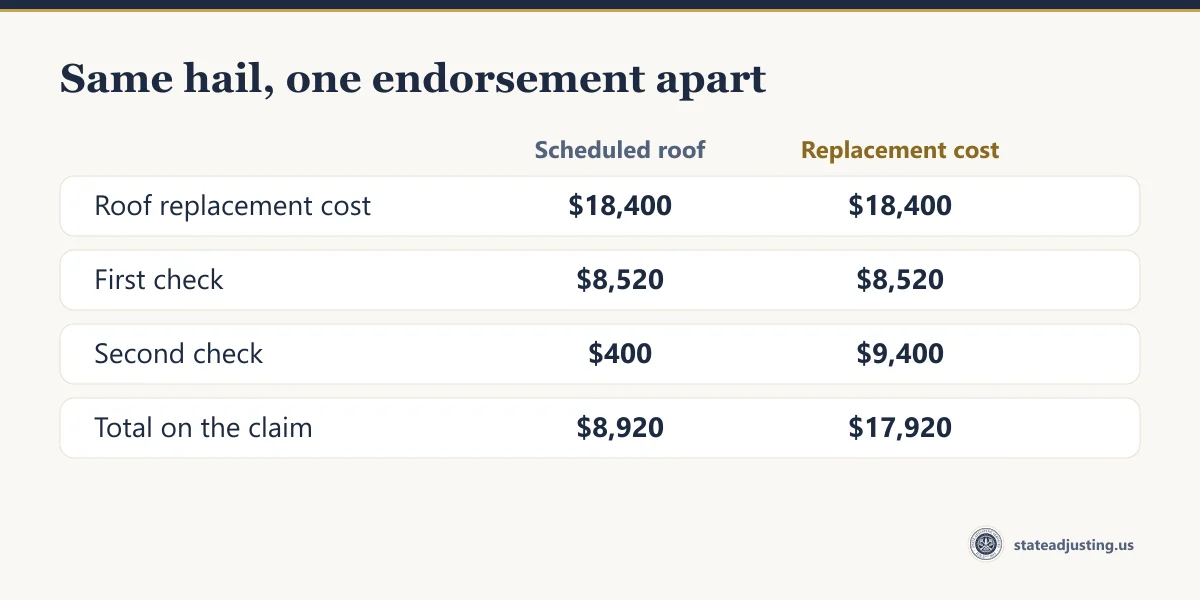
Take a seventeen-year-old architectural shingle roof hit by hail, with a $2,500 deductible. The agreed replacement cost of the roof is $18,400 and the carrier depreciates it by $9,000. Gutters and downspouts add $1,180 with $290 of depreciation; drywall and paint below the opening add $840 with $110. The figures are an illustration of the arithmetic, not a quote and not one of our files.
- Roof at actual cash value: $18,400 minus $9,000 equals $9,400.
- Gutters: $1,180 minus $290 equals $890. Interior: $840 minus $110 equals $730.
- Total actual cash value $11,020, less the $2,500 deductible: $8,520 as the first check.
Here is the part nobody expects. That first check is identical either way. The endorsement does not touch the opening payment — it changes the second one. Without it, completing the work releases $9,000 plus $290 plus $110, which is $9,400, and the claim totals $17,920. With it, the roof depreciation is not recoverable, so the second check is $400 and the claim totals $8,920.
The gap is $9,000, and none of it turns on the damage, the contractor or the negotiation. That is why the first estimate will not tell you what your claim is worth. If the terms are unfamiliar, our guides to actual cash value versus replacement cost and how to read the carrier estimate go through each line.
What does a cosmetic damage endorsement actually exclude?
It excludes damage that changes how something looks without affecting how it works. The wording is usually built around a metal roof surface and the metal that goes with it, and it typically names denting, marring, pitting and scratching. If the panel still sheds water, the endorsement says the dent is not paid.
That is narrower than it first appears, and the argument is almost always about the word function. A hail bruise that fractures an asphalt shingle mat is not cosmetic: the mat is the layer keeping water out, and once broken the shingle has a shortened life whatever it looks like from the driveway. Granule loss down to exposed asphalt is the same story — asphalt in direct sun ages faster, which is why the granules are there.
| What the inspector finds | How it is usually treated, and why |
|---|---|
| Dents in a standing seam or corrugated panel | Cosmetic while the panel sheds water and the coating is unbroken |
| Hail bruise that fractures the shingle mat | Functional — the mat is the waterproofing layer, not the finish |
| Granule loss exposing asphalt at the impact | Functional — exposed asphalt weathers faster, and progressively |
| Dented ridge vent, turbine or gutter | Cosmetic unless the vent no longer seals or the gutter no longer drains |
| Coating breached on painted metal | Argue it — see whether resulting corrosion is excluded or only appearance |
| Creased shingle along a wind line | Functional — a crease is a fracture, and the seal strip has usually let go |
Check two things on any cosmetic denial. What the endorsement lists: many name metal roof surfacing, siding, gutters and downspouts specifically, and applying one to an asphalt shingle roof stretches it past what it says. And whether it removes only the appearance or also the consequences — excluding the dent but not the corrosion that follows is a different policy from excluding both.
A cosmetic finding also runs into matching. Replace four dented panels and leave the rest, and you have a two-tone roof — a separate question with its own answer in Illinois, covered in when a policy owes a uniform roof rather than a patch.
How does the carrier work out how old your roof is?
From records, not from the shingles. Age drives rating and often the settlement schedule, so it comes from paperwork — and if the paperwork is wrong, so is the schedule you are being paid under.
- The application and renewal questionnaire. The roof year given when the policy was written stays in the file until somebody changes it.
- Permit records. A reroof usually pulls a permit, and the municipality keeps the date.
- Prior claims history. A roof paid on an earlier claim dates its replacement, or should have.
- Dated aerial and street imagery. Routine on the carrier side now — and the same evidence that can show a slope was clean before the storm.
What you can produce against it: the closing package if the roof predates your purchase, the roofer invoice, the permit, the warranty registration, dated photographs. If the roof is younger than the file says, send the proof before the settlement is issued rather than after.
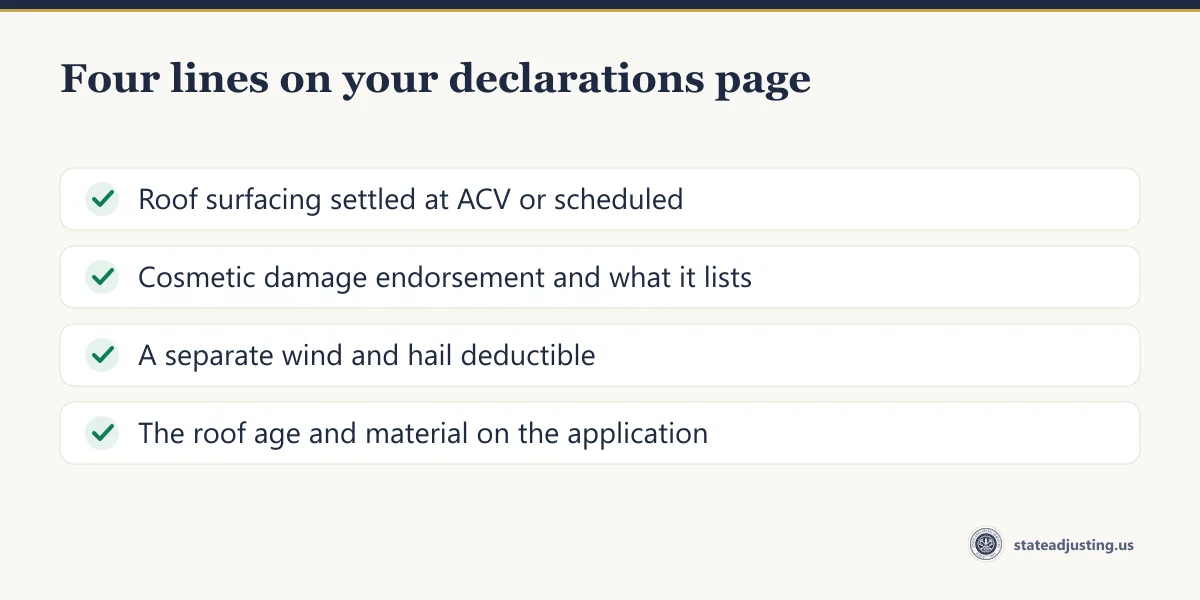
What should you look for on your own declarations page?
All of this is decided before a storm, on lines you already have. Read them now rather than mid-claim, because most of these endorsements can only be added or removed at renewal.
- The endorsement list. Anything naming roof surfacing, roof settlement, actual cash value roof or a payment schedule. Then find that endorsement in the booklet and read its definition of what it applies to.
- A cosmetic damage endorsement. Which surfaces it lists, and whether it stops at appearance or also excludes what follows.
- The wind and hail deductible. Often a separate figure from the all-other-perils one, and frequently a percentage of Coverage A rather than a flat amount — see percentage wind and hail deductibles.
- The roof year and material on record. If it is wrong, correcting it is protection, not exposure.
What to do if your roof was paid at ACV or called cosmetic
Take the arguments one at a time, in this order, because answering the wrong one wastes the time you have.
- Get the reason in writing and name it. No storm damage found, a settlement endorsement, or a cosmetic exclusion. A letter gesturing at all three is answerable on its own terms.
- Get the full estimate, not the summary. The line items show what was depreciated, at what rate, and whether the endorsement reached outside its own definition.
- Check the scope of the inspection. Which slopes were tested, how many impacts on each, whether soft metals were examined, and what date of loss was used.
- Build the functional record on a cosmetic denial. Photographs of fractured mat, exposed asphalt, creased tabs and any interior evidence, with a tape measure in frame.
- Fix the roof age if it is wrong. Permit, invoice or closing document, in writing, before the file closes.
- Know what appraisal can settle. It decides the amount of a covered loss, not whether an exclusion applies — the wrong lever against a cosmetic or wear denial, the right one against a low number. See the appraisal clause.
If you are holding an estimate that pays a fraction of what a reroof costs and cannot tell whether that is depreciation, an endorsement or a finding of no damage, we will read the policy and the estimate and tell you which of the three it is. That review is free. We work for a percentage of the recovery, agreed in writing and regulated by Illinois law — nothing upfront, and no recovery means no fee.
Start with our hail damage claim page or wind damage claim page, see how we work a claim, or send us the file. We are in Lincolnshire and serve all of Illinois, Monday through Friday, 7:00 AM to 7:00 PM, and Saturday and Sunday, 9:00 AM to 5:00 PM.
Questions we get about this
Can an insurance company deny a claim because the roof is old?
Not for age alone. Age is not a peril and not an exclusion, so an old roof damaged by hail or wind is covered on the same terms as a new one unless an endorsement says otherwise. What age does is make the wear-and-tear argument easier for the carrier to run, and it triggers any roof surfacing settlement schedule attached to the policy. Those are two different denials and they are answered differently. Your own policy wording governs.
What is a cosmetic damage endorsement on a roof?
It is an endorsement that excludes damage which changes appearance without affecting function, and it is usually written around metal roof surfaces, siding, gutters and downspouts. Denting, marring, pitting and scratching are the words it normally uses. It is often given in exchange for a premium credit. Whether a finding is cosmetic turns on function, so a hail bruise that fractures a shingle mat is a different case from a dent in a metal panel that still sheds water.
Why did my insurer only pay actual cash value on the roof?
Usually because a roof surfacing settlement endorsement is attached, which carves the roof out of the replacement cost promise and settles it at actual cash value or at a scheduled percentage that falls with roof age. It appears on the declarations page as an endorsement, and it normally applies only to roof surfacing — not to gutters, interior damage or, depending on the wording, flashing and tear-off. Check what the endorsement itself says it covers.
Does hail damage to an old roof still count as covered damage?
It can. The test the inspection applies is whether the damage has the signature of an impact event rather than of gradual weathering: a fractured mat under displaced granules, damage concentrated on storm-facing slopes, fresh dents in nearby soft metals, and a clean bright break rather than brittle oxidised cracking. An old roof loses that argument more often, which is why the inspection scope and the photographs matter more, not less.