Kitchen fire insurance claim: what gets paid beyond the stove
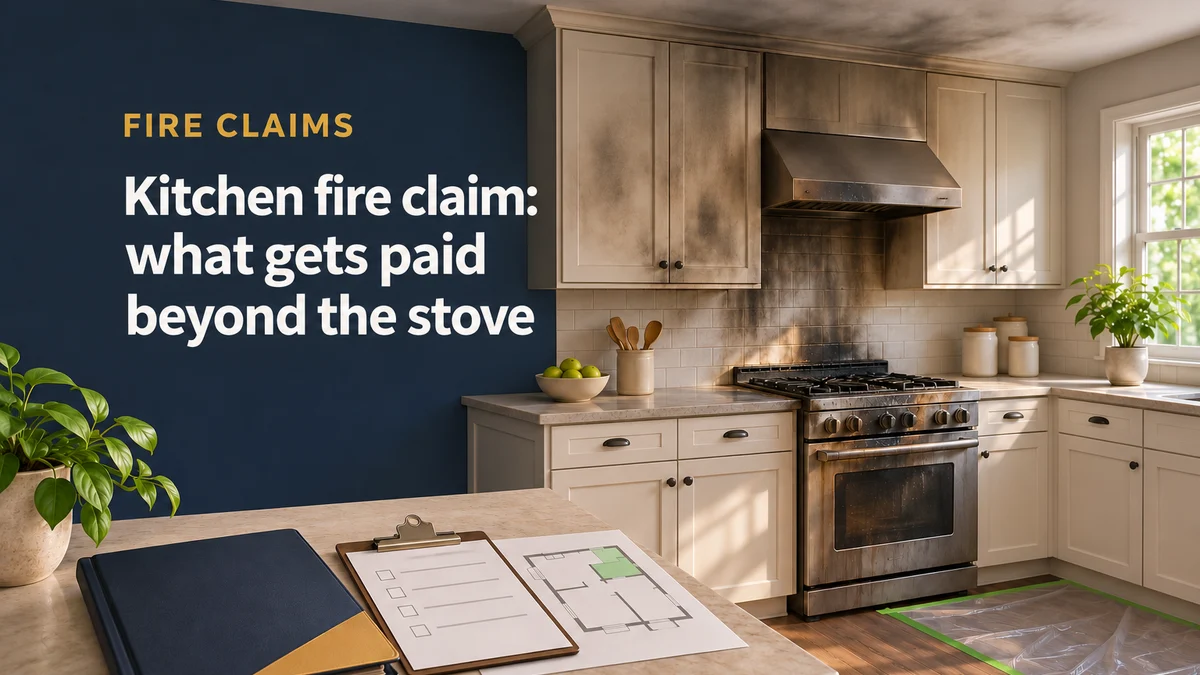
A kitchen fire insurance claim is usually covered when the fire was an accident, including one you started by leaving a pan on the burner. The harder question is how far the payment reaches. A first estimate often stops at the burned wall, while heat, soot and firefighting water may have travelled well past it. Getting those parts written down is most of the work.
We are licensed Illinois public adjusters, not attorneys, and your own policy governs your claim. Dollar figures on this page are examples to show how an estimate is built. None is a quote or a past result.
This is a common loss. The National Fire Protection Association says cooking causes 51% of reported home fires. It estimates 1,139 home cooking fires on Thanksgiving Day 2024, and it counts that day as the peak of the year, at more than three times the daily average.
Does it matter that you left the pan on the stove?
Usually not for coverage. Home policies are bought to pay for accidents, and a careless accident is still one. Intentional fires are excluded. The neglect exclusion in the widely used homeowners form concerns failing to protect the property at and after a loss, so it applies to what you do once the fire is out. What started the fire still decides which evidence to save.
| What started it | How it is usually treated | What to save |
|---|---|---|
| Grease or food on a burner | An accidental fire. A range burned by flames on its own cooktop is fire damage too, along with the hood above it. | The pan, if firefighters left it, and a written note of the times while you remember them. |
| A range, microwave or toaster oven that failed | Fixing a worn part may fall outside the policy, while the fire that followed is a separate matter. Your insurer may also look to the manufacturer afterward. | The appliance itself, its model and serial numbers, and any purchase record. Don't let a cleanup crew haul it away. |
| Wiring or an outlet behind the range | Fire damage is treated as above. Bringing old wiring up to code is a different cost, which ordinance or law coverage may pay. | An electrician's written finding, and photos taken before the wall is opened further. |
| A tenant's cooking | The owner's policy looks at the building and the tenant's policy at the tenant's belongings. Our guide to a claim on a rented house sets out who reports what. | The lease, the tenant's insurance details and the fire department's report. |
| A contractor's work in the kitchen | Your own policy can still respond first, and your insurer may then pursue the contractor. | The contract and the contractor's insurance certificate. Sign no release until someone has read it. |
How far does the claim reach from the stove?
It reaches as far as the fire's heat, smoke and water physically went, and a policy doesn't stop at the kitchen door. Walking outward from the stove in the order below shows where a first scope tends to thin out. Later bands are the ones most often missing, since nothing there looks burned.
The stove wall
Burned cabinets, the hood, backsplash, wall and ceiling. These are the lines nobody disputes.The rest of the kitchen
Warped doors, heat-marked counters and light fixtures. Open every closed cabinet and drawer, then look for soot on the shelves and inside the door faces.The floor and whatever is under it
Firefighting water runs down. Check flooring, subfloor and the basement ceiling below. Consumer Reports, citing the Insurance Information Institute, notes that the standard policy also covers damage firefighters cause.Above and behind
The hood's duct, the wall cavity and the attic over the stove. Insulation there can hold both soot and smell.The rest of the house
Rooms, closets and fabrics the smoke reached. If the blower was running, include the return vent, the filter and the ducts. Our guide to how soot gets scoped covers what cleans and what doesn't.
Is a small stovetop fire worth reporting?
Sometimes it isn't, but make that call after a look inside the house, not from the size of the flames. A fire out in one minute can leave a stained ceiling and nothing else. It can also leave soot in the return vent. So pull the furnace filter, then open the cabinets farthest from the stove and the closet nearest the kitchen.
If they're clean and the repair is close to your deductible, run the sum in our post on whether to file or pay out of pocket. If you find soot, get a written scope before you decide, and leave the surfaces alone in the meantime.
Who pays for the cabinets that did not burn?
That depends on your policy wording and on whether the damaged run can be repaired to look like one kitchen. Soot or heat inside a cabinet is physical damage in its own right. A cabinet with no damage at all is the harder request, and it's argued from availability: can the door style and finish still be bought?
What the wording gives you
The widely used form pays to replace "that part of the building damaged." An insurer may read this as the stove wall only. Your reply is evidence that the part can't be replaced on its own: the maker's name from inside a drawer box, a supplier's note that the door is discontinued, and a photo of a sample door held against the old finish. Section 919.80 doesn't use the word matching, so this is a discussion about your policy and your proof, as it is for roofs and siding.
What Illinois requires when the estimates differ
For a partial loss under a fire policy settled on a written estimate, the Illinois rule at 50 Ill. Adm. Code 919.80(d)(7) and (8) sets these duties for the company:
- Give you a copy of its estimate when you ask.
- Keep that estimate reasonable, and large enough to allow repairs "in a workmanlike manner."
- If your own written estimate is higher, review it and answer promptly in writing, naming a contractor who will do the work.
- If it names none, tell you in writing that it will reimburse reasonable costs above its estimate.
- Give you the worksheets behind any depreciation when you ask, showing age, condition and expected life.
- Explain any delay in writing if the claim stays unresolved past 75 days from the report, or 25 days after proof of loss, whichever is less.
So your contractor's estimate has a job to do. Have it itemized room by room, with a reason on each line beyond the first estimate, and send it in writing. If the company names a contractor, ask that contractor to confirm in writing that the scope includes the soot and cabinet work you've documented. Our post on a contractor's estimate above the insurer's goes through the line-by-line comparison.
In this example, a first estimate covers the stove wall and a fuller scope follows the walk above.
| Example line | Amount |
|---|---|
| Stove wall upper cabinets and hood | $4,800 |
| Kitchen wall and ceiling repair | $1,700 |
| Kitchen cleaning | $1,100 |
| First estimate | $7,600 |
| Lines added from the banner below | $12,000 |
| Fuller scope, before one deductible | $19,600 |
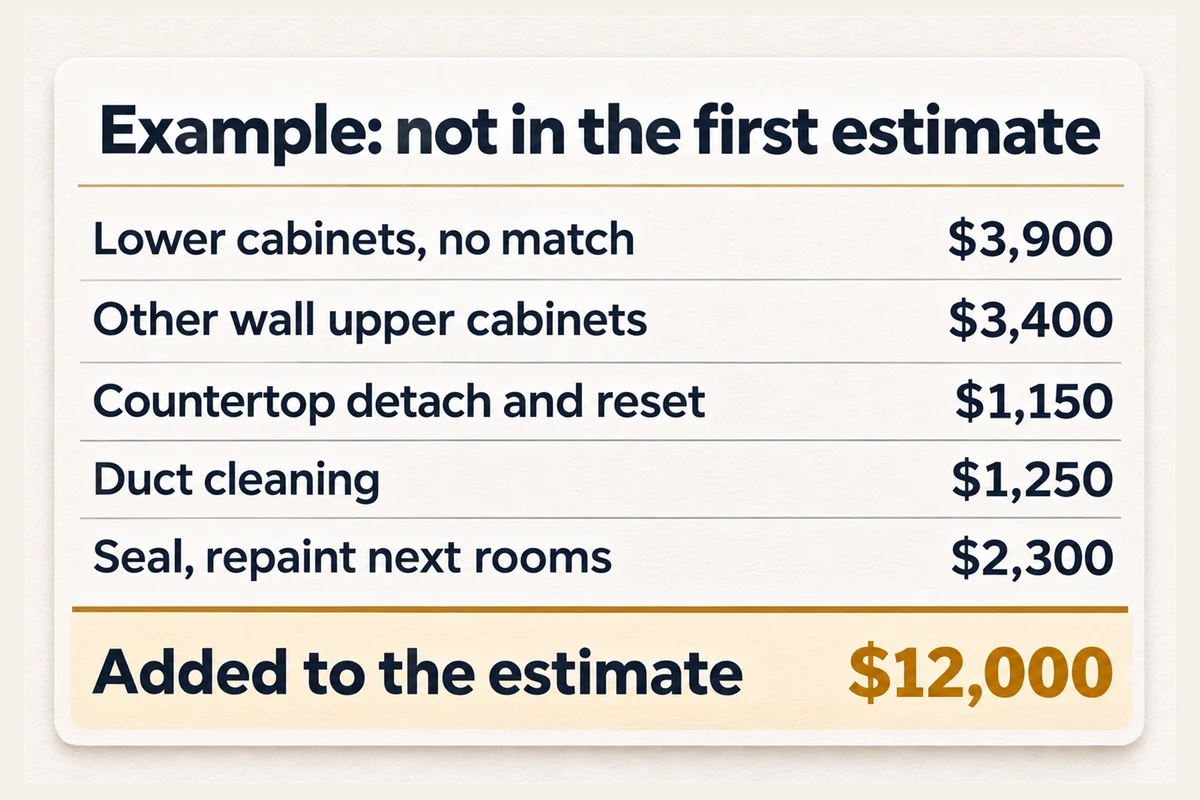
Each added line still needs its own proof, and an insurer may agree to some and not others. One fire is normally one occurrence, so the deductible applies once across structure and contents.
The kitchen is gone but the house is liveable. Are meals paid?
They may be, and only the extra cost counts. Additional living expense coverage responds when the part of the home you live in isn't fit to live in, and insurers don't all treat a lost kitchen alone the same way. Ask for the answer in writing before you build up a pile of restaurant receipts.
The claim is the difference from your normal spending. Suppose a household's usual groceries run $220 a week, and meals cost $400 a week during repairs. The increase is $180, and six weeks of that comes to $1,080. Your grocery receipts from the months before the fire prove the $220, so pull them from your bank or store account now. Our guide to additional living expenses covers hotels and rent if smoke moves you out altogether.
What about the food, the pans and everything in the drawers?
These belong on the contents list, even when they look untouched. A kitchen holds a great many small items, and they add up. A freestanding range is often treated as contents and a built-in one as part of the dwelling, so ask which applies, because the two can settle differently.
Food
The USDA Food Safety and Inspection Service says smoke fumes and firefighting chemicals can't be washed off. It warns about permeable packaging like cardboard and plastic wrap, and notes that a refrigerator's seal isn't airtight. Photograph shelves and labels first, then discard what its guidance says to.
Pans and dishes
The same agency gives a method for washing and sanitizing cookware, so some of it may be cleaned instead of replaced. Ask what cleaning method the restorer proposes, and list what still has a smell or a mark afterward. Don't throw out anything durable until the adjuster has seen it or agreed in writing.
Film each cabinet and drawer with the door open, narrating as you go. That video later becomes the list, using the fields in our guide to contents inventories.
What should you do before the kitchen is cleaned?
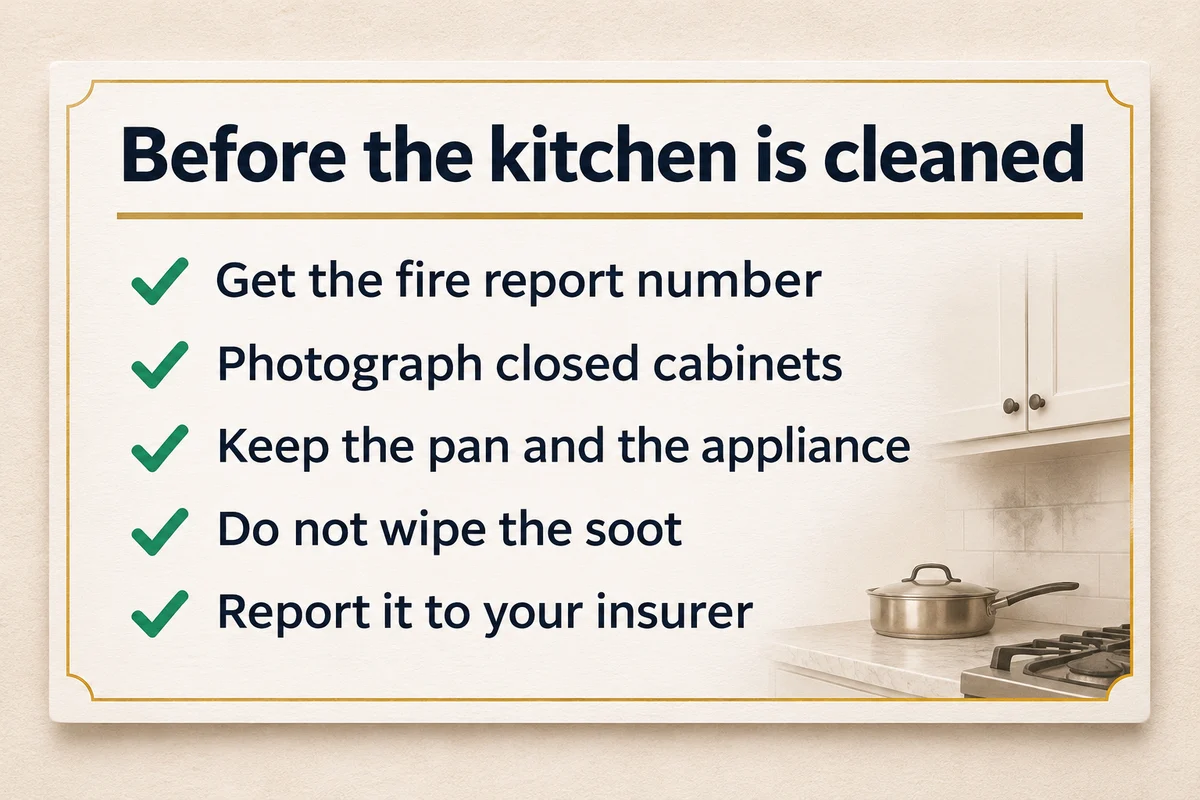
- Stay out until the fire department says the house is safe, and ask how to get its report.
- Report the loss to your insurer and write down the claim number and the name of each person you speak to.
- Photograph the walk above, starting at the stove and ending at the farthest room with soot. Open what's closed.
- Turn off the furnace blower if soot has reached the vents, and don't wipe surfaces.
- Set the pan and any failed appliance aside. Tell the cleanup crew in writing that they stay.
- Protect the house from further damage and keep each receipt for that work.
- Ask for the insurer's estimate in writing, then read it room by room against your photos.
When the estimate stops at the stove wall
Send us the insurer's estimate, your photos and your declarations page, and we'll compare them with the house. We handle fire damage claims and smoke damage claims across Illinois, for homes and commercial buildings, and our process page shows how a file runs from the first call.
The review is free through the contact page or at (630) 297-8136. We're open Monday through Friday, 7:00 AM to 7:00 PM, and Saturday and Sunday, 9:00 AM to 5:00 PM. If we take the claim on, nothing is due upfront: the fee is a percentage of the recovery, agreed in writing, and with no recovery there is no fee. Nobody can promise what an insurer will pay, and we don't.
Questions we get about this
Does homeowners insurance cover a kitchen fire I caused by accident?
Usually yes. Home policies are written to pay for accidental fires, including one caused by leaving food on a burner. Intentional fires are excluded. Your own policy governs, so read its fire coverage and exclusions, and report the loss promptly.
Does insurance pay to replace kitchen cabinets that did not burn?
It may, if they have soot or heat damage, or if your wording and the evidence show the damaged part can't be replaced on its own. Keep the maker's name, a supplier's note if the door is discontinued, and photos of a sample against the old finish.
What if my contractor's estimate is higher than the insurer's after a fire?
Send it in writing. On a partial fire loss settled by written estimate, 50 Ill. Adm. Code 919.80 requires the company to review it, answer promptly in writing and name a contractor who will do the work. If it names none, it must say in writing that it will reimburse reasonable costs above its estimate.
Can I eat food that was in the kitchen during a fire?
Follow the USDA Food Safety and Inspection Service guidance. It says smoke fumes and firefighting chemicals can't be washed off, warns about permeable packaging, and notes that a refrigerator's seal isn't airtight. Photograph the food and labels before you discard it, so it can go on your contents list.