Can you keep insurance money and not fix your house?

Can you keep insurance money and not fix your house? Often the first payment, yes, if your policy pays actual cash value and no lender is on the check. The rest of a replacement cost payment usually isn't paid until the repair happens. With a mortgage, the decision may not be yours, because most Illinois home loans send building money to the repair or to the debt.
We are licensed Illinois public adjusters, not attorneys, so this page explains documents and doesn't give legal or tax advice. Your own policy and loan papers govern. The dollar figures are examples of the arithmetic. None is a quote or a past result.
Which two contracts decide this?
Your homeowners policy decides what the insurer pays and when. Your mortgage decides what happens to building money once it's paid. Read them side by side, because a homeowner can be free under the first and bound under the second. These are the widely used versions, and yours may differ.
The homeowners policy
"We will pay no more than the actual cash value of the damage until actual repair or replacement is complete."
This line from the sample HO-3 form published by the Insurance Information Institute treats actual cash value as payable first. In Illinois, that value is replacement cost less depreciation, if any. The extra amount waits for the work.
The same form caps the full payment at "the necessary amount actually spent" on the repair.
The Illinois mortgage
"Borrower will promptly repair the Property if damaged to avoid further deterioration or damage."
That's the July 2021 version of Form 3014, the Fannie Mae and Freddie Mac Illinois mortgage. It applies proceeds to repair when the lender finds repair feasible and its security intact.
If not, the money goes against the loan, "with the excess, if any, paid to Borrower." Older and non-conforming loans use other wording, so read your own.
Which payments can stay in your account if nothing gets repaired?
A settlement is several payments, and each has its own answer. Contents money usually reaches you with no lender involved. Building money usually carries the lender's name, and the withheld depreciation normally isn't issued at all without repair. Check your settlement letter against this table, line by line.
| Payment | If you don't repair | What decides it |
|---|---|---|
| First dwelling check (actual cash value) | Yours under the policy once it clears the lender's process | The mortgage clause puts Coverage A and B payments to the "mortgagee and you, as interests appear." See the mortgage company on your insurance check. |
| Withheld depreciation | Normally not paid | Proof of completed work. The steps are in our guide to collecting recoverable depreciation. |
| Garage, fence or shed (Coverage B) | Same answer as the dwelling check | The same mortgage clause and the same settlement wording apply. |
| Contents | Usually yours, with no lender on the payment | Replacement cost on contents comes from an endorsement, which may also hold money back until items are replaced. |
| Additional living expense | Nothing extra to keep | It pays the necessary increase in your living costs, so the money follows bills you've already had. |
| A roof on an actual cash value schedule | No second check existed to lose | An age-based roof endorsement can settle the roof at depreciated value whether or not you replace it. |
What does each decision pay on the same loss?
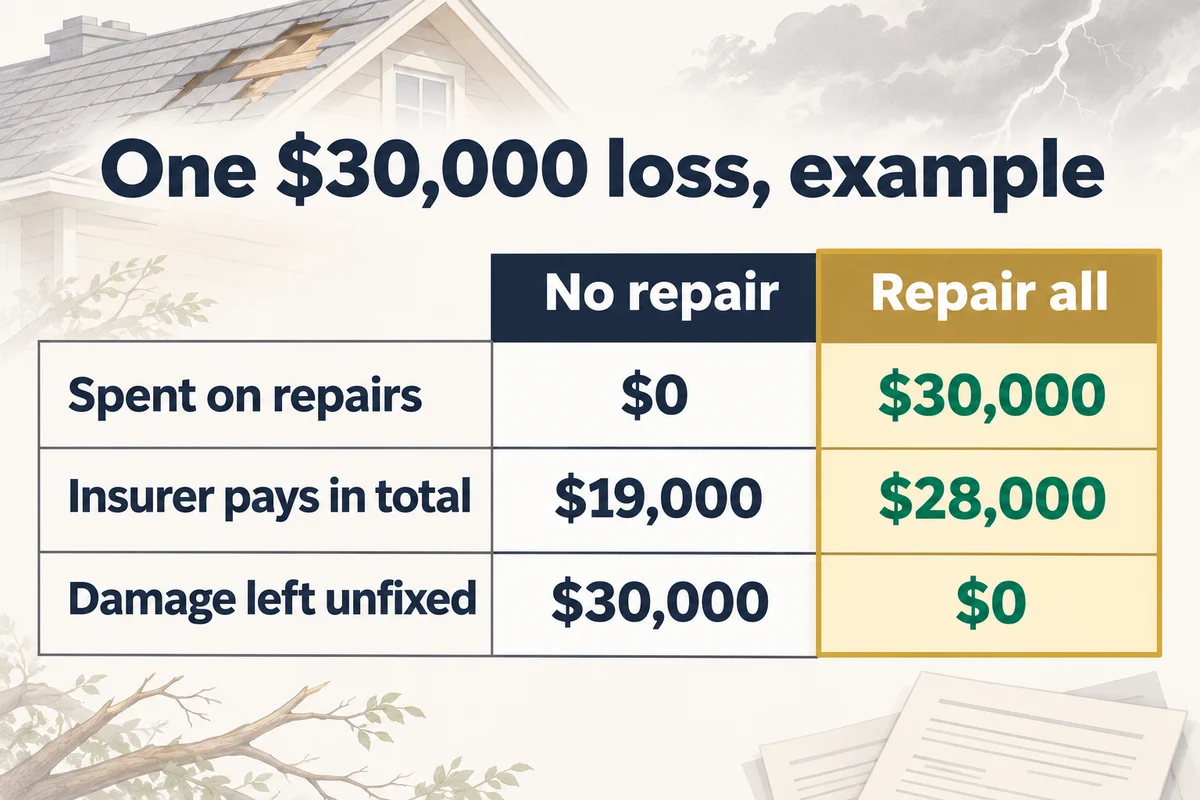
Fewer repair dollars never raise the insurer's total, and they can lower it. Take an example with $30,000 of covered damage, $9,000 of depreciation and a $2,000 deductible. The first check is $19,000: $30,000 less $9,000, less $2,000. No lender is included here, so the columns show the policy's arithmetic alone.
| Example | Full repair | Same work for less | Part of the work | No repair |
|---|---|---|---|---|
| Spent on repairs | $30,000 | $26,000 | $12,000 | $0 |
| First check | $19,000 | $19,000 | $19,000 | $19,000 |
| Second check | $9,000 | $5,000 | $0 | $0 |
| Cash after repair bills | -$2,000 | -$2,000 | +$7,000 | +$19,000 |
| Priced damage still there | $0 | $0 | $18,000 | $30,000 |
Read the last two rows together. The $19,000 in the final column sits beside $30,000 of damage at today's prices, and the $9,000 of holdback is gone once the policy's time limit passes. A cheaper contractor doesn't leave you a surplus either, since the second check shrinks to match the invoice. Spending more than the estimate is a separate conversation, covered in our post on a contractor's price above the insurer's.
You can also change your mind within limits. The sample form lets you claim on an actual cash value basis first and seek the rest later, "provided you notify us of your intent to do so within 180 days after the date of loss." Illinois endorsements and insurers vary, so find this line in your own policy and put any notice in writing. Our page on claim deadlines in Illinois lists the other dates to check.
When is a small repair paid in full without the work?
The sample form skips the holdback when the repair cost is both under 5% of the building's insurance amount and under $2,500. On a $300,000 limit, 5% is $15,000, so the $2,500 test is the one that matters. A $1,900 repair is then settled at replacement cost, less the deductible, whether or not it's done.
On a $40,000 limit for a small house, 5% is $2,000, which becomes the lower test. An estimate of $2,100 there fails it, and the depreciation waits for the work. Look for this sentence in your own loss settlement section, as some policies change it.
Is keeping the money insurance fraud in Illinois?
Illinois defines insurance fraud around deception. Under 720 ILCS 5/17-10.5, the offense involves obtaining an insurer's property by deception through a false claim. So the question to ask is whether anything you told the insurer is untrue. If you're unsure about your own facts, that's a question for an attorney.
A decision, reported truthfully
- Taking actual cash value and telling the insurer you won't claim the holdback.
- Doing part of the scope and submitting only what you paid for.
- Asking first whether your own labor counts, then following the written answer.
A false statement
- An invoice for work that wasn't done, sent to release the second check.
- A price raised so the holdback covers your deductible.
- Saying a repair is finished when it isn't.
The statute's stakes are high. It grades the crime by amount, and at more than $300 up to $10,000 it's a Class 3 felony. It also allows an insurer a civil claim for three times the value wrongly obtained, plus attorney's fees. Separately, 815 ILCS 513/18 bars a home repair contractor from advertising or promising to pay or rebate your deductible to win the job. If a salesperson offers to make the deductible disappear, our guide to storm chasers at the door covers what else to check.
What follows an unrepaired house after the check clears?
Most of what follows is a problem of proof, and it arrives later. The damage you were paid for stays on record, with photos, while the house keeps aging around it. Price these four into the decision before you make it.
The next storm
A later claim pays for new damage. Expect the adjuster to compare the roof with the last claim's photos and to separate old hail marks from new ones. A leak through a spot you were paid to fix invites that argument, and the sample form excludes neglect to preserve property "at and after the time of a loss."
Your renewal
An insurer that learns of an open roof problem may ask for repair proof or an inspection before it renews. Illinois limits on cancelling and nonrenewing are in our post on filing or paying out of pocket.
Selling
The Illinois seller's report under 765 ILCS 77/35 asks about awareness of "leaks or material defects in the roof, ceilings, or chimney." A paid claim you never repaired is hard to forget, and a buyer's inspector may find it anyway.
Taxes
IRS Publication 547 says, "If your reimbursement is more than your adjusted basis in the property, you have a gain." It also covers postponing a gain when you restore the property. Ask a tax preparer before a large payment goes unspent.
What should you check before deciding?
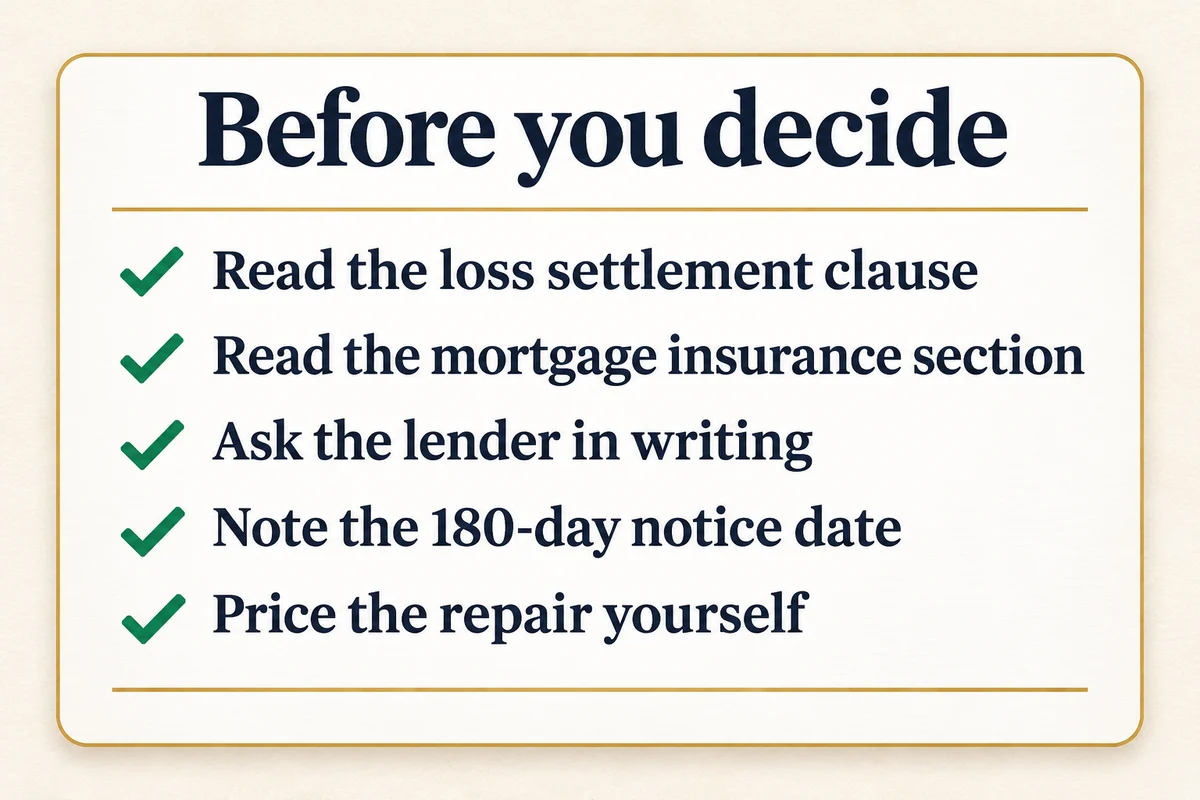
Get the facts in writing first, since most of them can't be undone later. Nobody needs a repair contract to run these checks. An hour with your papers will usually show which column of the example above you're really in.
- Find the loss settlement section of your policy and mark the actual cash value line, the small-repair test and any notice period.
- Find the insurance section of your mortgage, then ask the servicer's loss draft department in writing what it will do with funds if you don't repair.
- Ask the insurer for the depreciation worksheets, which the Illinois rule entitles you to on request, and write the deadline for the second check on your calendar.
- Ask whether the payment letter treats any amount as final, and don't sign a release you haven't read.
- Price the repair yourself with one written estimate, and compare it with the insurer's scope line by line.
When keeping the money looks better because the estimate is short
Plenty of owners consider skipping repairs because the first check won't pay for them. That's a different problem. If a roofer's written price is far above the insurer's scope, check the scope before giving up the second check. Missed lines can be supplemented, and a claim you've closed can sometimes be reopened within the policy's limits.
Send us the settlement letter, the estimate and your declarations page, and we'll read them against the damage. We handle storm damage claims and hail damage claims for Illinois homes and commercial buildings, and our process page shows how a file runs.
The review is free through the contact page or at (630) 297-8136. We're open Monday through Friday, 7:00 AM to 7:00 PM, and Saturday and Sunday, 9:00 AM to 5:00 PM. If we take the claim on, nothing is due upfront: the fee is a percentage of the recovery, agreed in writing, and with no recovery there is no fee. Nobody can promise what an insurer will pay, and we don't.
Questions we get about this
Can I keep the insurance money and not fix my roof?
Often you can keep the actual cash value payment if no lender is on the check, but withheld depreciation is normally paid only after the repair. With a mortgage, the loan contract may require repair or send the money against the balance. Your policy and loan papers govern.
Does my mortgage company have to approve what I do with the insurance check?
If the lender is named on the policy, building payments usually name it too. The Illinois uniform mortgage, Form 3014, applies proceeds to repair when the lender finds that feasible, and otherwise to the loan, with any excess paid to the borrower. Ask your servicer in writing.
Can I use a cheaper contractor and keep the difference?
Usually no on a replacement cost claim. The widely used form caps the full payment at the necessary amount actually spent, so a lower invoice lowers the second check. Report the real price, because an inflated invoice sent to release money is a false statement.
Is it illegal to keep an insurance payout without repairing?
Illinois defines insurance fraud around obtaining an insurer's property by deception through a false claim. A truthful claim followed by a decision not to repair is a different situation from a fake invoice. Your loan may still require repair, and an attorney can advise on your own facts.