Mortgage Company on Your Insurance Check: How to Get the Money Released

Your mortgage servicer is on the check because the policy's mortgage clause protects its interest in the building itself. It is not keeping your money. It opens a loss draft account, releases the funds in stages as the repair is inspected, and should only hold the dwelling portion — contents and loss of use normally come straight to you.
Finding the mortgage company on your insurance check is the moment a claim that finally settled appears to stall all over again. The payment arrives, it names you and a company you have not spoken to since closing, and your bank will not touch it. Nothing has gone wrong and nobody has made a mistake. This is the ordinary path for building money, and it has a name: a loss draft.
This guide covers why the servicer is a payee at all, which parts of a settlement it may hold, the document package that opens the account, how the repair draws are released, and the six things that most often stall a release. We are licensed Illinois public adjusters rather than attorneys or mortgage servicers, so this is how these files behave in practice — your own policy and loan documents govern yours.
Why is my mortgage company on the insurance check?
Because your policy contains a mortgage clause naming the lender as a payee for damage to the structure. The lender's collateral is the house, so it holds a documented interest in the money that rebuilds it. The clause was in force from your first premium, and nothing you did triggered it.
That clause is why the interest survives situations you might expect to erase it. Under a standard mortgage clause, the lender's protection is treated as a separate agreement from yours, so it can hold even where the homeowner's own claim runs into trouble. The clause exists to protect a loan against a burnt-down collateral, and it does exactly that.
Two practical points follow. First, the company named on the check is often not the lender you signed with — loans are sold, and the payee is whoever services the loan today, which is the name on your monthly statement. Second, the clause reaches the building. It does not give the servicer an interest in your furniture or in the hotel bill you ran up while displaced.
What is a loss draft account and what does the servicer do with the money?
A loss draft account is a holding account where the servicer parks building proceeds and pays them out in stages as the repair is verified. Smaller losses are often released in a single payment. Larger ones are monitored, meaning the money moves only after inspections at set points in the work.
Where the line falls between those two is set by the servicer's own guidelines, not by law, and it varies widely between companies. Ask for your servicer's threshold in writing on the first call, because the answer changes how your contractor has to be paid. A repair funded in three inspected draws is a different contract from one funded up front.
It is worth being clear about what the servicer is doing, because homeowners often read it as a second review of the claim. It is not. The servicer is protecting collateral, and its only question is whether the house is being repaired. It has no opinion on whether the carrier paid enough. That argument sits entirely between you and the insurer, and it is a separate piece of work.
Which parts of the settlement should not be escrowed?
The mortgage clause reaches building money. Personal property and additional living expenses are not the lender's collateral and are normally payable to you alone. The trap is mechanical: if the carrier puts every coverage on one check, the entire amount lands in the loss draft account, including the parts that never belonged there.
| Coverage | What it pays for | Usually names the servicer? |
|---|---|---|
| A — Dwelling | Repairs to the house itself | Yes |
| B — Other structures | Detached garage, shed, fence | Usually, as part of the mortgaged property |
| C — Personal property | Contents, furniture, clothing | No |
| D — Loss of use | Extra living costs while displaced | No |
| Recoverable depreciation | The withheld second payment on the dwelling | Yes — same route as the first |
The fix is upstream and it costs nothing. Ask the carrier, at the point of settlement, to issue payment split by coverage rather than as one lump sum. A separate contents check and a separate loss-of-use check clear your bank the same week instead of sitting in an escrow queue for a month. Ask before the check is cut; reissuing one afterwards means stopping payment and starting over. As always, your policy's own wording controls which coverages apply to your loss.
What does the servicer's loss draft package require?
Nearly every servicer asks for the same short list: the endorsed check, the carrier's loss statement, the full estimate, a signed contractor contract with a fixed total, the contractor's W-9, license and insurance certificate, a completion timeline, and the servicer's own authorization form. A single missing item sends the file back to the start of the queue.
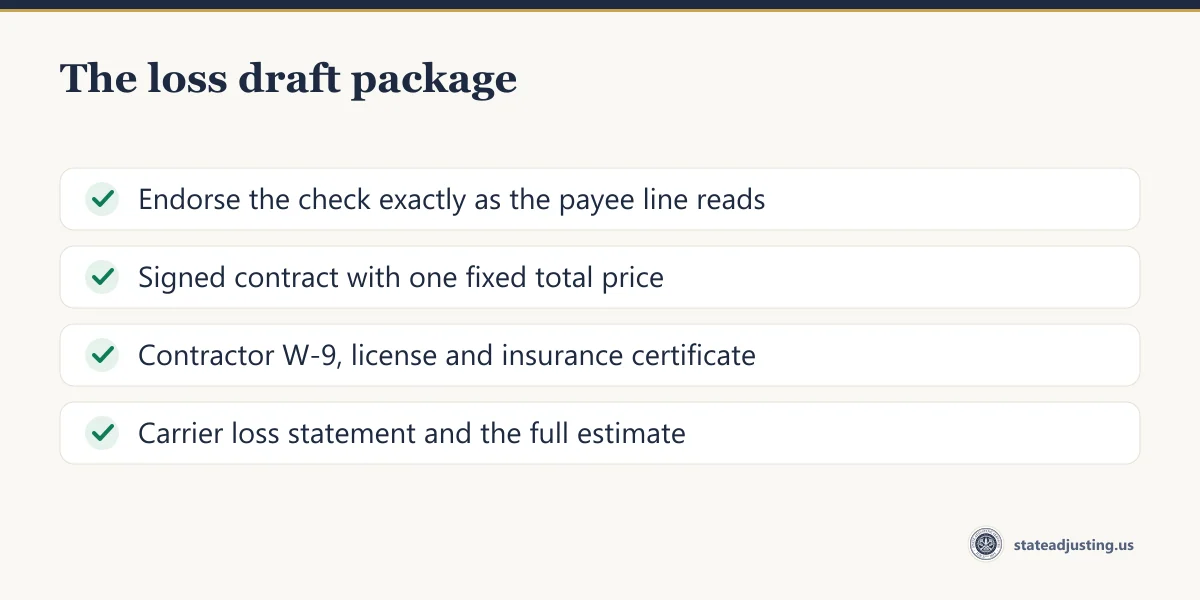
| Document | What it proves to the servicer |
|---|---|
| The endorsed check | Every named payee has signed and released the funds |
| Carrier loss statement or claim summary | What this payment covers, and whether more is still to come |
| The full estimate, line by line | The work being funded matches the damage that was insured |
| Signed contract with a total price | The money has a defined job, a defined price and a defined end |
| Contractor W-9 | The servicer can issue joint checks and report the payment |
| License and certificate of insurance | A licensed, insured party is working on the collateral |
| Completion timeline | Sets the inspection schedule the draws hang off |
| Borrower authorization form | Names who is allowed to discuss the file besides you |
The authorization form is the one people skip, and it causes more delay than any other line. Name your contractor and, if you have one, your public adjuster as authorized contacts on it. Most loss draft delays are not decisions — they are phone calls nobody was permitted to make.
How are the draws released?
A monitored claim usually pays in three stages: an opening draw once the package is accepted, a middle draw at roughly half completion, and the balance after a final inspection. Every stage after the first is released against an inspection the servicer orders, not against an invoice your contractor sends.
| Stage | What is released | What triggers it |
|---|---|---|
| Opening | A first portion, commonly around a third | A complete package is accepted |
| Midpoint | The next portion | An inspection confirming the work is roughly half done |
| Final | The remainder held back | Final inspection, sometimes with signed lien waivers |
The consequence is one your contractor needs to hear before anything is signed. The work is being funded on the servicer's inspection calendar, and inspections are ordered, scheduled and reported by a third party. Never sign a repair contract that requires payment in full at a point the servicer will not fund, and expect a modest inspection fee to be charged against the account each time. A contractor who has worked through loss drafts before will already know this, which is one of the quieter reasons the choice of contractor matters on an insurance repair.
What actually stalls a release?
Almost never a decision, and almost always paperwork. Six problems account for most of the weeks homeowners lose here, and five of the six are fixable in an afternoon if you know to look for them.
- The package is incomplete. Servicers usually review the file as a whole, so a missing W-9 is discovered late. Ask for their written checklist and submit everything in one delivery.
- The check total does not match the estimate total. This is normal — the first payment is the depreciated value less your deductible — but it reads as an error to a reviewer. Send a one-page note showing the arithmetic. Our guide to actual cash value against replacement cost explains the gap in full.
- Signature mismatch. The endorsement has to match the payee line exactly: a maiden name, a middle initial, a trust name or a deceased co-borrower all stop a check cold, and each has its own paperwork.
- The loan is delinquent. Most mortgage contracts permit the servicer to apply insurance proceeds to the loan balance rather than the repair. That is a loan question, not a claim question, and it is one of the few points on this page where an attorney rather than an adjuster is the right call.
- The contractor's paperwork is stale. The insurance certificate must be current and issued by the contractor's insurer, not typed on the contractor's letterhead.
- The work is already finished. Many servicers will still release against a final inspection and paid invoices, but you have given up staged funding and you will be asked to prove you paid for the repair yourself.
A worked example: what reaches you, and when
Take a storm loss on a house with a mortgage. The dwelling repair prices at $46,800 at replacement cost. The carrier withholds $9,300 of recoverable depreciation, leaving an actual cash value of $37,500, then subtracts a $2,500 deductible. The first dwelling check is $35,000. Contents settle at $6,200 and loss of use at $1,800.
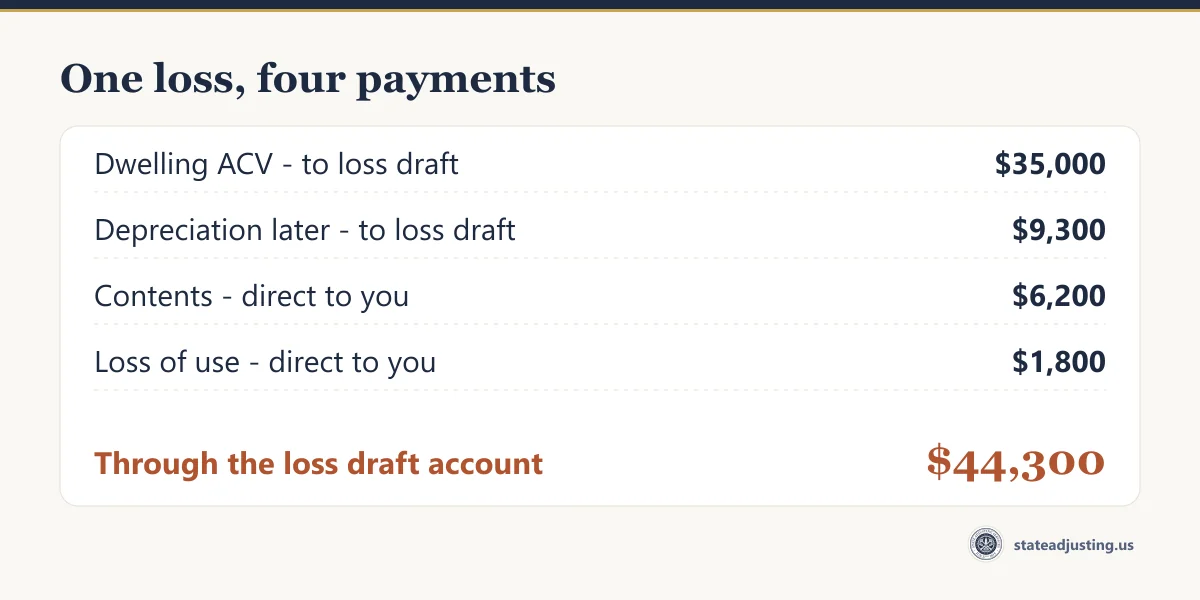
The $35,000 goes into the loss draft account. The $8,000 of contents and loss of use should reach you directly, provided you asked for the coverages to be paid separately. When the repair is complete and documented, the carrier releases the $9,300 of withheld depreciation, and that check takes the same road as the first, because it is still dwelling money. Of $52,300 settled, $44,300 passes through the servicer and $8,000 does not. Going back for that final $9,300 is its own task, and we have written about how recoverable depreciation is actually collected.
Notice what the example does not show: any judgment by the servicer about whether $46,800 was the right number. It was not asked, and it will not offer one.
What to do next
Call the servicer's loss draft department the day the check arrives and ask three questions: what is the monitoring threshold, what is on the required document list, and where do documents go. Get the answers in writing. Then endorse the check exactly as the payee line reads, mail it as the servicer instructs — tracked, always — and send the rest of the package in one piece.
Do that in parallel with the claim itself, not after it. The two clocks run independently, and the repair cannot be scheduled until the funding is arranged. If the settlement behind the check looks light for the damage you have, that is the fight worth having, and it happens with the carrier while the escrow paperwork moves. Our claim process page sets out how we work a file, and the storm damage page covers what these losses usually involve in Illinois.
If you want a second set of eyes on the settlement itself, we review Illinois residential and commercial claims at no charge and no obligation — tell us what happened and send the estimate. We are paid a percentage of what is recovered, agreed in writing and capped by Illinois law, so there is nothing to pay up front and nothing owed if there is no recovery.
Questions we get about this
Can I cash the insurance check without the mortgage company?
No. Every payee named on the check has to endorse it, and a bank that accepts it without the servicer's endorsement can be required to make the funds good later. Signing on the servicer's behalf is not an option. If your loan has been paid off, ask the carrier to reissue the check without the servicer on it, and expect to show the recorded release of the mortgage.
How long does a mortgage company take to release insurance funds?
Timelines are set by each servicer, not by a common rule, so ask yours for its published turnaround in writing. The part you control is the package: a complete submission is usually reviewed within days, while a file missing one document waits for the next review cycle. Send everything in a single delivery and confirm receipt.
Does the mortgage company decide how much my claim is worth?
No. The servicer only disburses money the insurer has already paid, and it takes no position on whether the settlement is adequate. Whether the estimate covers the real scope of damage is a separate question, argued with the carrier. The two run at the same time and neither one waits for the other.
What if I want to sell the house instead of repairing it?
That depends on your loan documents. Some servicers apply insurance proceeds to the loan balance in that situation, others release the funds after payoff at closing. Ask the servicer in writing before you sign a sale contract, and if the answer changes the terms of that sale, that is a question for an attorney rather than for your adjuster.