Recoverable Depreciation: The Money Most Homeowners Never Go Back For

Recoverable depreciation is the withheld difference between your first ACV check and full replacement cost — real money, not a bonus. It goes unclaimed when a homeowner never learns the second check exists, misses the deadline stated in the policy, or submits paperwork that doesn't match what the carrier already approved. Submitting a paid invoice before that deadline is usually what releases it.
Recoverable depreciation is the least understood step in a homeowners claim, and the most commonly abandoned. Our guide to ACV vs replacement cost covers why the first check on a replacement-cost policy runs short of the repair bill. This guide covers what happens after that first check clears: the process of actually going back for the rest of it, why so many homeowners never do, and exactly what a carrier checks before releasing the second payment.
What is recoverable depreciation, in one sentence?
It's the gap between actual cash value — what your first check paid — and full replacement cost, which your policy owes once the repair is finished and documented. The carrier holds it back, not because it isn't owed, but because it isn't owed yet.
That distinction matters because a settlement letter rarely spells it out in plain language. It states an ACV figure, a deductible, and a total — and the withheld depreciation often sits in a line the homeowner never reads twice. If you haven't confirmed which basis your policy actually settles on, our guide to reading your homeowners policy covers the clause that decides it.
Why do so many homeowners never collect it?
Mostly for reasons that have nothing to do with whether the money is owed. The claim gets set aside once the first check clears, the deadline is easy to miss because nothing reminds you of it, and repairs sometimes finish just late enough — after a bad storm season backs up every roofing crew in the region — to land outside the window.
- The first check is mistaken for the final payout, and the claim file gets closed mentally
- The submission deadline is stated once, in a letter from months earlier, with no follow-up reminder
- Repairs are delayed — by contractor availability, financing, or simply life — past the stated window
- The invoice submitted doesn't match what the carrier already approved, and the resubmission never happens
- The home is sold before repairs are finished, and nobody checks whether that changes anything
None of these is a legal bar to collecting recoverable depreciation. Every one of them is a paperwork or timing problem, and every one of them is fixable if you catch it early enough.
What do you actually need to submit to release it?
A paid invoice or receipt showing the completed repair, at a scope and cost consistent with what the carrier already approved, sent in writing before your policy's deadline and referencing your claim number. Carriers are checking that the work happened and cost roughly what was estimated — not re-litigating the original claim.
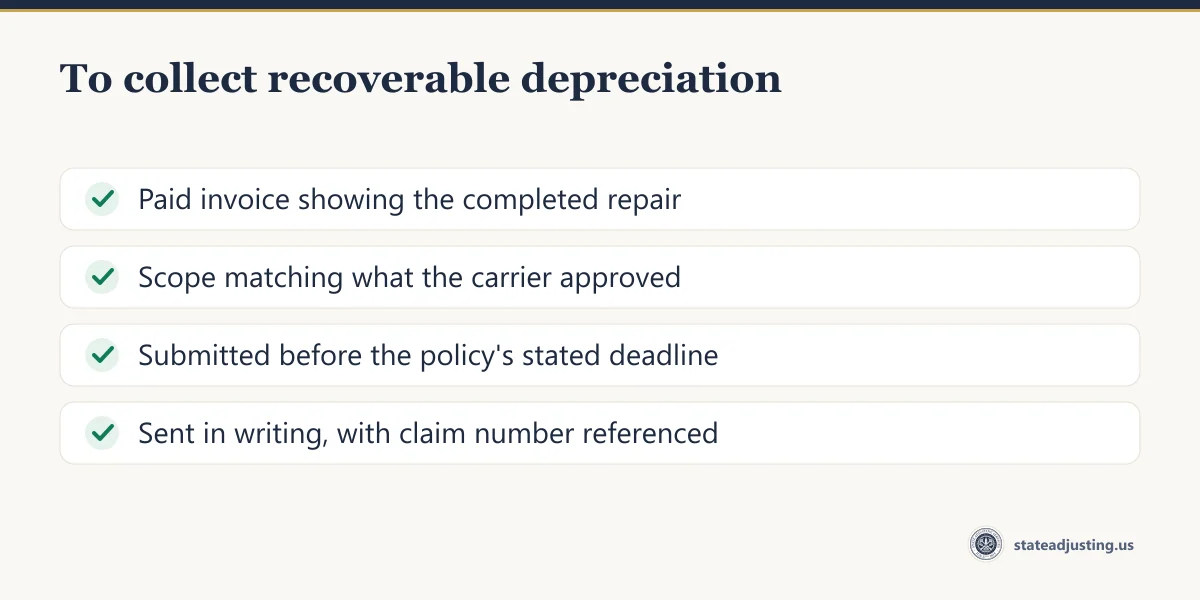
| What the carrier usually wants | Why it matters |
|---|---|
| Paid invoice or receipt, not an estimate | Recoverable depreciation is released against documented cost, not a quote |
| Scope matching the approved estimate | A materially different scope may need a supplement request first, not a depreciation release |
| Your claim number on every document | Without it, paperwork can be misfiled or delayed at the carrier's end |
| Submission before the stated deadline | Most policies do not pay recoverable depreciation requested after the window closes |
How long do you have — and what happens if the deadline passes?
It depends on your specific policy. Many homeowners policies give roughly one year from the date of loss to complete repairs and submit proof, but that figure is not universal, and the exact wording controls, not a rule of thumb. Read the deadline in your own settlement letter or policy rather than assuming a standard window applies.
What happens after the deadline also depends on the policy. Some carriers deny a late request outright; others will still review one with an explanation, particularly if the delay was outside your control — a contractor backlog after a widespread storm, for instance. Neither outcome is guaranteed, which is exactly why the deadline is worth confirming early rather than discovering it after it has passed.
If a repair is running behind schedule — a common outcome after a widespread hailstorm, when every roofing crew in the area is booked out for weeks — ask the carrier in writing for a specific extension before the original date passes, not after. A request made in advance creates a written record that you tried to meet the deadline; a request made after the window has closed is asking the carrier to waive a term it may have no obligation to waive.
What if the actual repair costs less than the original estimate?
You're generally not entitled to more than what you actually paid for the completed repair, even if the original withheld depreciation was a larger number. If a homeowner finds a contractor who completes the same scope for less than the carrier's estimate, the recoverable depreciation released is typically capped at the documented cost, minus what was already paid on the ACV check — not the full amount originally withheld.
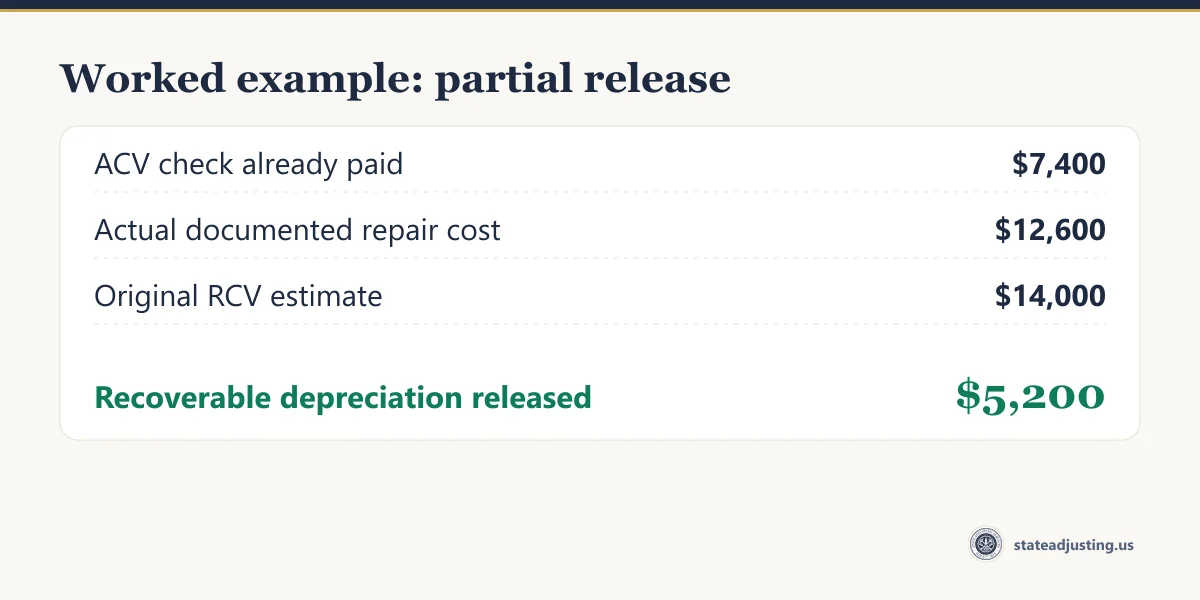
The figures below are a worked example only, not a quote or a past settlement, showing how that cap works in practice.
| Line item | Illustrative figure |
|---|---|
| Total replacement cost (RCV) originally estimated | $14,000 |
| ACV check already paid | $7,400 |
| Actual documented repair cost | $12,600 |
| Recoverable depreciation released | $5,200 |
That $5,200 is the gap between what was already paid and what the completed work actually cost — not the full $6,600 the original estimate withheld. Spending less than the estimate is not a loss; it simply means less depreciation is left to recover. Spending more, on the other hand, does not usually raise your total above the original RCV figure either — that ceiling generally holds in both directions.
What if you sell the house before repairs are finished?
This is worth checking before you list, not after. Many policies pay recoverable depreciation to the named insured who completed the repair — so if you sell before the work is done, the unfinished portion may not transfer to the buyer, and you may not be able to collect it either, since you no longer own the damaged property. Some carriers handle this differently; the policy language and your specific circumstances decide it, not a general rule.
If a sale is on the table while a claim is still open, that is a conversation worth having with the carrier directly, in writing, before the closing date rather than after.
What to do next
Pull your original settlement letter and find two things: the word "recoverable" against each line item, and the deadline for submitting proof. If repairs are underway, keep every invoice from day one — the second check is paid against documented cost, not the original estimate. Our construction partner is one option for the repair itself, always the homeowner's choice, never a condition of the claim. If you're unsure whether depreciation on your claim is still recoverable, or the deadline has already passed, our free claim review reads your policy and settlement letter together at no cost — our fee, when we're engaged, is a percentage of what we recover, agreed in writing, with $0 owed upfront. See our process for what that involves, our client reviews for what past clients say, and our hail damage claim guide for how recoverable depreciation commonly plays out on a roof.
Questions we get about this
How long do I have to submit for recoverable depreciation?
It depends on your specific policy. Many homeowners policies give roughly one year from the date of loss to complete repairs and submit proof, but that figure is not universal — read the deadline stated in your own settlement letter or policy rather than assuming a standard window applies.
Do I have to use the contractor from the original estimate?
Generally no. What carriers check is a paid invoice showing the completed work at a scope consistent with what was approved, not which contractor performed it. A lower invoice usually still releases the eligible amount, typically capped at what you actually spent minus what you've already been paid.
What if repairs will finish after the deadline has passed?
Contact the carrier in writing before the deadline, not after. Some carriers will review a documented delay outside your control, such as a contractor backlog after a widespread storm, though this is not guaranteed and depends on the carrier and your policy. Getting the request on record before the date passes matters either way.
Is recoverable depreciation available on every claim?
No. It only applies to items settled on a replacement-cost basis to begin with. Some personal property on certain policy forms, and some roofs under an ACV-only endorsement, are never eligible for a second check — see our guide to ACV vs replacement cost for how to check which basis applies to you.