The Recorded Statement: What It Is and How to Prepare for It
A recorded statement is an interview your insurer records and transcribes into your claim file, usually by phone in the first days of a claim. Most homeowners policies include a duty-to-cooperate condition, so refusing outright can put the claim at risk. You can, however, schedule it, prepare for it, and answer only what you actually know.
A recorded statement is one of the first things many carriers ask for after a property claim is reported, and it is the part of the process homeowners are least prepared for. The call is short, friendly and completely routine from the adjuster's side. It is also evidence: the transcript goes into the file, and later decisions about the date of loss, the cause of the damage and the scope of repair get checked against what you said on it. This guide covers what the statement is, whether you have to give one, what the questions are designed to establish, and how to walk into the call ready instead of surprised.
What is a recorded statement in a property claim?
It is a question-and-answer interview run by your insurer — usually a claims representative, sometimes an investigator — recorded with your permission and transcribed into the claim file. It typically covers who you are, what the property is, when the damage happened, what you believe caused it, and what has been repaired, replaced or thrown away since.
The call opens with the recording notice and your agreement to be recorded, then your name, address, policy number and the date of loss. From there it moves through the event itself and the condition of the property before it. In our experience these calls run roughly fifteen to forty-five minutes on a straightforward residential loss, longer where water, mold or a theft is involved, because those claims turn on a timeline rather than a single moment.
A recorded statement is not the same thing as an examination under oath. An EUO is a formal proceeding provided for in most policies: sworn testimony, usually taken by counsel for the carrier, usually requested later and usually when the carrier has questions it considers serious. A recorded statement is an early fact-gathering call. If a carrier moves from one to the other, that is a meaningful change in how your claim is being handled, and it is the point at which many policyholders speak to an attorney. We are licensed public adjusters, not lawyers — we can tell you what the process looks like, not what your legal position is.
Do you have to give a recorded statement?
Usually, in practice, yes. Nearly every homeowners policy contains a duty-to-cooperate condition among its post-loss obligations, and carriers generally treat a recorded statement as part of that cooperation. What that condition does not require is that you take the call the moment it arrives, or that you answer questions about things you do not know.
Read the conditions section of your own policy — it is usually titled something like "Your Duties After Loss" — because your policy governs, not a general rule. If the wording is unclear to you, ask the adjuster in writing which policy condition the request is being made under. That is a normal question and a reasonable one; the answer belongs in the file either way.
Before you agree to a time, it is fair to ask four things: who will be on the call, roughly what subjects it will cover, how long it is expected to take, and whether you can have a copy of the recording or the transcript afterwards. None of that is obstruction. All of it makes the call shorter and the record cleaner.
What does the carrier ask, and what is each question establishing?
The questions look like small talk about your house. Each one is filling a specific field in the claim file: the date that starts the clock, the cause that decides which peril applies, the age of the damaged item that drives depreciation, and the history that tells the carrier whether some of this damage predates the loss.
| What you are asked | What it establishes in the file |
|---|---|
| "When exactly did this happen?" | The date of loss — which storm or event the claim is tied to, and how the carrier counts your deadlines |
| "What did you notice first?" | Whether the loss reads as sudden or gradual, a distinction many policies treat very differently on water claims |
| "How old is the roof / water heater / flooring?" | Depreciation, and whether a wear-and-tear or maintenance exclusion will be raised |
| "Have you had damage like this before?" | Prior claims and prior repairs, which the carrier can also pull from claims history databases |
| "Has anything been repaired or removed?" | Your mitigation of further damage, and whether the physical evidence still exists to be inspected |
| "What do you think caused it?" | Your own words on causation — the single answer most likely to be quoted back later |
Notice that the last one asks for an opinion, not a fact. Cause is normally established by an inspection, an engineer or a contractor, not by the homeowner's guess on a phone call. "I don't know — that is what I'm asking you to inspect" is a complete and honest answer.
What is the adjuster actually listening for?
Precision, mostly. The representative on the call is not trying to trap you; they are filling required fields and they need answers specific enough to write down. The risk is not hostility, it is vagueness — an approximate date, a guessed roof age or a speculative cause becomes a fact in the file, and every later document gets measured against it.
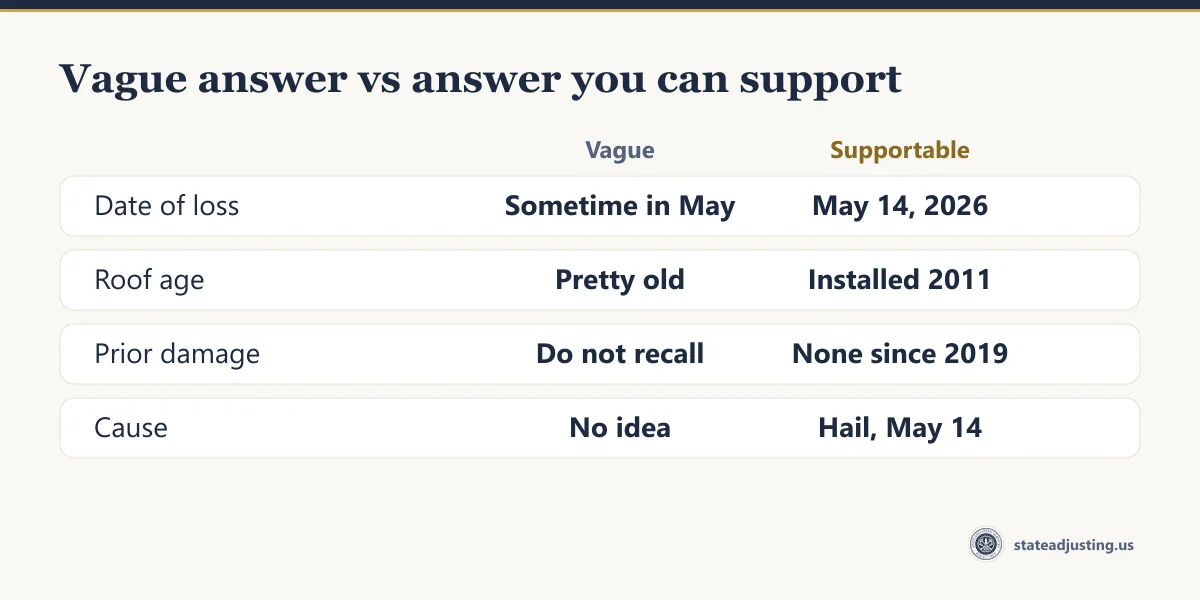
The table below is an illustrative example of the same four answers given two ways. The right-hand column is not a script to recite — it is what an answer looks like when you have checked it first.
| Question | Vague answer | Answer you can support |
|---|---|---|
| Date of loss | "Sometime in May" | "May 14, 2026" |
| Roof age | "Pretty old" | "Installed 2011" |
| Prior damage | "Do not recall" | "None since 2019" |
| Cause | "No idea" | "Hail, May 14" |
One caveat that matters more than the table itself: the right-hand column is only better if it is true. If you cannot support the date, the age or the cause from a document, a photograph or your own direct observation, then "I don't know" is the accurate answer and the correct one. A confident wrong answer is worse in a claim file than an honest blank, because the blank can be filled in later and the wrong answer has to be corrected.
How do you prepare for the call?
Spend thirty minutes with your own records before the call rather than thirty minutes recalling them during it. Everything the adjuster will ask about is written down somewhere: on the declarations page, in a weather report, on a roofing invoice, in the timestamps of the photographs on your phone.
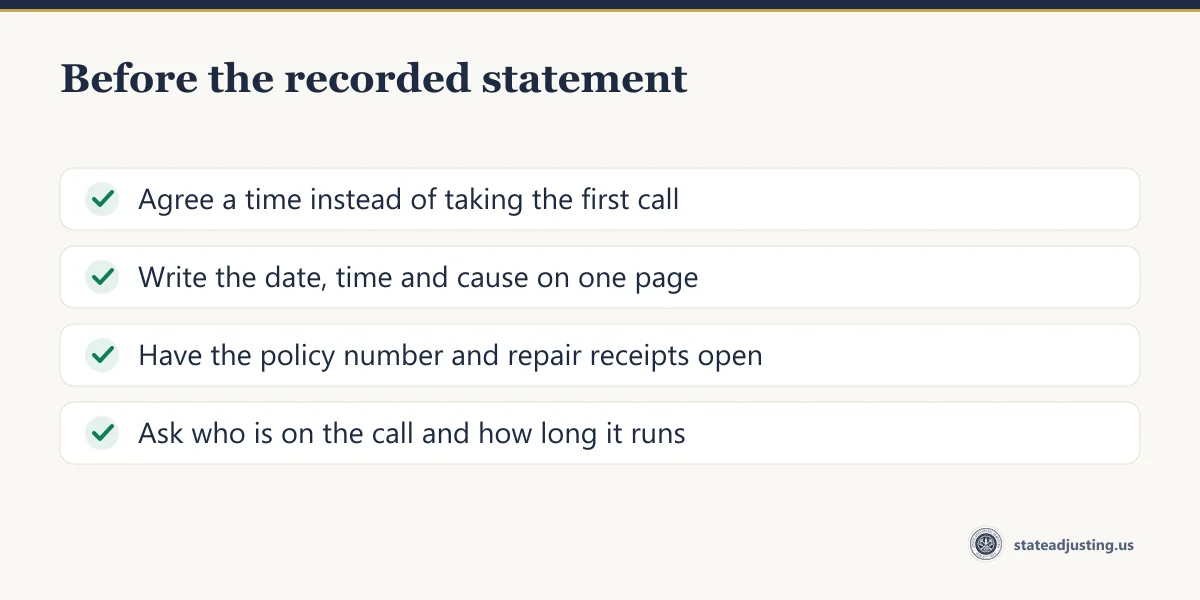
- Agree a time instead of taking the first call. A statement given in a driveway, between meetings, or the morning after a loss is the one most likely to contain a guess.
- Write the date, the time of day and what you observed on a single page. One page, in order, with nothing you cannot support on it.
- Have the policy number, the declarations page and any repair receipts open in front of you. Reading a number off a document beats remembering it.
- Check the roof, HVAC or water heater age against an invoice or the closing documents before you say a year out loud.
- Have your photographs sorted by date — the ones taken before anything was touched matter most.
- Ask who is on the call and how long it runs, so you are not answering an investigator's questions on the assumption you are talking to your adjuster.
What can you decline, defer or correct?
Cooperating with the investigation does not mean answering every question in the form it is asked. Three responses are always available and none of them is evasive: you can decline to guess, you can defer to a document, and you can correct the record afterwards in writing.
- Decline to guess. "I don't know" and "I'd be guessing" are legitimate answers. So is "I can check that and send it to you today."
- Defer to the document. Where an invoice, a receipt or a permit answers the question better than your memory, say so and send it.
- Stay inside what you saw. Describe the water on the floor and when you found it; leave the mechanism of failure to the plumber who opens the wall.
- Correct the record. If you realise afterwards that you gave a wrong year or a wrong date, email the correction to your adjuster promptly and keep a copy. A prompt written correction reads very differently from a discrepancy discovered months later.
- Ask for the transcript. Many carriers will provide a copy of the recording or transcript on request. It costs nothing to ask, and it tells you exactly what the file says.
If you have engaged a public adjuster, we normally take part in the statement and handle the claim correspondence around it. That is part of what representation is for — not to keep you from answering, but to make sure the questions and the answers stay on the same subject.
What happens after the recorded statement?
The recording is transcribed and stored in the claim file, where it becomes the baseline the rest of the claim is read against — the inspection report, the estimate, any engineer's report and, if the claim goes that way, the denial letter. It is not the final word on anything, but it is the first version of your account and it does not go away.
That is exactly why hidden damage found later is worth documenting carefully rather than arguing about verbally. New damage that appears once repairs open a wall or a roof is normally handled as a supplement to the existing claim, supported by photographs and a revised scope — not by revisiting what you said on a phone call in week one. And if the answers in the statement end up being used to narrow the claim in a way you do not recognise, ask for the carrier's position in writing, which is the same first step we describe in our guide to what to do in the first week after a denial.
What to do next
If a recorded statement has been scheduled and you are not sure what is in your own file, start with the documents: the declarations page, the dated photographs and any invoice showing the age of what was damaged. Our guide to what a public adjuster actually does explains where representation helps and where it genuinely is not worth it, and our water damage claims page covers the sudden-versus-gradual question that recorded statements on water losses tend to circle around. You can also see how we run a claim on our process page, and what past clients say on our reviews page.
If you would rather have someone read the policy and sit on the call with you, our free claim review does exactly that at no cost. When we are engaged, our fee is a percentage of what we recover, agreed in writing and regulated by Illinois law, with $0 owed upfront. We answer the phone Monday to Friday, 8:00 AM to 5:00 PM, at (630) 297-8136.
Questions we get about this
Do I have to give a recorded statement to my insurance company?
In practice, usually yes. Nearly every homeowners policy contains a duty-to-cooperate condition among your post-loss obligations, and carriers generally treat a recorded statement as part of that cooperation. Your own policy governs, so read its conditions section. What the condition does not require is that you take the call the moment it arrives, or answer questions about things you do not actually know.
Can I reschedule a recorded statement so I have time to prepare?
Asking for a time that works for you is normal and is not a refusal to cooperate. It is also reasonable to ask who will be on the call, what subjects it will cover, how long it should take, and whether you can receive a copy of the recording or transcript afterwards. A prepared statement is usually shorter and more accurate than one given on the spot.
What is the difference between a recorded statement and an examination under oath?
A recorded statement is an early fact-gathering interview recorded by the carrier and transcribed into the claim file. An examination under oath is a formal proceeding provided for in most policies: sworn testimony, usually taken by counsel for the insurer and usually requested when the carrier has more serious questions. If a claim moves from one to the other, many policyholders speak with an attorney at that point.
What if I gave a wrong date or a wrong answer in my recorded statement?
Send the correction to your adjuster in writing as soon as you notice it, and keep a copy. A prompt written correction with the supporting document attached reads very differently from a discrepancy found months later. Going forward, an honest "I don't know" is safer than a confident guess, because a blank can be filled in and a wrong answer has to be undone.