Sewer Backup vs Flood — Which One Your Policy Actually Covers
They are two different coverages, sold separately. Nearly every homeowners policy excludes flood — water that arrives over the ground — and also excludes water that backs up through a sewer, drain or sump unless you bought the endorsement. Which one applies depends on the path the water took into the house, not on how deep it got.
Sewer backup vs flood is the first question we ask on almost every Illinois basement loss, because the answer decides which policy pays and how much of the loss it reaches. Three inches of water on a basement floor looks the same whether it came up a floor drain, in through a window well, or out of a supply line that failed during the same storm. The insurance treatment is not the same at all: one is an endorsement on your homeowners policy with a fixed sublimit, one is a separate flood policy with federal caps, and one is ordinary water damage at your full dwelling limit. Policy wording varies between carriers and between years, so read your own alongside this.
What is the difference between sewer backup and flood?
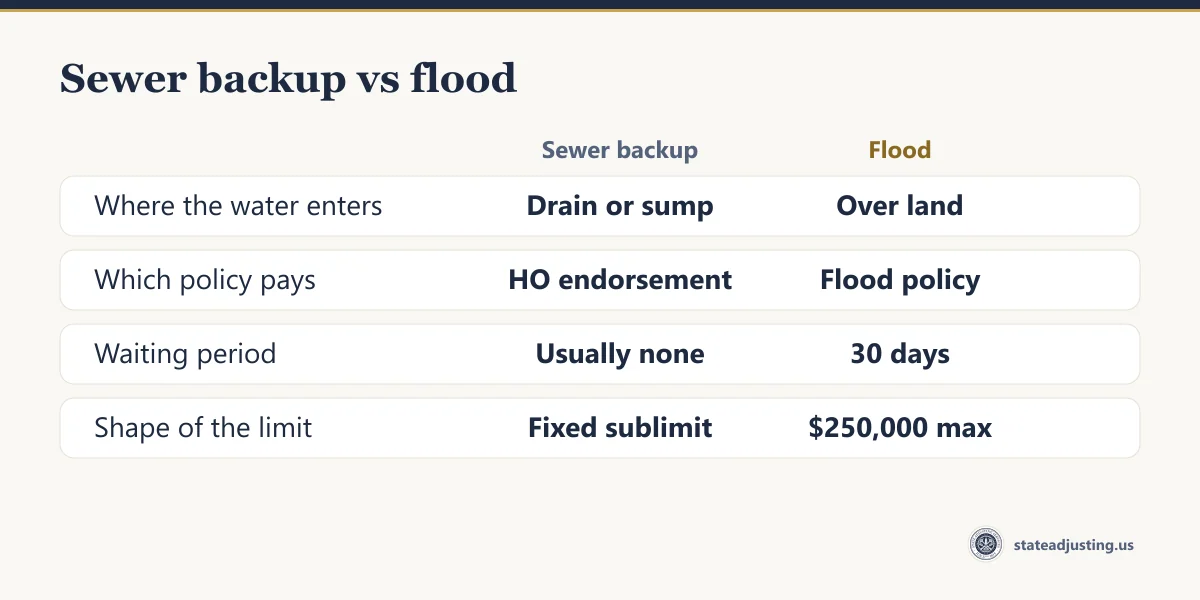
Flood is water that arrives over land — surface runoff, an overflowing creek, water at grade — and standard homeowners policies exclude it. Sewer backup is water that arrives from below, pushed up through a drain, toilet or sump pit. Backup is covered only by an optional endorsement on the homeowners policy, and never by a flood policy on its own.
The federal definition matters here, because it is the one a flood adjuster works from. Under the National Flood Insurance Program, a flood is a temporary inundation of normally dry land — from overflowing inland or tidal water, from unusual and rapid runoff or surface water, or from mudflow — affecting two or more acres, or two or more properties of which yours is one. Read that last part again. It takes more than your own basement. Water that filled one basement on one lot by coming up the drain is not a flood under that definition, no matter how much of it there is. FEMA publishes the definition and the full policy wording at FloodSmart.gov.
That is why "flood isn't covered" is the sentence that costs Illinois homeowners the most money. It is usually a true statement about flood, and beside the point, because the loss in front of them was not a flood. The four common paths look like this:
| What happened | Where the water came from | Coverage normally in play |
|---|---|---|
| Sewer or drain backup | Up through a floor drain, toilet or laundry standpipe | Water and sewer backup endorsement on the homeowners policy |
| Sump pump failed or lost power | Groundwater the pump should have moved out | Usually the same endorsement — some wordings name sump overflow separately |
| Water came in over the ground | Surface runoff at grade, window wells, an overtopped waterway | A separate flood policy — NFIP or private |
| A pipe, hose or appliance failed | A supply line inside the house | Ordinary water damage under your dwelling and contents limits |
The fourth row is the one people forget during a storm. A washing machine hose that lets go at 9pm during a heavy rain is not a weather loss at all — it is a sudden discharge from a plumbing system, which is the core of what a homeowners policy covers. The storm outside is a coincidence, and it is a coincidence that gets claims wrongly filed, and wrongly declined, every season.
Which policy actually pays, and how much?
Three different products, three different limits. The backup endorsement pays up to a fixed sublimit that is usually a small fraction of your dwelling limit. A flood policy pays up to federal caps and has its own deductibles. Ordinary water damage pays at your full policy limits. Same water, three very different ceilings.
| Water backup endorsement | Flood policy (NFIP) | Homeowners water damage | |
|---|---|---|---|
| How you get it | Added to your homeowners policy | A separate policy, through an agent or a private flood carrier | Already part of the policy |
| Limit | A fixed sublimit, often far below your dwelling limit | Statutory caps — $250,000 on the building and $100,000 on contents for a single-family home | Your full dwelling and contents limits |
| When it takes effect | When the endorsement is added | Generally 30 days after purchase, with limited exceptions | Immediately, as part of the policy |
| Contents in a basement | Normally included, up to the sublimit | Heavily restricted — see the next section | Included, subject to your limits |
| Deductible | Sometimes its own, separate from the policy deductible | Separate building and contents deductibles | Your standard policy deductible |
Two practical consequences follow from that table. The first is that a backup sublimit is a number you should know before you need it, not after — it is printed on your declarations page, and it is the single most common reason a covered backup claim still leaves the homeowner short. The second is that the 30-day NFIP waiting period means flood coverage cannot be bought once the forecast turns. Buying it in March is a decision; buying it in June is usually too late for June.
Why does a basement change flood coverage so much?
Because the NFIP's Standard Flood Insurance Policy treats a basement as a partly excluded space. It pays for the structural shell and the mechanical equipment down there, and for cleanup — but it does not pay for finished walls, floor coverings or the belongings most people store below grade. In Illinois, where the basement is where the loss usually happens, that gap is enormous.
Generally paid for in a basement under NFIP building coverage:
- Foundation walls, stairways and the unfinished floor
- Furnace, water heater, heat pump and central air conditioning equipment
- Sump pumps, well water tanks, electrical panels and junction boxes
- Cleanup and debris removal after the water goes down
Generally not paid for in a basement:
- Finished drywall, ceilings, carpet and other floor coverings
- Furniture, electronics, tools, documents and stored belongings
- Improvements you made to a finished basement
The contents side has a short list of exceptions — items such as washers and dryers, food freezers and the food in them, and portable air conditioners. Everything else stored down there is normally outside the policy. This is also why a homeowner who carries only a flood policy, and no backup endorsement, can be badly exposed on exactly the loss that is most likely to happen to them.
One nuance is worth knowing, because it decides which claim to open. A flood policy can respond to sewer backup when a general condition of flooding in the area is what forced the sewer to surcharge. If the sewer backed up on its own — a blockage, a pump station failure, a storm that overwhelmed the pipe without flooding the neighbourhood — that is a homeowners endorsement question, not a flood question. Establishing which of those happened is real investigative work, and it is where our flood and sewer backup claims practice spends most of its time.
How do you prove which one it was?
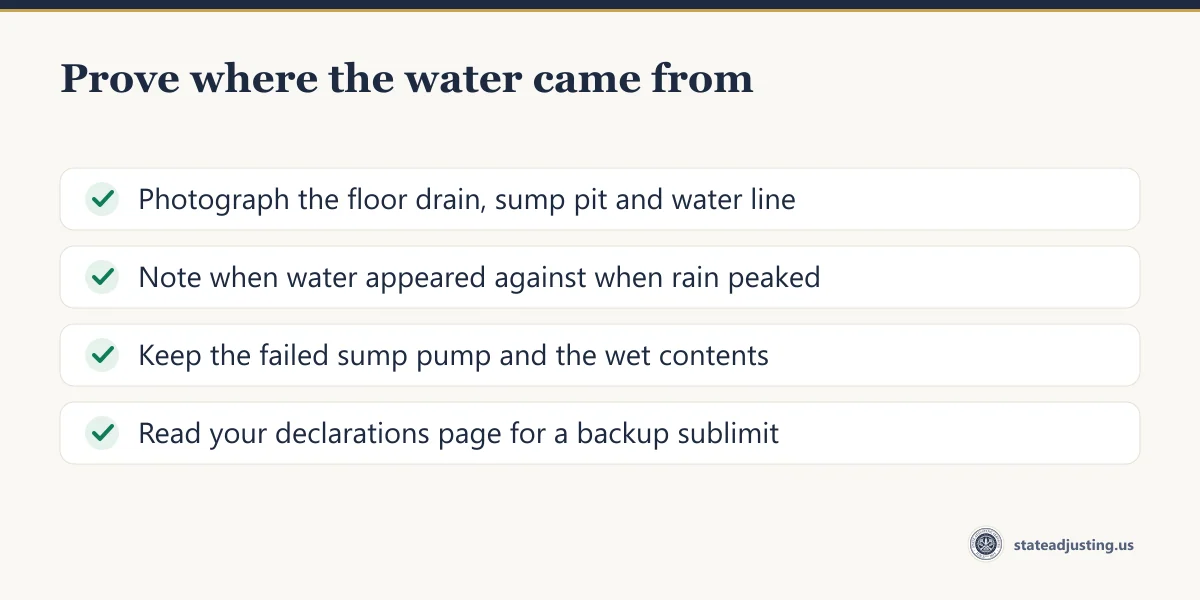
With evidence collected before the basement is pumped and cleared, because the proof disappears within hours. The water line on the wall, the state of the floor drain, the sump pit, the exterior grade and the timing against the rainfall record together tell the adjuster where the water came from. Memory alone does not.
- Photograph before you pump. The floor drain, the open sump pit, the water line on the foundation wall, the window wells and the grade outside them. Wide shots first, then close-ups, then a slow video walkthrough.
- Write down when the water appeared and compare it against when the rain peaked. National Weather Service records for your date of loss are public and free, and a timeline that matches the storm is very different evidence from one that does not.
- Keep the hardware. The failed sump pump, the float switch, the check valve, the cracked fitting. The part is the evidence, and it is the first thing thrown in a skip.
- Ask the municipality whether the main surcharged. Older Illinois systems — Chicago's among them — are combined sewers that carry storm water and sewage in the same pipe, which is exactly why heavy rain and basement backups arrive together.
- Inventory the contents before they leave the house. Basements hold what nobody itemises: tools, seasonal storage, furniture, paperwork. Photograph it wet, list it, then dispose of it.
- Read the declarations page and the endorsement schedule before you discuss limits with anyone. Our guide to the six lines that decide your claim shows which lines to look at first.
What gets left out of a sewer backup settlement?
Backup claims are settled small more often than they are denied. The endorsement applies, a figure is issued, and it covers drying and paint while the parts of the loss that actually cost money — contamination protocol, contents, code-required upgrades — are never scoped. These are the items we look for first.
- Category 3 remediation, not drying. The industry standard used by remediation contractors (IICRC S500) classifies water that contains sewage as grossly contaminated. Porous materials in its path — carpet, pad, drywall, insulation — are normally removed rather than dried. An estimate that only pays to dry a sewage loss is scoped as the wrong category of water.
- Contents, itemised. Contents are usually the largest under-claimed part of a basement loss, and the hardest to reconstruct once the skip has gone.
- Code-required upgrades on the rebuild. Where a local code requires a backwater valve or an overhead sewer when the basement is put back, ordinance-or-law coverage — if you carry it — is the line that pays for the upgrade. It is a separate coverage with its own limit, not part of the repair estimate.
- Mechanical equipment. Furnace, water heater, laundry, electrical panel and any low-mounted ductwork that sat in contaminated water.
- Additional living expense. If a covered loss takes out the heat or the hot water and the house is not liveable, additional living expense may apply. It depends on the policy and on the loss being covered in the first place.
- Depreciation held back. As with any replacement-cost claim, part of the first payment is withheld and released when the work is done. Our guide to recoverable depreciation covers how to actually collect it.
What to do next
Start with two documents and one photograph set. Pull the declarations page and find whether you carry a water and sewer backup endorsement and what its sublimit is; pull the endorsement itself and read what it names, since some wordings cover sewer backup but treat sump overflow separately. Then photograph everything before the basement is cleared. If you have already been told "flood isn't covered", that sentence on its own is not a claim decision — ask the carrier in writing which exclusion is being applied and to what part of the loss.
We handle these claims across Illinois, residential and commercial. Our water damage claims page covers the sudden-versus-gradual side of the same problem, the process page sets out how a claim runs with us in it, and the reviews page is where past clients describe how it went. If the water is still down there and you want somebody to read the policy before you talk to the adjuster, our free claim review costs nothing. When we are engaged, our fee is a percentage of what we recover, agreed in writing and regulated by Illinois law, with $0 owed upfront. We answer the phone Monday to Friday, 8:00 AM to 5:00 PM, at (630) 297-8136.
Questions we get about this
Is sewer backup covered by homeowners insurance?
Not by the base policy. Standard homeowners forms exclude water that backs up through sewers or drains or overflows from a sump. Coverage comes from an optional water and sewer backup endorsement, which is usually written as a fixed sublimit well below your dwelling limit rather than at full limits. Check your declarations page for the endorsement and the sublimit; your own policy governs.
Does flood insurance cover a sewer backup?
Only when a general condition of flooding in the area is what caused the sewer to back up. A backup that happens on its own — a blockage, a pump station failure, a storm that overwhelms the pipe without flooding the neighbourhood — is a homeowners endorsement matter, not a flood policy matter. Establishing which of the two occurred is the first real task in the claim.
Do I need flood insurance in Illinois if I am not in a flood zone?
That is your decision, and it depends on your property. Worth knowing before you make it: NFIP policies generally take effect 30 days after purchase, so the coverage cannot be added once a storm is forecast, and a flood policy sharply limits what it pays for in a basement. For most Illinois basements the more likely loss is backup or sump failure, which flood insurance does not cover at all.
My basement flooded and the insurer called it flood and denied it. What now?
Ask in writing which policy exclusion is being applied and to which part of the loss, and request the inspection report. Then establish the water's path with evidence: photographs of the floor drain and sump pit, the water line, the exterior grade, and the timing against rainfall records. If the water came up from below rather than over the ground, the exclusion being cited may not fit the facts.