Do you have to use the insurance company's contractor in Illinois?

No. When the adjuster hands you the name of the insurance company's preferred contractor, that is almost always a suggestion, and you can hire any licensed contractor you trust to repair your house. There is one exception to know about: most homeowners policies let the insurer choose to repair the damage itself, but only by sending you a written notice within a set time after your sworn proof of loss. A phone call or a list of names is not that notice. And in Illinois, if your own contractor's price comes in above the insurer's estimate, a state rule tells the company what it has to do next.
We are licensed Illinois public adjusters, not attorneys, so what follows explains how the standard policy and the state rule read, not legal advice. Your own policy governs your claim, and some companies word these conditions differently from the standard form quoted below.
The words the adjuster may use, in plain English
Much of the confusion starts with vocabulary. Four phrases come up on the first call, and they do not mean the same thing.
- Preferred vendor or preferred contractor
- A firm the insurer has an arrangement with. The terms of that arrangement are between the firm and the insurer, and none of them is written into your policy. It is a referral. Nothing in a referral obliges you to call that number.
- Managed repair or direct repair program
- The insurer's name for its referral network when it also coordinates the job: it books the firm, receives its estimate and may pay it directly. You still sign a contract with the firm, so read that contract the way you would read any other.
- Direct pay
- Payment that goes from the insurer to the contractor rather than to you. It can happen with any contractor if you sign a direction to pay, and it does not change who you are allowed to hire.
- Option to repair, or "Our Option"
- A condition in the policy that lets the insurer decide to repair or replace the damaged property instead of paying you money. This is the only one of the four that can take the choice of repairer away from you, and it has rules of its own, covered below.
Two routes through the same claim
The claim itself is the same on either route: the same policy, the same deductible, the same coverage decision. What changes is who writes the repair scope, whose price sets the number and who you go back to if the work is poor.
You accept the insurer's referral
- The insurer books the firm, often within a day or two.
- The firm writes its scope, and the insurer reviews it against its own estimate.
- The insurer approves that scope, and payment may go straight to the firm.
- You sign the firm's work agreement before work starts.
- Questions about missed damage go to the firm and the insurer together.
You hire your own contractor
- You pick a licensed firm and let it inspect alongside, or after, the adjuster.
- Your contractor writes its own scope and price.
- The insurer's estimate and your contractor's bid are compared line by line.
- Any difference is answered in writing, under the Illinois rule below.
- Payment follows the policy, with the mortgage company on the check if you have one.
Neither column is automatically cheaper or better for you. The referral route is often faster to start. Your own contractor answers only to you, and the scope it writes is not shaped by an agreement with the company paying the bill. If the two documents disagree, the gap is usually about scope and quantity rather than price, which we take apart in why your contractor's estimate is higher than the carrier's.
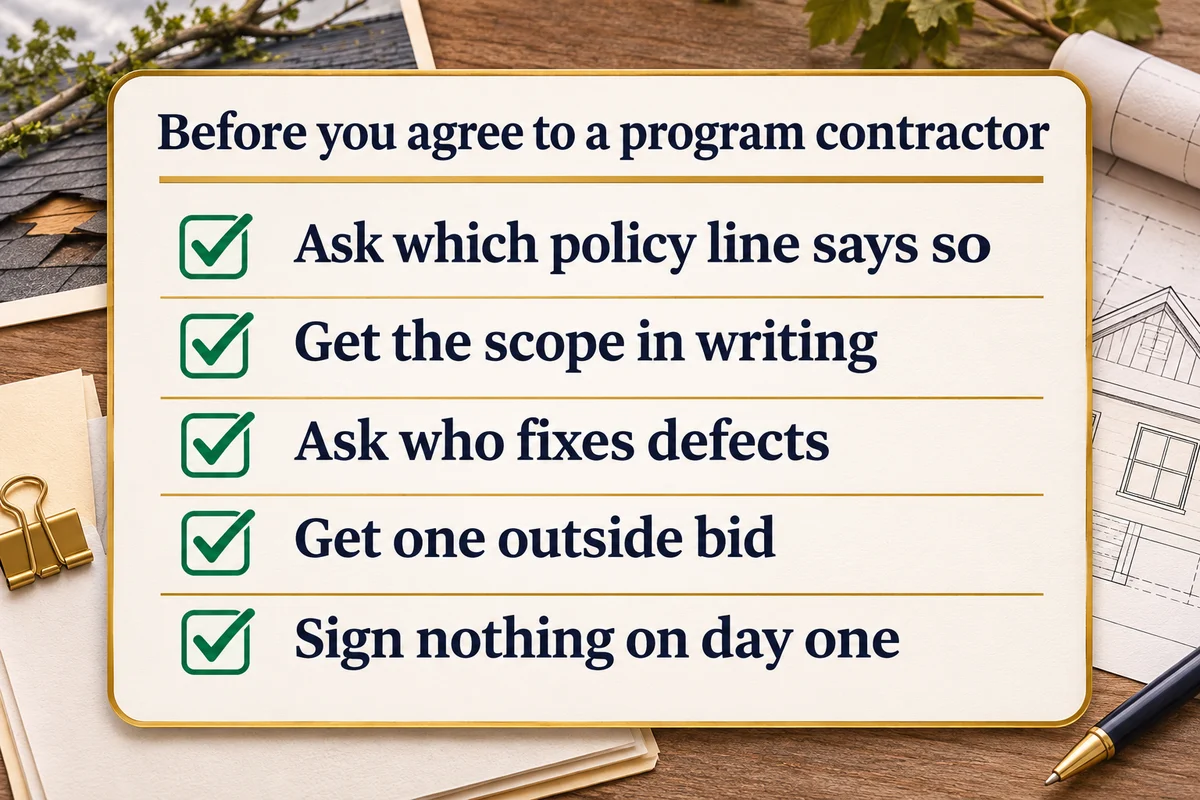
When the insurer really can choose the repairer
Only through the repair option in your policy, used the way the policy says. In the standard Homeowners 3 form, the insurer has to give you written notice, and it has to do so within 30 days after it receives your signed, sworn proof of loss. Here is that condition as printed in edition HO 00 03 04 91, in the copy published by the Nevada Division of Insurance:
The insurer "may repair or replace any part of the damaged property", but only "If we give you written notice within 30 days" of receiving your signed, sworn proof of loss.
Quoted in part from the Homeowners 3 Special Form HO 00 03 04 91, Section I Conditions, item 9, Our Option
Read it slowly and three requirements appear. The notice is written. It comes after a sworn proof of loss, which on many claims is never requested at all. And it has a clock. An adjuster saying on the phone that "we use our contractor for these" has met none of the three.
If you do receive a letter that says the company is electing to repair, keep it, note the date it arrived, and ask in writing who answers for the quality of that work and how long any workmanship warranty runs. A letter like that is also a sensible point to get advice from an attorney, because the election changes what the insurer owes you.
Later editions and company-written forms may word the notice or the time limit differently, so check yours. If someone tells you that you must use a named firm, ask which sentence of your policy says so. A real requirement can be pointed to.
What Illinois requires when your contractor's price is higher
Illinois has a rule for exactly this moment. In the part of the state's claim rules that covers fire and extended coverage claims, 50 Ill. Adm. Code 919.80(d)(7)(C) says the insurer's own estimate must be reasonable and enough to allow repairs in a workmanlike manner. If you then give the company a written estimate showing the necessary repairs cost more, it has to review it and respond promptly in writing.
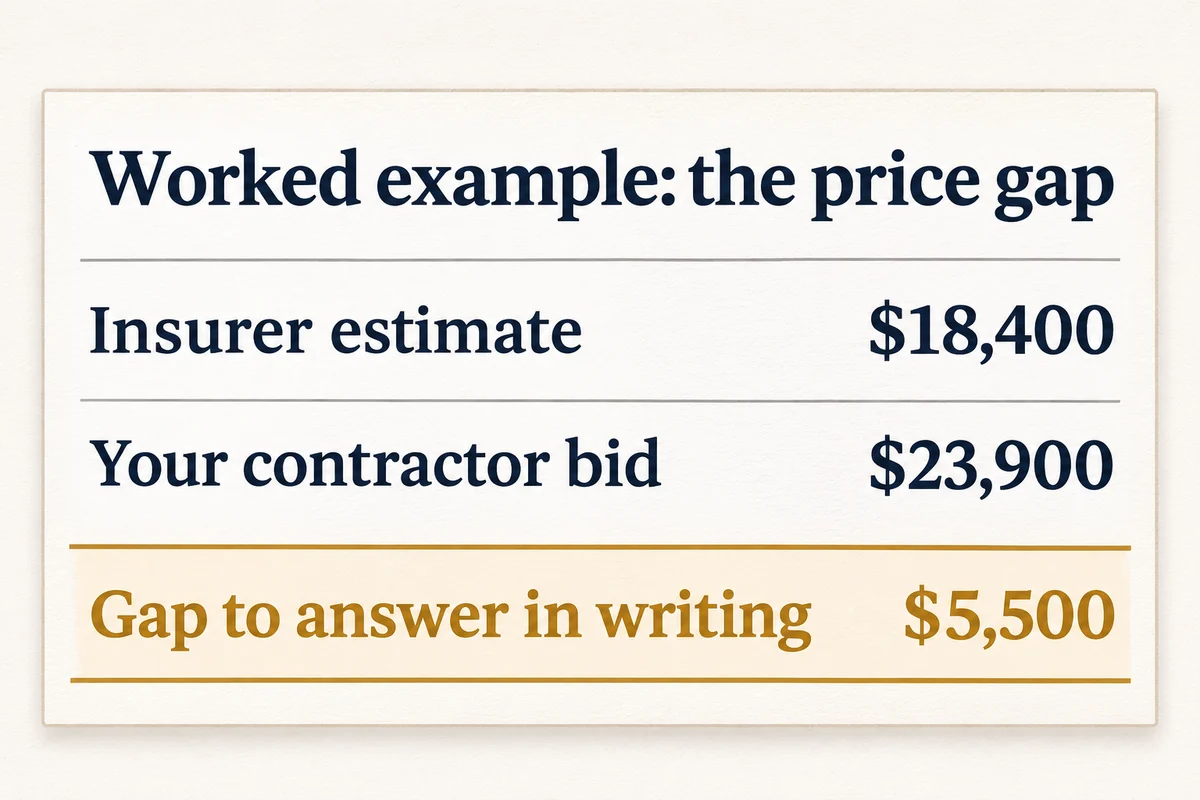
That written response has two possible shapes. The company can give you the name of a repair shop or contractor that will make the repairs in a workmanlike manner. If it does not name one, it has to tell you in writing that reasonable costs of repair above its estimate will be reimbursed. A worked example shows what that means for an ordinary roof and gutter job. The numbers are illustrative, not from any client file.
| Line | What it is | Amount |
|---|---|---|
| Insurer's estimate | Replacement cost of the scope the adjuster wrote | $18,400 |
| Your contractor's bid | The written estimate you send back, same house, same damage | $23,900 |
| Difference | What the written response has to deal with | $5,500 |
The insurer names a contractor
It points to a firm that will do the work for $18,400. You can hire that firm, or keep yours and keep pressing the $5,500 with line-by-line evidence, a supplement request or the appraisal clause.
The insurer names nobody
It has to tell you in writing that reasonable costs above $18,400 will be reimbursed. You keep your contractor, keep every invoice, and the argument narrows to which costs were reasonable.
Your deductible still comes off either way, and if the policy pays replacement cost, the first check is usually the actual cash value until the work is done. The rule does not decide that a higher bid is right. It stops the conversation ending at the insurer's number with no answer to yours.
Questions to put to the adjuster before you agree to anything
Ask by email, so the answers sit in your claim file with a date on them.
- Is using this firm a requirement, and if so, which sentence of my policy says so?A referral cannot be pointed to in the policy. An election under the repair option can, and it comes in a letter.
- If I use my own licensed contractor, will the amount you pay for the covered damage change?Ask for the answer in writing. It makes any later reduction easy to spot.
- Can I have a copy of your estimate, with every line item?The same Illinois rule gives you the right to a copy of the estimate a partial settlement is based on.
- If your firm misses damage or the work fails, who do I call, and who pays to put it right?Know where a complaint goes before the roof is on, not after.
- Will payment go to the contractor, to me, or to me and my mortgage company?The answer decides who has to endorse the check and when the contractor gets paid.
- What is the deadline for any supplement if hidden damage turns up during the work?Tear-off and demolition often find more. Knowing the window now saves a dispute later.
When the referral can be the simpler road
Choosing the insurer's firm is not a mistake in itself. It can suit some losses well, as long as you go in with the questions above answered.
| Your situation | What to weigh |
|---|---|
| Small, clear loss, such as one room of drywall after a leak | A quick start may matter more than a second bid. Still read the scope before work begins. |
| Roof, siding or anything that has to match existing materials | Matching and code items are where scopes differ most. One outside inspection costs little and shows what was left out. |
| Fire, smoke or a loss that empties the house | Large scopes have the most line items to miss, and the contents claim runs alongside. An independent scope is worth having. |
| A contractor you already know and trust | Use them. The policy does not ask you to give that up, and the Illinois rule covers a higher bid. |
What you should not do is let anyone, from the insurer's side or a stranger at the door, hurry you into signing on the first visit. Our guide to telling a contractor from a claim scheme after a storm covers the door-knocking side of the same problem.
The water crew that arrives on the first night
This is where the referral question usually comes up first, especially as the weather turns and pipes start to freeze. A pipe bursts, you call the claim line, and a water mitigation company is offered within the hour. Your policy requires you to protect the property from further damage, and accepting that crew is a reasonable way to do it. Calling a mitigation company you choose yourself is just as reasonable.
Either way, ask for the drying logs, the moisture readings and photos before anything is torn out, because those records later decide how much of the floor, wall and cabinets the water damage claim pays for. What insurers pay toward that first-night work, and what they argue about, is set out in our post on emergency mitigation and board-up bills.
Where a public adjuster fits in the contractor question
In Illinois, negotiating the claim and building the repair are separate jobs. A licensed public adjuster works the claim for you: the scope, the documentation and the written exchanges with the insurer. A licensed contractor does the building. You may use any licensed contractor you choose, and our construction partner page explains how that separation works on our files, with no tie-in. If the insurer's estimate and your contractor's bid are already far apart, our claim process starts with a free review of both documents. You can reach us seven days a week: Monday through Friday 7:00 AM to 7:00 PM, and Saturday and Sunday 9:00 AM to 5:00 PM, at (630) 297-8136.
Questions we get about this
Do I have to use my insurance company's preferred contractor?
Usually not. A preferred contractor is a referral, and you can hire any licensed contractor you choose. The exception is the repair option in many policies, which lets the insurer elect to repair the property itself, but only by written notice within the time the policy sets after your sworn proof of loss. Your own policy governs.
What if my contractor's estimate is higher than the insurance company's?
Send the insurer your contractor's written estimate. Under Illinois rule 50 Ill. Adm. Code 919.80(d)(7)(C), the company must review it and respond promptly in writing, either naming a repair shop or contractor that will do the work in a workmanlike manner for its estimate, or giving written notice that reasonable costs above its estimate will be reimbursed.
Will the insurance company pay less if I use my own contractor?
The covered damage is the same whichever firm does the repair, and the deductible applies either way. Ask the adjuster in writing whether the amount changes if you use your own licensed contractor, so the answer is in your claim file.
Can the water mitigation company the insurer sends be replaced?
Yes. Your policy asks you to protect the property from further damage, and you can do that with the crew the insurer offers or with a mitigation company you choose. Whichever you use, ask for moisture readings, drying logs and photos before materials are removed.