Stolen from your car or storage unit: what home insurance pays
Belongings stolen from your car or from a storage unit are claimed on your homeowners policy, not your auto policy, because the personal property part of a homeowners policy covers what you own while it is anywhere in the world. What that claim pays depends on three things the policy decides: whether the place counts as another residence, which special dollar limits apply to the items taken, and whether the cause is one of the perils the policy names for personal property. The smashed window or forced lock on the car belongs to the car's own policy.
Your own policy governs your claim, and the wording differs between companies and between editions of the same form. We are licensed Illinois public adjusters, not attorneys, so this explains how the standard homeowners form reads, not legal advice. The policy sentences quoted below come from the Homeowners 3 Special Form, edition HO 00 03 04 91, in the copy published by the Nevada Division of Insurance. Many insurers start from this form; yours may use a later edition or its own words.
Where it was taken decides which rule applies
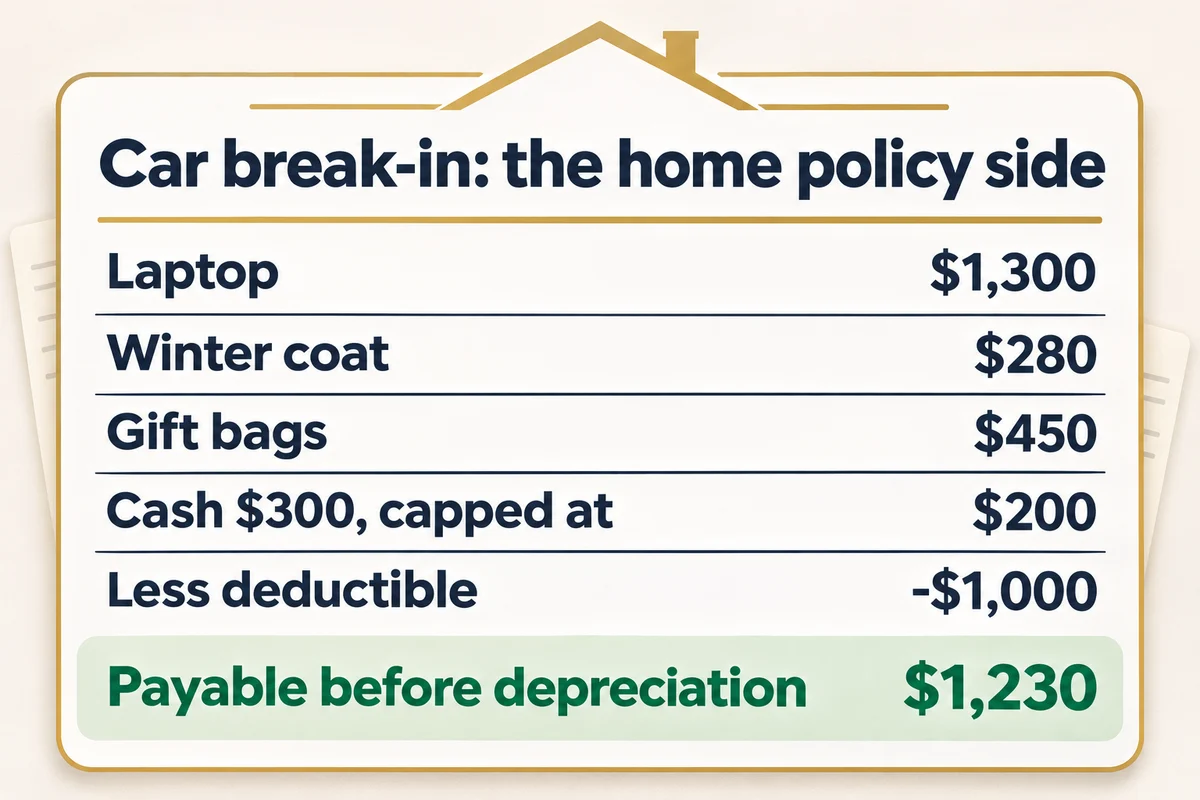
Start with the place, because the place picks the limit. Six places cover most of the calls people make about theft away from home.
Your car
Full contents limit, special limits applyThe bags, laptop, coat and gifts go on the home policy. The window, lock and anything built into the car go on the car policy, usually under its comprehensive coverage if you carry it.
A storage unit
Full contents limit on the standard wordingA rented unit is not a residence, so the 10% sentence does not reach it. The catch is the cause: contents are covered only for the named perils, and a slow roof leak in the facility is not one of them.
A hotel room or your luggage
Full contents limit, special limits applyProperty you carry on a trip stays covered, and the theft peril keeps working while you are temporarily living away from home.
A college dorm
10% of contents or $1,000A dorm is another residence, so the 10% limit applies to what the student keeps there. Theft counts if the student had been there at some point in the 45 days before the loss, in this edition.
A second home or cabin
10% of contents or $1,000Property usually kept there is capped at 10%, and theft there is not covered unless someone insured was temporarily living there. A policy written on that home usually carries its own contents limit.
Your office or a job site
$250 for business propertyAnything used for business, kept away from home, is held to $250 in this edition, with separate limits for certain electronics. A business policy is where that property belongs.
The 10% sentence, read word for word
The 10% limit is narrower than most articles say. In the standard form it caps property that usually lives at another residence of yours, not everything that happens to be away from the house when it is stolen.
Our limit of liability for personal property usually located at an "insured's" residence, other than the "residence premises," is 10% of the limit of liability for Coverage C, or $1000, whichever is greater.
Homeowners 3 Special Form HO 00 03 04 91, Section I, Coverage C
Two phrases do the work. "Usually located" is about where the item normally lives, not where it was at the moment of the theft. A laptop that lives in your kitchen and spent one afternoon in the trunk is not property usually located somewhere else. "Residence" means a place someone lives. A dorm room, a lake cabin or a condo you own in another city fits that word; a car and a rented storage unit do not.
The difference is real money. Take a contents limit of $150,000 and a storage unit holding $40,000 of furniture. If the 10% rule reached the unit, the cap would be $15,000 before the deductible. Under the sentence above, the measure is the contents limit itself, less the deductible and subject to the special limits.
Some companies write their own forms with a wider cap, aimed at property "away from the residence premises" or at self-storage by name. The declarations page will not tell you which kind you have. Open the policy itself, find the Coverage C section, and read the sentence that follows the words about property at other locations. If your wording matches the one quoted here and the adjuster applies 10% to a car or a storage unit, ask in writing which sentence of your policy that limit comes from.
A car break-in is two claims on two policies
One broken window usually means two separate claims, each with its own deductible. The homeowners policy pays for what you owned inside the car. The car's policy pays for the car, and the homeowners form says so directly: it does not cover motor vehicles, their equipment, or electronics designed to run only on the car's power while that equipment is in the vehicle.
Homeowners policy, personal property
- Bags, clothes, a laptop or tablet, a phone, sunglasses
- Gifts you bought for other people, since you own them until you hand them over
- Cash, but only up to $200 in this edition
- Jewelry and watches, up to $1,000 for theft in this edition
- Portable electronics that can run on the car or on their own battery, up to $1,000 while in a vehicle
The car's own policy
- The broken window, the forced door lock, a damaged ignition or dashboard
- A stereo, screen or dash camera wired to run only on the car's power
- The car itself, if it is stolen
- Normally under comprehensive coverage; a policy with liability only pays none of this
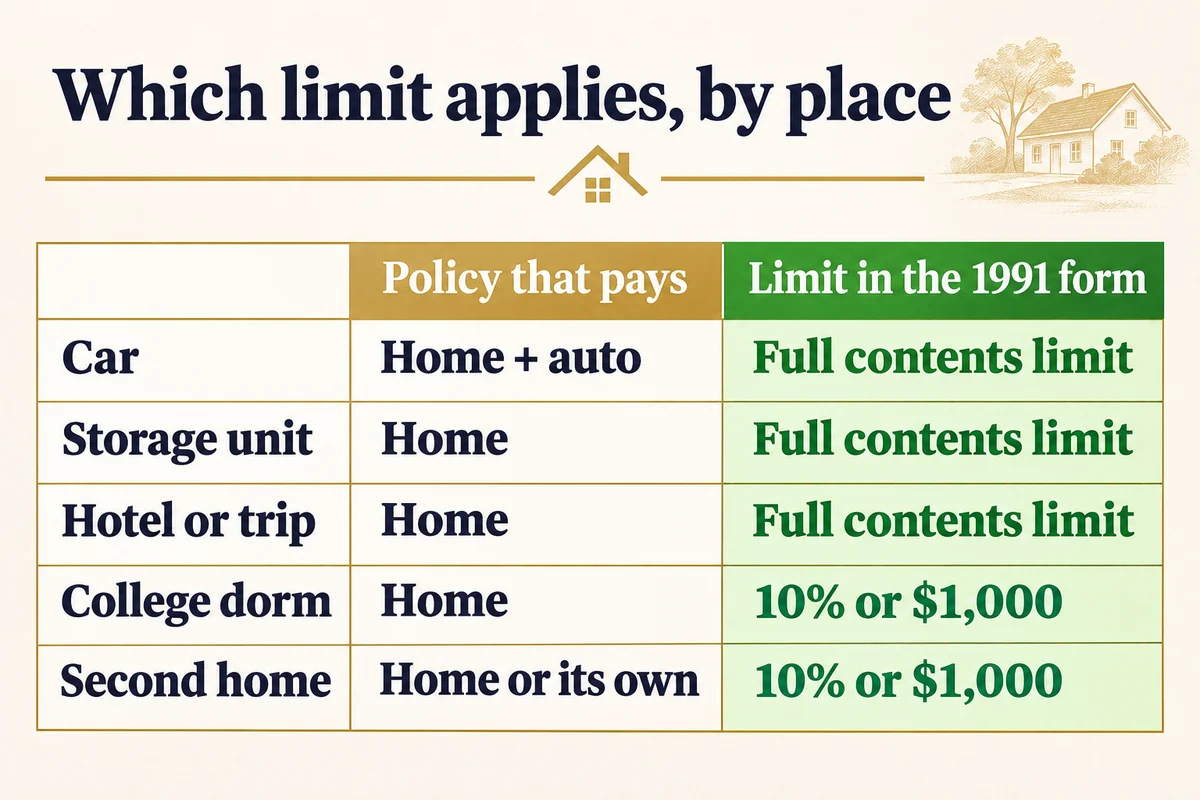
Take an example, not a real claim. A car parked at a shopping centre in December has its rear window broken. Taken: a laptop that costs $1,300 to replace, a winter coat at $280, gift bags worth $450 and a wallet holding $300 in cash. The window costs $380 to replace. The homeowners deductible is $1,000 and the comprehensive deductible on the car is $500.
| Laptop | $1,300 |
| Winter coat | $280 |
| Gift bags | $450 |
| Cash, $300 taken, special limit $200 | $200 |
| Counted on the homeowners claim | $2,230 |
| Homeowners deductible | minus $1,000 |
| Homeowners policy, payable before any depreciation | $1,230 |
| Window, $380, against a $500 car deductible | $0 |
If your contents are paid at actual cash value first, the first check will be lower than $1,230, because the laptop and the coat are depreciated for age; our guide to how used household goods are depreciated shows how that number is reached and what moves it. When the total sits only a few hundred dollars above the deductible, it is worth weighing the claim against its effect on your premium before you file, which we work through in file a claim or pay out of pocket.
Special limits cap the bag before the 10% rule ever matters
For most car and luggage thefts, the special limits decide the payment, not the 10% sentence. Each one is a ceiling for the whole category in one loss, and several apply only when the cause is theft.
| Category | Limit in HO 00 03 04 91 | When it applies |
|---|---|---|
| Money, bank notes, coins, gold and silver other than goldware and silverware | $200 | Any covered loss |
| Securities, passports, tickets, stamps, personal records | $1,000 | Any covered loss |
| Jewelry, watches, furs, precious and semi-precious stones | $1,000 | Theft only |
| Firearms | $2,000 | Theft only |
| Silverware, goldware, pewterware | $2,500 | Theft only |
| Business property away from the home | $250 | Any covered loss |
| Electronics that run on the car's power or their own, while in a vehicle | $1,000 | Any covered loss |
The "theft only" column changes outcomes. A watch stolen from a glovebox is held to the $1,000 theft limit. The same watch destroyed in a fire at a storage facility is not, because fire is not theft. Later editions and many company forms raise or rename some of these amounts, so read your own list. Items you have scheduled separately, such as an appraised ring, are paid under that schedule and sit outside this table.
What a storage unit is covered for, and where the gap is
A storage unit is usually covered for the same named perils as the furniture in your living room, and only for those. On a Homeowners 3 policy the house is insured against any cause not excluded, but personal property is insured only for a list of sixteen perils. That list, not a percentage, is where most storage claims succeed or fail.
Named perils that commonly reach a unit
- Fire or lightning
- Windstorm or hail; rain inside only through an opening the wind or hail made
- Smoke, sudden and accidental
- Vandalism or malicious mischief
- Theft, including property missing from a known place when it is likely it was stolen
- Weight of ice, snow or sleet
- Sudden discharge of water from a plumbing or heating system or a sprinkler in the building
Common storage damage outside that list
- Rain through a worn roof or a failed door seal with no storm opening
- Damp air, condensation and mildew over a season
- Mice, insects and other pests
- Surface water and flood, which are excluded
One phrase in the theft peril helps storage claims in particular: it covers "loss of property from a known place when it is likely that the property has been stolen." Nobody has to see the theft. A unit you locked in August and found half empty in November, with a cut lock, fits those words. Read your rental agreement as well, since it sets out what the facility is and is not responsible for and whether it sells its own protection plan, which is separate from your homeowners claim.
The proof to gather this week
The standard form makes reporting a theft to the police one of your duties after a loss, so that comes first. The rest is about showing what you owned and what it cost, since there is no burned item to photograph.
- On the first day, report the theft to the police and write down the report number. Photograph the broken glass, the forced lock or the cut padlock before anything is cleaned up, and keep the lock itself.
- The same day, for a storage unit, report it in writing to the facility office and ask it to keep its gate entry records and camera footage for your dates.
- By the second day, give notice to your homeowners insurer, and separately to your car insurer for the glass. Cancel stolen cards and report a stolen phone to your carrier.
- Over the rest of the week, list every item with brand, model, size or colour, where and when it was bought, and the price. Pull receipts, card and bank statements, online order history, warranty registrations, and any photo in which the item appears; serial numbers often sit on old boxes.
- Before the adjuster calls, check the list against the special limits table, so you know which lines will be capped and which the full contents limit covers.
For a whole storage unit, the list is the claim. Our guide to building a contents inventory was written for fire losses, and the same method rebuilds a list for a unit you can no longer open.
When a claim like this is worth calling us about
A single bag taken from a car is usually a short claim you can handle yourself with the steps above. It changes when the numbers grow: a storage unit full of household goods that was emptied or burned, furniture stored after a fire or a water loss at your home, an adjuster applying a 10% cap to a car or a storage unit when your form's sentence covers another residence only, or an argument over whether water in a unit came through a storm opening. Our page on vandalism and theft claims covers how we handle those for Illinois homeowners, and the guide to theft and vandalism at the house covers break-ins at home.
We work for a percentage of what is recovered, set out in a written contract and regulated by Illinois law, with nothing paid up front and no fee if there is no recovery. If your own claim has stalled on one of these points, send us the policy and the adjuster's letter and we will tell you whether it is one we can help with.
Questions we get about this
Does my car insurance cover things stolen from my car?
Usually not. Comprehensive coverage on a car policy pays for the car, its broken window or lock, and equipment built into the car. Your own belongings inside the car, such as bags, a laptop or gifts, are normally claimed on your homeowners or renters policy, under its personal property coverage and its own deductible. Your policies govern the details.
Does the 10% off-premises limit apply to a storage unit?
In the standard Homeowners 3 form (HO 00 03 04 91), the 10% or $1,000 limit applies to personal property usually located at another residence of an insured, such as a second home or a dorm. A rented storage unit is not a residence, so on that wording the unit is measured against the full contents limit. Some insurers write their own forms with a wider cap, so read the Coverage C section of your own policy.
Do I need a police report for a theft claim away from home?
Yes. The standard homeowners form lists notifying the police in case of loss by theft as one of your duties after a loss. Report it promptly, keep the report number, and give it to your insurer with your list of items and proof of what they cost.
Are my child's belongings covered in a college dorm?
If the student is an insured under your policy, the standard form covers their property at the dorm up to 10% of your contents limit or $1,000, whichever is greater. In the 1991 edition, theft there is covered if the student had been at that residence at some point in the 45 days before the loss. Later editions and company forms may use different wording.