Storm Chasers at the Door: Contractor or Claim Scheme?

A storm chaser is a sales operation that follows hail into a state, signs as many roofs as it can and leaves before a workmanship warranty means anything. Knocking is not illegal, and travelling crews are not automatically dishonest. What separates a contractor from a scheme is checkable in ten minutes: an Illinois license number, a written contract with a price, real insurance, and whose name is on the paperwork.
Storm chaser contractors are on Illinois streets within days of a serious hail or wind event, sometimes within hours of the sirens. Some are competent crews brought in because every local roofer is booked eight weeks out. Some are selling a signature rather than a roof. The homeowner has to tell them apart standing in a doorway, with a damaged house behind them and no idea yet what the policy covers.
This guide is the checking process we would run ourselves: what to ask for, which clauses in a door-step contract quietly change what you own, why the offer to waive your deductible is the one to walk away from, and where Illinois draws the line between building the repair and negotiating the claim. Two limits before the detail. We are licensed Illinois public adjusters, not attorneys, so this is how these documents work in practice, not legal advice. And nothing here says an out-of-state contractor is dishonest. It says the checks are the same for everybody, and the people who fail them are the ones who did not want to be checked.
What is a storm chaser, and is door-knocking after a storm legal?
A storm chaser is a sales operation that follows catastrophe weather, signs as many roofs as possible in a few weeks and moves to the next state. Door-to-door selling is lawful in Illinois, although many municipalities require solicitors to register with the village or city first. The risk is not the knock. It is a contract signed in five minutes with a company that has no address here.
Travelling capacity is a real thing and it is not sinister. After a bad hail day in one county, the local roofing companies are booked for months, and crews from outside the area are part of how that county gets re-roofed before winter. Being from out of state proves nothing by itself, in either direction.
What matters is who answers the phone in year three. A workmanship warranty is a promise by a legal entity, and it is worth exactly as much as that entity's willingness to still exist and still be reachable. So the questions are dull and practical: which company is signing, how long has it existed, where is its Illinois address, who pulls the permit, and who carries the insurance if somebody falls off your roof.
The tempo of the pitch is the other tell. "We are only in the area this week", "sign here so we can get up and inspect", a price that is never stated, a promise that the insurance company will pay for all of it before anyone has read your policy. A contractor with a real schedule does not lose the job because you took three days to check them. A sales operation that needs the signature today needs it today for a reason.
Which documents tell you who you are actually dealing with?
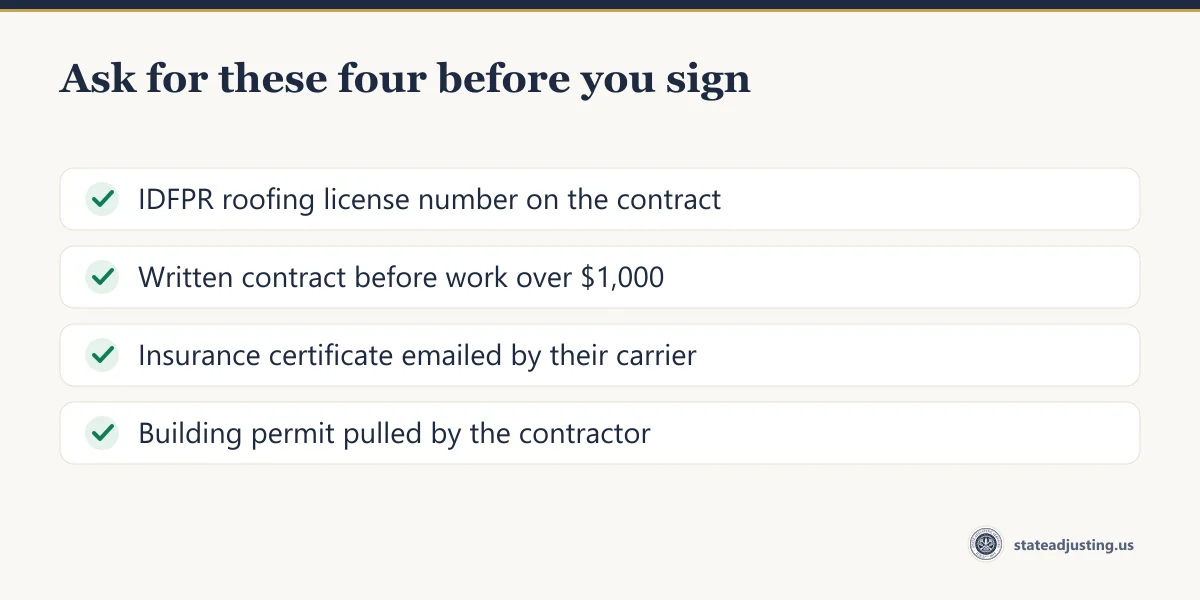
Five: the Illinois roofing license number, a written contract with a scope and a price, a certificate of insurance sent by their insurer, the building permit, and a verifiable local address tied to the exact legal entity that is signing. Each one is either a public record or a document a real contractor already carries.
| Document | What to ask for | What a problem looks like |
|---|---|---|
| Illinois roofing license | Roofing work in Illinois is licensed by the state under the Roofing Industry Licensing Act (225 ILCS 335), and the license number belongs on the contract, the bid and the advertising. Take the number and look it up on the IDFPR license search. | No number on the paperwork, a number that belongs to a different company, or "my office has that". |
| Written contract | The Home Repair and Remodeling Act (815 ILCS 513) requires a written contract or work order for home repair over $1,000, signed before work begins and stating the total cost, plus the state's "Home Repair: Know Your Consumer Rights" pamphlet. | A single-page "authorization" with no scope, no price and no pamphlet. |
| Certificate of insurance | General liability and workers' compensation, emailed to you directly by their agent or carrier, showing the same entity name as the contract. | A photo of a certificate on a phone, an expired date, or a different company named as the insured. |
| Building permit | Pulled by the contractor, in the contractor's name, where your municipality requires one. | "You can pull the permit yourself, it is faster." That moves the responsibility for the work onto you. |
| Identity and address | The exact legal entity name, an Illinois street address, and how long that entity has been operating. | A PO box, a magnet with only a mobile number, or a name that changes between the truck, the business card and the contract. |
The entity name is worth more attention than it gets. A crew that has worked several storms can appear under a new limited liability company each season, with the same trucks and the same phone. Warranties follow the entity that signed, not the people you met, so a two-month-old company offering a ten-year workmanship warranty is offering something it cannot yet demonstrate. Ask for the warranty in writing and read which company is obliged by it.
Which clauses in the door-step paperwork are the actual trap?
Four: a document titled an inspection authorization that is really a contract, a price defined as whatever the insurer approves, an assignment of your claim benefits, and a cancellation penalty calculated against a price nobody has fixed. None is unlawful on its own. Together they turn a doorstep signature into a binding job at an unstated cost.
- The "authorization" that is a contract. The heading at the top of the page is not the agreement. The paragraph directly above the signature line is. If it says you authorize the company to perform the repairs, you have hired them, whatever the document is called.
- The price that is not a price. Wording along the lines of "the contract price shall be the amount approved by the insurance carrier" means you have agreed to a figure neither of you has seen, set by a third party. A real bid states a scope and a number, and says in writing what happens if the carrier's approved scope turns out larger or smaller.
- The assignment of benefits. This assigns your right to be paid under your own policy to the contractor. The check stops coming to you, and your only real leverage over the quality and completeness of the work goes with it. Many policies also require the carrier's written consent before benefits are assigned, so a clause that ignores that condition is a dispute waiting to happen. For a routine roof replacement there is rarely a good reason to sign one.
- The cancellation penalty. A percentage fee is common enough. A percentage fee attached to a contract with no stated price is different: the fee is later calculated against whatever number the contractor produces.
- The three days you are entitled to. Illinois consumer law gives you three business days to cancel most sales of $25 or more that are solicited at your home, and notice of that right belongs in the paperwork (815 ILCS 505/2B). If the contract says nothing about cancelling, and the salesperson says the deal is final at the door, you have your answer about them.
Two habits protect you from all of it. Never sign a document with blank fields — the blanks get filled in later and not by you. And photograph every page you sign, front and back, before it leaves your hands, because the copy you are handed is not always the copy that was signed.
Why "we'll waive your deductible" is the fastest route to a problem
Because the deductible is your share of the loss under the policy. If nobody collects it, the price the carrier was shown is not the price of the job, and the gap has to come from somewhere: either the estimate was padded, or the work will be short. Both leave a document with your name on it that misstates what the repair cost.
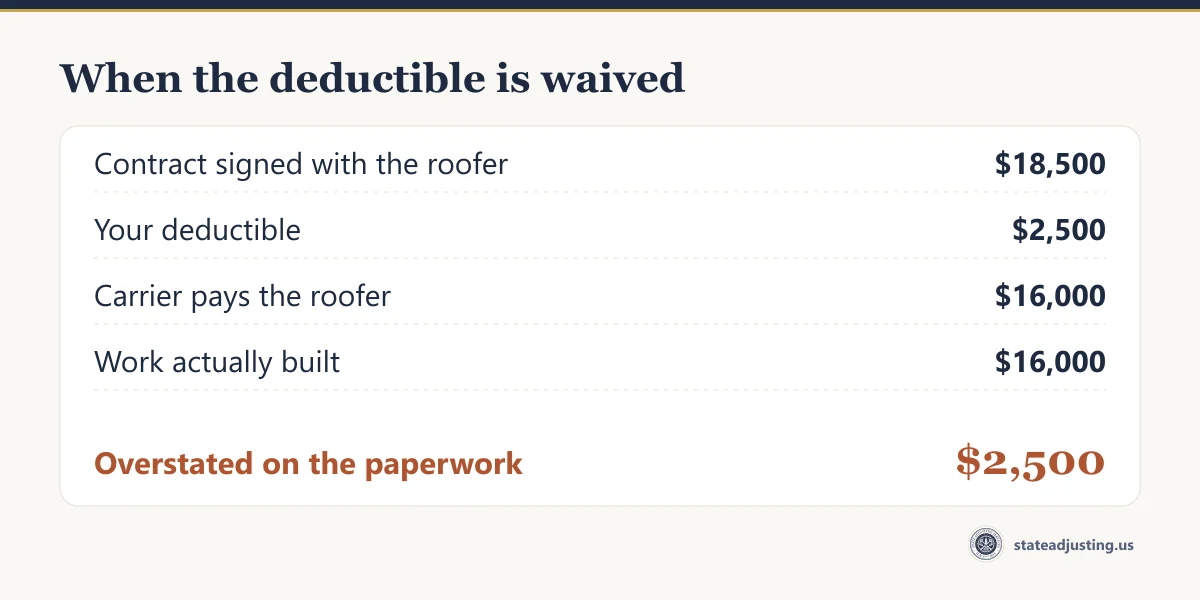
Here is the arithmetic on an illustrative roof. The figures are a worked example to show the mechanics, not a result from any client file.
| Line | Amount | What it means |
|---|---|---|
| Contract signed with the roofer | $18,500 | The figure the carrier is shown |
| Your deductible | $2,500 | 1% of a $250,000 dwelling limit, a common Illinois wind and hail deductible |
| Carrier pays | $16,000 | The approved estimate less the deductible |
| Roofer actually collects | $16,000 | Because your $2,500 was "taken care of" |
| Overstated on the paperwork | $2,500 | It was a $16,000 job described as an $18,500 job |
That table is simplified: on a replacement cost policy the money normally arrives in two parts, an actual cash value payment first and the withheld depreciation afterwards, which we set out in our guide to recoverable depreciation. The mechanic is unchanged by the split.
There is a second version of the same trick where the deductible is not skipped but built in — the estimate carries an extra $2,500 of line items that never get installed. Either way you end up in one of two places. The scope you were owed is short by the amount of your deductible, or the document submitted to your insurer overstates the price of the work. Knowingly submitting false figures on an insurance claim is a criminal offense in Illinois, and it is your policy, your claim and your signature on it. Carriers do ask for proof that the deductible was paid, so keep the canceled check or the card receipt.
None of this makes a discount improper. A contractor is free to price a job at whatever they like. The line is disclosure: a real discount appears on the contract and on the invoice the carrier sees, and the claim is settled against the real price. A discount that exists only in conversation, while the paperwork says something else, is not a discount.
Who is allowed to negotiate the claim itself in Illinois?
A contractor may inspect your roof, tell you what they found and build the repair. Negotiating the settlement on your behalf is the work of a licensed public adjuster or an attorney. So the sentence "we will handle the insurance company for you", said at a front door by a roofing salesperson, describes work the person saying it generally may not do.
The practical problem sits underneath the legal one. A contractor who is paid out of the settlement has an interest in a scope that can be built profitably at the number the carrier is already offering. That is not dishonesty, it is arithmetic — but it is a different objective from getting the estimate corrected, and correcting the estimate is where most of the money on a storm claim is. We wrote separately about what carriers routinely leave out of a hail estimate, and almost none of it is anything a roofer would refuse to build. It simply never gets asked for.
Illinois keeps the two roles apart deliberately, and we work inside that separation: our construction partner builds, we adjust, and using them is always the client's choice rather than a condition of anything.
The five-minute check before you sign anything
- Ask for the Illinois roofing license number and look it up yourself on the IDFPR license search before signing.
- Write down the exact legal entity name and compare it to the name on the truck, the card, the certificate of insurance and the contract. All five should match.
- Require the certificate of insurance to arrive by email from their agent or carrier, not from the salesperson's phone.
- Read the paragraph immediately above the signature line, out loud, before signing anything called an authorization.
- Refuse any document with blank fields, and photograph every page you do sign.
- Decline the assignment of benefits. If it is genuinely necessary, that is a conversation to have with your own adviser, not at the door.
- Treat "we'll take care of your deductible" as the end of the meeting.
- Take the three business days. A contractor you would want does not mind.
What to do next
If the house is damaged, the first job is documentation rather than a signature. Photograph the damage before anything is covered or cleaned up, keep receipts for tarps and emergency measures — policies generally require you to take reasonable steps to prevent further damage, and generally pay for them — and report the loss to your carrier yourself so the claim is opened in your name. Then get a scope written before you agree to a price, not after.
We handle hail damage and storm damage claims across Illinois, residential and commercial, and a large part of that work is reading an estimate that has already been written and finding what is not in it. Our process page describes how a claim runs with us in it, and past clients describe the experience on our reviews page. If you want somebody to look at the paperwork a contractor handed you before you sign it, our free claim review costs nothing and carries no obligation. When we are engaged, our fee is a percentage of what we recover, agreed in writing and regulated by Illinois law, with $0 owed upfront. We answer the phone Monday to Friday, 8:00 AM to 5:00 PM, on (630) 297-8136.
If you believe a contractor has already misled you, the Illinois Attorney General takes consumer complaints about home repair, and the Illinois Department of Insurance takes complaints about how a claim is being handled. If the dispute has become a legal question rather than a claim question, that is the point to speak with an attorney — it is not something we do.
Questions we get about this
Is it illegal for a roofer to knock on my door after a storm in Illinois?
No. Door-to-door selling is lawful in Illinois, though many municipalities require solicitors to register with the village or city first, and you can ask to see that registration. The problem is not the knock. It is signing a contract in five minutes with a company whose license, insurance and Illinois address you have not checked, at a price the document never actually states.
Can a contractor waive my insurance deductible?
The deductible is your share of the loss under your policy, so if it is quietly not collected while the carrier is billed for the full amount, the paperwork overstates what the repair cost. Knowingly submitting false figures on an insurance claim is a criminal offense in Illinois, and the claim is in your name. A genuine discount is fine when it appears on the contract and on the invoice the insurer sees.
Should I sign a contractor’s paperwork before my insurance company inspects?
You do not need to. Nothing in a property claim requires a signed repair contract before the carrier inspects, and signing one early can commit you to a company and a price before the scope of the damage is known. Read the paragraph above the signature line: a document titled an inspection authorization is often a contract to perform the repairs.
How do I check whether a roofing contractor is licensed in Illinois?
Roofing work in Illinois is licensed by the state under the Roofing Industry Licensing Act (225 ILCS 335), and the license number is required on contracts, bids and advertising. Take the number from the paperwork and search it on the Illinois Department of Financial and Professional Regulation license lookup, then confirm the licensed name matches the exact company on your contract.