Rented house damaged: who claims what, the owner or the tenant
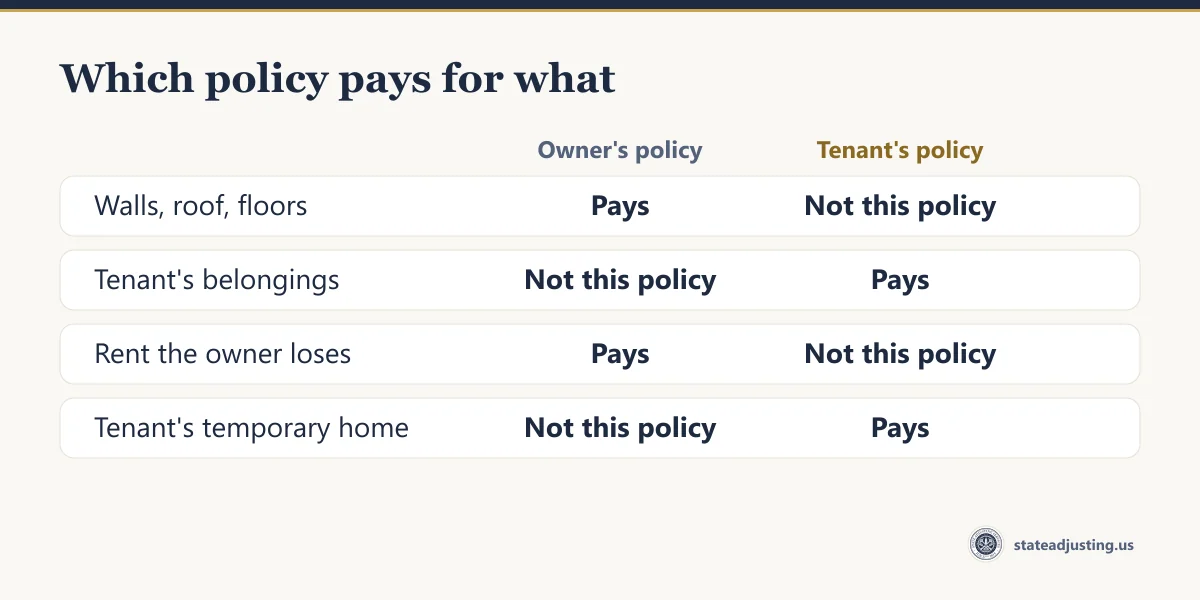
When a rented house or two-flat is damaged, there are usually two insurance claims, not one. The owner's policy, normally a dwelling policy that people call landlord insurance, claims the building and the rent the owner cannot collect while it is repaired. The tenant's renters policy claims the tenant's belongings and the extra cost of living somewhere else. Neither policy pays the other side's losses, so each side has to file its own claim, on its own policy, with its own deductible.
We are licensed Illinois public adjusters, not attorneys. Policy wording differs from carrier to carrier and edition to edition, and the reader's own policy and lease decide what applies.
Which policy is the house actually on?
Before anything is scoped, the owner needs to know which form the house is insured under, because that decides what the claim can include. Most rented houses fall into one of three situations.
The owner bought a dwelling policy
This is the form written for a house someone else lives in. It insures the building and other structures, and it can carry fair rental value (lost rent) and, if a limit is shown, the owner's own furniture and appliances in the house. This is the cleanest case.
The owner moved out and kept a homeowners policy
The widely used homeowners form is written around the residence premises, the house where you live. If the owner moved out and the agent was never told, the carrier may first ask whether the house was still covered as written. Settle that question in writing before arguing about the estimate.
The owner lives in one unit of a two-flat
An owner-occupied two-flat is often on a homeowners policy that allows a rented unit. The building claim is the owner's; the tenant upstairs still claims belongings and living cost on a renters policy. Check the declarations for how the rented unit is described.
Who claims what, item by item
Sort the loss before anyone files. The owner's policy follows what the owner owns and the rent the owner earns; the tenant's policy follows what the tenant owns and where the tenant has to sleep. The table below is how the split usually falls under widely used forms.
| Item | Owner's dwelling policy | Tenant's renters policy | Watch for |
|---|---|---|---|
| Walls, roof, floors, wiring, plumbing | Yes, as the dwelling | No | The owner files even when the tenant caused the loss |
| Detached garage, fence, shed | Yes, as other structures | No | Usually a smaller separate limit |
| Appliances the owner supplied | Depends on the form | No | Some forms treat them with the building, others need a personal property limit on the declarations |
| Furniture, clothes, electronics of the tenant | No | Yes, as personal property | Special limits on jewelry, cash and some other categories |
| Upgrades the tenant paid for | Usually no | Often a small amount | The widely used renters form commonly allows up to 10% of the personal property limit |
| Rent the owner cannot collect | Yes, as fair rental value | No | Only while the house is unfit because of a covered loss |
| Tenant's hotel or temporary rental | No | Yes, as loss of use | Pays the increase over normal living cost |
Lost rent: what fair rental value pays and where it stops
Fair rental value pays the rent the owner loses while the rented part of the house cannot be lived in because of a covered loss, for the time it should take to repair it. It is calculated, not assumed: the monthly rent in the lease, times the months of repair, less any of the owner's costs that stop while the house is empty.
Rent in the lease: $2,100 a month. Repair time: four months.
Water and trash the owner normally pays, which stop while the house is empty: $75 a month.
Fair rental value claimed: $8,400 less $300 = $8,100.
Three limits come up again and again. The coverage is not a rent guarantee: if a tenant simply stops paying for a reason unrelated to the damage, it pays nothing. It has a limit, shown on the declarations page, sometimes as a separate figure and sometimes as a share of the dwelling limit, so read your own page rather than a rule of thumb. And when a civil authority closes the street because of damage next door, many dwelling forms pay the lost rent for up to two weeks only.
The proof is ordinary paperwork: the signed lease, twelve months of rent deposits, and a written note from the tenant or the move-out date if the tenant left. Keep the contractor's schedule too, because the carrier will measure the months against how long the repair should take, not how long it did take.
The tenant's side: belongings and the hotel
The tenant reports to the tenant's own carrier, and the owner cannot file on that policy. The renters claim has two parts. Belongings are claimed item by item, usually at actual cash value first, with the rest paid after replacement if the policy is written at replacement cost. Our guide to building a contents inventory after a fire shows how to rebuild that list from records.
The second part is loss of use: the extra cost of living somewhere else while the unit is unfit. It pays the increase over what the household normally spends, not the whole new bill, which is why the old rent matters. If the lease ends at the fire and the tenant stops paying the owner, the increase is the gap between the old rent and the new place. If the tenant still owes the old rent under the lease, the increase is the whole new rent. Whether rent stops is a question of the lease and of local ordinances such as Chicago's, and that is a question for an attorney, not for us. Our article on additional living expenses walks through what counts.
The two sides connect at one point. If the tenant keeps paying rent during the repair, the owner has no rent loss to claim. If the tenant stops, the owner claims it. The same month of rent is a loss on one side or the other, never both.
When the tenant caused the damage
An accidental fire started by a tenant is still a covered loss for the owner in most forms, and the owner files on the owner's policy as with any other fire. The harder question comes later: can the owner's carrier pay the owner and then sue the tenant to get its money back? In Illinois that depends heavily on the lease. The Illinois Supreme Court held in Dix Mutual v. LaFramboise (1992) that the insurer could not pursue the tenant on the lease in that case. In 2022, in Sheckler v. Auto-Owners, the court limited that decision to its own facts, as Cozen O'Connor summarized. A tenant who receives such a letter should speak to an attorney and to the tenant's own liability carrier.
Damage a tenant does on purpose is the hardest file for the owner. Some forms pay it as vandalism, some exclude it, and wear and tear from ordinary use is excluded in all of them. The owner should photograph the condition at every move-in and move-out; those dated photographs are what separate a single event from years of wear.
Between tenants: the empty house
A house that sits empty between leases changes the claim. Dwelling forms, like homeowners forms, commonly stop paying for vandalism once the building has been vacant for more than 60 consecutive days, and an empty house has no one to notice a leak or a failed furnace. Our article on vacant and unoccupied property claims covers how carriers count those days and what keeps the cover in place.
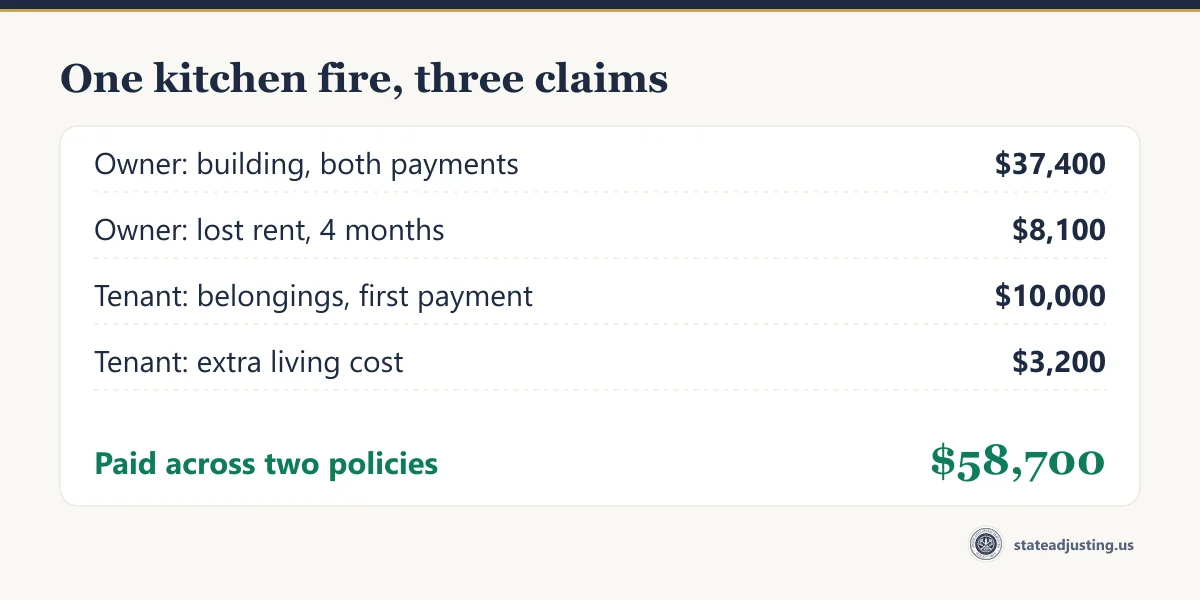
One kitchen fire, three claims: a worked example
A rented single-family house in Illinois has a kitchen fire on a weekday evening. Smoke reaches the rest of the first floor. The tenant moves to a short-term rental for four months while the house is repaired, and the lease ends at the fire. All figures are an illustration, not a result.
| Claim | Policy | Arithmetic | Paid |
|---|---|---|---|
| Building, first payment | Owner's dwelling policy | $38,400 repair cost less $6,200 depreciation less $1,000 deductible | $31,200 |
| Building, after repair | Owner's dwelling policy | Depreciation released when the work is done | $6,200 |
| Lost rent | Owner's dwelling policy | $2,100 x 4 months less $300 of costs that stopped | $8,100 |
| Belongings, first payment | Tenant's renters policy | $14,600 replacement cost less $4,100 depreciation less $500 deductible | $10,000 |
| Extra living cost | Tenant's renters policy | $2,900 new rent less $2,100 old rent, x 4 months | $3,200 |
That is $58,700 across two policies and two deductibles. Two details change the totals. If the lease had not ended and the tenant still owed the old rent, the tenant's living-cost claim would be $2,900 x 4 = $11,600 and the owner would have no lost rent, because the rent kept coming. And the $6,200 of building depreciation comes back only once the repair is finished, as our guide to recoverable depreciation explains.
The first week, for each side
If you own the house
- Report the loss to your carrier the same day, and tell it the house is rented.
- Find the declarations page and confirm which form the house is on and whether fair rental value has a limit.
- Photograph the damage before any board-up or cleanup, and keep every invoice for emergency work.
- Send the tenant a written note with the claim number and ask for theirs. Do not ask to see their policy.
- Gather the lease, a year of rent deposits and your last move-in photographs.
- Get the contractor's written repair schedule; it is the measure for the rent claim.
If you rent the house
- Report the loss to your renters carrier yourself; your landlord's policy will not pay for your things.
- Photograph every room and closet before anything is thrown away.
- Keep receipts for the hotel, meals above normal and the move.
- Ask your landlord in writing whether the lease continues or ends, and keep the answer.
- Start the contents list from bank and card statements and order histories.
- If anyone says you caused the loss, call your own carrier's liability line and an attorney before you sign anything.
If you own the rented house, we can review the building and lost-rent claim with you free of charge. There is nothing to pay upfront, and no fee if nothing is recovered. You can read about the fire and smoke claims we handle, see how a claim runs with us, or send us the estimate and the lease.
Questions we get about this
Does landlord insurance pay for the tenant's belongings after a fire?
Usually not. A dwelling policy insures the building, other structures, lost rent and, if a limit is shown, the owner's own property in the house. The tenant's furniture, clothes and electronics are claimed on the tenant's renters policy. Your own policy governs.
Can a landlord claim lost rent after a fire or storm?
Many dwelling policies include fair rental value, which pays the rent the owner cannot collect while the rented part is unfit because of a covered loss, for the time it should take to repair, less costs that stop. It has a limit on the declarations page and does not pay when a tenant stops paying for unrelated reasons.
Who pays if the tenant caused the fire?
The owner normally claims the building on the owner's policy first. Whether that carrier can then pursue the tenant depends heavily on the lease and on Illinois case law, including Dix Mutual v. LaFramboise and the 2022 Sheckler decision. That part is a question for an attorney.
Does a homeowners policy still cover a house I moved out of and rented?
The widely used homeowners form is written around the house where you live. If you moved out and rented the house without telling your carrier, it may question the coverage. Ask your agent in writing which form the house is on, and settle that before arguing about the estimate.