Solar panels and a hail or wind claim: who pays for what
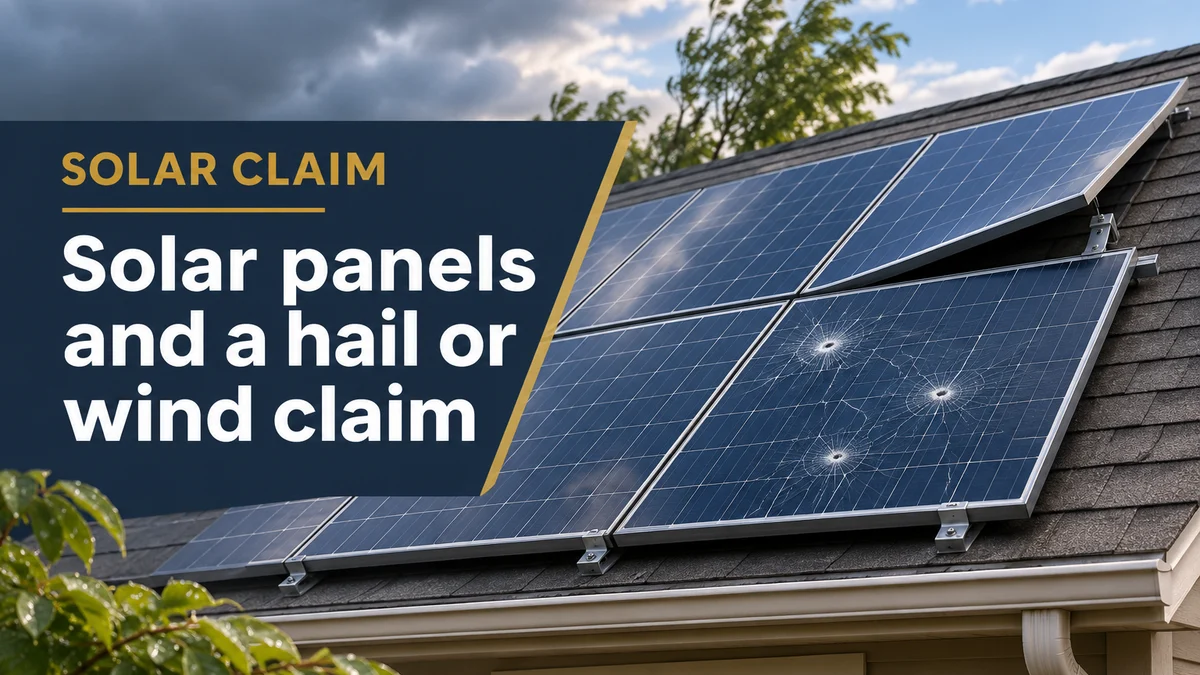
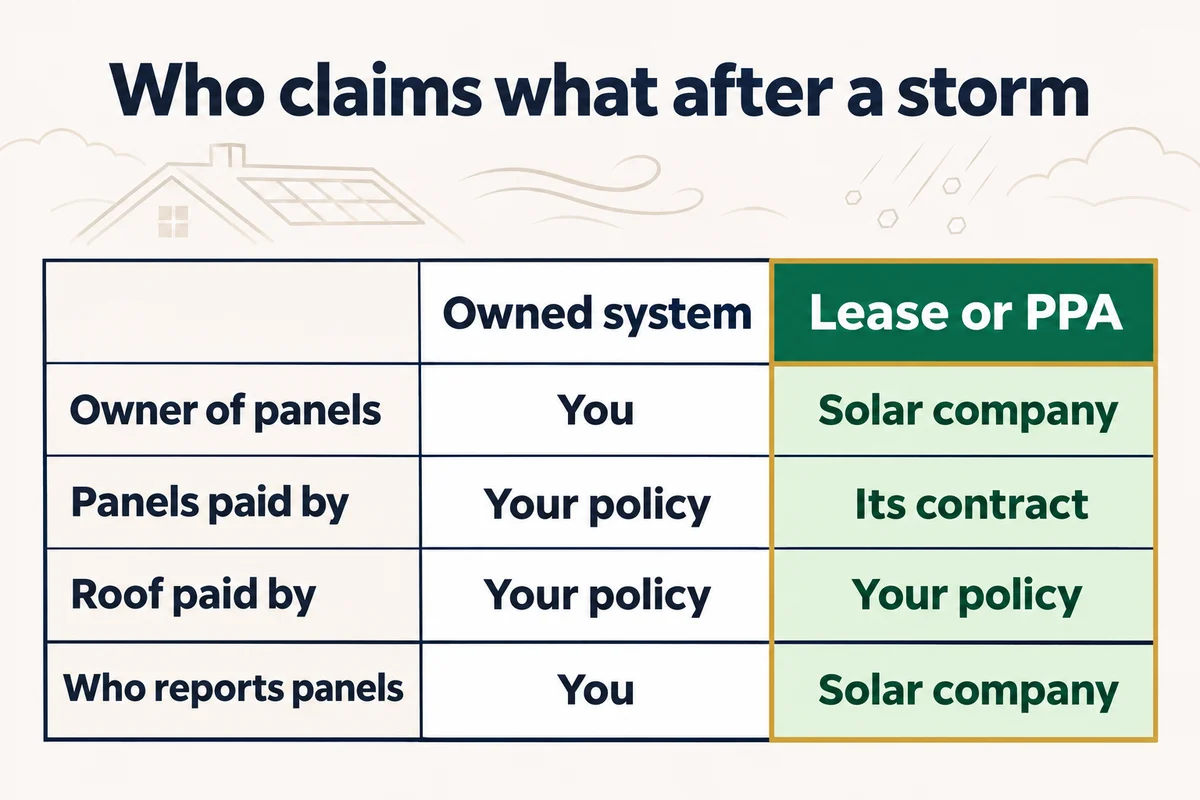
After a hail or wind storm, a solar panels insurance claim splits along one line: who owns the panels. If you bought the system, the panels, the racking and the inverter are part of your house claim. If you lease the system or buy its power under a PPA, the panels belong to the solar company and its insurance or its contract covers them. The roof under the panels is your claim either way, and so, in most cases, is the cost of taking the panels off and putting them back so the roof can be replaced.
That last cost is the one people lose. The panels often survive a hailstorm that ruins the shingles around them, and the first estimate prices a new roof as if nothing were sitting on it. Your own policy and your solar contract govern everything below. We are licensed Illinois public adjusters, not attorneys, so this explains how these claims are usually read and is not legal advice.
Who files for which part, by how you got the system
Find your row first. The way you acquired the system decides whose policy pays for the panels and who has to report them. The roof is in your claim on every row.
| Your setup | Who owns the panels | Whose policy pays for the panels | What you put in your own claim |
|---|---|---|---|
| Bought with cash | You | Your homeowners policy, usually as part of the dwelling when the panels are attached to the house | Roof, panels, racking, inverter, wiring, removal and reinstallation |
| Bought with a solar loan | You, with the lender holding a security interest | Your homeowners policy, same as cash; check the loan papers for any notice you owe the lender | The same list as a cash purchase |
| Lease | The solar company | Whatever the lease says: usually the company's insurance, sometimes a duty on you to insure it | The roof and anything of yours damaged; the panels only if the lease puts them on your policy |
| PPA (you buy the power, not the system) | The solar company | The same as a lease: read the insurance clause | The roof and your own property |
| Ground mount you own | You | Usually your policy's other structures coverage, which has its own, smaller limit | The array, its posts and trenching, and the wire run to the house |
The ground mount row is the one that surprises owners. On the widely used homeowners form, a structure set apart from the house by clear space falls under other structures, often limited to 10% of the dwelling limit on the declarations page. A shed, a fence, a detached garage and an array in the yard can all draw on that same amount. Our guide to what other structures coverage pays for shows how that limit runs out.
The four clauses to find in an Illinois solar contract
If your system was installed through Illinois Shines, the state's solar incentive program, your contract had to answer the damage questions in writing. The program's Distributed Generation Contract Requirements, published April 17, 2026, list what every customer contract must contain. Four of them matter after a storm.
The contract must explain who is responsible for maintaining insurance on the system, and the required insurance terms.
Look for the paragraph headed insurance or risk of loss. It names whose policy carries the panels and whether you had to add them to yours.
The contract must also state who is responsible if there is damage to the system.
This is the sentence that tells you whether you call the solar company or your insurer about a cracked panel.
The contract has to name the party responsible for maintenance of the system. On a lease that is usually the company, which matters when the carrier calls a fault wear rather than storm damage.
A warranty has to state its term, who gives it and which defects it covers, with roof damage given as an example. Roof leaks at the panel mounts may be the installer's warranty and not your insurance.
Older contracts were written under earlier versions of the same requirements, which asked for the same allocation of insurance and damage. If you can't find your copy, the program administrator's contact details are on that document, and the installer has to give you the contract you signed.
Taking the panels off so the roof can be replaced
When the roof is a covered loss, the cost of removing and reinstalling the panels is part of repairing the roof, because the roof can't be replaced with the array on it. That holds even if no panel broke. Estimates call it detach and reset, and it is a separate line that a first estimate often leaves out.
The work happens in a fixed order, and each step is something a complete estimate either prices or explains:
- The system is shut down and disconnected.Done by the installer or a licensed electrician, not the roofer. On a lease, the contract usually says only the company's crew may touch it.
- Panels, rails and mounts come off and are stored.Priced per panel or per system. Storage on site or at the installer's yard is part of it.
- The roof is torn off and replaced.The roofing lines, plus new flashing at every mount location, because the old penetrations are reused or moved.
- Mounts, rails and panels go back on.Including any rail or clamp that can't be reused, which the installer should name in writing.
- The system is tested and switched back on.Commissioning by the installer; if a permit or inspection is required where you live, that fee belongs here too.
Two things go wrong with this line. Sometimes it is missing because the inspector looked at the shingles and not at what sat on them. Sometimes it is priced as a roofer's hourly add-on rather than from the installer's written quote. Ask the company that installed the system for that quote early: on a lease it may be the only company allowed to do the work, and its price is the evidence the estimate needs. Some policies hold back depreciation until the work is finished; our page on recoverable depreciation explains how that holdback comes back.
What the carrier may say, and what answers it
Panels are built to take hail, so a carrier often starts from the view that they weren't hurt, or that a failure has another cause. These are the usual positions and the evidence that answers each one.
| The carrier's position | What answers it |
|---|---|
| The panels show no visible damage | The production record from your monitoring app: daily output for the weeks before and after the storm date. A drop that starts that day, on one string of panels, calls for a test by the installer, who can check for cracks inside the cells that the glass hides. |
| The roof is old, so this is wear | Hail marks are fresh and scattered; wear is uniform. The date of the roof's installation and of the solar installation, and photos of the shingles next to the array, show which one you are looking at. Read our page on roof age and cosmetic damage wording before you accept an age argument. |
| The panel came loose because it was installed wrong | Local wind reports for the date and damage to the rest of the roof and the gutters. If the wind was modest and only the array moved, the installer's workmanship warranty is the place to look, and on a lease it is the company's problem under its maintenance duty. |
| The leak is at a mount, so it is maintenance | Whether the flashing failed with the shingles around it in the storm, or had been leaking before. Stains in the attic that are old and dark point one way; fresh wet decking points the other. |
Animals are the other common cause given. Squirrels chew the wiring under panels, and most homeowners policies exclude damage by rodents. A storm claim and a chewed-wire problem can turn up at the same inspection, so ask the installer to say in writing which faults are which.
A made-up example of how the bill splits
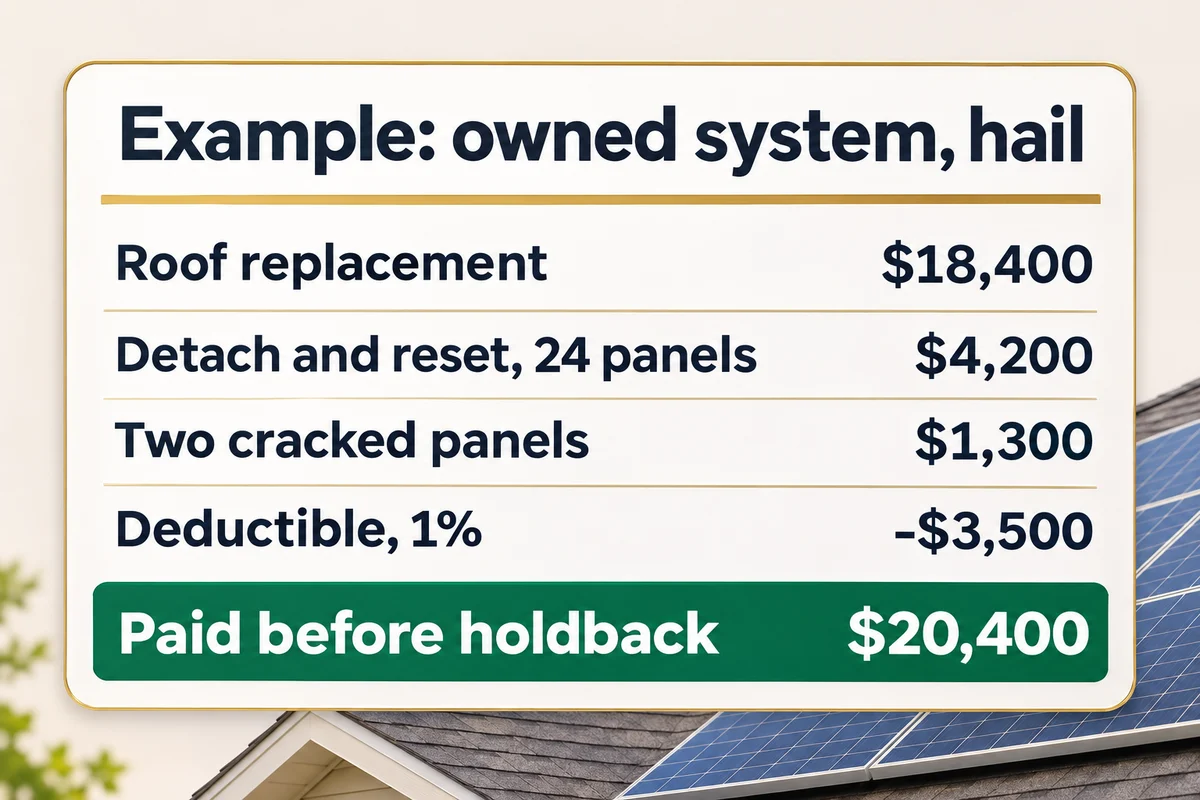
These numbers are invented to show the arithmetic. They are not a price list and not a result of ours. Take a house with a dwelling limit of $350,000, a 1% wind and hail deductible, a hail-damaged roof and 24 panels, two of them cracked.
| Line | Owned system |
|---|---|
| Roof replacement, including flashing at the mounts | $18,400 |
| Detach and reset, 24 panels | $4,200 |
| Two cracked panels replaced | $1,300 |
| Deductible, 1% of $350,000 | −$3,500 |
| Paid on the claim, before any depreciation holdback | $20,400 |
On a lease or PPA, the $1,300 for the two panels comes off your claim and goes to the solar company under its contract. Your claim is then $18,400 + $4,200 − $3,500 = $19,100. The deductible works the way our guide to percentage wind and hail deductibles describes: it is a share of the dwelling limit, not of the loss, so it stays $3,500 whatever the panels cost.
In the first week after the storm
- Take a screenshot of your monitoring app showing production for the 30 days before the storm and every day since.
- Photograph the array and the roof from the ground and from windows; don't walk on the panels.
- Find the solar contract and mark the insurance, damage, maintenance and warranty clauses.
- On a lease or PPA, report the storm to the solar company in writing and keep its reply and claim number.
- Report the roof to your own insurer, and tell the adjuster before the inspection that the roof has solar panels on it.
- Ask the installer for a written detach and reset quote and, if any panel is suspect, a written test result.
- Keep the dates of the roof installation and of the solar installation handy for the age question.
If the estimate came back without the panels, without the removal line, or with the roof called worn out, that is a scope question rather than the final word. We review hail damage claims and wind damage claims across Illinois, and a first look at your estimate costs nothing: send it to us.
Questions we get about this
Does homeowners insurance cover solar panels damaged by hail?
If you own the system and it is attached to the house, most homeowners policies treat the panels as part of the dwelling, so hail damage is handled like other roof damage, subject to your deductible. A ground-mounted array you own usually falls under other structures, with its own smaller limit. Your own policy governs.
Who files the claim for leased solar panels?
The solar company owns leased and PPA panels, so their damage is handled under its contract and insurance. Illinois Shines contracts must state who insures the system and who is responsible if it is damaged. You still claim the roof under the panels on your own homeowners policy.
Does insurance pay to remove and reinstall solar panels for a new roof?
When the roof is a covered loss, removing and reinstalling the panels is usually treated as part of repairing the roof, even if no panel broke. It is a separate estimate line, often called detach and reset, and the installer's written quote is the best evidence of its cost.
What if the panels look fine but produce less after the storm?
Panels can have cracks inside the cells that the glass hides. Save your monitoring data from before and after the storm date and ask the installer for a written test. A drop that starts on the storm date is evidence the carrier can check.