Mold After a Water Loss: Sublimits and Why the Cause Decides Coverage
Mold is not a peril your policy insures against. It is payable only when it grows out of water damage the policy already covers, and even then most homeowners forms cap the mold work with a sublimit — commonly $5,000 or $10,000 — instead of paying it from your dwelling limit. Mold from seepage, humidity or flood is usually excluded outright.
Mold after a water loss is the part of a claim where two arguments happen at once. The first is whether it is covered at all, which is decided entirely by what let the water in. The second is how much of the bill gets charged against a small, separate limit buried in your policy rather than against the dwelling limit you thought you were insured for. Homeowners usually find out about the second argument when the estimate arrives and a five-figure remediation invoice has been paid down to $5,000.
This guide sets out how that limit works, which costs belong on which side of it, and what the cause of the water does to the whole file. We are licensed Illinois public adjusters, not attorneys, and nothing here is legal advice. Policy wording varies between carriers; what follows describes the widely used industry homeowners form that most policies are built on. Your own policy governs.
Is mold covered by homeowners insurance?
Sometimes, and never on its own. Most forms exclude fungi, wet or dry rot and bacteria in the Section I exclusions, then add back a limited amount of coverage for mold that results from a peril the policy covers. So the question is never "is mold covered" — it is "is the water that caused it covered, and how much limited coverage did I buy".
That structure matters, because it changes what you are arguing about. Mold is treated as a consequence, not a cause. If a supply line lets go and soaks a kitchen, the water loss is covered, and the mold that follows is a resulting condition the limited coverage responds to. If the same kitchen got wet from a shower pan that has leaked for eight months, there is no covered water loss underneath, so there is nothing for the mold coverage to attach to. Nothing about the mold itself changed between those two files.
On the declarations page this shows up as an endorsement, usually titled something close to Limited Fungi, Wet or Dry Rot, or Bacteria Coverage, with a dollar figure beside it. If you cannot find that line, look in the endorsement schedule rather than in the coverage summary — carriers list it in different places, and some issue separate limits for property damage and for liability.
Why does the cause of the water decide the coverage?
Because the mold coverage is a give-back to an exclusion. It only operates where the underlying water damage is payable. Sudden and accidental discharge — a burst pipe, a failed water heater, a wind-created opening in the roof — normally is. Long-running seepage, groundwater, surface flooding and humidity normally are not, and mold that follows them is excluded with them.
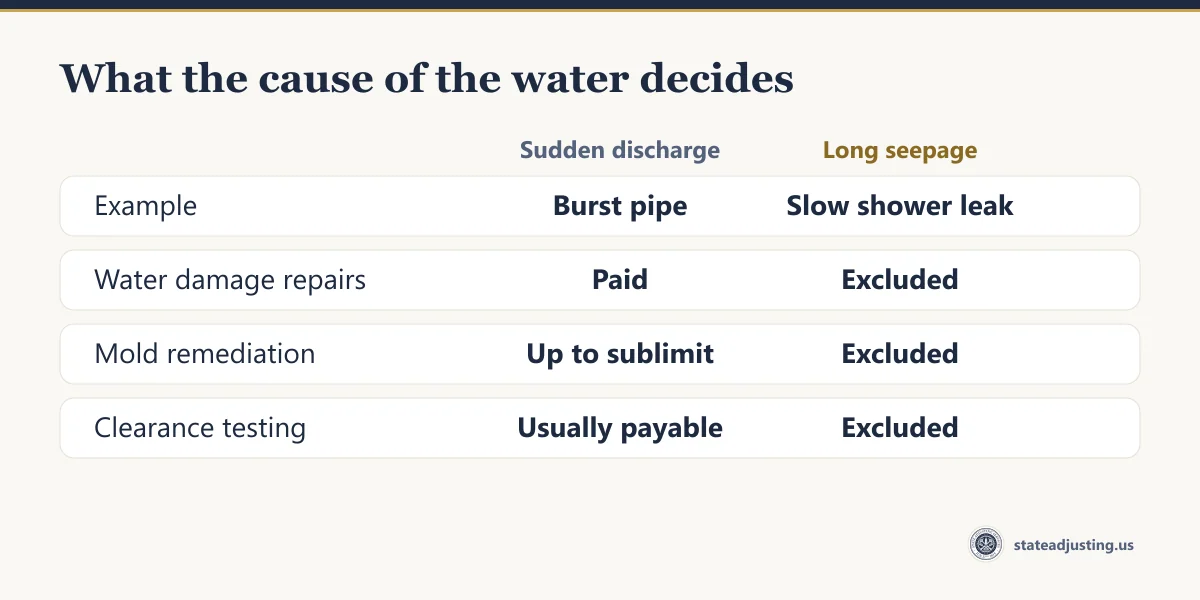
The distinction between a sudden discharge and weeks of seepage is the single most consequential sentence in a water file, and it is worth reading in full: we set out the exclusion wording, the evidence that separates the two, and what a duration denial actually rests on in sudden versus gradual water damage. Mold is where that argument usually surfaces, because mold takes time and a carrier that finds mature growth will ask how long the water was there.
| What let the water in | The water damage | The mold that follows |
|---|---|---|
| Burst supply line, failed appliance hose, water heater | Normally covered | Payable within the mold sublimit |
| Wind or hail opens the roof, rain enters | Normally covered | Payable within the mold sublimit |
| Slow leak behind a wall or under a shower pan | Commonly excluded as seepage | Excluded with it |
| Worn roof, failed flashing, no storm event | Commonly excluded as wear | Excluded with it |
| Surface water or river flooding | Excluded on a homeowners policy | Handled under flood coverage, not here |
| Sewer or drain backup | Only with the backup endorsement | Follows the endorsement |
| Condensation, humidity, an unheated house | Not a loss — maintenance | Excluded |
Two rows deserve a note. Sewer backup is not standard coverage on most homeowners policies — it is bought as an endorsement with its own separate limit, often $5,000 to $25,000, and mold that follows a backup sits inside that structure rather than beside it. We separate the three water coverages in sewer backup versus flood. And flood is its own policy: the National Flood Insurance Program's standard policy excludes mold and mildew damage that the policyholder could have avoided, which in practice means damage caused by not inspecting and drying the property once the water went down. Flood mold is therefore a question of what you did in the days after, not just of what the water did. Our flood claim page covers how those files are handled.
What is a mold sublimit, and what does it have to cover?
A separate dollar cap that applies to everything attributable to mold — testing, containment, remediation, and the tear-out and rebuild of material removed because of mold. It sits inside your coverage rather than on top of it. On many forms it is an aggregate for the whole policy period, not per claim, so a second loss in the same year draws on whatever is left.
The common defaults are $5,000 and $10,000. Higher options — $25,000 and $50,000 are typical — are available by endorsement from most carriers, and the premium difference is usually small relative to what a full remediation costs. The limit cannot be raised once a claim is open, so this is a renewal item, and it is the cheapest thing a homeowner reading this can act on today.
Because the cap is small, the fight is almost never about the cap itself. It is about allocation — which invoices get charged against it. Every dollar the carrier moves from the water claim into the mold column is a dollar that competes for $5,000 instead of for your dwelling limit.
| Cost | Where it usually belongs | Why |
|---|---|---|
| Emergency extraction and structural drying | Water claim | Done to stop the damage, before mold is a question at all |
| Removing saturated drywall, insulation, cabinets | Water claim | Saturated porous material comes out under the restoration industry's standard whether or not growth has started |
| Containment, negative air, HEPA scrubbing, antimicrobial | Mold sublimit | Performed only because of the mold |
| Air sampling and post-remediation clearance testing | Mold sublimit | Some forms pay testing only where remediation itself is payable |
| Rebuilding material that was removed | Depends on why it came out | Follows the reason for the removal, line by line |
| Cleaning or disposing of contents | Split the same way | Water-ruined and mold-ruined items are different columns |
None of that is a trick on the carrier's part. Estimating software makes it easy to code a whole room to one category, and the person writing it is working through a queue. But the effect on a homeowner is real money, and correcting it is a documentation exercise rather than a dispute: the drying log, the moisture readings and the restoration contractor's scope usually show exactly why each piece of material was removed.
What does that look like in dollars?
Take a supply line under a kitchen sink that lets go on a Friday and is found on a Sunday. The restoration contractor dries the kitchen and the adjoining hall, removes wet material, finds growth behind the base cabinets, sets containment, and the house is put back. The full loss prices out at $23,000.
- Emergency extraction and three days of structural drying — $2,380
- Tear-out of saturated drywall, base cabinets and flooring — $4,150
- Containment, negative air and HEPA scrubbing, antimicrobial treatment — $3,900
- Independent post-remediation clearance testing — $850
- Rebuild: drywall, paint, flooring, cabinets — $11,720
The first estimate charges the containment, the testing and the entire tear-out to the mold coverage: $3,900 + $850 + $4,150 = $8,900 against a $5,000 sublimit. The carrier pays $5,000 of it and the remaining $3,900 lands on the homeowner, who assumes a cap has simply been reached.
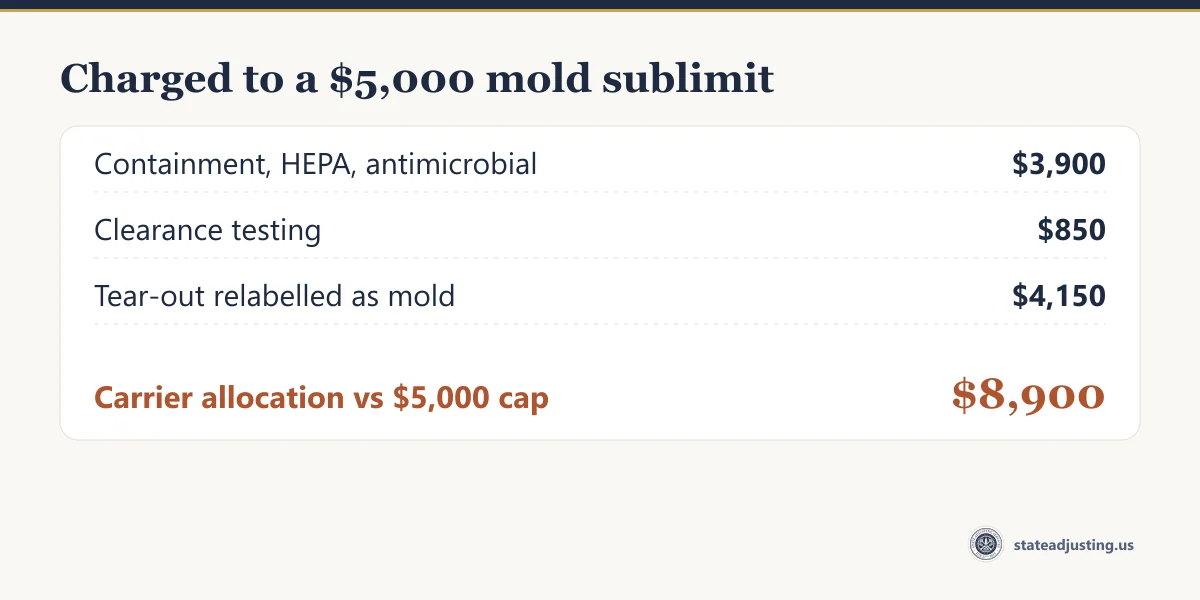
Now move the tear-out back. That drywall, those cabinets and that flooring were saturated by a covered discharge, and saturated porous material is removed under the restoration standard regardless of whether anything has grown on it — which is why the contractor's drying log records moisture content, not spore counts. The mold-attributable total becomes $3,900 + $850 = $4,750, which fits inside the $5,000 with $250 to spare, and the $4,150 goes where the rest of the water damage went. The invoices and the policy are identical in both versions; the difference to the homeowner is $3,900.
Two things make that argument winnable rather than merely arguable. The contractor's scope has to state why each material was removed, and the estimate has to be read line by line rather than at the summary. If the carrier's document is unfamiliar, our guide to reading the carrier's estimate explains what each field does and where the categories are set.
What can still remove coverage after a covered loss?
Three things, and all of them are about what happened after the water rather than before it: neglect, delay, and a break in the chain between the covered event and the growth. Each is a separate provision, and each is answered with dates and documents rather than with opinion.
- Neglect. Every homeowners policy excludes damage caused by the insured's failure to use reasonable means to save and preserve property at and after a loss. A kitchen left wet for two weeks because nobody called anyone is the case that provision was written for. The EPA's guidance for water-damaged buildings is to dry wet materials within 24 to 48 hours; a file where drying started inside that window is a very different file.
- Late reporting. Prompt notice is a duty after loss, and mold is where late notice bites hardest, because delay is visible in the growth itself. Illinois claim clocks and how carriers count them are set out in deadlines that end claims in Illinois.
- A second, uncovered source. If the carrier can show the wall was already wet from something excluded before the covered event, the growth gets attributed to the excluded cause. This is where dated photographs, water bills and service records earn their place.
Notice what is not on that list: the presence of mold by itself. Growth is evidence about duration and conditions, and it is used that way, but finding it does not close a covered claim. If a denial letter reads as though it does, the reasoning underneath it is worth asking for in writing.
What should you do in the first 72 hours?
Stop the water, start the drying, and document before you throw anything away. The order matters: the mitigation duty requires you to prevent further damage immediately, but once the wet material is in a skip nobody can price what was there. Photograph first, then dry, then keep everything the contractor removes until the adjuster has seen it.
- Photograph the failed part and the wet area before anything is touched. Wide shot to place the room, then close-ups with a tape measure in frame. Our guide to what to photograph after property damage covers the sequence.
- Keep the failed part itself. The section of hose, the burst fitting, the valve. It is the physical evidence that the discharge was sudden, and it is usually in the bin before anyone asks for it.
- Get the drying log and the moisture readings. Ask the restoration contractor for daily readings and the equipment record. That document decides the allocation argument later.
- Ask the carrier in writing for two numbers. What mold sublimit applies to this policy, and what has been charged against it so far. Both are answerable in a sentence, and both belong in the file in writing.
- Do not sanitise the scene before the inspection. Bleaching visible growth removes the evidence of what was there without changing what has to be paid for.
What to do next
If a claim is already open, pull the estimate and look for a heading that separates mold or fungi work from the rest. Add up what has been charged there, compare it to the sublimit on your declarations page, and then go line by line asking one question of each entry: was this done because of mold, or because the material was wet? Anything in the second group is worth raising, and raising it is a correction request rather than an appeal.
If nothing has happened yet, find the endorsement on the declarations page, note the figure, and ask your agent what it would cost to raise it at renewal. Then check whether you carry sewer backup coverage at all, because a basement backup is the most common way an Illinois homeowner meets both of these limits at once.
State Adjusting Services is a licensed Illinois public adjuster. On water damage claims we read the policy, price the whole loss including the parts that get coded into the wrong column, and negotiate it with the carrier. Our fee is a percentage of the recovery, regulated by Illinois law and agreed in writing, paid out of the settlement: $0 upfront, and no recovery means no fee. If you want a free review of your policy and your claim, get in touch, or read how the process works first. Our office is open Monday through Friday, 7:00 AM to 7:00 PM, and Saturday and Sunday, 9:00 AM to 5:00 PM.
Questions we get about this
Is mold covered by homeowners insurance?
Only when it results from water damage the policy already covers, such as a burst pipe or a wind-created opening in the roof. Mold from a slow leak, humidity or flooding is generally excluded. Where it is covered, most policies cap the mold-related work with a separate sublimit rather than paying it from the dwelling limit.
How much is a typical mold sublimit?
Commonly $5,000 or $10,000 on Illinois homeowners policies, shown on the declarations page as a limited fungi, wet or dry rot and bacteria coverage. Higher limits, often $25,000 or $50,000, are usually available by endorsement. On many forms the limit is an aggregate for the whole policy period rather than per claim.
Does the mold sublimit cover the tear-out and the rebuild?
It covers the tear-out and rebuild of material removed because of mold. Material removed because it was saturated by a covered water loss generally belongs in the water claim instead. That split decides how much of the bill competes for a small limit, so the contractor’s scope should state why each material was removed.
Does testing for mold count against the limit?
Usually yes. Air sampling and post-remediation clearance testing are normally paid from the same limited coverage as the remediation, and some forms pay for testing only where the remediation itself is payable. Ask the carrier in writing what has already been charged against the limit.