Hail hit your AC unit: what the insurance claim can pay for
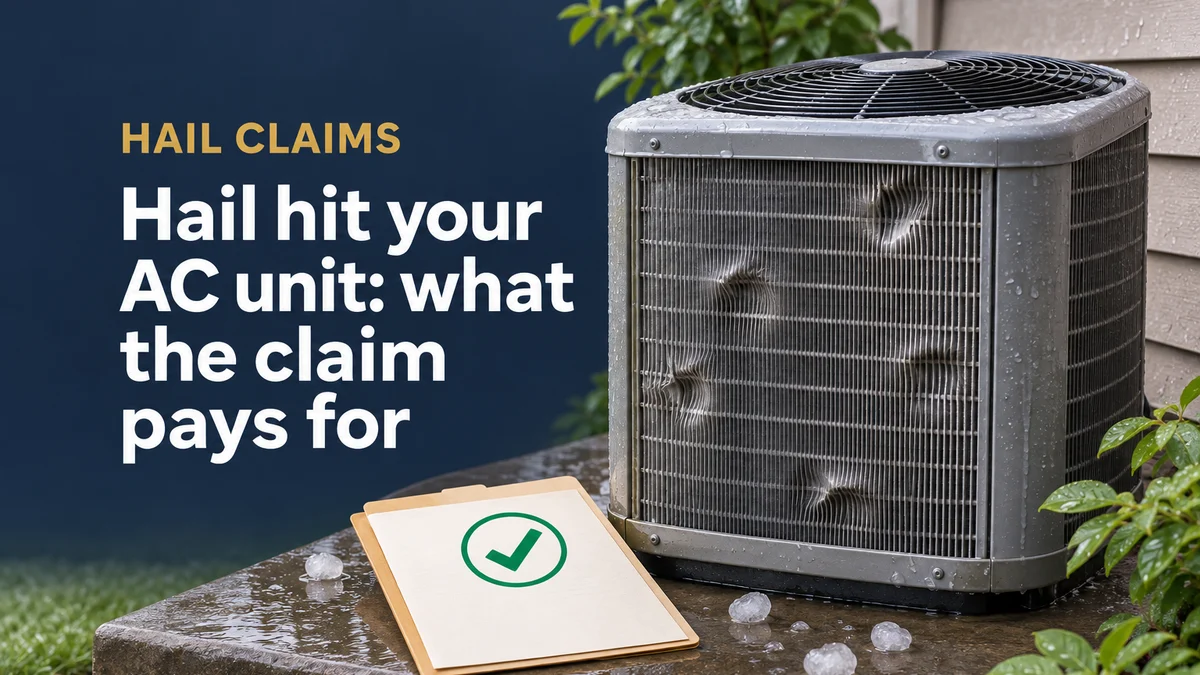
A hail damaged AC unit is usually part of the house claim, not a separate one, and the claim can pay for one of three repairs: combing the bent fins, replacing the coil, or replacing the outdoor condenser. Which one your scope reaches depends on what the hail did to the coil and on how well that is written down. The same applies to a heat pump, which is the same box outside your wall doing double duty in winter.
On most homeowners policies the outdoor unit is treated as part of the dwelling, the way the furnace and the water heater are. A window unit is usually personal property instead. Your own policy governs both points. We are licensed Illinois public adjusters, not attorneys, so this page explains how these claims are read and isn't legal advice.
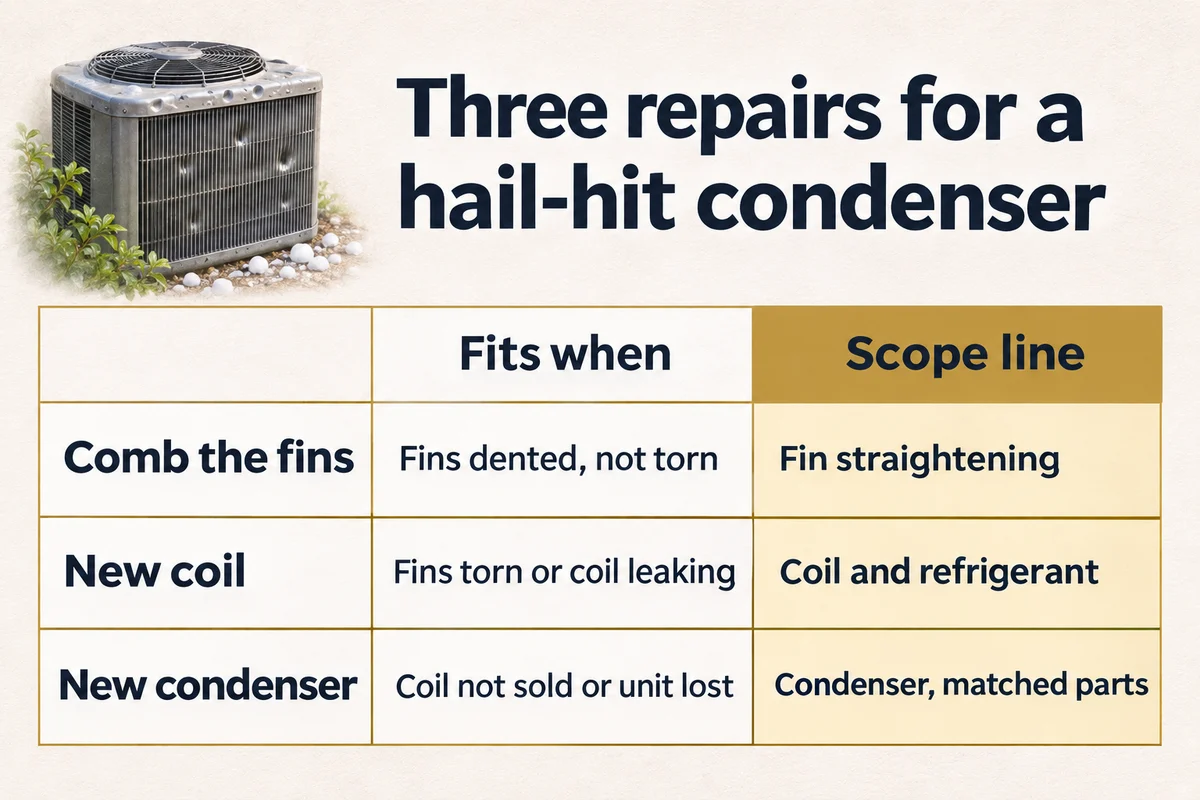
Which of three repairs does your unit need?
It depends on whether the thin aluminum fins were only bent or were torn, and on what kind of coil sits behind them. Bent fins can often be straightened. Torn fins, a cracked tube or a coil type that can't be straightened move the repair up a level.
Comb the fins
A technician runs a fin comb through the dented area until air passes freely again. It fits when the fins are pushed flat but still whole.
On the estimate this is a labor line for fin straightening, sometimes with a coil cleaning.
Replace the coil
It fits when fins are torn, when the copper or aluminum tubing behind them is dented or leaking, or when the coil is a microchannel type. An industry article for claim staff, PropertyCasualty360 on hail and condenser coils, notes that torn fins usually can't be restored by combing and that microchannel coils can't be combed at all.
The scope then needs the coil, recovering and recharging the refrigerant, and the labor to braze it in.
Replace the condenser
It fits when the replacement coil for your model isn't made any more, when the cost of a coil swap comes close to a new unit, or when the cabinet, fan and compressor were hit as well.
The scope names the new condenser and any parts the manufacturer says must change with it.
That last point is where scopes often stop short. Manufacturers list outdoor and indoor units that are rated to work together, and the new part has to suit the refrigerant your system runs on. If your technician says the indoor coil in the basement has to change along with a new condenser, ask for the reason in writing with both model numbers. The insurer will want to know why an undamaged part inside the house is on a hail estimate, and a written reason from the person doing the work is the answer it can check.
How do you show the marks came from hail?
By where the dents are and what shape they take. Hail lands from above and from the side the storm came from, so it leaves round dents scattered across the top and the exposed faces of the unit. Other damage has its own pattern, and the insurer's inspector will be looking for it.
| Cause | Where it shows | What it looks like | What to photograph |
|---|---|---|---|
| Hail | Top grille, fan guard, the coil faces turned toward the storm | Round or oval dents of similar size, spread out, fewer on the side facing the wall | Each face with a coin or tape measure for scale, then the top from above |
| Mower or trimmer | Low on the coil, near the pad | A straight horizontal band at one height, described in the PropertyCasualty360 article linked above | The full height of the coil, so the clean upper part is visible too |
| Pressure washing | Large areas of one face | Wide vertical streaks where the fins were flattened together, per the same article | The undamaged faces, to show the pattern isn't the same on every side |
| Age and dirt | Bottom rows, corners | Corroded or crumbling fins, packed debris, no clear impact marks | Your service records, if a technician cleaned the coil before the storm |
What else in the yard dates the storm
An inspector compares the unit with everything soft around it. Photograph dents in the gutters and downspouts on the same side of the house, the grill lid, the mailbox, painted fence caps and window screens. Dents of matching size across several of them make a strong case that one storm did it. Write down the date of the storm and keep any weather alert or news report you have. Our guide on what to photograph after property damage covers the order to take the pictures in, and the one on hail damage to siding shows how to read the walls that usually face the same way as the unit.
Can the insurer call fin dents cosmetic?
Only if your policy says so, and only for the items it names. Some Illinois policies carry a cosmetic damage endorsement that excludes dents which change how something looks but not how it works. Many of these endorsements list roof coverings and siding. Read which items yours names before you accept that it reaches the air conditioner.
Even where the wording is broad, the question is function. Fins exist to pass air across the coil, and the PropertyCasualty360 article states that flattened fins can reduce airflow and the coil's ability to move heat. A technician who measures that loss and writes it down is answering the cosmetic argument with a fact. We explain how these endorsements are worded in our guide to roof age and cosmetic damage endorsements, and how a 2026 federal appeals decision read a similar clause on a metal roof in the post on hail dents and the cosmetic exclusion.
Is the unit worth claiming on its own?
Often it isn't claimed on its own. A storm that dents a condenser usually dents gutters, siding or the roof too, and on most policies one deductible applies to the loss from one storm rather than to each item. The arithmetic below uses made-up numbers to show how the deductible type changes the answer.
Flat $1,000 deductible
Coil replacement on the estimate: $2,400. Gutters and downspouts: $1,600.
$4,000 of damage less $1,000 leaves $3,000 before any depreciation.
1% hail deductible on a $350,000 dwelling limit
The deductible is $3,500. The same $4,000 of damage leaves $500.
A combing job alone, say $450, would fall under it completely.
Depreciation matters here as well. A ten-year-old condenser loses part of its value on the first payment, and on a replacement cost policy that amount normally comes back once the work is done, as our guide to recoverable depreciation explains. To see how a percentage deductible is figured from your declarations page, read percentage wind and hail deductibles. If the numbers are close, our post on claiming or paying out of pocket walks through the rest of that decision.
What the technician's report should say
It should let someone who never saw your unit understand why the repair is the one on the estimate. A one-line invoice saying hail damage, replace coil is easy to question. These five points are harder to argue with.
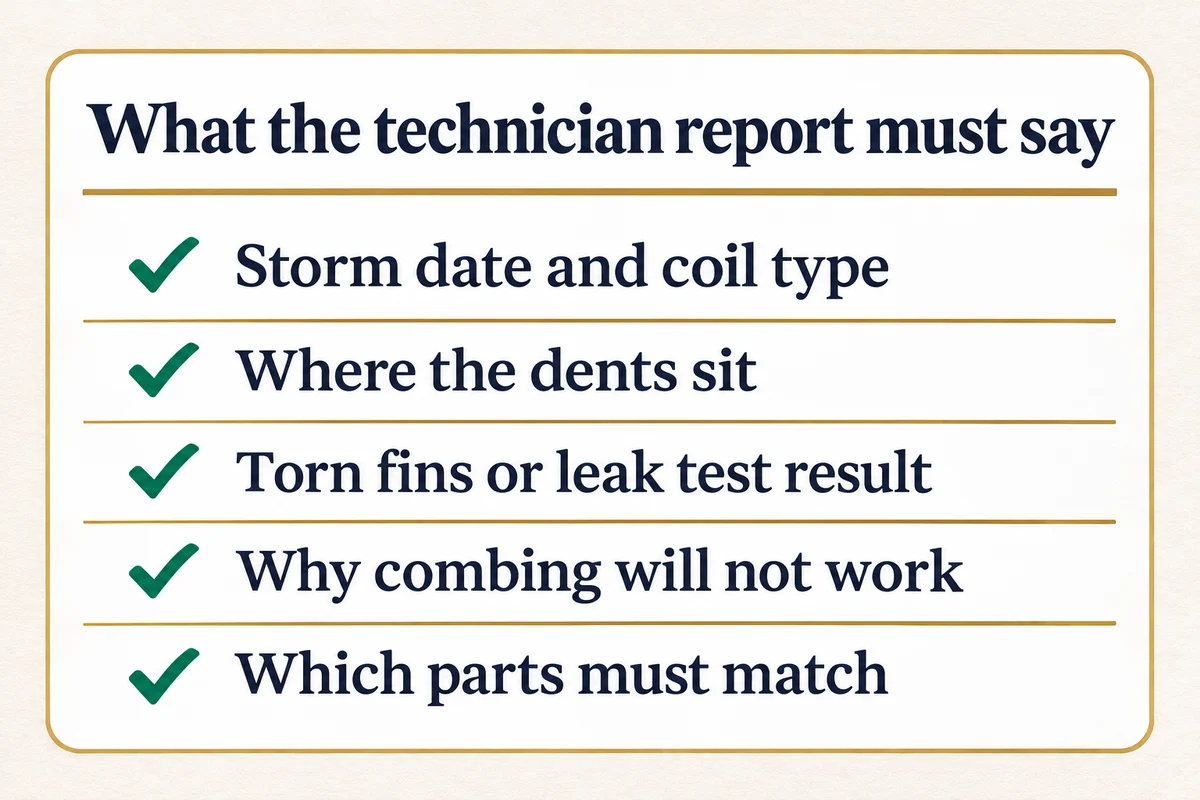
- The storm date you gave them, the unit's make, model and serial number, and whether the coil is tube and fin or microchannel.
- Which faces are dented and roughly how many impacts, with their own photos attached.
- Whether any fins are torn, and the result of a leak test if the refrigerant charge was low.
- If they recommend a new coil, why combing won't bring it back. If they recommend a new condenser, why a coil alone won't do, with the part availability they found.
- Any other part that must change with it, the reason, and the model numbers.
Give your insurer notice of the storm promptly, even while you wait for the report, because most policies require it and some set a time limit for hail. Our notes on Illinois claim deadlines list where those limits sit in a policy. If the coil fails later and the first scope paid only for combing, the claim can be reopened with a supplement, as described in how a claim gets reopened.
Sending your hail claim to us
We read the whole file: the unit, the roof, the siding and the gutters, against your policy and the carrier's estimate. Our hail damage claims page shows what we handle across Illinois, and the process page shows how a file runs from the first call.
To have us look, send the estimate, the technician's report and your declarations page through the contact page, or call (630) 297-8136. The review is free. We're open Monday through Friday, 7:00 AM to 7:00 PM, and Saturday and Sunday, 9:00 AM to 5:00 PM. Hiring us costs $0 upfront: our fee is a percentage of what's recovered, set out in a written agreement, and there's no fee if nothing is recovered. What an insurer finally pays depends on the policy and the damage, and nobody can promise that figure.
Questions we get about this
Does homeowners insurance cover hail damage to an AC unit?
On most homeowners policies the outdoor condenser is treated as part of the dwelling, and hail is a covered peril, so a hail claim usually includes it. The deductible, depreciation and any cosmetic damage endorsement still apply, and your own policy governs.
Will insurance replace my AC unit or just comb the fins?
It depends on the damage. Fins that are bent but whole are often combed. Torn fins, a damaged tube or a microchannel coil usually call for a new coil, and a new condenser fits when the coil isn't available or the unit was hit elsewhere too. A technician's written reasons decide which one the scope reaches.
How can I prove my AC unit was damaged by hail?
Photograph round dents on the top and the faces toward the storm with a coin or tape for scale, then dents of similar size on gutters, downspouts, the grill lid and fence caps. Mower damage sits in a low horizontal band and pressure washing leaves wide vertical streaks, so showing the whole unit helps.
Is a hail damaged heat pump claimed the same way as an air conditioner?
Yes. The outdoor part of a heat pump has the same coil and fins, so the same three repairs and the same evidence apply. Because it also heats the house, a damaged coil can matter in winter as much as in summer.