Tenant damaged your rental: what the landlord insurance claim pays

Whether a tenant damage insurance claim pays depends less on who did the damage than on what kind of act it was and how many separate times it happened. A landlord policy is written around events: a sudden accident, a fire, an act of vandalism. A tenant can cause any of those, and the policy may pay for them. What it does not pay for is the slow wearing down of a house by the people living in it, or a problem nobody fixed for months. So the first job after a bad move-out is to sort the damage, line by line, the way the carrier will.
Your own policy decides every point below, and landlord forms differ more than homeowners forms do. We are licensed Illinois public adjusters, not attorneys, so this explains how these files are usually read and is not legal advice.
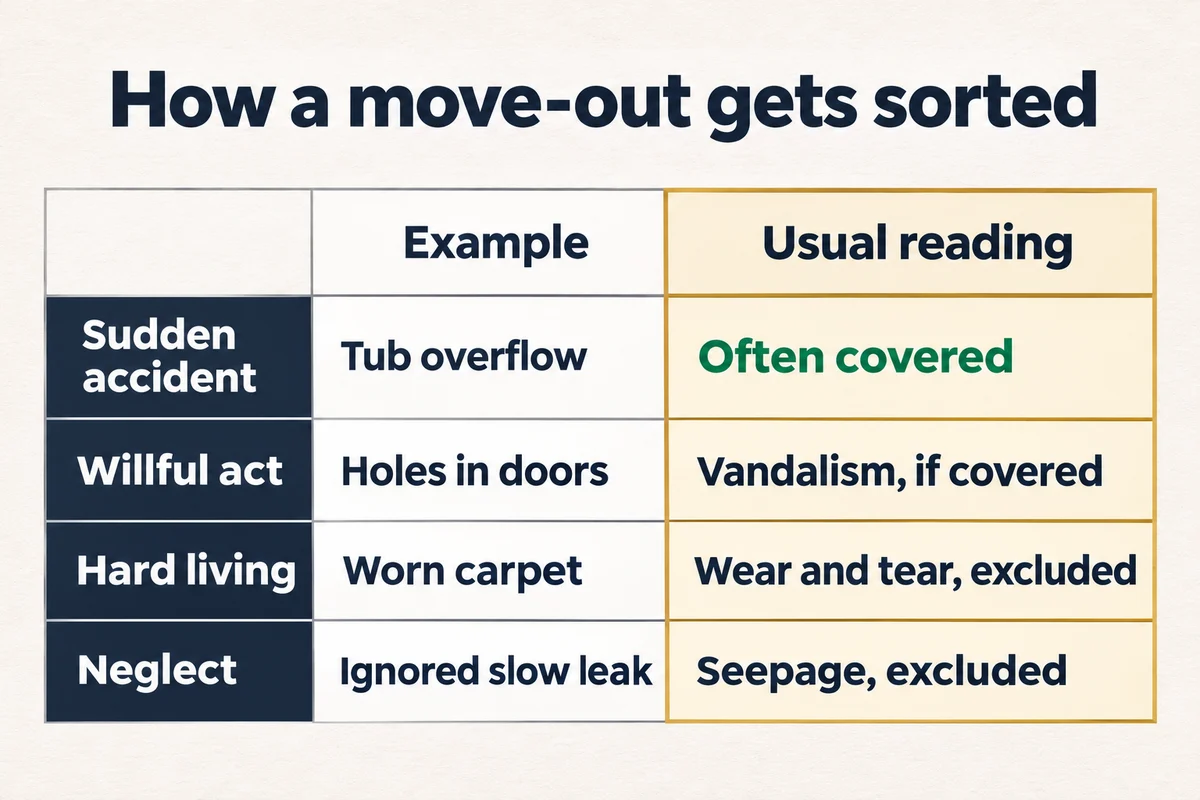
Four ways the carrier sorts a move-out
The carrier's adjuster walks the house and puts every item into one of four piles. The same broken door can land in a different pile depending on how and when it broke, so the evidence matters as much as the damage.
| Pile | What it looks like | How a landlord form usually reads it | What moves an item into this pile |
|---|---|---|---|
| Sudden accident | A bathtub left running that soaks the ceiling below; a pan fire in the kitchen | A covered loss in most forms, the same as if you had caused it yourself | A date, a cause and damage that appeared at once: a plumber's note, a fire department run report, the tenant's own message to you |
| Willful act | Fist holes in doors, spray paint, cabinets pulled off on the way out | Vandalism and malicious mischief, where the form names that peril; some landlord forms exclude it when the tenant did it | A police report, photos dated before and after, a neighbour or a text that places the act on a day |
| Hard living | Worn and stained carpet, scuffed walls, a door that sagged from use | Wear and tear, excluded in standard dwelling and homeowners forms | Damage spread across the house and built up over the lease, with no single moment it happened |
| Neglect | A slow drip under a vanity that rotted the subfloor; a dryer never vented | Usually excluded as continuous or repeated seepage, or as lack of maintenance | Staining in rings, rot, mould and a tenant who never reported it |
The pile for neglect often takes in more than owners expect. If the leak itself is excluded, the rot is too, and the line between a sudden discharge and a slow one is explained in our article on sudden versus gradual water damage.
Is damage the tenant meant to do ever covered?
It can be. The common short answer, that intentional tenant damage is never covered, is too strong. Many dwelling forms list vandalism and malicious mischief as a covered peril and do not say the vandal must be a stranger. Whether yours does is in two places: the list of perils, and any endorsement or exclusion that mentions tenants or occupants.
The policy usually does not define vandalism, so the ordinary meaning applies. The coverage editors at FC&S worked through exactly this question for a rental insured on a DP-3 form, where the insurer had called part of the damage hard living and part of it vandalism.
Note that vandalism needs to be willful or malicious, not both.
Jim Grady, Vandalism versus Hard Living, PropertyCasualty360 FC&S
Their example was a tenant who stripped wallpaper to redecorate and ruined the wall underneath. The tenant meant to redecorate, not to destroy, yet the act was deliberate and the result was damage, so it could be read as vandalism. The same answer held the other side of the line firmly: a family with children and dogs wears a house down faster than a retired couple, and that is still wear and tear unless an act was willful or malicious.
Two practical points follow. File a police report for the deliberate damage soon after you find it, because many carriers ask for one on a vandalism claim. And count the days the house stood empty before you found it: a dwelling left vacant for more than 60 days in a row often loses its vandalism cover, which our guide to vacant and unoccupied property claims explains.
One deductible or several
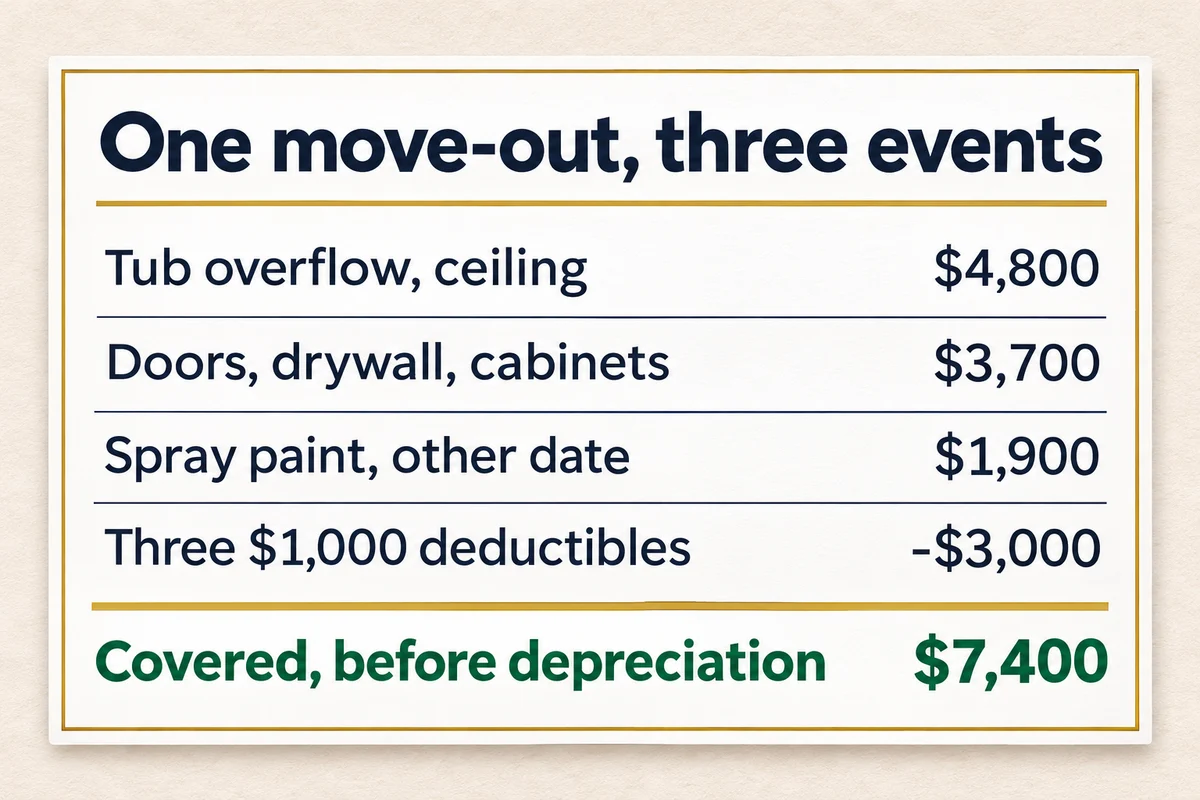
When the damage happened on different days, the carrier may take a separate deductible for each event. The FC&S answer above found that reasonable: a fire on Monday and another on Friday are two occurrences even if the same person lit both. So the number of events you can show matters almost as much as the dollar figure.
Here is a made-up move-out to show the arithmetic. The figures are invented and are not a result of ours. The policy has a $1,000 deductible per occurrence, and depreciation is left out to keep the sums plain.
| Item found at move-out | Pile | Repair cost |
|---|---|---|
| Ceiling below the bathroom, tub left running in March | Sudden accident | $4,800 |
| Three doors and drywall punched, one night in August | Willful act | $2,600 |
| Kitchen cabinet doors torn off, the same August night | Willful act | $1,100 |
| Spray paint in the living room, a different date | Willful act | $1,900 |
| Carpet worn and stained in every room | Hard living | $3,200 |
| Subfloor rotted by a vanity leak nobody reported | Neglect | $2,100 |
The carpet and the subfloor, $5,300 together, stay with the owner whichever way the rest is read. The other $10,400 depends on how many events the carrier counts.
A thousand dollars turns on one fact: the date. If the adjuster splits the damage into more events than happened, the answer is evidence of when each thing was done, not an argument about the deductible.
The Illinois deposit clock runs at the same time
While the claim is open, the Illinois Security Deposit Return Act sets its own deadlines for any part of the deposit you keep for damage. Miss them and you may have to return the whole deposit, which takes away the money that would have covered the excluded piles.
Since Public Act 103-0224 took effect in 2024, the rule in 765 ILCS 710/1 applies to a lessor of any residential property; the old limit to buildings with 5 or more units was struck out. Counted from the day the tenant moved out, or the day the right of possession ended if that is later:
- The day the tenant moves out is day 0. Photograph every room that day, before any trade starts work, because those pictures serve the deposit and the insurance claim.
- By day 30 the tenant must have an itemized statement: each item of damage with its estimated or actual cost and the paid receipts, delivered in person, by postmarked mail or to the tenant's verified e-mail address.
- Where the statement used estimates, the paid receipts follow within 30 days of the date it went out.
- With no statement and receipts, the whole deposit goes back within 45 days of the move-out.
A court that finds the statement was refused or given in bad faith can order twice the deposit plus court costs and attorney's fees. Chicago has its own residential landlord ordinance with further rules, and a landlord there should read it as well.
Keep the deposit and the claim on the same set of numbers. A carrier will not pay you for an item the deposit already paid for, so tell the adjuster what you kept and for which lines. The cleanest order is usually to put the deposit against the excluded piles first, such as the carpet, and the claim against the covered events.
Where the rest of the money comes from
After the deductibles and the excluded piles, part of the bill is still open. These are the places it can come from, roughly in the order owners turn to them:
- The security deposit, kept in line with the clock above.
- The tenant's renters policy. On the widely used renters form, the liability part excludes damage to the place the tenant rents, but gives back damage caused by fire, smoke or explosion. A small additional coverage for damage to property of others, often up to $1,000, may pay for other accidents. Neither pays for damage the tenant did on purpose. Ask the tenant, in writing, for the carrier's name and the policy number.
- The tenant directly, through a demand and, if needed, small claims court. An attorney can tell you whether that is worth it.
- Your own carrier's recovery. After it pays you, it may try to collect from the tenant, and the lease can decide whether it may. Our article on a rented house damaged by fire or storm covers the Illinois cases on that question.
None of these routes changes how your own policy reads the damage. Start with the sorting, because it decides which lines go to the carrier at all.
Before you file
- Find the move-in photos or checklist. Without them, the carrier may call everything wear.
- Photograph and measure every damaged item before cleaning or repair, room by room.
- Write down when you last saw each room in good shape, and any date the tenant or a neighbour gave you.
- File a police report for the deliberate damage and keep the report number.
- Count the days the house was empty before you found the damage.
- Pull the lease clauses on damage, insurance and the deposit.
- Read the vandalism peril in your policy and any endorsement that mentions tenants.
- Report the loss to the carrier promptly, even if you are still counting.
If the adjuster has put a covered event in the wear pile, or split one night into several deductibles, that is a scope question, not the last word. We handle vandalism damage claims and water damage claims on rental property across Illinois, and a first look at your file costs nothing: send it to us.
Questions we get about this
Does landlord insurance cover damage caused by a tenant?
It can. A sudden accident the tenant caused, such as an overflowing tub or a kitchen fire, is usually a covered loss for the owner. Deliberate damage may be paid as vandalism where the policy names that peril and does not exclude tenants. Wear and tear and damage from neglect are excluded. Your own policy governs.
Is hard living by a tenant covered as vandalism?
Usually not. Damage that builds up from ordinary use over a lease, such as worn carpet or scuffed walls, is wear and tear even when it is heavy. It becomes vandalism only when a specific act was willful or malicious, which is why dated photos and a police report matter.
Do I pay a deductible for each item of tenant damage?
Not for each item, but possibly for each event. Damage done at different times can be treated as separate occurrences, each with its own deductible. Damage done in one night is usually one occurrence. Evidence of when each thing happened decides how many deductibles apply.
Can I keep the security deposit and also file an insurance claim in Illinois?
Yes, but not for the same repair twice. Under the Illinois Security Deposit Return Act you must give the tenant an itemized statement with receipts within 30 days of move-out to keep any of the deposit for damage. Tell your carrier which items the deposit paid for.