Additional Living Expenses: What You Can Claim While You Are Out of the House
Additional living expenses — Coverage D, or Loss of Use, on most homeowners policies — pay the extra cost of living somewhere else while your home cannot be lived in after a covered loss. It pays the increase over your normal spending, not your whole cost of living, for the shortest time needed to repair or relocate, up to its own limit.
Additional living expenses is the coverage households use worst, and the reason is timing. The first bills after a fire or a burst pipe are not repair bills — they are a hotel, a security deposit, a laundromat and a month of restaurant food, and they arrive in the week when nobody has read the policy. By the time the file is organised, three weeks of receipts are already gone. What follows is what the coverage is, how the payment is actually calculated, what it will not pay, and what makes it stop. Policy wording varies between carriers and between policy years, so read your own declarations page alongside this.
What are additional living expenses on a homeowners policy?
They are the necessary increases in your cost of living while your home cannot be lived in because of a covered loss. Most policies put them in a section headed Loss of Use and label it Coverage D. It normally has two parts: additional living expense for your household, and fair rental value if you were renting part of the home to somebody else.
Three words in that sentence do most of the work. Necessary means the expense has to follow from the loss — a rental you needed, not a rental you preferred. Increase is the arithmetic the whole coverage runs on, and the next section is about nothing else. And cannot be lived in is a condition somebody has to establish: a house with smoke through it and no working kitchen is usually uninhabitable, a house with a damaged detached garage usually is not, and the cases in between are argued.
The limit is its own. In most forms Coverage D does not come out of the money available for the building or for your belongings — it sits beside them, commonly written as a percentage of the dwelling limit, with 20% to 30% the usual range, and in some newer forms as a period of time with no dollar cap at all. Your declarations page states which. Our guide to the six lines that decide your claim shows where to find it.
Two smaller provisions are worth knowing before you need them. Many forms pay these expenses for up to two weeks when a civil authority prohibits use of your home because of direct damage to neighbouring property by a peril the policy covers — the fire was next door, not in your house. And in most forms the coverage is not cut off when the policy period ends: if the policy lapses or renews mid-repair, loss of use for that loss carries on under its own terms.
Why does it pay the increase and not the whole bill?
Because the coverage exists to hold your standard of living level, not to pay your living costs twice. You keep paying what you paid before — mortgage, taxes, groceries — and the policy pays the difference between that ordinary month and the more expensive displaced one. Nearly every disagreement about this coverage starts at that distinction.
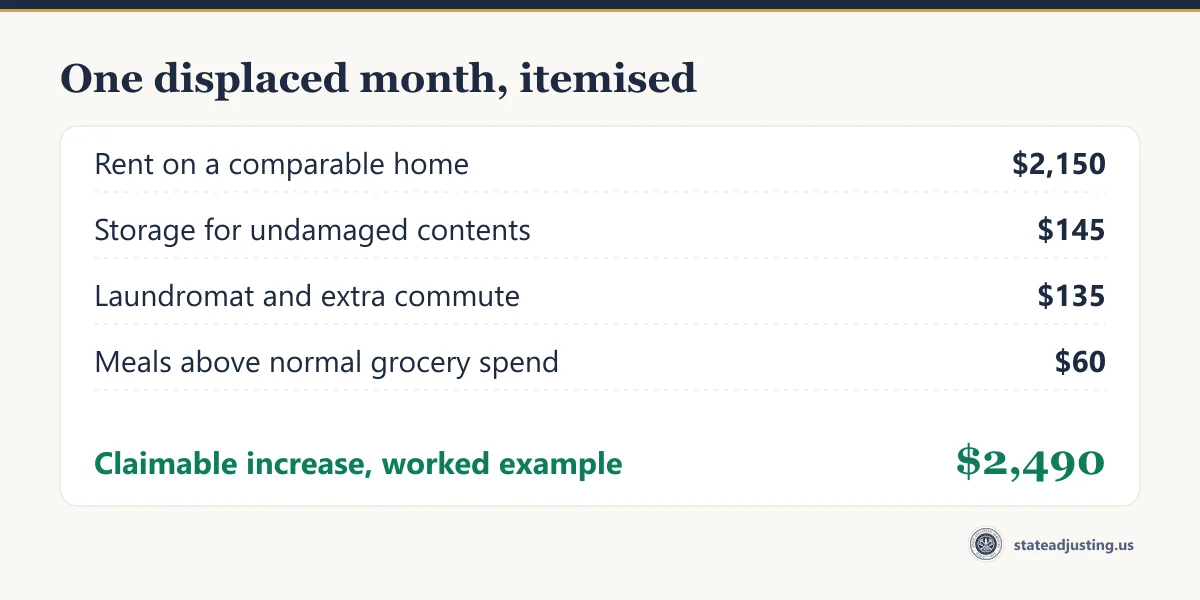
Here is one month worked through. The figures are an illustration rather than anybody's file, and every household's baseline is different, but the shape is always this.
| Category | Normal month | Displaced month | Claimable increase |
|---|---|---|---|
| Housing | $1,780 mortgage | $1,780 mortgage + $2,150 rent | $2,150 |
| Groceries and eating out | $1,100 | $1,160 | $60 |
| Utilities | $210 at home | $180 at the rental | Nothing — no increase |
| Laundry | $0, own machines | $70 laundromat | $70 |
| Storage of undamaged contents | $0 | $145 | $145 |
| Commute | $85 | $150 | $65 |
| The month | $2,490 |
Two things fall out of that table. The mortgage appears in both columns and produces nothing — you owed it before the loss and you owe it after — which is the single most common misunderstanding about this coverage. And the utility line produces nothing either, because the rental's bills replaced bills you were already paying. Meanwhile the small lines are real money: laundry, storage and twenty extra minutes of driving each way add up to $270 in that month, and over a five-month rebuild they are the part that most often goes unclaimed, because nobody keeps the receipt from a laundromat.
What counts, and what does not?
A necessary increase caused by being out of the house generally counts. Anything you would have paid anyway, and anything belonging to a different coverage, does not. The table below is the usual dividing line in a homeowners form — your own policy governs, and carriers differ at the edges.
| Usually claimable as ALE | Usually not |
|---|---|
| Hotel, or rent on a comparable temporary home | Mortgage, property tax, insurance premium |
| Security deposit and utility hook-up fees | The part of the food bill you always spent |
| Meals above your normal grocery spend | Replacing damaged belongings — that is contents coverage |
| Laundromat, when the temporary home has no machines | Lost wages, or time off work to handle the claim |
| Storage of undamaged contents, and the move both ways | An upgrade on the home you actually had |
| Furniture and appliance rental for the temporary home | Repairs to the house itself |
| Pet boarding, or what a pet-friendly rental costs extra | Anything you cannot document |
| Extra mileage or transit when the commute got longer | Anything after the coverage has ended |
"Comparable" cuts both ways, and it is worth saying plainly. You are not entitled to a better house than the one you left. Equally, a family of five is not expected to live in one hotel room for eight months, and a household that had a garage, a washer and a dishwasher is not expected to give up all three. Where a rental at that standard genuinely costs more in your area, the way to establish it is listings rather than argument: three or four comparable properties, printed with their dates.
How long does the coverage last?
For the shortest time reasonably required to repair or replace the damage — or, if you are not going back, the shortest time required for your household to settle somewhere else. Many forms also cap the period outright, commonly at twelve or twenty-four months. Whichever ceiling arrives first is the end of the coverage.
"Shortest time required" is the phrase to sit with, because it does not mean "however long the repair actually takes". It means how long the repair ought reasonably to take, which is a judgement, and the carrier will form its own. When a rebuild stalls for a reason that is not yours — a permit, a supplier, a scope still being argued — what protects the coverage is a paper trail built while it happens: dated emails, the contractor's schedule, the permit application, the date each revised estimate arrived. Assembling that after the payments stop is far harder than keeping it as you go.
The dollar limit can also run out before the time does, and the arithmetic takes a minute. If Coverage D is 20% of a $300,000 dwelling limit, that is $60,000: comfortable for four months in a rental, thin for a two-year rebuild with a family and two storage units. Work out roughly what your monthly increase is, divide the limit by it, and you know which of the two ceilings you meet first. That number changes real decisions — starting with whether to take a month-to-month rental or a twelve-month lease.
What ends an ALE payment early?
Usually one of five things, and four of them are avoidable. This coverage is rarely lost in an argument. It is lost to paperwork that was never created, to a deadline nobody wrote down, or to a commitment signed before anyone checked what the policy would fund.
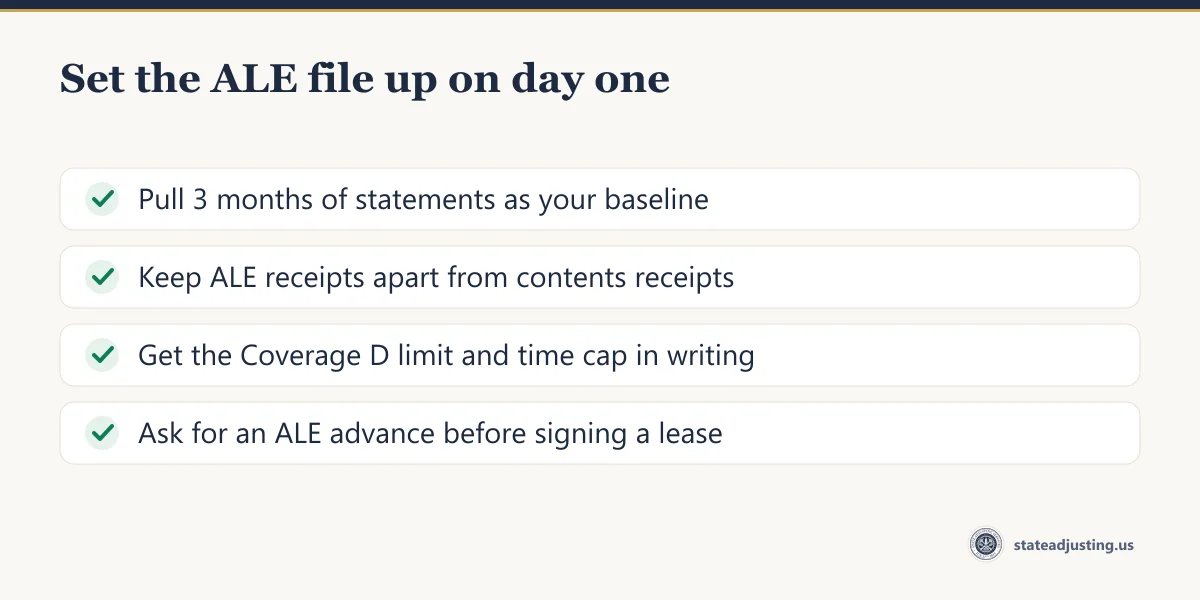
- No baseline. If you cannot show what a normal month cost, the increase cannot be calculated and somebody else will estimate it. Pull three months of bank and card statements from before the loss and keep them with the claim file. That is the denominator for everything else.
- Receipts mixed into the contents claim. These are separate coverages with separate limits, and a hotel receipt filed among the contents paperwork tends to be paid under neither. Keep one folder, paper or digital, that holds nothing but loss-of-use costs.
- A lease longer than the coverage. Signing for twelve months while the carrier is funding five leaves you paying the difference. If a longer lease is the only thing available in your area — often the case — put that in writing before you sign, and ask the carrier to confirm in writing how it will be treated.
- Waiting to be reimbursed. Few households can float two homes for months. Advance payments are ordinary on this coverage: ask for one in writing, with the figures behind it, and ask before you need the deposit rather than after.
- Repairs finish and nobody says so. The coverage ends when the home is habitable again, and habitable is not the same as finished. Expect that question, and know exactly what is still missing when it is asked.
What to do next
Get the declarations page in front of you and write down two numbers: the Coverage D limit, and the time cap if your form states one. Then read the Loss of Use section itself — it is usually shorter than a page — and note the words your policy uses for "shortest time" and for what happens if you relocate permanently. Fifteen minutes there shapes the next several months.
Then set the file up before you move out: three months of statements as the baseline, a folder for loss-of-use receipts only, and a written note of the date you left. Photograph the property before anything is cleared or cleaned — our guide to the contents inventory covers the other half of that paperwork, and it is usually the larger number. If the loss came from water or from fire, our water damage and fire and smoke damage pages set out how we scope those claims.
We are licensed Illinois public adjusters, not attorneys, and none of this is legal advice. If a carrier will not put a decision about loss of use in writing, the Illinois Department of Insurance takes consumer complaints.
We handle residential and commercial property claims across Illinois, and the loss-of-use side is part of every displacement claim we take on. Our process page sets out how a claim runs with us in it, and past clients describe how it went on our reviews page. If you would like somebody to read the Loss of Use section and tell you what your file is missing, our free claim review costs nothing. When we are engaged, our fee is a percentage of what we recover, agreed in writing and regulated by Illinois law, with $0 owed upfront. We answer the phone Monday to Friday, 8:00 AM to 5:00 PM, on (630) 297-8136.
Questions we get about this
Does my homeowners insurance pay my mortgage while I am out of the house?
In almost every form, no. Additional living expenses pay the increase in your cost of living, and the mortgage is a payment you owed before the loss and still owe after it, so it produces no increase. The rent on a temporary home is claimable; the mortgage underneath it is not. Property taxes and the insurance premium work the same way.
Do I have to pay everything myself and claim it back?
Not usually. Advance payments are ordinary on this coverage, because very few households can carry two homes for months. Ask in writing, show the figures behind the request — the rent, the deposit, the estimated monthly increase — and ask before you need the deposit rather than after you have paid it. Keep every receipt regardless, because advances are reconciled against actual costs later.
How long will the insurer pay additional living expenses?
For the shortest time reasonably required to repair or replace the damage, or to settle elsewhere if you are not returning. Many forms cap that period as well, commonly at twelve or twenty-four months, and the dollar limit can run out before the time does. Read both limits on your own policy, and keep dated proof of anything that delays the repair through no fault of yours.
I am staying with family instead of renting. Can I claim anything?
Possibly, though it works differently. With no rent there is no rent to reimburse, but other increases are still real: a longer commute, contributing to the host household costs, storage, laundry, meals. Some carriers will consider a reasonable payment where a relative is genuinely bearing extra cost. Ask in writing what documentation they will accept before the arrangement has run for months.