Fire Claims: Why the Contents Inventory Decides the Settlement
Your belongings are insured under a separate coverage with its own limit, and the carrier settles that part of a fire claim item by item, from the list you hand in. Anything you do not list is not paid. Most policies also make building that list your duty after a loss. That is why the inventory usually decides the number.
A fire claim contents inventory is the least interesting document in the file and the one that moves the most money. The building is scoped by people who walk it with a tape measure. Your personal property is scoped by you, from memory, in the weeks after you have lost it. That asymmetry is why two households with a similar fire can settle far apart. What follows is how the list is built, what each field on it does, where your policy quietly caps what it will pay, and how people reconstruct a list when the things themselves are gone. Policy wording varies between carriers and between policy years, so read your own alongside this.
What is a contents inventory in a fire claim?
It is an itemised list of the personal property you lost — room by room, with quantity, description, age and what each item costs to replace today. Most homeowners policies place the duty to prepare it on you after a loss, and ask for bills, receipts or other documents that support the figures. The carrier prices the settlement from that list.
Read the duties-after-loss section of your own policy and you will usually find language close to this: prepare an inventory of the damaged personal property showing the quantity, description, actual cash value and amount of loss, and attach any bills, receipts and related documents that justify the figures. Two things follow from that sentence. Preparing the list is a duty the policy places on you, so it is part of what you have to do to be paid. And every field named in it exists so that somebody can put a defensible price on the line — which is what the document is for.
In practice the carrier sends a spreadsheet and the household starts filling it in. A whole-house loss commonly runs to hundreds of lines once closets, drawers, the garage and the basement are actually opened. Most carriers then run the completed list through a contents pricing service, which searches for a like-kind-and-quality replacement for each description and returns a price. That last step is the reason a vague description costs money: the search is only as good as the words you gave it.
Why does the inventory decide the settlement?
Because personal property is its own coverage line with its own limit, and it is paid line by line. Nobody at the carrier walks through your house cataloguing what used to be in it. The scope of that half of the claim is whatever appears on your list, so an item left off is not underpaid — it is simply not part of the claim at all.
Your declarations page states the personal property limit, usually as a set amount or as a percentage of the dwelling coverage. That figure is a ceiling, not an estimate of what you own, and it is worth knowing before you start: if the list runs past the limit, the effort shifts from listing everything to documenting enough to reach it. Our guide to the six lines that decide your claim covers where to find that number.
The second reason is valuation. Contents depreciate faster than buildings. If your policy pays personal property on actual cash value, a five-year-old sofa is paid at what a five-year-old sofa is worth, not what a sofa costs. If it pays replacement cost, you are usually paid actual cash value first and the withheld depreciation afterwards, once you have actually replaced the item and shown proof — and many policies set a deadline for completing that. We cover the mechanic in ACV versus replacement cost and how to collect the held-back money in recoverable depreciation. On a large contents loss the second cheque is often the larger one, and it is claimed by receipt, so the inventory and the replacement records have to line up.
What does a usable line item actually contain?
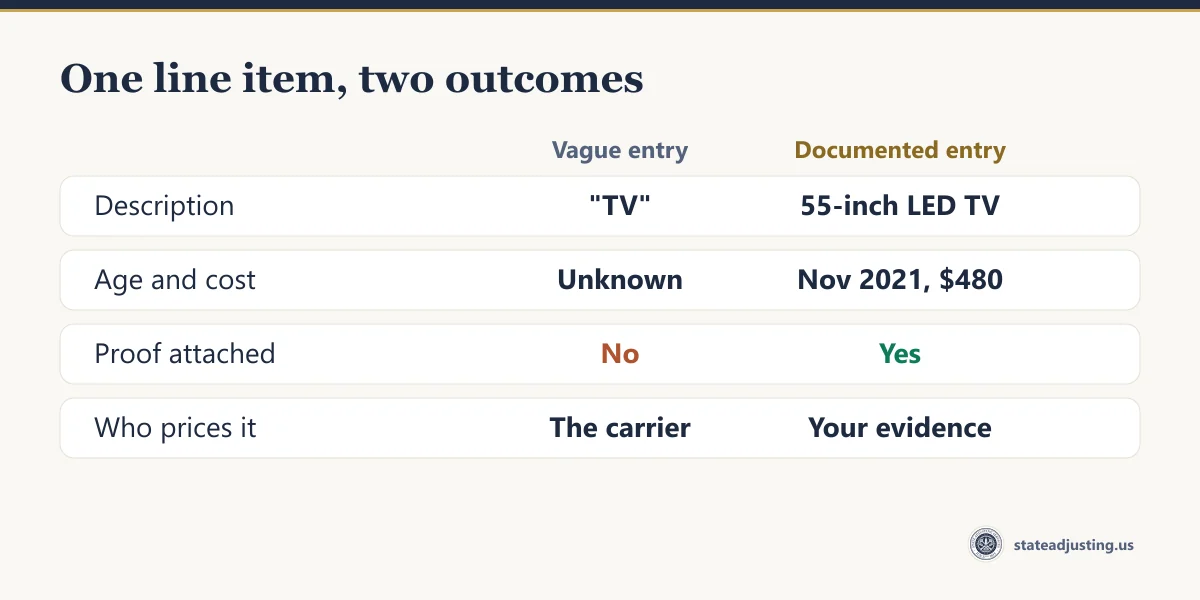
Seven fields: room, quantity, description, brand or model, age or purchase date, original cost, and what it costs to replace today. The description is doing the most work. "TV" and "55-inch LED television, bought November 2021 for about $480" are the same item and rarely the same payment, because only one of them can be priced.
| Field | What it is used for | What happens when it is blank |
|---|---|---|
| Room | Groups the loss and lets both sides check nothing was skipped | Whole rooms get forgotten — garages, basements, attics, storage units |
| Quantity | Multiplies the line | Sets of things become one thing: one towel, one plate, one tool |
| Description | Drives the like-kind-and-quality search | The pricing service returns the cheapest item matching a vague phrase |
| Brand or model | Separates a mid-range item from an entry-level one | Everything defaults to entry level |
| Age or purchase date | Sets depreciation on an actual cash value settlement | Age is estimated, and the estimate rarely goes your way |
| Original cost | Sanity-checks the price the carrier returns | No basis on which to disagree with the returned figure |
| Replacement price today | Sets the replacement-cost value of the line | The carrier's price stands unopposed |
You do not need a receipt for every line, and no one expects one. What helps is a mix: receipts and emailed order confirmations where they exist, photographs where they do not, and specific description everywhere. A line supported by a photograph of the item in the room is a different proposition from a line supported by nothing.
Where do the special limits bite?
Most policies cap certain categories of personal property under a section usually headed Special Limits of Liability. The important detail is that some of those caps apply to any covered loss, while others apply only to loss by theft — and a fire is not a theft. Which category an item falls into can change what is payable by a wide margin.
| Category | How the cap is commonly written | Why it matters after a fire |
|---|---|---|
| Money, bank notes, coins, bullion | Capped for any covered loss, and the cap is usually small | Cash that burned is capped however much was in the house |
| Securities, deeds, passports, personal records, manuscripts | Capped for any covered loss | The cap is rarely reached, but replacing documents is a real cost — list it |
| Jewellery, watches, furs, precious stones | In many forms the cap applies only to loss by theft | Fire damage to the same items is often not limited by that cap, and may be payable up to the personal property limit |
| Firearms and related equipment | In many forms the cap applies only to loss by theft | Same point — check whether the words in your form say "by theft" |
| Silverware, goldware, pewterware | In many forms the cap applies only to loss by theft | Same point, and these items often survive partially, which makes cleaning versus replacement the argument |
| Property used mainly for business, kept at the home | Capped for any covered loss, usually at a low figure | A home office of equipment and stock passes the cap quickly; a rider or a commercial policy is the fix, before the loss |
| Items scheduled by endorsement | Outside these caps, paid to the scheduled amount and often with no deductible | The appraisal you filed when you scheduled it is already your proof of value |
The exact figures are printed in your own policy, and carriers do raise them. Find that section, read whether each line says "by theft" or nothing at all, and note the ones that apply to you before the inventory is submitted rather than after. We are licensed public adjusters, not attorneys, and none of this is legal advice — it is a description of how those clauses are normally structured.
What about the things that look fine and smell like smoke?
They belong on the list. Smoke travels far past the burn, and soot is acidic and fine enough to settle inside cabinets, drawers, ducts and electronics. The question is not whether an item is charred, but whether it can be restored to its pre-loss condition at a reasonable cost, which can be established by inspection and by testing rather than by looking at it.
Three categories cause most of the disagreement. Textiles and soft goods hold odour, so the argument is over how many cleanings are reasonable before replacement is the cheaper answer. Electronics can look untouched while soot sits on the boards, which is why an inspection by someone qualified is worth more than a visual verdict. And food, cosmetics, medication and anything porous that was open to the air is normally not cleaned at all.
Cleaning is itself a covered line item when it is the reasonable route, so a fire claim contents inventory should carry both kinds of entry: items to be replaced, and items to be cleaned with the cost of cleaning shown. What it should never carry is a blank where an item used to be. Do not throw anything away before it has been photographed and listed, and do not have anything cleaned before it has been documented in its damaged state. Once it is gone or restored, the evidence for that line is gone with it. Our fire and smoke damage claims page sets out how we scope the smoke side of a loss.
How do you rebuild the list when everything burned?
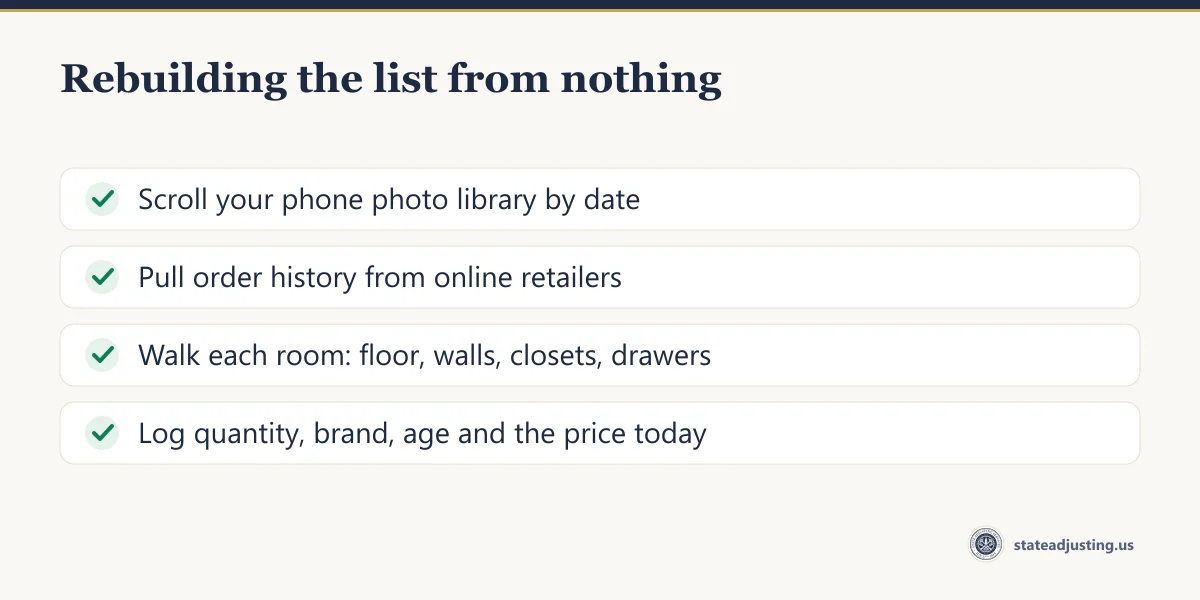
Systematically, from records that survived somewhere other than the house. Almost every household holds more evidence of what it owned than it thinks, because so much of it lives on a phone, in an email account or in a bank statement. Work sources first, then rooms, and keep a running file rather than trying to remember in one sitting.
- Your phone's photo library, scrolled by date. Years of birthdays and holidays photographed inside your own rooms. The furniture, the electronics and the shelves are all in the background.
- Online order history. Retailer accounts hold years of purchases with dates and prices. Search the email account for "order confirmation", "your receipt" and "invoice" as well.
- Bank and card statements, month by month. A slow method that recovers the mid-size purchases nobody remembers — the appliance, the mattress, the power tools.
- Warranty and product registrations, service records, and the accounts of any store where you have a card.
- Photographs held by other people. Family, friends and social media posts taken in your home.
- The moving inventory, if you moved recently, and the home inspection report from when you bought.
- A fixed walk order for every room. Floor, then walls, then closets, then drawers, then anything mounted or overhead. The same order every time, so a room is never half-done.
- The rooms people skip. Garage, basement, attic, laundry, mud room, the shed, the car if it was in the garage, and off-site storage.
Which mistakes cost the most?
Four of them, in roughly this order: discarding items before they are documented, submitting a partial list under time pressure, describing things too vaguely to be priced, and never going back for the withheld depreciation. All four are avoidable, and none of them is about arguing with anyone.
- Clearing the house before the inventory exists. Understandable and expensive. Photograph and list first, then dispose — and keep a sample of anything unusual if you can.
- Signing a sworn proof of loss with a list you know is incomplete. Policies commonly require a signed, sworn proof of loss within a set period after the carrier asks for it. If the inventory is not finished, say so in writing and ask for more time in writing, rather than signing a number you cannot support.
- Round-number groupings. "Kitchen items — $500" is not a line anybody can price. It will be paid as one item or queried, and both cost time.
- Accepting a returned price without checking what it bought. If a pricing service replaced a solid-wood dining table with a laminate one, that is a like-kind-and-quality question worth raising, politely and with a link to the item you actually owned.
- Missing the replacement window. On a replacement-cost policy, the held-back depreciation is claimed after you replace, within whatever period your policy allows. Diarise that date on the day you settle.
- Mixing additional living expenses into the contents list. Hotel, meals above your normal grocery spend and the laundromat belong to a different coverage with its own limit. Keep those receipts in a separate folder from day one.
What to do next
Get the declarations page in front of you and write down three numbers: the personal property limit, whether contents are settled at actual cash value or replacement cost, and the deductible. Then read the Special Limits of Liability section and mark which caps say "by theft". Those five minutes change how the next several weeks are spent.
Then start the list before anything is moved or cleaned. Photograph each room from the doorway and from the corners, then work the sources above — photo library, order history, statements — and build the file in one place. Ask the carrier, in writing, what format they want and what their deadline is, and keep every answer.
If the claim is already moving faster than the inventory, that is normal and it is worth saying out loud to the adjuster: a fast offer on contents is usually an offer made before anyone knew what was in the house. Illinois has rules about how carriers handle and explain claim decisions, and the Illinois Department of Insurance takes consumer complaints if you cannot get a straight written answer.
We handle fire and smoke losses across Illinois, residential and commercial, and building the contents inventory with the household is a large part of that work. Our process page sets out how a claim runs with us in it, and past clients describe how it went on our reviews page. If you want somebody to read the policy and look at the list before you submit it, our free claim review costs nothing. When we are engaged, our fee is a percentage of what we recover, agreed in writing and regulated by Illinois law, with $0 owed upfront. We answer the phone Monday to Friday, 8:00 AM to 5:00 PM, at (630) 297-8136.
Questions we get about this
Do I have to list every single item after a fire?
You have to list what you want paid for. Most policies place the duty to prepare an inventory of the damaged personal property on the insured, showing quantity, description, value and amount of loss. There is no exemption for small items, and small items in quantity — linens, kitchenware, tools, clothing — often add up to more than the furniture. If the total will clearly exceed your personal property limit, ask the carrier whether a full list is still required before spending weeks on it.
What if I have no receipts for anything?
That is the normal situation and it does not stop a claim. Receipts are one form of support, not the only one. Photographs taken inside your home, online order histories, bank and card statements, warranty registrations and specific descriptions all support a line. Be exact rather than apologetic: brand, size, age and what the item costs today does more for a line than a missing receipt takes away.
Is my jewellery limited to the small cap in my policy after a fire?
It depends on how your form is worded, and this is worth checking rather than assuming. In many homeowners forms the cap on jewellery, watches and furs applies to loss by theft, and a fire is not a theft — so those items may be payable up to the personal property limit. Other forms are written differently, and scheduled items sit outside the caps entirely. Read the Special Limits of Liability section of your own policy.
The carrier's price for my replacement item is lower than anything I can find. What now?
Reply with evidence rather than an objection. Send the specific item you owned, the specific item their price bought, and a current listing for a comparable one, and ask them to reprice the line on like kind and quality. Keep it to individual lines rather than the total. If a large number of lines have the same problem, that is a pattern worth raising in writing with the file's adjuster.