Squirrels, raccoons or bats in the attic: what home insurance pays
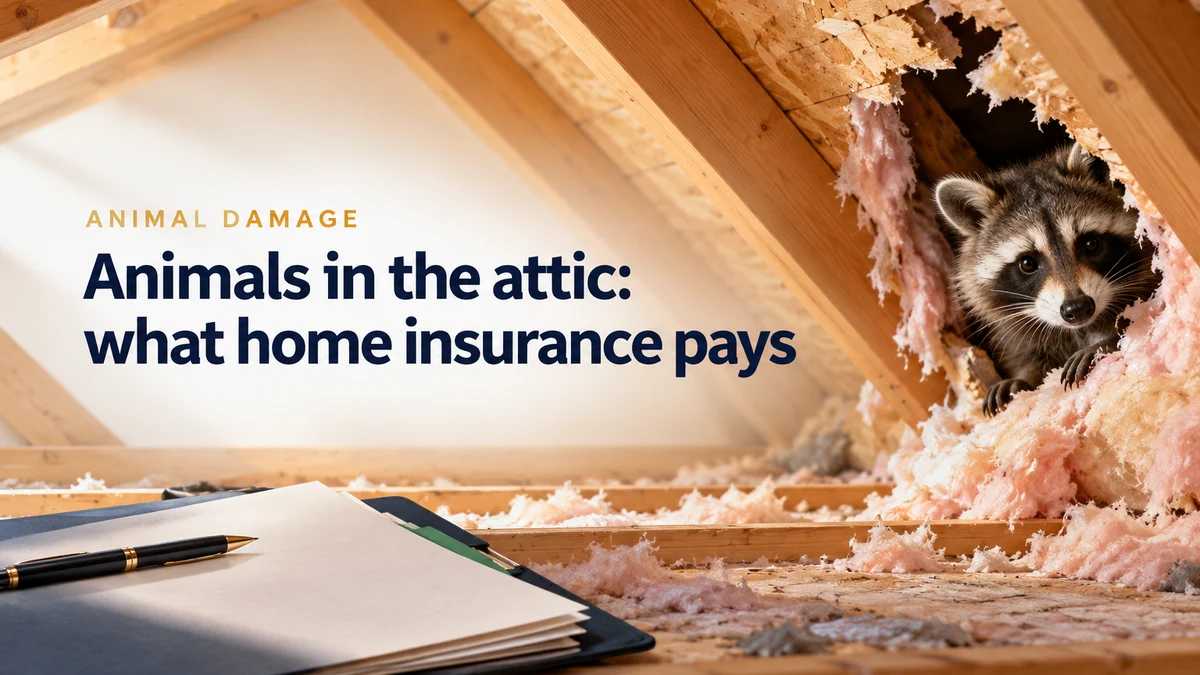
Animal damage in the attic is usually not paid by a homeowners insurance policy when the animal is a squirrel, a mouse, a rat or a bird, because the standard policy forms exclude those by name. Raccoons and bats are the open question, and the answer turns on which edition of the form your policy is built on. What the animal sets off is a separate matter. A fire that starts at a chewed cable, or water pouring from a gnawed supply line, is often a covered loss of its own even when the chewing is not.
Late fall is when Illinois attics fill up with animals looking for a warm place to spend the winter, and the calls about torn soffits and shredded insulation start with it. This guide sorts the animals, sets the two editions side by side and lists what to record before the wildlife company seals the roof. We are licensed Illinois public adjusters, not attorneys, and the wording of your own policy governs.
Which animal did it changes the answer
Start with the animal, because the exclusion is written as a list of animals. If the list names yours, the damage it did with its teeth and claws is usually your cost. If it does not, the claim is still open.
Squirrels
Usually excludedSquirrels are rodents, and both common editions of the homeowners special form exclude loss caused by rodents. Gnawed fascia, rafters and insulation are normally yours to repair.
Mice and rats
Usually excludedExcluded as rodents. They nest inside walls and ceilings, where the newer wording on nesting adds a second reason to refuse.
Raccoons
Depends on the editionA raccoon is not a bird, a rodent or an insect. Under the older edition that leaves its damage open to a claim. Under the newer one, its nest and its waste are excluded.
Bats
Depends on the editionBats are not rodents either. Guano on the insulation and the ceiling below it falls under the newer wording on waste from any animal, and is argued under the older one.
Woodpeckers and other birds
Usually excludedBirds are excluded by name in both editions, so holes pecked into cedar siding or trim are normally your cost.
Deer and larger animals
Usually covered for the houseNo exclusion names them, so a deer through a patio door is treated like other sudden damage to the house. Belongings inside are paid only for causes the policy lists, and pets you keep are excluded.
Two editions of the same form, two answers for one raccoon
Many homeowners policies are built on the special form published by the Insurance Services Office, or on a carrier form that copies its structure. Two editions of it are still in use, and they treat attic animals differently. The form number is printed at the bottom of each page of your policy: HO 00 03 10 00 is the October 2000 edition, HO 00 03 05 11 the May 2011 edition. A carrier that writes its own form prints its own number, and its animal sentence is the one to read.
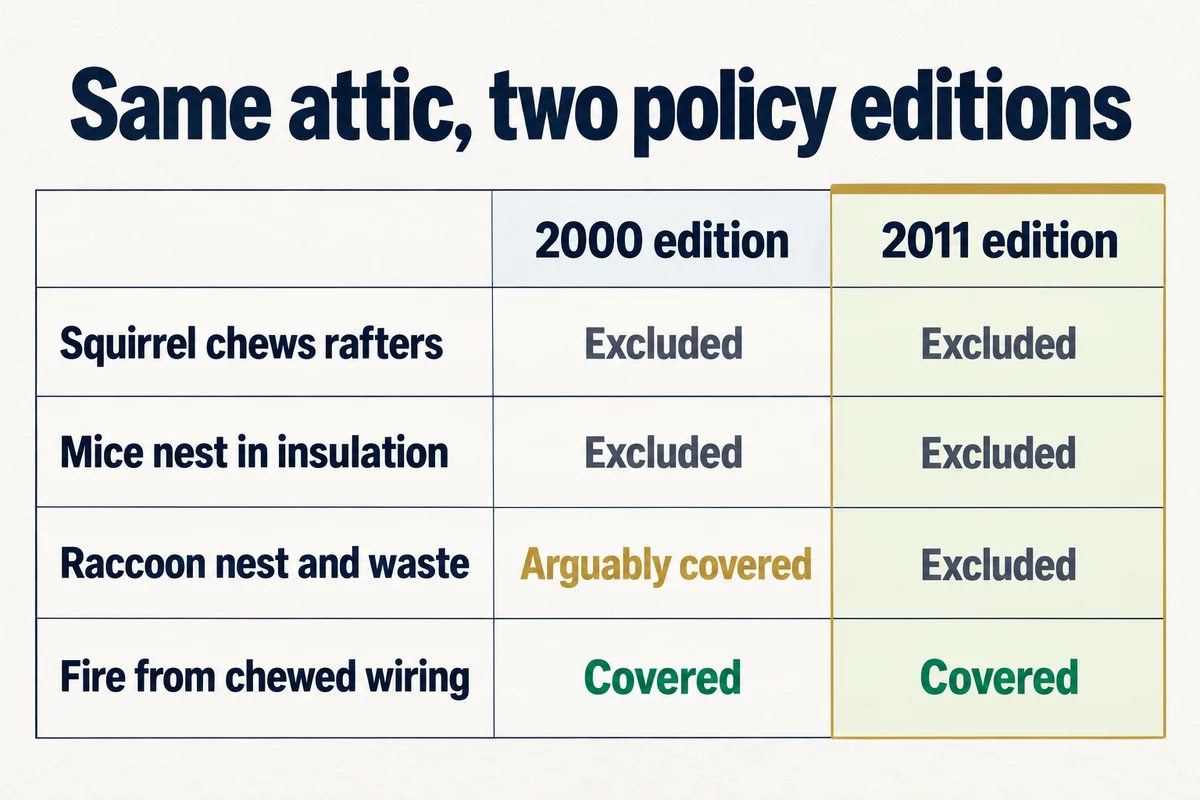
| Situation | 2000 edition | 2011 edition |
|---|---|---|
| What the exclusion lists | Birds, vermin, rodents or insects | Birds, rodents or insects, plus nesting or infestation by any animal and the waste it leaves |
| Squirrel chews the roof framing | Excluded as a rodent | Excluded as a rodent |
| Raccoon nest, urine and droppings in the insulation | Arguable: a raccoon is not on the list, and vermin is not defined in the policy | Excluded as nesting and waste |
| Bat guano on insulation and ceiling | Arguable for the same reason | Excluded as waste from an animal |
| Fire that starts at a chewed cable | Covered as a loss that follows the excluded cause | Covered as a loss that follows the excluded cause |
PropertyCasualty360 worked through a raccoon nest and cleanup claim under both editions and reached the same split: arguable under the 2000 wording, excluded under the 2011 wording. A raccoon that rips through the roof deck in one night is the hardest case to sort. Carriers tend to read the hole as part of the nesting, while the owner reads it as sudden physical damage, and the policy sentence decides it.
When the damage after the animal is paid
The exclusion stops at the animal's own work. The special form then says that a loss which follows an excluded cause is covered unless another part of the policy rules it out. So a fire or a sudden escape of water that an animal started is judged as a fire claim or a water claim, not as an animal claim. This is how a single attic can hold an excluded bill and a paid bill side by side.
- A squirrel strips the jacket off a cable in the atticThe chewed cable and the chewing: excluded as rodent damage.
- The bare conductors arc at a junction box and light the insulationThe event that starts a new loss.
- Fire burns the roof framing and smoke spreads through the second floorFire damage: paid under the dwelling and contents cover, less the deductible.
The same chain runs with water. Mice gnaw plastic supply lines inside ceilings and walls. When one splits and soaks the drywall below, the gnawed pipe is excluded, and the water that escaped can be a covered water damage claim if it came out suddenly rather than seeping for weeks.
On one attic fire, the bills split like this. The figures are an example we made up to show the arithmetic, not a quote and not a result of ours. The policy has a $1,000 deductible.
| Line | Who pays | Amount |
|---|---|---|
| Fire repair: framing, roof deck, drywall, paint | The claim | $14,800 |
| Smoke cleaning of rooms and belongings | The claim | $2,300 |
| Deductible | The claim | -$1,000 |
| Wildlife removal and sealing the entry hole | You | $650 |
| Chewed cable outside the burned area | You | $400 |
| Claim pays in this example | $16,100 |
The sum is $14,800 + $2,300 = $17,100, less the $1,000 deductible, which leaves $16,100. The owner carries $650 + $400 + $1,000 = $2,050. A chewed cable inside the burned area is part of the fire repair, because the fire destroyed it. One outside the burned area is still rodent damage.
Removal, trapping and cleanup: the bills that stay with you
Getting the animal out and closing the hole it used is upkeep under every edition, so it is not an insurance item. In Illinois, raccoons are protected furbearers. Removing wildlife from a house for pay is the work of a nuisance wildlife control operator with a permit from the Illinois Department of Natural Resources, and a homeowner who wants to trap a raccoon must first get a removal permit from the district wildlife biologist. The department keeps a searchable list of permitted wildlife control operators.
Cleanup of droppings and soiled insulation follows the edition table above: usually your cost under the 2011 wording, worth asking about under the 2000 wording. The operator's written report is the best record of which animal it was, so ask for one even if you never plan to claim.
Insects run on a parallel track. Termite and carpenter ant damage is excluded, but the standard form names insect or vermin damage hidden from view among the causes of a covered collapse, as our guide to a collapse from hidden decay explains.
What to record in the attic before it is sealed
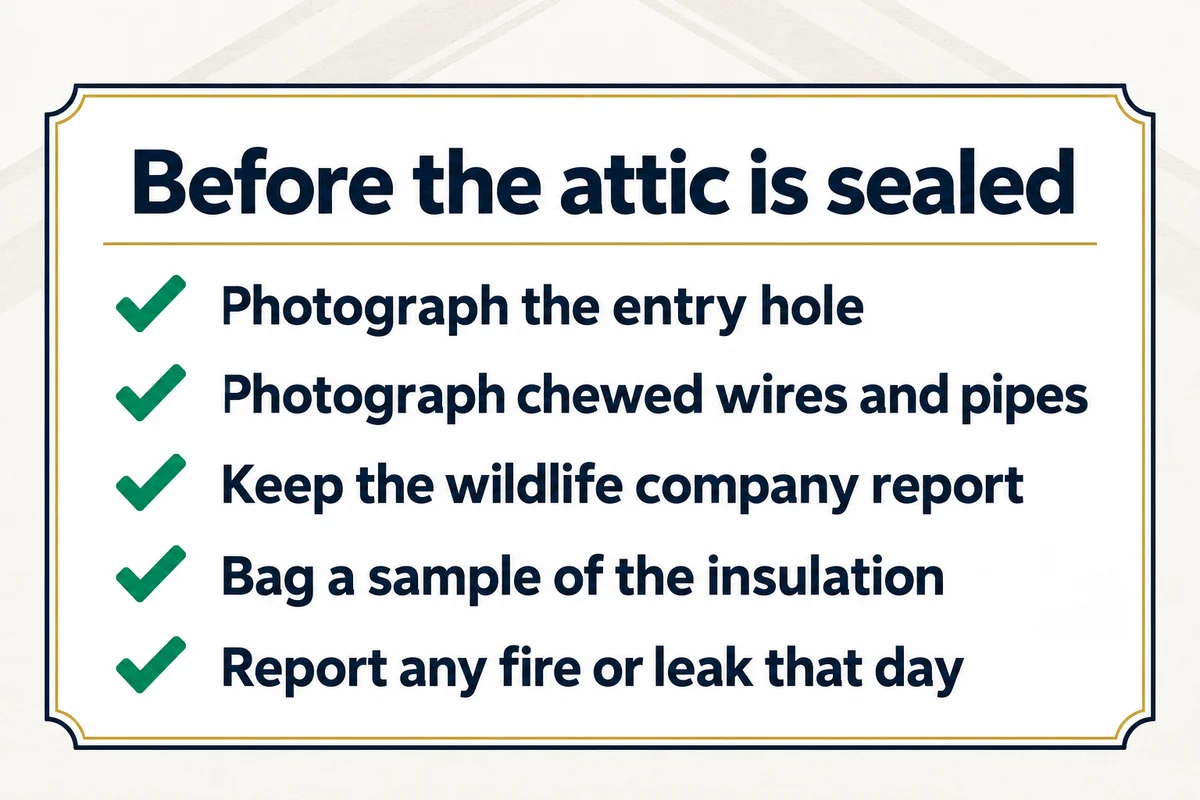
A wildlife crew fixes the entry, removes the nest and often vacuums out the insulation within a day or two. Once that is done, the evidence for a claim is gone. Before the work starts:
- Photograph the entry point from outside, close and wide: the torn soffit, lifted shingle or chewed vent, and where it sits on the house.
- Photograph the attic as it is: the nest, droppings, tunnels through the insulation, gnawed rafters and the ceiling below.
- Shoot every chewed cable, pipe or duct up close with a tape measure or coin in the frame. Our list of what to photograph after property damage covers the wide shots that go with them.
- Ask the wildlife operator to name the animal in writing, with the entry points and the date. Under the 2000 edition the claim can turn on that one word.
- Keep a bagged sample of the soiled insulation, and any burned or chewed length of cable, until the carrier says in writing that you may throw it away.
- If there was smoke, a burning smell, breakers tripping or water coming through a ceiling, report the claim the same day and note the claim number.
- Have the electrician or plumber write what failed and why, such as cable jacket gnawed through, arc mark at junction box, rather than just repaired wiring.
When an animal denial deserves a second read
A claim for chewed insulation alone is usually small and usually excluded, and we will say so if you ask. The denials worth a second read are a fire damage claim refused because an animal started the fire, a water loss refused for the same reason, a raccoon or bat claim refused under a 2000-edition policy, and a large loss where the scope stops at the burned joists and leaves out the smoke in the rest of the house. We read the animal sentence and the ensuing loss sentence against the evidence and negotiate with the carrier for a percentage of the recovery, with nothing upfront. If yours was refused, send us the letter through our denied claim review or the contact page, and we will tell you whether there is more in it.
Questions we get about this
Does homeowners insurance cover raccoon damage in the attic?
It depends on the edition of the policy form. Under the 2000 edition of the standard homeowners special form, the exclusion lists birds, vermin, rodents and insects, and a raccoon is none of those, so the damage is arguable. The 2011 edition also excludes nesting, infestation and waste by any animal, which usually removes coverage for a raccoon nest and its cleanup. The form number at the bottom of each policy page tells you which one you have, and your own policy wording governs.
If squirrels chew the wiring and start a fire, will insurance pay?
Usually yes for the fire. The chewed wiring is excluded as rodent damage, but the standard form covers a loss that follows an excluded cause unless something else in the policy rules it out, and fire is covered. The burned framing, smoke cleaning and damaged belongings are typically paid, less the deductible. A chewed cable outside the burned area stays your cost.
Is wildlife removal covered by homeowners insurance?
No. Removing the animal, installing one-way doors and sealing the entry hole are treated as upkeep under every common edition of the policy. In Illinois, that work is done by nuisance wildlife control operators with a state permit, and trapping a raccoon yourself needs a removal permit from the district wildlife biologist first.
How do I find out which edition of the policy form I have?
Look at the bottom of each page of your policy. HO 00 03 10 00 is the October 2000 edition of the standard special form and HO 00 03 05 11 the May 2011 edition. If the number is the carrier's own, read its exclusion list for birds, rodents, vermin, insects and nesting, because that sentence decides animal damage on your policy.