Hidden decay collapse claim: proving the rot was out of sight

A hidden decay collapse claim is paid under the collapse part of a homeowners policy when a roof, ceiling or floor suddenly falls or caves in because wood rotted where nobody could see it, and nobody insured knew it was there. The carrier's first answer is often that rot is wear and tear. On the widely used form that sentence does not end the claim, because decay hidden from view is one of six causes the collapse coverage names. What decides the claim is evidence of two facts: where the rot was, and who knew about it.
We are licensed Illinois public adjusters, not attorneys. The wording quoted here is from the homeowners special form HO 00 03 05 11, in the copy the Maine Bureau of Insurance publishes, Section I, Additional Coverages, item 8, Collapse. Many carriers write their own version, and your policy and its endorsements govern.
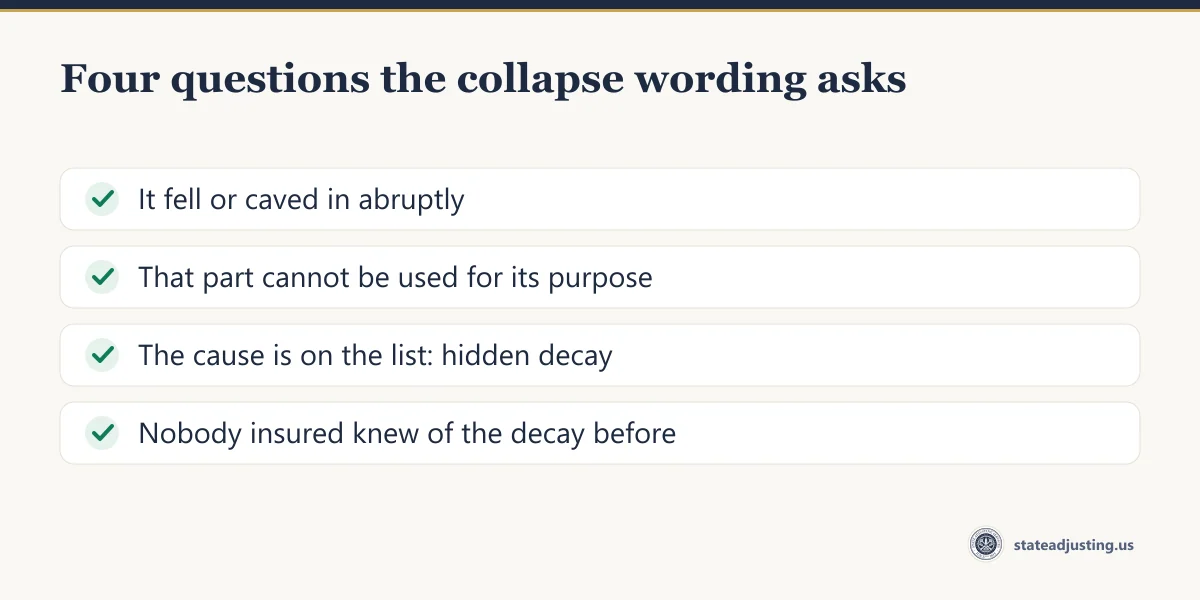
The four questions, in the order the policy asks them
The collapse coverage asks four questions, and a claim needs a yes to each one. A no at any step ends the collapse route, though not always the claim, since some of the damage may still be paid under another part of the policy.
Did it fall or cave in abruptly?
The form applies "only to an abrupt collapse" and describes that as "an abrupt falling down or caving in", whether of the whole house or one part of it. A rafter bay that dropped overnight qualifies. A ceiling that has bowed a little more each month does not.
The same paragraph rules out three conditions in so many words: a building in danger of falling, a part that is still standing although it has pulled away from another part, and a part that is standing while it cracks, bulges, sags, bends, leans or settles.
Can that part of the house still be used?
The definition goes on to require that the part which fell "cannot be occupied for its intended purpose." One room whose roof is lying on the floor is enough. The whole house does not have to be empty.
Is the cause on the list?
Six causes are named: the perils listed for your personal property (fire, windstorm, weight of ice and snow and the rest), decay hidden from view, insect or vermin damage hidden from view, the weight of contents, equipment, animals or people, the weight of rain that collects on a roof, and defective material or methods, but only if the collapse happens while the construction or remodeling is under way.
Was the decay hidden, and unknown?
The decay line covers rot "hidden from view", then takes the cover away again if "the presence of such decay is known to an 'insured' prior to collapse". That is two tests. The wood had to be out of sight, and no insured could have known of it. The policy defines insured as you and the relatives who live with you, plus others under 21 in your household's care.
The sentence says known, not should have known. How that difference is argued in a lawsuit is a question for an attorney. In a claim, it means the carrier has to point to something that shows knowledge, and you answer with what your own records show.
Where rot stays out of sight in an older house
Hidden from view is a physical fact about the house. The working test is whether someone living there could have seen the decayed wood without opening a wall, a ceiling, a soffit or a roof. In older Illinois framing, these are the places where it stays covered.
- Rafter ends on the wall plate
- Covered by the soffit and fascia outside and by insulation in the attic. At a low eave nobody crawls far enough to see them.
- Joist and beam ends in brick or block
- The masonry pocket wraps the end grain, which is where water wicking through the wall reaches first.
- Sill plate and rim joist
- Siding and sheathing on one side, basement insulation or a finished wall on the other.
- Roof deck under a low-slope membrane
- The membrane can look sound while the boards under a ponding spot soften from below.
- Floor framing under a tiled shower or toilet
- Tile and backer board hide a slow leak. Expect the carrier to raise its seepage and wet rot exclusions here as well.
- Porch roof beams inside trim wraps
- Decorative boxing covers the beam completely, so the first sign is often the drop.
Not hidden: exposed rafter tails that are visibly soft, or a sagging ceiling photographed and left for two winters. A stain on a soffit is not decay, but a carrier will still ask what was done about it.
Known to an insured: the records that answer it
Knowledge is shown with dated documents, not with what anyone remembers in a phone call. Before you give a recorded statement, read your own house file. Here is a made-up house to show how the records line up; it is an illustration, not a client's claim.
- Purchase. The home inspection report notes "staining on the rear soffit, recommend evaluation by a roofer". The carrier will ask for this report. It records a stain on a board, not rot in the framing.
- A gutter installer replaces the rear gutter on the addition. The invoice describes the gutter and hangers and says nothing about wood, although the crew worked along that fascia.
- The main roof is replaced. The contract lists the addition's low-slope roof as not in scope. The roofer's job photographs show the joint between the two roofs.
- The owner photographs the rear gutter overflowing in a storm and emails it for a quote. That shows a water source. It does not show that anyone saw decay.
- After two days of rain the back room ceiling and roof cave in along the rear wall. With the soffit off, the rafter ends are rotted where they sat on the top plate.
In that file the useful documents are the ones that put a tradesperson next to the rot without it being written down: the gutter invoice and the roofer's photographs. The 2017 report is the one the carrier leans on, and the answer to it is physical: the stain was on the face of the soffit, and the decay was in the rafter ends behind it. Answer only what the records show; our notes on preparing for the recorded statement explain why guessing at dates costs more than saying you will check.
When the denial letter calls the rot wear and tear
A denial usually quotes the list in the dwelling section that excludes "Wear and tear, marring, deterioration", along with latent defect and, sometimes, "wet rot". Read the line just above that list. The same section excludes loss involving collapse, and then gives it back:
"b. Involving collapse, including any of the following conditions of property or any part of the property: (1) An abrupt falling down or caving in; ... except as provided in E.8. Collapse"
E.8 is the collapse coverage, and it names decay. Rotting wood is what both the exclusion and the coverage describe, so a letter that answers a hidden decay collapse with the deterioration exclusion alone has not dealt with the coverage the policy wrote for this exact event. A New Jersey court made that point in 2014, saying hidden decay coverage would be illusory if the deterioration exclusion applied, as Insurance Business reported in March 2026. That is one state's court, not a rule for Illinois.
Our part is the facts the wording turns on: where the decay was, what could be seen from where, and what the records show about who knew. We put those in writing against the letter. If the carrier keeps to its reading after that, the dispute is about what the policy means, and that is the point to bring in an attorney, as we set out in public adjuster or attorney. If the carrier's engineer wrote the cause, read the report the way we describe in answering an engineering report: what was opened, and what was only looked at.
What a collapse claim covers: a worked example
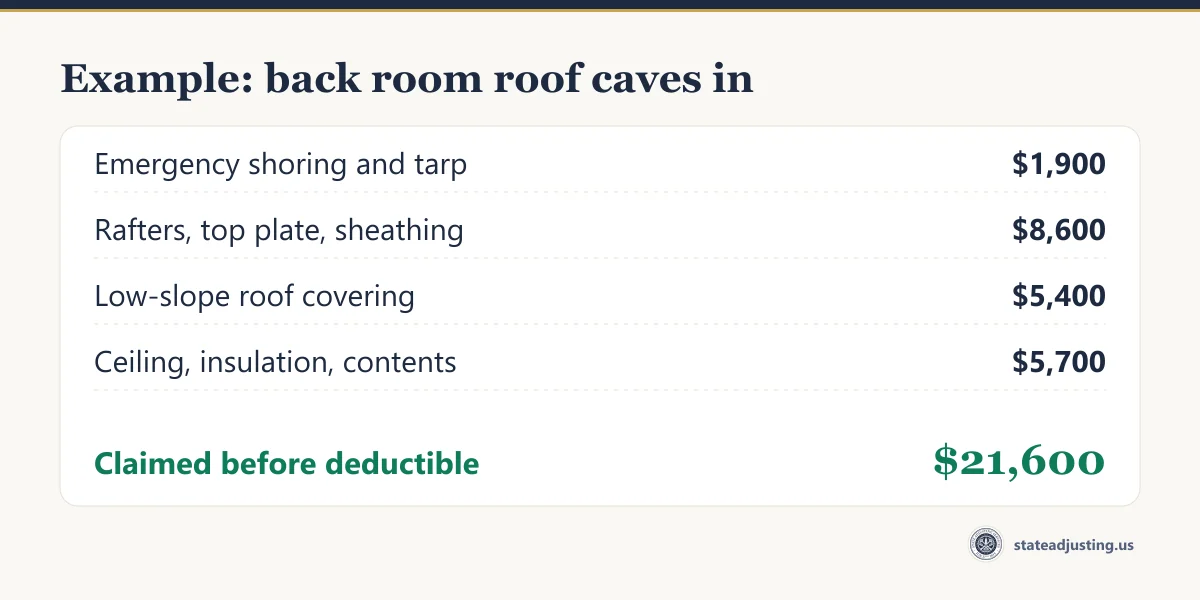
The coverage pays for "direct physical loss to covered property involving abrupt collapse", which reaches the structure that fell and the things it fell on. The figures below continue the made-up back room. They show where each line belongs, not what any carrier will pay.
| Line | Amount | Where it sits in the policy |
|---|---|---|
| Emergency shoring and tarp | $1,900 | Reasonable repairs to protect the house from further damage |
| Rafters, top plate and sheathing | $8,600 | Collapse coverage: the part of the building that fell |
| Low-slope roof covering and flashing | $5,400 | Collapse coverage |
| Ceiling drywall, insulation and paint | $3,300 | Collapse coverage |
| Sofa, rug and floor lamp crushed | $2,400 | Collapse coverage reaches covered personal property too |
| The rear gutter that kept overflowing | $0 | Its own replacement is upkeep and is not claimed |
| Claimed | $21,600 | Before depreciation and the deductible on your declarations page |
Two limits sit around these numbers. The form says the collapse coverage "does not increase the limit of liability that applies to the damaged covered property", so it is paid inside your dwelling and personal property limits, not on top of them. Our guide to emergency mitigation bills covers what a carrier questions on the shoring invoice.
Where the collapse wording stops
- A roof that is sagging or cracked but still standing. Under snow, that damage is claimed under the weight of ice, snow or sleet instead, which our snow load guide walks through.
- A deck, patio, awning, fence or foundation that gives way on its own. The form keeps these out of the decay, insect, weight and construction causes, unless their damage comes straight from a building falling in.
- Decay that an insured knew about before the collapse, such as rot a contractor pointed out and quoted to fix.
Before anyone cuts out the rotted wood
The proof that decay was hidden is the decayed wood itself, and the repair crew's first job is to throw it away. Keep it.
- Make the room safe and have it shored. Do not walk under a dropped roof to take pictures.
- Photograph the failure in place from below and, when it is safe, from the attic or roof: a wide shot, then close shots with a tape measure in the frame.
- Ask the contractor to cut out and keep the failed pieces: a rafter end, a length of the top plate, a piece of sheathing. Bag and label them with the date and location. A cross-section shows rot running inside wood that looked sound outside.
- Photograph whatever covered the rot as it comes off: soffit, fascia, trim, insulation. That is the record that it was out of view.
- Report the claim in writing, describe it as a collapse, and ask whether the carrier wants to inspect before the damaged framing is removed.
- Pull your house file: the purchase inspection, invoices for roofing, gutters and siding, and any earlier claims. Read them before anyone asks you about them.
- Keep every shoring, tarp and engineer invoice, itemised.
Where we come in
We read the collapse wording on your form, document where the decay was and what covered it, and answer a wear and tear letter in writing. Our roof collapse claims page explains how we work on these losses. The first review is free, and our fee is a percentage of the recovery, agreed in writing and regulated by Illinois law, so nothing is paid upfront. Call (630) 297-8136 or send us the details; we answer seven days a week.
Questions we get about this
Is a roof collapse from rotted rafters covered by homeowners insurance?
On the widely used homeowners form it can be, when the roof abruptly fell or caved in, the decay was hidden from view, and no insured knew of it before the collapse. Decay you could see, or knew about, is not covered under that line. Your own policy wording governs, and many carriers use their own version.
My ceiling is sagging but has not fallen. Is that a collapse claim?
Under the current widely used form, no. The collapse coverage excludes a building or part of one that is still standing, even if it is sagging, cracking or bending, and anything only in danger of falling. If snow or ice caused the sag, the damaged framing may still be claimed under the weight of ice, snow or sleet peril.
The home inspection when I bought the house mentioned a stain. Does that mean I knew about the decay?
Not by itself. The wording asks whether the presence of decay was known to an insured. A note about a stain on a soffit or ceiling records a stain, and the answer usually lies in showing where the stain was and where the rotted wood was found. Read the report before any recorded statement and answer only what it says.
Should I keep the rotted wood after the roof is repaired?
Yes. Ask the contractor to cut out and keep the failed rafter end, a length of the top plate and a piece of sheathing, bagged and labelled with the date and location, and photograph the soffit, trim and insulation that covered it as they come off. That is the evidence that the decay was hidden from view.