Business Interruption Insurance Claims, in Plain English

Business interruption insurance — called business income coverage on most commercial forms — pays the profit the business would have earned plus the operating expenses that keep running, while covered physical damage has you closed or slowed down. On standard wording it starts 72 hours after the loss, and it ends when the property should be repaired, not when it actually is.
Business interruption insurance is the part of a commercial property policy that most owners read for the first time with the doors already shut and payroll still due. It is also the part that gets argued over hardest, for a simple reason: every other figure on a property claim describes something you can photograph, and this one is a forecast of what the business would have earned if the loss had never happened. Nobody can photograph that. It has to be built out of records.
This guide sets out what the coverage pays, when it starts and stops, how the number is assembled, and which conditions in your own declarations quietly decide how much of it you can collect. Two limits before the detail. Wording differs between carriers, between form editions and between endorsements, so the paragraph printed on your policy governs — including the edition date in the corner of the form, which changes real things. And we are licensed Illinois public adjusters, not attorneys: this is how these claims are measured and documented, not legal advice.
What does business interruption insurance actually pay for?
It pays net income — the profit the business would have earned before income taxes — plus the normal operating expenses that continue while operations are suspended, including payroll unless an endorsement limits it. It does not pay lost revenue. Expenses that stopped because the business stopped are subtracted from the figure.
That distinction is the single biggest source of surprise on a first commercial claim. An owner whose store books $300,000 a month reasonably expects a month of closure to be worth $300,000. It is not, because roughly half of that revenue was going straight back out to buy the goods being sold, and those purchases stopped the day the doors closed. Insuring gross revenue would leave the business better off closed than open, and no property form is written to do that.
Coverage also has to be triggered before any of the arithmetic matters. On the widely used commercial forms, four things must all be true at once.
| What must be true | What that means in practice |
|---|---|
| Direct physical loss or damage | Something has to have been physically damaged. A drop in trade with no physical damage does not trigger the coverage, however real the lost income is. |
| To property at the described premises | The damaged property is at the location listed in the declarations. Damage elsewhere is handled by separate extensions — see the civil authority and dependent property sections below. |
| Caused by a Covered Cause of Loss | The peril has to be one your property form covers. If the physical damage claim is denied, the income claim usually falls with it. |
| Resulting in a suspension of operations | "Suspension" is commonly defined to include a slowdown as well as a full stop, and to include part or all of the premises being rendered untenantable. Running at 40% still counts. |
The last row is the one that is left on the table most often. A restaurant that loses its kitchen but keeps the bar open, or a shop that reopens half its floor, frequently never files an income claim at all because it did not fully close. Partial loss of trading capacity is exactly what the definition is written to reach.
When does the clock start, and when does it stop?
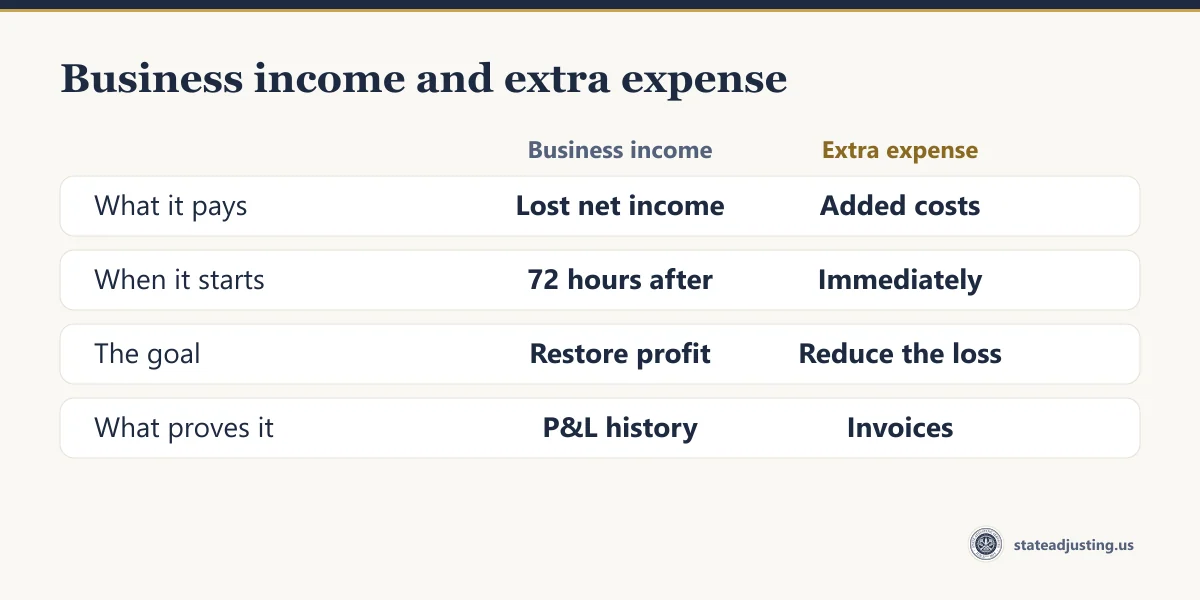
On standard wording the period of restoration begins 72 hours after the direct physical loss for business income, and immediately for extra expense. It ends on the earlier of two dates: when the property should be repaired, rebuilt or replaced with reasonable speed and similar quality, or when operations resume at a new permanent location.
Read that ending condition again, because it is not what most people assume. The measure is the time a reasonable repair should take, not the time yours actually took. If a contractor sits on the job for two months, or a decision about the layout takes six weeks, the carrier is entitled to argue that the period of restoration ended earlier than the reopening date. The defence is a documented construction timeline — dated bids, permit applications, material lead times, and a written record of every delay and its cause. Build that file from week one, not when the dispute arrives.
Two adjustments to the clock are worth knowing about. The 72-hour waiting period can be shortened or deleted by endorsement, and many policies have done so — check the declarations before assuming three days are lost. And the standard period of restoration expressly excludes any additional time needed to comply with an ordinance or law, so if the rebuild is slowed by a code upgrade, that extra time is only covered if an increased-period-of-restoration endorsement was bought.
There is also a tail after reopening. Extended business income continues the coverage once operations resume, until income returns to the level it would have reached or a set number of consecutive days runs out — commonly 30 unless a longer period is shown in the declarations. It exists because customers do not all come back on the day the sign goes back up, and it is routinely forgotten once the doors are open again.
How is the business income number actually calculated?
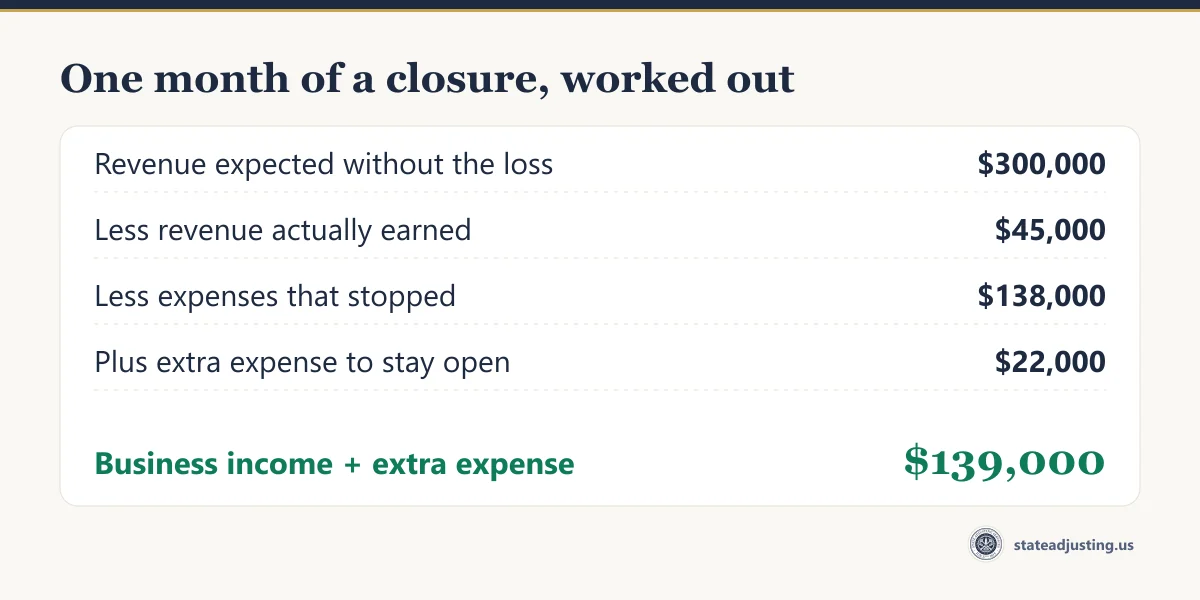
Take the revenue the business would have earned during the period of restoration, subtract the revenue it actually earned, then subtract the expenses that did not continue because operations stopped. What is left is the business income loss. Extra expense — the money spent to keep trading or to shorten the closure — is claimed on top of it.
Here is that arithmetic on one month of a hypothetical retail closure. The figures are an illustration to show the mechanics, not a result from any client file.
| Line | Amount | Where the figure comes from |
|---|---|---|
| Revenue expected without the loss | $300,000 | Prior-year same month, adjusted for the trend in the twelve months before the loss |
| Less revenue actually earned | $45,000 | Online orders still shipping from a rented unit |
| Less expenses that stopped | $138,000 | Goods not purchased, hourly wages not paid, utilities down to a standby level |
| Business income loss | $117,000 | $300,000 − $45,000 − $138,000 |
| Plus extra expense | $22,000 | Temporary unit rent, moving costs, rush freight, replacement signage |
| Total claimed | $139,000 | Business income plus extra expense |
Every one of those lines is arguable, and the first one is where most of the money sits. Standard wording directs that due consideration be given to the experience of the business before the loss and its probable experience afterwards, which cuts both ways: a business that was growing 12% a year is entitled to have that growth reflected, and a business that was declining will have the decline applied to it. Seasonality matters just as much. A month of closure in the quietest week of the year and a month of closure across the holiday season are not the same loss, and a projection built on a flat twelve-month average will understate one and overstate the other.
Extra expense has its own rule that catches people out. In the base wording it is generally payable to the extent it reduces the loss the policy would otherwise have paid. Spend $22,000 on a temporary unit that saves $60,000 of income and the case is straightforward; spend it on something that saves nothing and the carrier will say so. A standalone extra expense policy — bought by businesses that must stay operating whatever happens, such as clinics, data-dependent offices and broadcasters — works differently and is not held to that test in the same way.
Which policy conditions decide how much you can collect?
Four or five entries in the declarations do most of the work, and none of them appears in the paragraph anybody reads. They decide whether a penalty applies for under-reporting income, how much can be paid in any 30-day stretch, how long the coverage runs, and whether ordinary payroll survives past the first two months.
| Condition | What it does | What to check |
|---|---|---|
| Coinsurance | Applies a percentage — often 50% to 100% — to your estimated income and expenses for the twelve months ahead. Insure for less and the payment is reduced proportionally, even on a small loss. | The worksheet the limit was set from, and whether it has been updated since the business grew |
| Monthly Limit of Indemnity | Replaces coinsurance. Caps payment in each period of 30 consecutive days at a fraction of the limit — typically one third, one quarter or one sixth. | Which fraction is shown, and whether a long closure would hit the monthly ceiling |
| Maximum Period of Indemnity | Also replaces coinsurance. Pays the loss sustained during the 120 days after the physical loss, or the limit, whichever is less. | Whether your realistic rebuild time exceeds 120 days |
| Ordinary payroll limitation | An endorsement that excludes, or limits to 60 or 90 days, the payroll of staff other than officers, executives, managers and contracted employees. | Whether it is on the policy at all, and what happens to your crew after day 60 |
| Ordinance or law — increased period | Covers the extra rebuild time forced by current building codes. Without it, that time is outside the period of restoration. | Whether the building predates the current code, which is when this matters most |
Coinsurance is the one that produces the worst surprises, because the penalty is proportional and it applies to losses far smaller than the limit. A business that reported income figures three years out of date is not merely under-insured at the top end — its ordinary, mid-sized claim gets scaled down too. This is a renewal conversation, not a claim conversation; by the time a loss happens the figure is already fixed.
What if the damage is somewhere else, not at your building?
Two extensions reach beyond your own walls, and both are narrower than their names suggest. Civil authority covers income lost when an official order bars access to your premises because of damage to other property. Dependent property coverage responds when a supplier or a major customer is damaged. Neither is automatic on every policy.
- Civil authority. It requires an order that prohibits access to your premises, issued in response to damage to property other than yours, caused by a covered peril. Current wording generally requires the damaged property to be within one mile of your premises, starts business income 72 hours after the order and runs for up to four consecutive weeks; older editions differ on all three points, so read the edition on your form rather than a summary of it. A road closed for convenience, or an order that discourages rather than prohibits access, will usually not qualify.
- Dependent property, also called contingent business interruption. This covers a loss caused by damage at somebody else's location — a supplier you depend on, a customer that buys most of your output, a manufacturer that makes what you sell, or an anchor tenant that draws your foot traffic. It normally has to be added by endorsement, and the dependent locations are often listed by name, which is worth checking against who you actually depend on today.
- Access blocked without an official order. If the street is impassable but no authority has prohibited access, civil authority may not respond at all. Some policies add an ingress/egress extension for exactly that gap. Many do not.
What records prove a business income claim?
The claim is won or lost in the accounting records, not in the site inspection. Assemble the file before the first number is discussed: three years of financial statements, monthly detail rather than annual totals, and anything that documents the trend the business was already on when the loss happened.
- Profit and loss statements, monthly, for at least the last three years — annual totals hide the seasonality that decides the projection.
- Federal tax returns for the same period, which is the document carriers treat as the anchor when statements and books disagree.
- Sales journals, point-of-sale exports and sales tax filings, so the revenue line can be traced independently of the bookkeeping.
- Payroll registers, split between the staff an ordinary payroll endorsement would reach and the staff it would not.
- Accounts payable and purchase records, which is how you prove which expenses stopped and which kept running.
- Every invoice for extra expense, kept separate from the repair invoices from the first day, with a one-line note on each explaining what it saved.
- A dated construction timeline — bids, permits, material lead times, and the cause of every delay.
- Orders you turned away, if you can evidence them. Declined work is some of the strongest evidence a projection has.
One practical note on bookkeeping: keep the loss out of the ordinary ledger. Extra expense recorded in the same accounts as normal operating costs is very difficult to separate out later, and "we think about half of that line was storm-related" is not a claim, it is an invitation to have it discounted.
What to do next
Start with three documents on the table together: the declarations page, the business income form itself with its edition date, and the last three years of monthly financials. From those alone you can answer whether coinsurance or a monthly limit applies, how long the coverage would run, whether ordinary payroll is limited, and what the projection is likely to look like. Then put the claim's dates on one sheet — date of loss, date reported, date any proof of loss was filed — because on a commercial claim those dates carry the same weight they do on a residential one. We set them out in our guide to the deadlines that end an Illinois claim, and Illinois rules require a carrier to offer payment within 30 days of affirming liability where the amount is determined and not in dispute (50 Ill. Adm. Code 919.50).
Expect the income claim to be revised more than once. The period of restoration is an estimate until the building is finished, and hidden damage found during the rebuild lengthens it — which is a supplement, not a new claim, and the same process applies to the income side. If the amount is disputed while coverage is not, some policies allow appraisal; whether it can be used for a business income figure depends on the wording and is a question worth asking early rather than at an impasse. If the delay itself becomes the problem, the Illinois Department of Insurance takes consumer complaints about claim handling.
We handle commercial as well as residential property claims across Illinois, including the income side of losses that started as fire damage or water damage to the building. Our process page describes how a claim runs with us in it, and past clients describe the experience on our reviews page. If you want somebody to read your business income form and your financials and tell you what the claim is actually worth under that wording, our free claim review costs nothing. When we are engaged, our fee is a percentage of what we recover, agreed in writing and regulated by Illinois law, with $0 owed upfront. We answer the phone Monday to Friday, 8:00 AM to 5:00 PM, on (630) 297-8136.
Questions we get about this
What does business interruption insurance actually cover?
It covers the net income your business would have earned, plus the normal operating expenses that continue while operations are suspended, when covered physical damage to your property causes that suspension. It does not cover lost revenue as a gross figure, because the expenses that stopped when the business stopped are deducted. Extra expense — the money spent to keep trading or shorten the closure — is a related but separate coverage.
How long does business interruption coverage last?
On standard wording the period of restoration begins 72 hours after the direct physical loss and ends when the property should be repaired, rebuilt or replaced with reasonable speed and similar quality, or when operations resume at a new permanent location, whichever comes first. Extended business income can continue the coverage after you reopen, commonly for 30 consecutive days unless a longer period is shown in the declarations.
Do I need physical damage to claim business interruption?
Under the standard commercial forms, yes — the coverage is triggered by direct physical loss of or damage to property from a covered cause of loss. Two extensions reach beyond your own building: civil authority, when an official order bars access because other property was damaged, and dependent property coverage, when a supplier or major customer is damaged. Both have their own conditions and are often narrower than expected.
Why is the insurer's business income figure lower than my lost sales?
Usually for two legitimate reasons and one arguable one. Expenses that stopped are properly deducted, and revenue you still earned is credited against the loss. The arguable part is the projection: what the business would have earned. If the carrier used a flat average where your records show growth or a strong season, that is the figure to challenge, with monthly statements and tax returns rather than an estimate.