Deadlines That End a Property Insurance Claim in Illinois

Three deadlines decide most Illinois property claims: prompt notice to your carrier, a sworn proof of loss due within the time your policy states, and the suit-limitation period that runs from the date of loss. Illinois law tolls that last clock from the day proof of loss is filed until the day the claim is denied in whole or in part.
Insurance claim deadlines in Illinois are not one clock. They are five or six, started by different events, counted in different units, and written in different places — some in your policy, some in the Illinois Insurance Code, some in the Department of Insurance rules. A claim rarely dies because somebody refused it. It dies because a date passed while the file was still open and nobody was watching it. This guide sets out which deadlines exist on an Illinois property claim, what starts each one, how the days are counted, and where each rule is written so you can read it yourself.
Two things before the detail. Your own policy governs — the wording differs between carriers and between policy years, and the paragraph on your form is the one that counts. And we are licensed public adjusters, not attorneys. Nothing here is legal advice, and a deadline that has already passed, or is close, is a question for a lawyer rather than for us.
Which deadlines actually end an Illinois property claim?
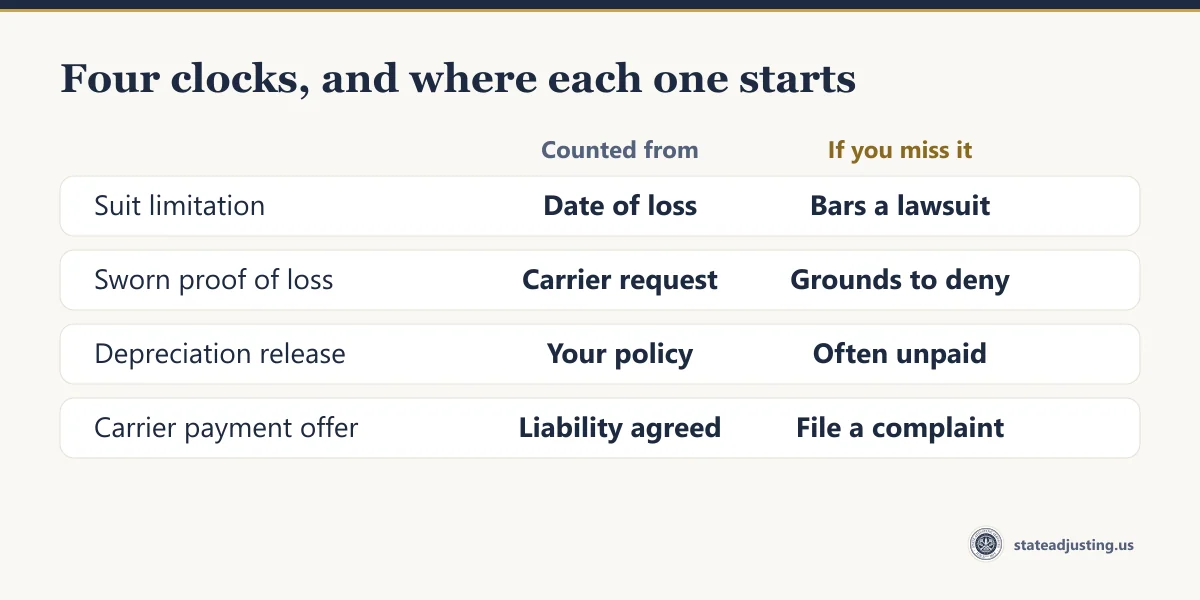
Five clocks matter on a typical residential or commercial property claim: notice of the loss, the sworn proof of loss, the window to submit completed-repair invoices for withheld depreciation, the appointment steps in the appraisal clause, and the suit-limitation period. The last of those is the outer wall. The other four can close a claim in practice long before it is reached.
| Clock | Counted from | Where it is written | What missing it can cost |
|---|---|---|---|
| Notice of loss | The date of loss | The duties-after-loss condition in your policy | Grounds for the carrier to argue late notice |
| Sworn proof of loss | The date the carrier requests it | Your policy — standard wording allows 60 days from the request | Grounds to deny for breach of a policy condition |
| Recoverable depreciation | Varies — the date of loss or the date of the first payment | The replacement cost condition or an endorsement | The withheld second payment, which is usually not paid late |
| Appraisal appointments | The date the written demand is received | The appraisal clause in your policy | The choice of appraiser or umpire being made without you |
| Suit limitation | The date of loss | Your policy, tolled by 215 ILCS 5/143.1 | The right to bring suit on the claim |
How soon do you have to report the damage?
Most homeowners forms require prompt notice rather than notice within a stated number of days, so there is no single Illinois filing deadline to quote. Report as soon as you know there is damage. Illinois rules also bar a carrier from stating a notice time limit that relieves it of its obligations, unless the insured has already unreasonably failed to give written notice.
That rule sits in the Department's improper-practices section, alongside a prohibition on telling an insured to complete a proof of loss in less time than the policy provides (50 Ill. Adm. Code 919.60). It does not make late notice safe. Whether notice was reasonable in the circumstances is decided on the facts of the file, and that is legal ground.
The practical case for reporting early has nothing to do with the rule book. Evidence degrades: water dries, hail bruises weather over, and the storm date becomes harder to establish the further you get from it. And the carrier's own clocks do not start until you report. Under the Department's definitions, a prompt investigation is evidenced by a bona fide effort to communicate with insureds and claimants, once liability is reasonably clear, within 21 working days after a notification of loss (919.40). Nothing in that sentence can happen while the loss is unreported.
Report in writing, or confirm a phone report by email the same day. Two reasons: it fixes the date of notification on the record, and it makes the file harder to build on unrecorded conversations. Part 919 says a company may not deny a claim on information obtained in a telephone conversation or personal interview unless that conversation is documented in the claim file.
What is a proof of loss, and when is it due?
A proof of loss is your signed, sworn statement of what was damaged and what you are claiming. Standard homeowners wording gives you 60 days after the carrier requests it. Your own form sets the period, and an Illinois carrier may not tell you to complete one in less time than the policy allows.
Most forms ask the same things: the time and cause of the loss, your interest in the property and anyone else's, other insurance that may cover it, changes in title or occupancy, specifications of the damaged buildings, the inventory of damaged personal property, and receipts for any additional living expense being claimed. It is a sworn document, which is why it is signed in front of a notary and why guessing on it is a bad idea.
The deadline is missed in two ordinary ways. Either the request arrives inside a long letter and is not recognised as a request, or the repair estimates are not finished in time and the form is held back until they are. The second is the more expensive mistake: a proof of loss submitted on time with figures marked as estimated and subject to supplement is in a far better position than one that is late and complete.
- Diary the date the moment a request arrives, and note which document contained it.
- Send it before the deadline even if your numbers are provisional, and say plainly on the form which figures are estimated.
- Ask for any extension in writing, before the date, and keep the reply. An extension agreed by email is a record; one agreed by phone is a memory.
- Keep proof of delivery — a tracked mailing or an email with the claim number in the subject line.
- Keep a signed copy. It is the document your later supplement will be measured against.
The suit-limitation clause, and the Illinois rule that stops the clock
Most property policies limit the time to bring suit — commonly one or two years from the date of loss, depending on the form. Illinois law then suspends that period at a defined point: it stops running when proof of loss is filed and starts again when the claim is denied in whole or in part.
The statute is short. It provides that where a policy contains a provision limiting the period within which the insured may bring suit, the running of that period "is tolled from the date proof of loss is filed, in whatever form is required by the policy, until the date the claim is denied in whole or in part" (215 ILCS 5/143.1). Three consequences follow, and all three catch people out.
- Filing a proof of loss is what starts the tolling. If none was ever filed, there may be nothing suspending the clock while the claim is discussed.
- A partial denial ends the tolling. A letter that pays for one slope and declines the rest is a denial in part, even though a payment came with it, and the clock is running again from that date.
- Negotiation does not extend anything. The period is measured from the date of loss, not from the date the disagreement started, and it keeps running underneath a friendly exchange of estimates.
Whether a particular letter counts as a denial, and what a court would make of a given date, are legal questions rather than adjusting ones. If your date of loss is approaching one or two years old and the claim is unresolved, that is the point to speak to an attorney — not after the anniversary has passed.
How are the days counted, and which clocks run against the carrier?
In the Illinois Department of Insurance rules, "days" means calendar days. Several of the carrier's duties are instead measured in working days, which is a meaningful difference over a holiday week. The table below sets out the ones that apply to a first-party property claim, with the section each comes from.
| The company must | Within | Counted in | Written in |
|---|---|---|---|
| Acknowledge pertinent communications from you | 15 working days from receipt | Working days | 919.40, defining Section 154.6(b) |
| Make a bona fide effort to contact you once liability is reasonably clear | 21 working days after notification of loss | Working days | 919.40, defining Section 154.6(c) |
| Provide the forms needed to present a claim after you ask for them | 15 working days of the request | Working days | 215 ILCS 5/154.6(o) |
| Offer payment after it affirms liability, where the amount is determined and not in dispute | 30 days | Calendar days | 919.50(a) |
| Give a written explanation when a first-party claim is denied or settled for less than claimed | 30 days after the investigation and determination of liability is complete | Calendar days | 919.50(a)(1) |
Two details in 919.50 are worth knowing before you write to an adjuster. The 30-day payment duty applies to the portions of a claim that are not in dispute and for which the payee is known — a disagreement about the roof does not license holding the undisputed interior payment. And the written explanation of a denial or a lower offer must clearly set out the policy definition, limitation, exclusion or condition it rests on, and must be accompanied by the Notice of Availability of the Department of Insurance. A denial that names no policy language has not met that description; ask for one that does.
One correction worth making, because it circulates widely: Part 919 does contain recurring "explain the delay in writing" deadlines, but they are not written for homeowners claims. The 40-day and 60-day delay letters belong to private passenger automobile claims, and a 45-day version applies to life, accident and health claims. On a property claim the operative standards are the reasonable-time duty in 919.50 and the working-day definitions above. Quoting a 40-day rule to a property adjuster invites a correct answer that costs you credibility for the rest of the file.
Which deadlines expire quietly while the claim is still open?
The dangerous deadlines are the ones that run while nothing appears to be wrong. Nobody sends a reminder, the file feels active because emails are still moving, and the date passes inside an ordinary week. Four of them account for most of the money lost this way.
- The window to release withheld depreciation. It is stated once, usually in the settlement letter, and the repair often finishes after a bad storm season has backed up every crew in the region. We set out what releases it, and what to do if the date is close, in our guide to recoverable depreciation.
- The appointment days after an appraisal demand. Standard wording gives each side a short period to name its appraiser and the two appraisers a short period to agree on an umpire. Miss yours and the selection can end up being made without your input — see our guide to the appraisal clause.
- The period Coverage D pays. Additional living expense is limited by both a dollar amount and a time period, and the time period is the one people discover late. Our guide to additional living expenses explains both ceilings.
- The suit-limitation period underneath an open negotiation. This is the one that ends everything, and it is invisible precisely because the claim still looks alive.
One related trap is not a deadline at all but behaves like one. If a payment arrives described as final, or as a release of the claim, check whether the policy limit has actually been paid or whether there is a genuine dispute over coverage or amount. Illinois rules bar a company from describing a payment as final or as a release outside those circumstances. A check is not a closing date.
What to do next
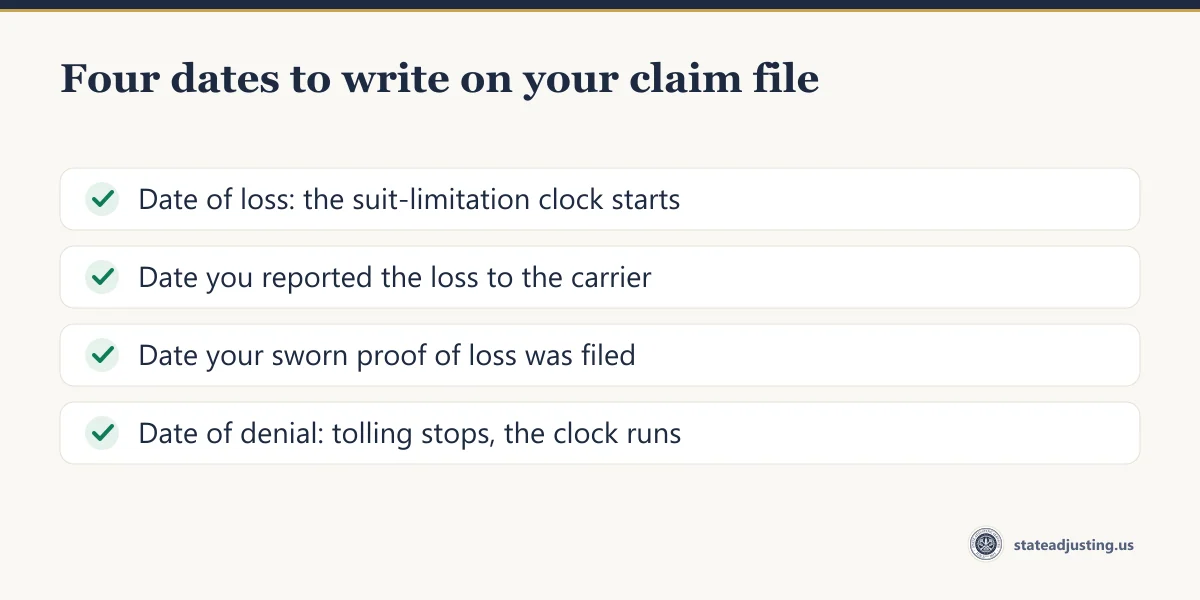
Start with a single sheet of paper carrying four dates: the date of loss, the date you reported it, the date any proof of loss was filed, and the date of any denial in whole or in part. Nearly every question in this article is answered from those four dates. Then read three paragraphs of your own policy — duties after loss, appraisal, and the limitation on suit — and write their deadlines beside the dates.
If the carrier has gone quiet, put your request in writing and keep it short and dated. If a claim has been denied, the first week matters and the steps are specific; we set them out in what to do in the first week after a denial. If you believe the company has missed its own obligations, the Illinois Department of Insurance takes consumer complaints, and the improper-claims-practice list it works from is public (215 ILCS 5/154.6).
We handle residential and commercial property claims across Illinois, and claims that stalled until a date got close are a familiar part of the work. Our storm damage and hail damage pages explain how we scope a loss, the process page describes how a claim runs with us in it, and past clients describe the experience on our reviews page. If you want somebody to read your policy and your correspondence and tell you which clocks are running, our free claim review costs nothing. When we are engaged, our fee is a percentage of what we recover, agreed in writing and regulated by Illinois law, with $0 owed upfront. We answer the phone Monday to Friday, 8:00 AM to 5:00 PM, on (630) 297-8136.
Questions we get about this
How long do I have to file a property insurance claim in Illinois?
There is no single statutory filing deadline. Your policy sets the duty, and most homeowners forms require prompt notice rather than notice within a stated number of days. The outer limit is the suit-limitation clause, commonly one or two years from the date of loss depending on the form. Read the duties-after-loss paragraph on your own policy, because that is the wording that governs your claim.
Does filing a proof of loss stop the deadline to sue?
Under 215 ILCS 5/143.1 the running of a policy's suit-limitation period is tolled from the date proof of loss is filed, in whatever form the policy requires, until the date the claim is denied in whole or in part. So the filing suspends the clock and a denial restarts it. Whether a particular letter amounts to a denial is a legal question, so take advice rather than assuming.
How long does an insurance company have to pay a claim in Illinois?
Department of Insurance rules require a company to affirm or deny liability within a reasonable time and to offer payment within 30 days after affirming liability, where the amount is determined and not in dispute. Those 30 days are calendar days. For the portions of a claim that are not in dispute and where the payee is known, payment is to be tendered within the same 30 days.
What can I do if my carrier misses its own deadlines?
Put the missed item in writing, with dates, and ask for the specific document you are owed — usually a written explanation naming the policy provision relied on. Keep the reply. If nothing moves, the Illinois Department of Insurance takes consumer complaints about claim handling. Where delay is alleged to be vexatious and unreasonable, the remedies sit in court and belong to an attorney, not to a public adjuster.